
A Shopify Plus agency retainer should include release management, incident handling, integration ownership, a prioritized backlog, operating reporting, and an exit plan. Your 2026 agreement should name the accountable owner for each workstream and distinguish routine support from separately approved projects; buying development capacity alone leaves those responsibilities unresolved.
- A Shopify Plus agency retainer needs named owners for releases, incidents, integrations, reporting, and handover.
- Require separate commitments for incident response and service restoration; acknowledgment does not mean recovery.
- DigiForm fits buyers seeking Shopify development and replatforming consulting, rather than a software subscription.
- Defer the retainer when the backlog, internal owner, or business case remains undefined.
Why this matters
A retainer purchases an operating relationship, not just access to developers. The contract needs to explain who makes decisions when a release breaks an integration, an urgent request displaces planned work, or a supplier needs access to production.
Buy accountable ownership, not an undefined bucket of hours. If you are still deciding who should run the store, start with the criteria for choosing a Shopify Plus agency for ongoing operations. Then use the scope below to test the proposal against your actual workload.
What should a Shopify Plus agency retainer include?
Structure the retainer around 6 workstreams. For each, require an accountable person, a written deliverable, an approval rule, and a boundary stating what the agency does not own.
1. Release management
The agency should own the release process for its work: development, review, testing, deployment, and rollback preparation. Your team should retain explicit approval rights over business-sensitive changes.
Require a release record showing what changed, who approved it, what was tested, and how the change can be reversed. Establish a code freeze around important trading periods, with an exception process for urgent fixes.
Ask: Who can authorize a production change, and who can stop it? A named developer is not a substitute for a release owner. Your 2026 scope should cover emergency changes as clearly as planned releases.
2. Incident handling
Define an incident by business effect, not by how loudly someone complains. A failed order flow, an incorrect inventory update, and a cosmetic defect need different escalation paths.
Your agreement needs 2 service clocks: response and restoration. Response means someone has acknowledged and assessed the issue; restoration means the affected service is working again. Require the supplier to propose explicit commitments for both without treating acknowledgment as resolution.
Specify coverage hours, escalation contacts, communication ownership, and the process when another vendor controls the failing component. Do not assume an agency retainer includes overnight coverage.
3. Integration ownership
List the systems connected to the store and assign responsibility at each boundary. Include ERP, warehouse, payment, subscription, or other connections only where your business actually uses them.
For each connection, document the source of truth, failure detection, retry behavior, reconciliation process, and escalation owner. The agency should explain how an operator identifies records that need attention after a failure.
Ask: Who verifies that an order reached the downstream system correctly? Fixing the connection and correcting affected records are separate tasks. Put both responsibilities in the scope.
4. Backlog and delivery management
Require a visible backlog ranked by operating importance. Each item should identify the problem, expected business effect, acceptance criteria, dependencies, and approver.
Separate defects, maintenance, and discretionary improvements. Otherwise, urgent repairs can consume the same capacity that stakeholders expected to fund new features.
The retainer should explain how work enters the queue, how estimates become commitments, and what happens when priorities change. Require written approval before an item expands beyond its agreed scope.
5. Operating reporting
Ask for reporting that connects work to store operations. Completed tickets show activity; they do not establish whether order accuracy, checkout reliability, or operating workload improved.
Agree on the baseline and measurement method before work starts. Track measures relevant to the agreed scope, such as unresolved incidents, failed integration records, release defects, or manual reconciliation effort.
For revenue-related work, separate observed changes from attributed results. A promotion, assortment change, or trading period can affect sales alongside a site release. Do not accept every sales increase as proof of agency impact.
6. Documentation and exit
Require documentation throughout the engagement, not only after termination. Your business needs access to its code, configuration records, integration maps, deployment instructions, and unresolved-issue register.
Specify account ownership, access removal, credential transfer, and handover responsibilities. Define what assistance is included when another team takes over and what requires separate approval.
Ask: Can another qualified team operate the work without relying on undocumented knowledge? That is a useful acceptance test for the handover, even when you expect the relationship to continue.
Which delivery model fits your operating workload?
A retainer is not automatically the right purchase. Compare ongoing agency support with a defined project and internal ownership before committing recurring budget.
| Delivery model | Best for | Main advantage | Main limitation |
|---|---|---|---|
| Ongoing agency retainer | A recurring backlog needing external development and operating support | Maintains an agreed delivery and escalation process | Undefined boundaries make accountability difficult to enforce |
| Defined project | A bounded migration, integration, or feature with clear acceptance criteria | Creates a specific deliverable and completion decision | Ongoing maintenance needs a separate owner |
| Internal ownership | A business prepared to staff and manage store operations directly | Keeps prioritization and operating knowledge inside the business | Requires internal coverage, management, and relevant technical skills |
Choose the model that matches recurring responsibility, not the model with the longest deliverables list. A project can include a handover without becoming a permanent retainer. An internal team can also use an agency for a bounded specialist assignment.
DigiForm is best suited to CPG, manufacturing, and private-equity-backed companies seeking Shopify development and replatforming consulting. That service scope does not establish a particular support commitment: buyers still need to agree coverage, acceptance criteria, and responsibility boundaries in writing.
How should you approve work under the retainer?
Keep 3 approval decisions explicit: priority approval, release approval, and acceptance approval. The same person can hold these responsibilities, but the contract should not leave them implicit.
- Priority approval: Your business owner decides which problem deserves capacity. The agency provides effort, dependency, and technical-risk information.
- Release approval: The designated approver checks the test evidence and business timing. The release owner confirms deployment and rollback readiness.
- Acceptance approval: The named business owner verifies the agreed outcome. The agency records remaining defects and transfers operating instructions.
This sequence prevents a completed development task from being mistaken for an accepted operating change. It also gives finance and leadership a clear record of who authorized the work.
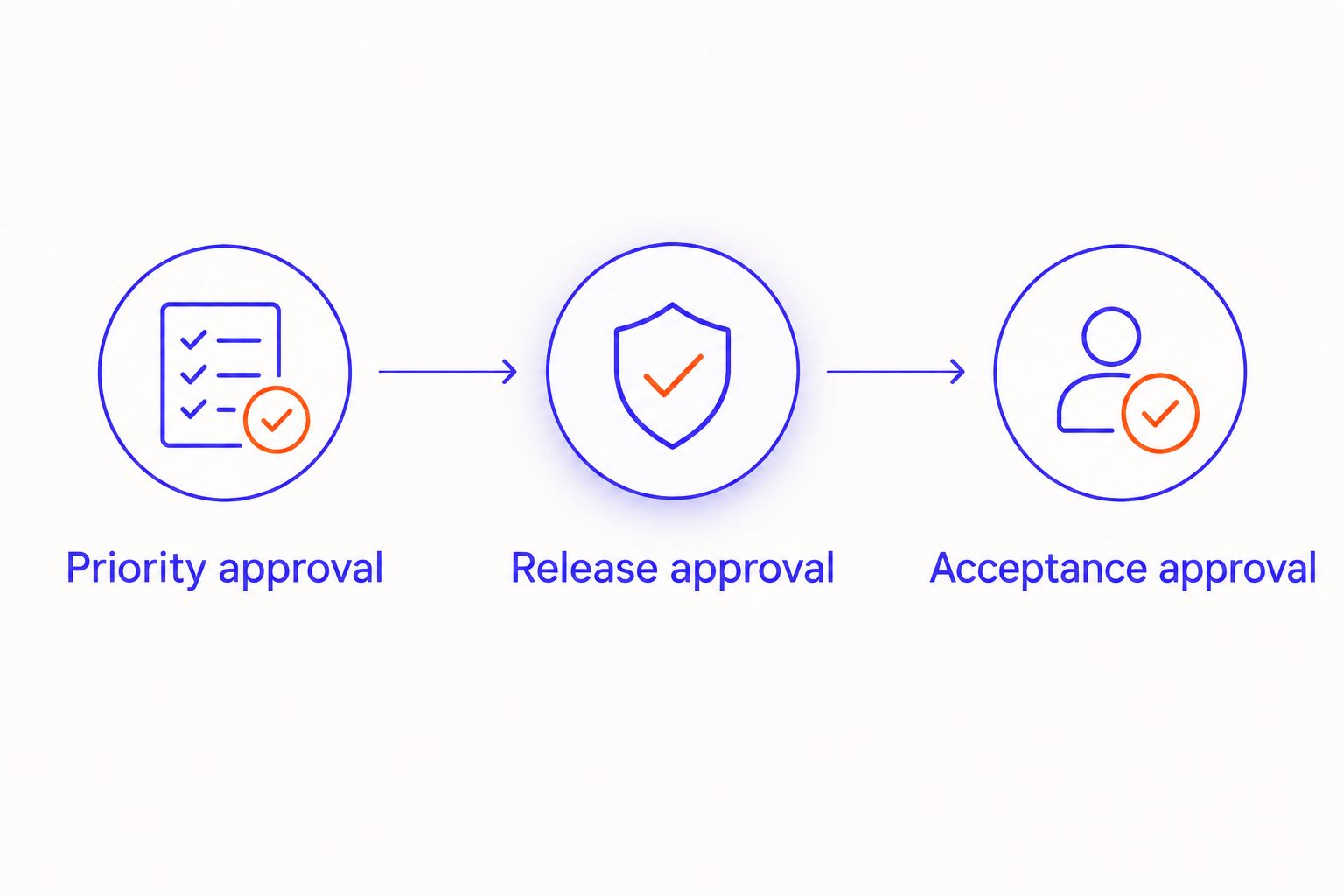
For a 2026 procurement review, ask the proposed delivery lead to walk through this sequence using a change from your actual backlog. Require the explanation to cover a rejected release as well as a successful one. The process must work when the answer is no.
Why Shopify Plus agency retainer scope varies
Your operating responsibilities should determine the scope. Use these factors to explain differences between proposals rather than comparing deliverable counts in isolation.
- System boundaries: More connected systems create more ownership decisions. Require the proposal to identify which interfaces the agency maintains and which remain with other vendors.
- Trading calendar: Launches and peak periods affect release approval, code freezes, and escalation coverage. Put the relevant business dates into the operating plan.
- Change workload: A maintenance backlog needs different delivery arrangements from a continuing stream of new features. Separate committed maintenance from discretionary development.
- Internal capacity: Your team still needs someone to approve priorities and accept work. State which tasks require your staff and whether they have capacity to perform them.
- Custom code: Custom applications and modified integrations need documented maintenance ownership. Ask who handles dependency changes, testing, access, and eventual retirement.
Use your 2026 operating plan to establish which factors apply. Do not purchase a broader scope merely because a proposal includes it. Equally, do not remove a responsibility without assigning it somewhere else.
What should you ask before signing?
Ask the supplier to show how the proposed agreement handles an incident, a planned release, and a handover. These are contract questions, not requests for a sales demonstration.
- Who owns an incident when the cause crosses agency and vendor boundaries?
- What happens to planned work when an urgent defect enters the queue?
- Which approvals must your team provide before work starts?
- What evidence accompanies a request for release approval?
- Which operating responsibilities remain explicitly outside the retainer?
- What documentation and access will your business control at termination?
Defer the purchase if nobody can define the recurring workload or accept the delivered work. Also defer when a bounded project solves the immediate problem without creating an ongoing agency dependency. A retainer needs a continuing job to do.
Should migration work sit inside the retainer?
Migration work needs its own acceptance criteria, dependencies, cutover plan, and rollback decision. Do not bury a replatforming program inside an ordinary support backlog simply because the same supplier handles both.
Specify where migration delivery ends and ongoing operations begin. Account for data reconciliation, outstanding defects, access transfer, and responsibility for post-cutover issues. Your 2026 agreement should make that transition explicit before the migration starts.
Should unused retainer capacity roll over?
Unused capacity should follow an explicit contract rule, not an assumption. Require the proposal to state whether capacity expires, carries forward, or can be reassigned, and who approves the change.
Then examine why capacity is unused. A blocked backlog, unavailable approver, and lack of valuable work require different decisions. Accumulating unused hours does not fix an engagement without a clear purpose.
FAQ
What should a Shopify Plus agency report each month?
A Shopify Plus agency should report delivered work, incidents, release defects, backlog decisions, and operating measures tied to its scope. Require the report to distinguish activity from business outcomes and identify decisions your team must make.
Does a Shopify Plus agency retainer include emergency support?
Emergency support is included only when the agreement explicitly defines it. Specify coverage hours, incident severity, response commitments, restoration responsibilities, and escalation contacts before signing.
Is a retainer better than hiring an internal developer?
A retainer fits recurring work that your business wants an external team to deliver under an agreed scope. Internal ownership fits a business prepared to manage the workload, technical decisions, and coverage directly; neither arrangement removes the need for a business owner.
Who should own the code and accounts under an agency retainer?
Your agreement should give your business the ownership and access needed to operate and transfer its commissioned work. Have the contract distinguish business-owned assets from third-party software, licenses, and supplier materials.
Can DigiForm help with Shopify development and replatforming?
DigiForm offers Shopify and e-commerce development and replatforming consulting for CPG, manufacturing, and private-equity-backed companies. Agree the operating scope separately rather than assuming a particular incident response or support arrangement.
When should you decline a Shopify Plus agency retainer?
Decline a Shopify Plus agency retainer when the recurring workload, accountable business owner, or acceptance criteria are undefined. Use a bounded project when it addresses the need without requiring an ongoing operating engagement.
One last thing
Ask the supplier to write the handover checklist before you sign. Then compare that checklist with the monthly deliverables.
Anything essential to handover should have an owner during delivery. If deployment instructions, integration maps, or access records appear only as termination tasks, move them into the ongoing scope. Documentation should support the operating team while the engagement is active, not just help the next supplier.