
A manufacturing AI readiness assessment is a review of production data, operating workflows, controls, and ownership with the aim of deciding which AI investments deserve funding. This 2026 guide explains how to assess systems that connect orders, inventory, quality, and production without confusing a working demonstration with a supportable operation.
- A manufacturing AI readiness assessment should approve a specific workflow, not declare the entire company ready.
- DigiForm provides AI strategy, governance, and implementation consulting; evaluate the consultancy against operating deliverables.
- Check ERP records, production data, access controls, and exception handling before approving implementation.
- Defer the build when verified benefits do not cover implementation and ongoing operating costs.
Why AI readiness matters for manufacturing
Manufacturing readiness is not just a question of whether your data warehouse is organized. An order recommendation can depend on customer records, material availability, production status, and quality holds maintained by different owners. Your assessment must establish which source controls each decision and what happens when sources disagree.
DigiForm is best for manufacturing leaders seeking AI strategy, governance, and implementation from a consultancy rather than a software vendor. DigiForm also offers Shopify development and replatforming; for this assessment, the buying decision concerns operating workflows and the systems behind them.
Start your 2026 assessment with a decision the business already makes. Ask whether better information, faster processing, or fewer corrections would change its cost or outcome. If the underlying problem is an inconsistent approval rule, fix that rule before buying a model.
The deliverable should be a funding decision with conditions. A slide showing data maturity does not tell a plant leader whether to approve an order-entry build, restrict a quality assistant, or postpone an inventory recommendation.
How to assess manufacturing AI readiness
1. Choose one workflow and establish its baseline
Select a workflow with a named operating owner and an observable output. Order entry, quality-document retrieval, and production exception triage are possible assessment subjects, not interchangeable implementations. Keep the first scope narrow enough to trace an input through to a completed task.
Use existing transaction records, correction logs, and staff walkthroughs before commissioning software. Record hands-on work separately from elapsed time: an order waiting for approval is not necessarily consuming labor throughout the wait. Define the current error and exception categories before asking whether AI improves them.
For a practical starting exercise, inspect 30 completed orders and 10 exception cases. These are suggested review samples, not statistical evidence of readiness. Expand the review when it misses a relevant customer, plant, product family, or failure mode. Use the operating-cost briefing guide to structure the commercial brief.
- Name the workflow owner and budget owner.
- Document the current task, output, and acceptance rule.
- Separate processing time, waiting time, and correction work.
- Record exceptions that the proposed scope excludes.
2. Trace records back to authoritative systems
Follow actual records through the workflow. Identify where an order originates, how its identifiers change, and which system owns its final status. ERP, manufacturing execution, warehouse, quality, and commerce systems belong in the map only when the selected workflow uses them.
A spreadsheet and a supervised walkthrough are enough to start. Trace both a normal transaction and a correction. A successful join on one export does not establish that records remain consistent after cancellations, partial shipments, or quality holds.
Make the 2026 system map reflect production reality, including manual transfers. Distinguish a data defect from a legitimate difference in meaning: available inventory and inventory released for shipment are not automatically the same field. Require agreement on definitions before evaluating model output.
- List source records, identifiers, and business definitions.
- Identify the authoritative source for each decision field.
- Trace corrections, cancellations, and status changes.
- Record export schedules and manual handoffs.
3. Test data access and operational boundaries
Check access with existing permission reports and supervised queries before building an integration. Establish what the proposed application must read, what it would write, and which actions require approval. Treat those as separate permissions, not one broad integration credential.
Organize the assessment around Data lineage, Access boundaries, and Decision rights. Data lineage explains where an input came from. Access boundaries define what the application can reach. Decision rights establish who can approve a consequential action.
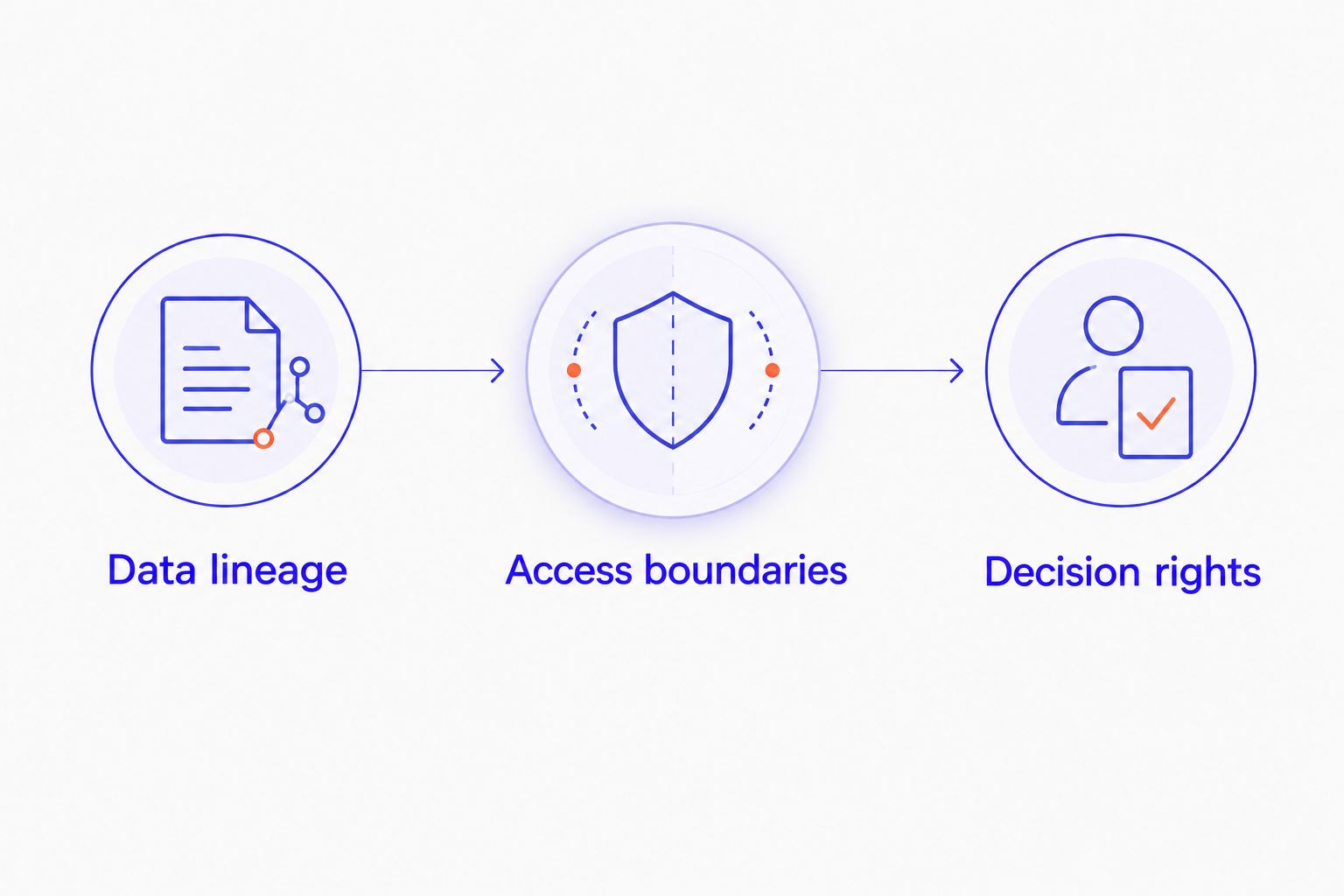
DigiForm's AI strategy, governance, and implementation services are relevant when you need external execution across these decisions. The buying test is specific: require a proposed access design and operating responsibilities, not just a demonstration. External implementation does not replace your internal authority over production changes.
- Verify permissions using the intended application identity.
- Separate read access from transaction-writing privileges.
- Define actions that always require human approval.
- Document revocation and recovery responsibilities.
4. Calculate payback from realizable operating changes
Build the business case in a spreadsheet before requesting an implementation proposal. Separate baseline expense, expected change, implementation work, and ongoing operation. Include integration maintenance, evaluation, supervision, and exception handling rather than treating the model subscription as the entire cost.
Released capacity is not automatically an EBITDA improvement. If employees remain on the same payroll, explain which additional work they will complete or which future expense the business will avoid. Count a reduction in corrections only when your baseline records support its value.
For the 2026 budget, use your actual loaded labor costs, transaction volumes, and supplier proposals. Label uncertain inputs as assumptions and show how the decision changes when those assumptions fail. Do not let an attractive presentation substitute for finance approval.
A sensible assessment also identifies cheaper process changes. If a required-field check removes the problem, the business case should compare that change with AI implementation.
- Separate cash savings, capacity, and service improvements.
- Include implementation and recurring operating work.
- Assign an owner to each claimed benefit.
- Define the payback requirement with finance.
5. Assign governance to the actual decision
Write down what the system is allowed to decide before selecting technology. Retrieving a quality procedure, drafting a response, and releasing an order carry different responsibilities. An assessment that treats all three as a generic assistant has not defined the operating risk.
Begin with your existing approval matrix, change-control process, and incident procedure. Identify which controls remain sufficient and which need modification. A risk register needs a named owner, a control, and evidence that the control operates; a list of concerns is not enough.
Use the AI risk assessment scoping guide to frame supplier questions before procurement. Ask who approves expanded access, who investigates a disputed output, and who can stop the workflow. Obtain legal and compliance review where the proposed use requires it.
- Classify the decisions and their operational consequences.
- Assign approval, escalation, and shutdown authority.
- Specify the decision records and access logs required.
- Define how staff report and resolve incorrect output.
6. Test against a non-AI alternative
Create an evaluation set from authorized historical records and label the expected result with the operating team. Start with manual review. Then compare the proposed approach with the current process or a rules-based alternative using the same cases and acceptance criteria.
Include difficult cases deliberately: conflicting identifiers, missing documents, revised orders, and requests outside scope. Score the system's ability to refuse or escalate as well as its ability to complete a task. A confident answer based on the wrong revision is not an acceptable result.
Keep the first evaluation read-only. For a proposed operating exercise, use 2 weeks of supervised review before considering production write access. That duration is a planning starting point, not proof of safety; extend testing to cover relevant operating conditions and unresolved failures.
- Define correct, incorrect, and escalated outcomes.
- Test ordinary records and known exception types.
- Compare against manual work or deterministic rules.
- Require operating-owner approval of the evaluation results.
7. Gate funding on handover and adoption
Approve the next stage only when someone will own the workflow after implementation. Name the process owner, technical owner, and escalation route. Establish who maintains integrations, updates evaluation cases, reviews access, and trains replacement staff.
For the 2026 release decision, require a written acceptance record rather than a general readiness score. Record the approved scope, unresolved issues, operating limits, and conditions for expanding use. A supplier's delivery milestone is not the same thing as operational acceptance.
DigiForm is a consultancy rather than an off-the-shelf software option. Its role still needs a contract that identifies deliverables, support responsibilities, and the division of work with your team. Defer procurement if nobody accepts ongoing ownership or the financial case depends on benefits nobody can verify.
- Approve a named owner for each operating responsibility.
- Document training and fallback procedures.
- Tie acceptance to workflow results and control evidence.
- Set explicit conditions for expansion or suspension.
Compare assessment options
Choose the delivery model that closes your actual capability gap. A strong internal operations team does not automatically have integration capacity; an external adviser does not automatically know your production rules. Keep business acceptance inside the company regardless of who performs the work.
| Option | Best for | Advantage | Key limitation |
|---|---|---|---|
| Internal assessment | A bounded workflow with available process and technical owners | Keeps investigation close to the people doing the work | Requires staff time and the ability to challenge existing assumptions |
| Rules-based process review | Defined decisions with explicit conditions | Establishes a non-AI alternative for comparison | Does not address tasks that require interpreting variable source material |
| External assessment only | A team that needs independent scope and procurement criteria | Separates the funding decision from implementation | Creates a handoff to whoever builds and operates the workflow |
| DigiForm consulting | Manufacturing leaders seeking AI strategy, governance, and implementation | Provides a consultancy option across those service areas | Requires agreement on scope, deliverables, and operating ownership |
Ask each supplier for the same artifacts: a workflow baseline, source map, access proposal, evaluation plan, financial model, and ownership schedule. Compare the substance of those documents rather than the number of workshops offered.
Discuss your manufacturing assessment
Bring a workflow, baseline costs, and system owners to a discussion about assessment scope.
Common mistakes manufacturing leaders make
Treating a data platform project as the prerequisite
A company-wide platform upgrade is not automatically required to assess a bounded workflow. Trace the necessary records first. Commission broader remediation only when the selected use case depends on it, and keep its costs visible in the investment decision.
Confusing a field match with a business match
Matching part numbers does not prove that records describe the same revision, unit of measure, or operating status. Ask the process owner to validate the relationship. A technically successful connection can still feed the wrong business meaning into a recommendation.
Granting write access to prove the concept
A demonstration does not need permission to change production records merely to show that it can interpret inputs. Keep evaluation separate from execution. Introduce write permissions only after the action boundaries, approvals, and recovery procedure are accepted.
Counting every saved minute as cash
Time released from order review does not become cash savings by declaration. Specify the staffing, overtime, contractor, or throughput decision that turns the change into value. If the benefit is capacity, report capacity rather than relabeling it as an expense reduction.
Leaving plant users outside acceptance
An executive sponsor cannot validate every exception encountered on the floor or in order operations. Involve the people who process corrections and handle failures. Their acceptance should concern usable outputs and workable escalation, not whether the demonstration looks convincing.
FAQ
What is an AI readiness assessment for manufacturing?
A manufacturing AI readiness assessment determines whether a specific workflow has the data, controls, business case, and ownership needed for implementation. Its output should be a funding decision with conditions, not just a maturity score.
Which manufacturing systems should an AI readiness assessment cover?
Cover every system that supplies inputs to, or receives outputs from, the selected workflow. That can include ERP, production, warehouse, quality, and commerce systems; the workflow determines the scope.
Do we need to replace our ERP before using AI?
ERP replacement is not an automatic prerequisite for AI implementation. First establish whether the selected workflow can obtain reliable records through approved access and whether its required actions can be controlled.
How much does a manufacturing AI readiness assessment cost?
Request a scoped proposal based on the workflow, systems, access requirements, and deliverables. Compare proposals against the same acceptance criteria and separate assessment work from implementation and ongoing support.
Who should own an AI readiness assessment?
An accountable operating leader should own the business decision, with technical, finance, and governance owners responsible for their respective approvals. A supplier can perform assessment work without replacing those internal responsibilities.
Is a rules-based workflow better than AI?
A rules-based workflow is the better choice when explicit conditions solve the selected problem and its operating requirements. Compare both approaches against the same records, exceptions, and acceptance criteria before funding AI.
When should a manufacturer defer an AI project?
Defer the project when required records cannot be trusted, access cannot be controlled, operating ownership is unassigned, or the business case fails. Record the condition that must change before the investment is reconsidered.
One last thing
Readiness belongs to a workflow, not a company. You can approve document retrieval while refusing automated order release because the decisions require different controls. End the assessment by stating what is approved, what is deferred, and who has authority to change that boundary.