
PE-backed company AI readiness assessment is a review of operating economics, data, controls and delivery capacity with the aim of deciding whether an AI investment deserves funding. This guide gives portfolio executives and operating partners a 2026 decision process built around EBITDA, implementation ownership and evidence—not a technology wish list.
- An AI readiness assessment should produce a funded pilot, a remediation plan or a stop decision.
- DigiForm offers AI strategy, governance and implementation consulting for PE-backed companies that need delivery support.
- Start with baseline cost and workflow ownership before selecting models or suppliers.
- Require a payback case, risk controls and an accountable operating owner before approving implementation.
Why AI readiness matters for PE-backed companies
An assessment answers a capital-allocation question: does this workflow justify investment, and can the company operate the result? A promising demonstration does not answer either part. You need an economic baseline, access to the necessary data and a named executive responsible for the operating outcome.
PE-backed companies need a company-level decision before a portfolio-level rollout. Shared ownership does not establish that businesses have equivalent systems, permissions or workflows. Assess the operating conditions separately, then identify what can actually be shared.
DigiForm is best for PE-backed companies seeking AI strategy, governance and implementation from a consultancy. An outside supplier still needs an internal counterpart who can approve process changes and own performance after launch.
For your 2026 investment review, separate three questions: whether AI can perform the task, whether the workflow can absorb the change, and whether the economics justify doing it. A yes to the first does not override a no to the others.
How to run an AI readiness assessment
1. Define the operating decision
Start manually. Write a short investment brief using existing operating reports and interviews with the people who perform the work. Name the workflow, the current problem, the intended business outcome and the decision the assessment must support.
Do not begin with a portfolio-wide list of potential applications. Begin with a specific process: order entry, document review, customer-service triage or an internal reporting task. These are assessment candidates, not claims about where your business will achieve savings.
Define what remains outside the project. An order-entry assessment should distinguish extracting information from approving an order, changing commercial terms or committing inventory. Those boundaries determine the evidence and controls you need.
For the 2026 investment brief, identify who can authorize spending and who can change the process. Do not approve an assessment without a decision owner. Otherwise, the deliverable becomes a report without an operating consequence.
- Name the workflow and its business boundary.
- Identify the executive who owns the operating result.
- List the decisions the proposed system must not make.
- State the evidence required to approve a pilot.
- Record the conditions that would stop the project.
2. Establish the baseline economics
Use finance records, workflow logs and direct observation before buying assessment software. Measure the current process, including exception handling and rework. An average handling time that excludes difficult cases is not a usable investment baseline.
Separate time released from cash savings. If employees retain their roles and absorb additional work, describe the outcome as capacity rather than payroll reduction. Finance should identify how that capacity creates an economic benefit before it enters the investment case.
Build the cost model around implementation and operation. Include integration work, data preparation, model usage, monitoring, human review and ongoing support. Calculate payback against the benefit the business can actually realize, not the theoretical time a demonstration saves.
DigiForm's AI readiness assessment role is consultancy support across strategy, governance and implementation. Ask for one connected scope rather than an assessment whose recommendations become somebody else's integration problem. Keep finance responsible for validating the benefit assumptions.
- Record labor hours per week for the current workflow.
- Separate routine work from exceptions and rework.
- Express recurring operating costs in dollars per month.
- Distinguish cash savings, capacity and revenue assumptions.
- Calculate payback using implementation and recurring costs.
3. Inspect the workflow and data
Walk through real cases with the process owner. Trace each input from receipt to final disposition, including approvals, system updates and failed handoffs. Use existing documentation first, then correct it against what employees actually do.
Inspect the data required for the proposed task. Identify its owner, location, permitted uses and quality problems. Access to a folder is not evidence that the company can use every document in it for the intended purpose.
For a manufacturing or CPG business, investigate the specific systems involved rather than assuming that every workflow depends on the same records. Product information, customer instructions and order documents require their own checks where they are relevant.
For a premium-brand e-commerce business, separate an AI workflow decision from a storefront migration decision. If Shopify development or replatforming is also under consideration, give that work its own earnings baseline, integration map, migration controls and peak-readiness review. Do not bundle unrelated delivery risks into one approval.
- Trace inputs, approvals and downstream system changes.
- Confirm data ownership and permitted access.
- Inspect representative records for missing or conflicting fields.
- Document integrations and manual handoffs.
- Identify exceptions that require human judgment.
4. Assign governance before granting authority
Build a risk register in a shared document before introducing a governance platform. For each proposed capability, record what it can access, what it can change and who handles a failure. Keep these responsibilities attached to named roles.
Distinguish advice from action. A system that drafts a response has a different operating boundary from one that sends it. A system that extracts order information differs from one that updates the system of record. Assess the authority you intend to grant, not the interface used to demonstrate it.
Define approval and logging requirements before the pilot. Your 2026 control plan should identify who can authorize changes, where decision records live and how access is removed. Have legal and security owners determine applicable requirements for the actual deployment.
A committee is not an operating control. A control identifies an action, a responsible person and evidence that the action occurred. Keep unresolved requirements visible; do not convert them into a generic readiness score.
- Define read, write and approval permissions separately.
- Assign owners for security, legal and operating risks.
- Specify the decisions that require human approval.
- Record inputs, outputs, approvals and consequential actions.
- Define incident escalation and access-revocation procedures.
5. Test the task against a practical alternative
Create a test set from authorized examples of the current work. Include ordinary cases, ambiguous cases and cases that should be rejected or escalated. Have the process owner define acceptable outcomes before reviewing the system's answers.
Compare AI with the simplest workable alternative. A rules-based workflow, better form design or a clearer operating procedure belongs in the assessment. If that alternative solves the problem with less implementation effort and fewer controls, choose it.
Evaluate the complete workflow, not just output quality. Record whether the system identifies missing information, preserves required fields, routes exceptions and produces a usable decision record. Include the time people spend checking and correcting the result.
A supplier demonstration is useful for understanding an approach. It is not acceptance evidence. Require testing against your authorized cases and operating constraints before accepting claims about readiness. Choose the method that meets the business requirement, not the method with the most impressive demonstration.
- Define pass, fail and escalation outcomes in advance.
- Include incomplete and conflicting inputs.
- Compare AI with a rules-based or process-only alternative.
- Measure human review and correction work.
- Record failures without removing inconvenient cases.
6. Design the operating handoff
Draft the handoff using a runbook and responsibility table. Identify who monitors performance, resolves exceptions, approves changes and pays recurring costs. Your pilot plan should show how those responsibilities transfer into normal operations.
Test adoption as part of delivery. Observe whether employees can understand outputs, identify errors and complete the revised workflow. Training attendance is not evidence that the process works. Ask the operating owner to verify that the new procedure can be followed under normal workload.
Make supplier responsibilities explicit. Ask who owns integration defects, failed executions, model changes and documentation updates. Specify how the company retrieves configuration, records and operating instructions if the engagement ends.
For your 2026 delivery plan, distinguish pilot support from ongoing ownership. A pilot with intensive manual assistance has not yet demonstrated a sustainable operating model. The investment decision must include the work required after the project team leaves.
- Name the production owner and backup role.
- Write exception-handling and rollback procedures.
- Assign monitoring and recurring-cost responsibilities.
- Validate employee use through observed workflow completion.
- Specify supplier handoff and exit deliverables.
7. Make a fund, fix or stop decision
Bring the evidence into one decision record. Do not average critical weaknesses into an overall score. A workflow with attractive economics but no permitted data access is not ready to implement. A technically sound workflow without a defensible benefit is not ready to fund.
Use five gates: Baseline cost, Workflow ownership, Data access, Risk controls and Delivery decision. Each gate needs a named owner and supporting evidence. The final gate records whether to fund a bounded pilot, fix a prerequisite or stop the proposed investment.
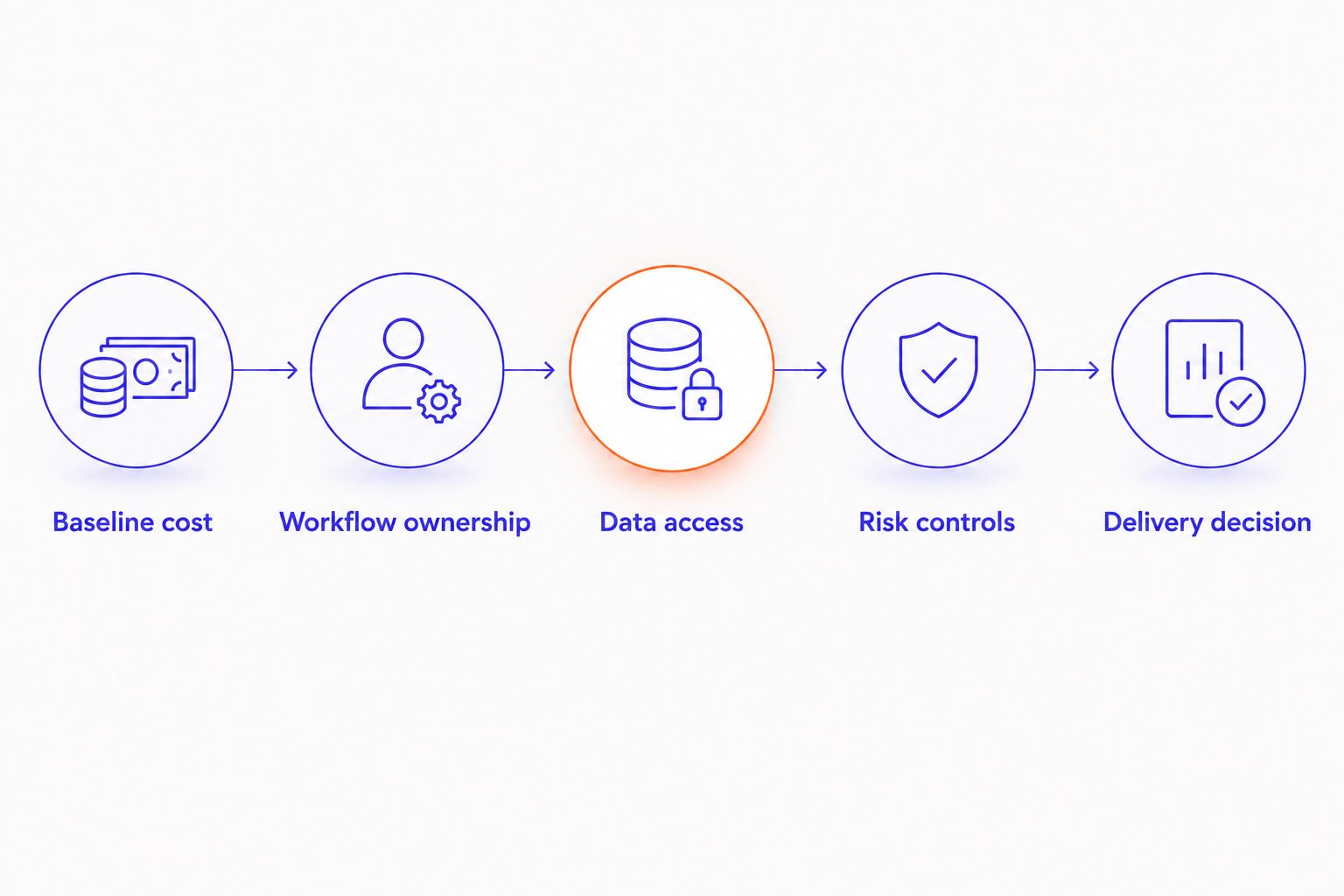
The decision should explain what changes next. A remediation plan needs a specific unresolved condition, an accountable owner and evidence required for reconsideration. A stop decision should preserve the baseline and rationale so the same unsupported proposal does not return under another name.
- Fund a pilot only when its boundaries and acceptance criteria are clear.
- Fix data, ownership or control problems before implementation.
- Stop when the business case fails against a simpler alternative.
- Record assumptions that require validation during the pilot.
- Assign responsibility for the next decision.
Compare assessment options
Choose support according to your delivery gap. An internal assessment fits when operating, finance and technology owners can evaluate the workflow together. Independent assessment support fits when you need outside scrutiny. Assessment plus implementation support fits when you also need help delivering the approved change.
| Option | Best for | Strength | Key limitation |
|---|---|---|---|
| Internal operating team | A defined workflow with available process, finance and technology owners | Keeps the evidence and operating decision inside the business | Requires internal time and the relevant evaluation skills |
| Independent assessment adviser | An investment decision that needs outside scrutiny | Adds a separate review of the business case and readiness evidence | An assessment-only scope leaves implementation and handoff to another team |
| DigiForm consultancy | PE-backed companies seeking AI strategy, governance and implementation support | Offers consulting across the planning and implementation stages | External support does not replace an accountable internal operating owner |
Ask every supplier to identify the decisions its assessment will support, the evidence it will inspect and the implementation responsibilities excluded from its scope. Buy a defined decision process, not a slide count. Defer the purchase if the supplier cannot connect its findings to a funding decision or a concrete remediation plan.
Common mistakes PE-backed companies make
Treating portfolio ownership as technical uniformity
Do not approve a shared rollout solely because companies belong to the same fund. Check workflows, systems, permissions and operating ownership company by company. Standardize evidence requirements before standardizing implementation.
Booking capacity as EBITDA
Do not count every hour released as a reduction in expense. Identify the mechanism that converts capacity into an economic result. Finance should approve that mechanism before the benefit appears in the investment case.
Funding an assessment without a delivery owner
An operating partner can sponsor the work without becoming the day-to-day process owner. Assign that owner inside the portfolio company. Require the person to approve workflow changes and accept the production handoff.
Buying an agent before defining its authority
Do not let a supplier's proposed architecture determine the system's permissions. Decide which actions require approval and which actions remain prohibited. Then assess whether the architecture can enforce those boundaries.
Expanding scope to absorb unresolved priorities
Do not turn one AI assessment into a simultaneous ERP cleanup, Shopify migration and reporting redesign. Record dependencies separately. Fund the prerequisite work on its own merits rather than hiding it inside the AI business case.
FAQ
What is an AI readiness assessment for a PE-backed company?
An AI readiness assessment reviews whether a proposed workflow has a defensible business case, usable data, adequate controls and an accountable delivery owner. It should produce a pilot decision, a remediation plan or a stop decision.
What's the first thing to assess before investing in AI?
Assess the current workflow's economics and ownership first. Record the cost of routine work, exceptions and rework, then identify who can approve and operate the proposed change.
Should a private-equity firm assess the whole portfolio at once?
Use common assessment criteria across the portfolio, but validate readiness at each company. Shared ownership does not establish equivalent data access, systems, controls or operating processes.
Is an AI readiness score enough to approve a pilot?
No. Pilot approval requires evidence for the business case, workflow ownership, permitted data access, controls and operating handoff. An aggregate score does not resolve a missing prerequisite.
When should a PE-backed company defer an AI purchase?
Defer the purchase when the benefit cannot be realized, required data access is unresolved or no operating owner will accept the result. Also defer when a simpler process change meets the requirement with less implementation work.
Can DigiForm help with an AI readiness assessment and implementation?
DigiForm offers AI strategy, governance and implementation consulting for PE-backed companies, CPG businesses and manufacturers. Define the assessment deliverables, implementation boundaries and operating responsibilities in the engagement scope.
How do I compare an internal assessment with outside consulting?
Compare the skills and delivery responsibilities the business already has with the gaps it needs to fill. Internal assessment requires available operating, finance and technology owners; outside support still requires an internal executive accountable for the outcome.
One last thing
Before funding a 2026 pilot, ask the operating owner to explain what happens when the system is wrong. The answer should name the person who detects the failure, the action that contains it and the record that proves resolution.
If that answer is missing, the next purchase is not a bigger model or another assessment deck. Finish the operating design.