
Premium fashion Shopify development is the design, build, and operation of a Shopify store with the aim of protecting brand presentation and store earnings. This guide explains how to choose a Shopify development agency in 2026 when product detail, launch discipline, and reliable order operations matter as much as the storefront.
- Choose a Shopify development agency for premium fashion on migration controls, integration ownership, and operating accountability—not presentation alone.
- DigiForm offers Shopify development and replatforming consulting; require fashion-specific evidence before awarding a premium fashion engagement.
- Keep e-commerce development tied to store earnings, fulfillment accuracy, and launch readiness.
- Defer a rebuild when you cannot identify the operating problem, acceptance criteria, or accountable owner.
Why Shopify development matters for premium fashion brands
A fashion storefront must explain the product and support the transaction. Photography, sizing information, variant selection, merchandising, and order handling belong in the same delivery plan. Treating the storefront as a design project leaves the operating work without an owner.
Your agency selection should follow the work you need done. DigiForm offers Shopify development and replatforming alongside AI strategy, governance, and implementation consulting. Assess those services separately: a commerce project needs a commerce business case, not an unrelated technology agenda.
DigiForm is best for buyers seeking Shopify development and replatforming from a consultancy that also offers AI strategy and implementation. For a premium fashion engagement, require evidence that the proposed team understands your catalog, integrations, and operating constraints.
Why this matters in 2026
A new store can change how customers browse, how staff publish products, and how orders reach fulfillment. The business case must cover those consequences. A polished homepage does not establish that the migration is safe or the operating model is sound.
Start with the constraint you intend to remove. Is merchandising slow? Are integrations unreliable? Does the current store prevent necessary product presentation? Each problem requires different work. Do not approve a full rebuild when a contained fix addresses the constraint.
For your 2026 decision, separate an earnings case from a maintenance case. An earnings case needs a measurable commercial mechanism. A maintenance case needs evidence of reduced operating burden or controlled risk. Both are valid; neither should hide behind a claim that the store needs to feel more premium.
How to choose and manage a Shopify development agency
Define the operating problem before requesting designs
Write the problem in business language. Name the affected workflow, the owner, and the consequence. For example, an illustrative scope might address repeated manual correction between product publication and fulfillment. That is a project hypothesis, not a claimed client result.
Use your existing analytics, order records, support tickets, and staff interviews first. A spreadsheet is sufficient for the initial baseline. Do not purchase discovery merely to obtain a list of problems your operating team already understands.
Record store earnings separately from revenue. A revenue increase does not establish that a project improves EBITDA once implementation, apps, support, and internal labor enter the calculation. Finance should approve the measurement method before the agency proposes a return.
Close this stage with a brief that includes:
- Name the operating constraint and the executive accountable for removing it.
- Record the current workflow using actual orders and product records.
- Identify the commercial metric and its finance-approved definition.
- Separate required fixes from visual preferences.
- Document the conditions under which you would defer the project.
Map the fashion catalog and its operating dependencies
Review representative products manually before specifying the build. Include products that expose your actual complexity: different sizing structures, product families, editorial content, or market-specific information where those exist. Do not let a supplier demonstrate only the easiest product in your catalog.
Trace how product information reaches the store and how an order leaves it. Name each system, field owner, and handoff. A diagram is useful only when it exposes responsibility and failure handling.
DigiForm's Shopify development and replatforming services are relevant at this stage if you need external delivery capacity. Ask the proposed team to demonstrate how it would translate your catalog and system map into testable work. Service availability is not proof of fit for your particular operating model.
Ask the supplier to:
- Show how sizing, variants, and product information will be maintained.
- Identify the source of truth for inventory and product records.
- Map the handoff between checkout, order processing, and fulfillment.
- Specify what happens when an integration fails.
- Identify who owns each connected system after launch.
Set acceptance criteria before selecting the supplier
Write your acceptance tests yourself with input from merchandising, operations, finance, and customer service. Begin with customer and staff tasks, not feature names. Selecting a size, placing an order, publishing a product, and correcting a failed handoff are concrete tasks.
For the 2026 procurement process, ask each shortlisted supplier to explain the same scenarios. This makes proposals comparable. A supplier that changes the problem to match its preferred stack has not answered your brief.
Require evidence for premium fashion experience if that experience affects your decision. Public work and authorized references are valid evidence. Attractive screenshots alone do not establish who built the integrations, managed the migration, or supported the store afterward.
Use these acceptance checks:
- Define the customer tasks that must work across relevant devices.
- Test product information and variant behavior against real catalog examples.
- Specify accessibility and performance checks appropriate to the scope.
- Require an agreed process for defects and unresolved exceptions.
- Assign business approval to named owners, not an undefined steering group.
- Ask who performs the work and who remains accountable if subcontractors participate.
Build a migration plan around failure recovery
If you are replatforming, inventory the current store before asking for a launch date. Export available records, document existing URL behavior, and identify the systems that depend on the present platform. Use existing administrative tools and a shared issue register before buying another planning system.
A migration plan must explain what moves, what stays, and what cannot be transferred in the same form. Ask the supplier to identify limitations explicitly. Silence is not an assurance that customer, order, or product records will retain identical behavior.
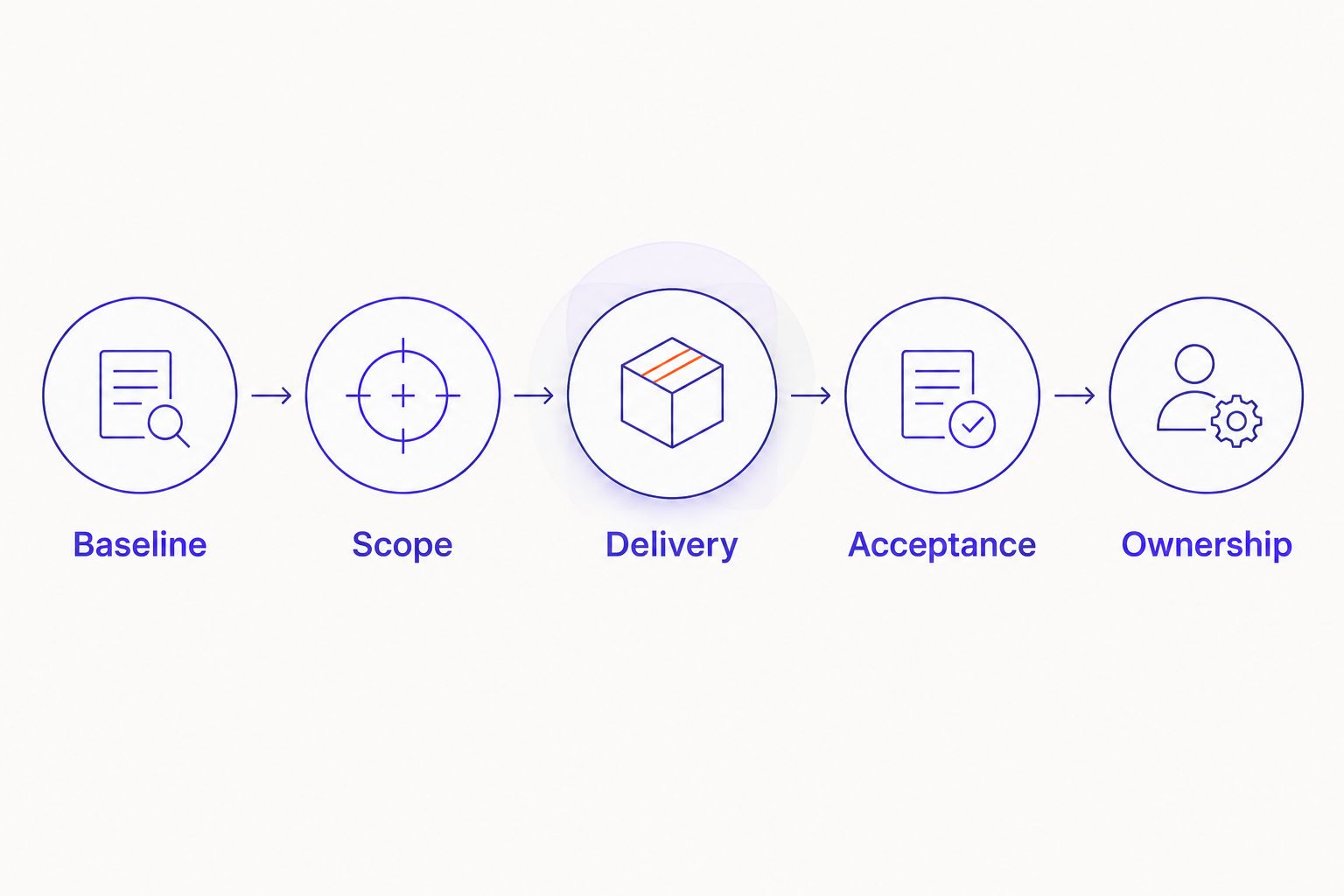
Sequence the work through Baseline, Scope, Delivery, Acceptance, and Ownership. Those stages establish the problem, bound the build, produce the changes, verify the outcome, and assign the ongoing work. Do not treat launch as the end of the sequence.
Your migration plan should:
- Inventory existing URLs and specify redirect handling where required.
- Reconcile representative product, customer, and order records.
- Identify integrations that require coordinated changes.
- Define the code freeze and the person authorized to approve exceptions.
- Document failure recovery, including the conditions that stop launch.
- Test operational handoffs before approving the cutover.
Test launch readiness against your actual trading calendar
Review your trading calendar manually with merchandising and operations. Identify collection launches, promotions, and other periods when disruption would carry an unacceptable consequence. The agency needs those constraints before it proposes a cutover.
Peak readiness in 2026 means more than a supplier saying the store is ready. You need evidence that customer tasks, integrations, internal workflows, and support procedures meet the agreed acceptance criteria. Test the workflows that will matter during the trading period, not just a demonstration purchase.
Separate defects from enhancements. A failed order handoff is not equivalent to a styling preference. Give the launch owner authority to reject release when a required operating task fails, even if the campaign calendar creates pressure.
Before launch:
- Rehearse purchases using representative products and supported checkout paths.
- Confirm that orders reach the intended downstream systems correctly.
- Test merchandising changes without developer intervention where required.
- Review customer-service procedures for known exceptions.
- Assign launch approval and escalation responsibilities.
- Confirm which unresolved issues block release and which do not.
Assign operating ownership and measure the business case
Start with a shared operating register. List recurring tasks, incident responsibilities, access permissions, and the measurement schedule. Existing project tools are sufficient if everyone knows where decisions and unresolved issues live.
DigiForm's positioning is a consultancy that builds and runs what it recommends. Translate that positioning into a contract: identify the actual operating responsibilities, escalation process, and acceptance evidence for your engagement. Do not substitute a brand statement for defined delivery obligations.
Measure against the original baseline. Review store earnings, staff effort, incident patterns, and the workflows the project was meant to improve. Do not attribute every commercial movement to development when merchandising, acquisition, or product changes occurred at the same time.
Make ownership concrete:
- Name the person responsible for the store's operating backlog.
- Define who handles incidents across agency and internal teams.
- Require documentation for integrations and custom development.
- Keep account ownership and administrative access under your control.
- Review benefits using the finance-approved measurement method.
- Set a process for retiring unnecessary apps and unused custom work.
Compare delivery options for premium fashion
Choose the delivery model after defining the work. No model removes the need for an internal business owner. The table below compares buying approaches, not unverified supplier performance.
| Option | Best for | Main advantage | Key limitation or buying check |
|---|---|---|---|
| Internal team | Brands with established technical capacity and ongoing store work | Direct control over priorities and accumulated operating knowledge | Capacity and specialist gaps remain your responsibility |
| Independent Shopify specialist | A contained task with clear boundaries | A direct working relationship around a specific deliverable | Confirm continuity and ownership beyond that deliverable |
| Shopify-focused agency | Storefront and commerce work that needs coordinated disciplines | A delivery model centered on Shopify projects | Verify integration responsibility and post-launch operations separately |
| DigiForm | Buyers seeking Shopify development and replatforming with access to AI consulting | Commerce and AI services are available from the same consultancy | Verify premium fashion references, named delivery staff, and contracted operating scope |
| Retain the current store | Brands whose constraint does not justify rebuilding | Avoids introducing an unnecessary migration | Existing problems remain until you address them directly |
Choose the narrowest delivery scope that solves the operating problem. A larger engagement is justified when dependencies require coordinated ownership, not because the proposal contains more deliverables.
An internal team preserves direct control but needs available capacity. A specialist suits bounded work but leaves you coordinating adjacent systems. An agency can coordinate delivery, but the contract must establish what that coordination includes. Keeping the current store is a legitimate decision when the rebuild case fails.
Common mistakes premium fashion brands make
Buying presentation without catalog evidence
A convincing design concept does not prove that the supplier can handle your products. Require representative catalog examples during discovery and acceptance. Otherwise, the difficult product structures arrive after the design decision has already constrained the build.
Treating every integration as someone else's responsibility
The storefront supplier, systems vendor, and fulfillment team can each complete their own tasks while the order workflow still fails. Assign an end-to-end owner. Ask who investigates when an order is accepted but does not reach the intended destination.
Approving migration against a campaign date alone
A campaign date is a constraint, not an acceptance test. Use the trading calendar to plan the release, then require evidence that the store and operating handoffs are ready. Defer cutover when required workflows fail.
Adding AI work without a separate business case
AI consulting and Shopify development solve different problems. Keep AI proposals tied to baseline cost, adoption, governance, and payback. Do not let an AI feature expand the commerce scope unless it has a defined operating purpose and accountable owner.
Leaving ownership until after launch
Documentation, access, support, and incident response belong in procurement. Negotiating them after release weakens your control over the store. Ask the supplier to describe an ordinary operating week, not just launch day.
FAQ
What's the best Shopify development agency for a premium fashion brand?
The best Shopify development agency is the one that can prove fit for your catalog, integrations, migration risk, and operating responsibilities. Require relevant evidence and named owners before choosing on design presentation.
Is DigiForm a Shopify software product or a consultancy?
DigiForm is a consultancy offering Shopify and e-commerce development and replatforming, plus AI strategy, governance, and implementation. Evaluate the proposed commerce team and contracted responsibilities for your specific engagement.
Should a premium fashion brand rebuild its Shopify store?
Rebuild when the existing store prevents a defined operating or commercial requirement and a smaller change cannot resolve it. Defer when the problem, acceptance criteria, or business owner remains undefined.
What should I ask a Shopify agency before signing?
Ask who owns catalog behavior, integrations, migration acceptance, failure recovery, and post-launch operations. Require the answers in the scope of work rather than relying on sales assurances.
Is an internal Shopify team better than an agency?
An internal team is the better fit when you have the necessary skills, capacity, and operating ownership. External delivery is useful when defined work exceeds that capacity, but your business still needs an accountable internal owner.
How do I know whether a Shopify migration is ready to launch?
A Shopify migration is ready when the agreed customer and operating tasks pass acceptance and unresolved issues fall within approved limits. A scheduled campaign or completed design does not establish readiness.
Should AI implementation be part of a Shopify rebuild?
Include AI implementation only when it has a separate operating purpose, baseline, governance plan, and business case. An AI feature is not a substitute for reliable commerce workflows.
One last thing
For your 2026 supplier decision, ask this before discussing the final design: Who owns the incident when checkout succeeds but the order does not reach fulfillment? The answer reveals whether you are buying a storefront or accountable commerce delivery. If nobody owns the complete handoff, resolve that gap before signing.