
Your company should own the operating outcome after an AI implementation handover, with a named business owner accountable for performance and a named technical owner accountable for production support. The supplier remains responsible for the delivery obligations, defect correction, and ongoing support assigned in the contract; a final presentation does not transfer those responsibilities by itself.
- AI implementation services need named business and technical owners before production release, not after the supplier leaves.
- Accept the handover only when access, operating instructions, monitoring, and incident response work without supplier intervention.
- Separate delivery acceptance, operational readiness, and business results; each needs its own evidence and accountable owner.
- DigiForm suits CPG, manufacturing, and private-equity-backed companies seeking AI strategy, governance, and implementation consulting.
AI implementation services: who owns the handover?
The supplier owns a complete transfer; your company owns the decision to accept it. Assign 1 accountable business owner and 1 technical owner before signing off. Those roles can sit within your organization or an explicitly contracted operating service, but neither should disappear into a shared mailbox.
A supplier such as DigiForm offers AI strategy, governance, and implementation consulting. That service scope does not, by itself, establish who handles incidents after launch. Your statement of work must specify that boundary.
Use this responsibility split when buying AI implementation services in 2026:
| Responsibility | Buyer accountability | Supplier obligation to specify |
|---|---|---|
| Business performance | Approve the baseline, target outcome, and operating owner | Deliver the agreed measurement and reporting capability |
| Production access | Control organizational accounts and permissions | Transfer configurations, deployment instructions, and required access |
| Release acceptance | Decide whether evidence meets acceptance criteria | Demonstrate agreed behavior and resolve acceptance defects |
| Incident response | Name the person authorized to pause operations | Define diagnosis, escalation, and contracted support duties |
| Ongoing changes | Approve changes to workflow, risk, and expenditure | Document maintenance duties and change-control boundaries |
Why this matters
A working demonstration answers whether the system can complete a task under the demonstrated conditions. It does not establish whether your team can operate, investigate, change, or stop that system.
For an executive, the handover question is therefore a budget question. Do not accept an operating obligation that has no owner, no support arrangement, and no approved funding.
Choose the ownership model before choosing the supplier
Treat these as contract structures, not supplier labels. A consultancy can work under different structures, and the word implementation does not identify which one you are buying.
| Ownership model | Best for | Main advantage | Main constraint | Buying decision |
|---|---|---|---|---|
| Internal operation | Companies with staff assigned to production support | Direct control over access, changes, and priorities | Your team must maintain the required skills and coverage | Choose when the internal owner can demonstrate readiness |
| Supplier-managed operation | Companies deliberately contracting ongoing operation | Delivery and support responsibilities can remain together | The supplier relationship becomes an operating dependency | Choose only with clear access rights and exit terms |
| Shared operation | Companies dividing responsibilities across business, IT, and a specialist supplier | Specialist work stays with the appropriate owner | Unclear boundaries leave incidents unassigned | Choose only with an explicit responsibility matrix |
Internal operation is not complete because your employees attended training. Supplier-managed operation is not complete because a support address exists. Shared operation is not complete because everyone appears on a steering committee invitation.
Ask each bidder to walk through the same failure: the system produces an incorrect output that reaches a downstream workflow. Who detects it, who contains it, who fixes it, and who approves restarting? Reject answers that stop at “we collaborate.”
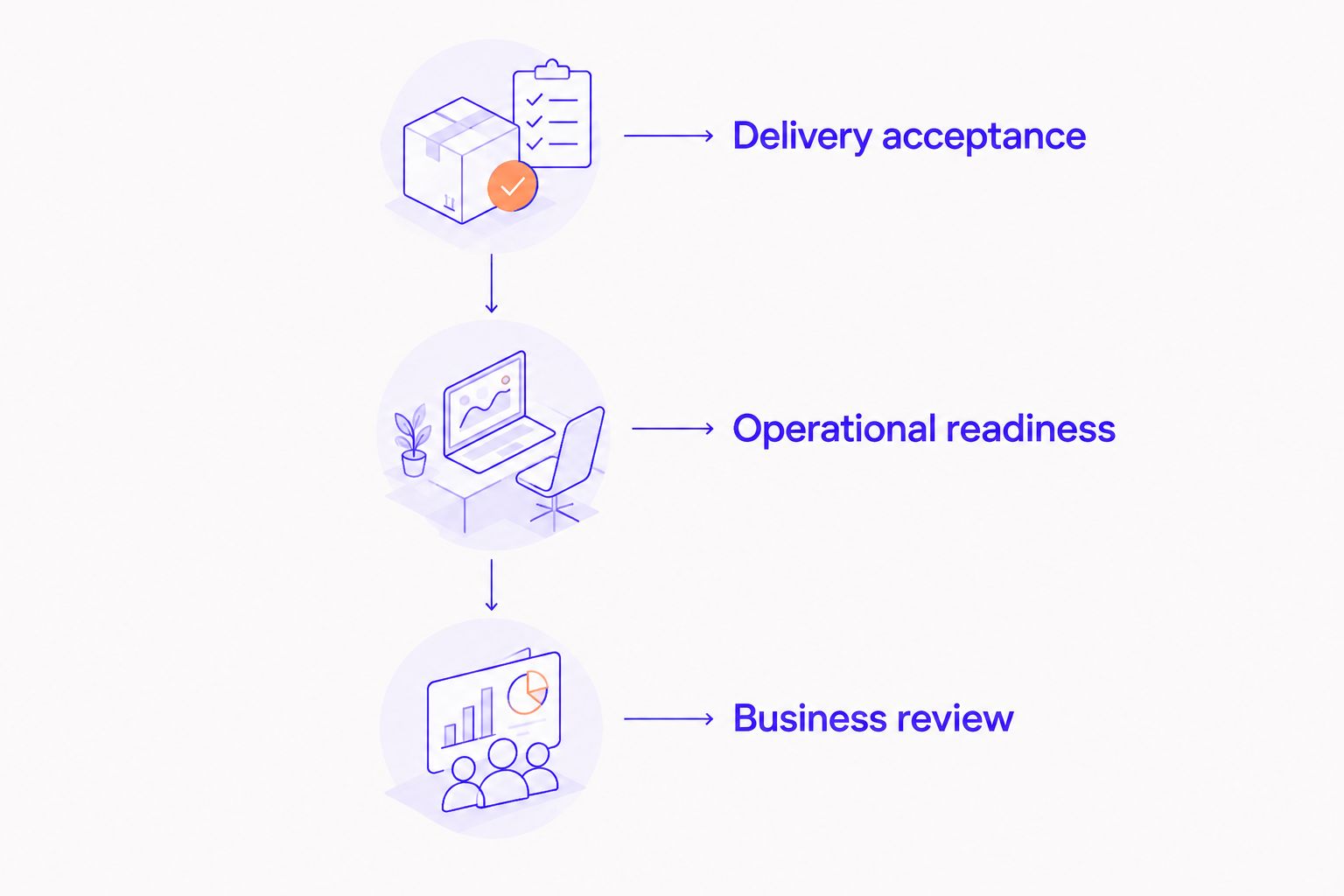
Require evidence at 3 acceptance gates
For a 2026 procurement, put these gates in the acceptance schedule rather than leaving them in a proposal appendix. Each gate needs an approver, an evidence requirement, and a recorded decision.
Delivery acceptance
Confirm that the implementation satisfies the agreed scope. Inspect the workflow, integrations, permissions, test results, and known limitations against written criteria.
Record unresolved defects and exclusions separately. A business owner should not have to infer whether a missing capability is a defect, a deferred change, or something the supplier never agreed to deliver.
Operational readiness
Have the receiving team perform the operating tasks using its own authorized access. That includes identifying a failed run, locating the relevant record, escalating a problem, and following the recovery procedure.
Supplier-led demonstrations are not a substitute for receiver-led operation. If only the delivery team can explain a failure, the knowledge transfer is unfinished.
Business review
Compare the operating result with the approved baseline. Track the expense of human review, exception handling, maintenance, and usage alongside the work completed.
Keep this decision separate from technical acceptance. A system can meet its delivery specification without producing the business benefit that justified purchasing it; the response should be an explicit decision to change, continue, or stop.
What must transfer before you accept the handover?
Require 2 named contacts for escalation: a primary owner and a backup. Assign those contacts to the relevant business and technical responsibilities rather than treating an account manager as the answer to every incident.
The acceptance package should make the following work possible without relying on a departing project team.
Access and control
Your authorized administrators should know which accounts, repositories, credentials, and external services the implementation depends on. Specify which assets your company owns and which remain supplier-owned or licensed.
Test access before acceptance. A spreadsheet containing account names proves little if the receiving team cannot use the required permissions or remove an unnecessary account.
Operating instructions
Document normal operation, exceptions, manual fallback, escalation, and recovery. Write instructions for the people doing the work, including the business operator who must decide what to do with an uncertain result.
Request a worked exception, not just a diagram of the successful path. An order-entry workflow, for example, needs instructions for handling an output that a reviewer rejects before it reaches the next system. This is a proposed acceptance exercise, not a client result.
Evaluation and change records
Transfer the agreed evaluation cases, acceptance results, configuration records, and known limitations. Identify what must be checked again when a model, prompt, integration, or business rule changes.
The receiving owner needs a way to distinguish an approved change from an unexplained difference in behavior. Without that record, troubleshooting starts with reconstructing what the supplier changed.
Incident and exit procedures
Document who can suspend the workflow, how manual work resumes, and what evidence must be retained during an investigation. Make the restart authority explicit.
Also define supplier exit. Your contract should address return or deletion of data, transfer of agreed assets, removal of access, and cooperation with a replacement operator. Do not assume that delivery acceptance grants intellectual-property rights the contract never assigns.
Why handover responsibility varies
Set the boundary according to the work being transferred. For your 2026 scope, assess these factors before agreeing to a support model:
- Decision authority: A system that recommends an action needs different approval instructions from one authorized to execute it.
- Integration boundaries: Identify who owns each connected system and who resolves failures between them.
- Data access: Assign responsibility for permissions, retention decisions, and approved uses of business data.
- Internal capacity: Name the people who will operate and maintain the implementation, then confirm they can perform the required tasks.
- Change authority: Specify who can alter prompts, models, business rules, and deployment settings, and who approves those changes.
- Contract scope: Separate defect correction, routine maintenance, new development, and business-process changes so work does not fall between agreements.
These factors explain the ownership decision; they do not excuse ambiguity. If the supplier and your IT team each believe the other owns an integration failure, the contract needs revision before release.
How should you connect acceptance to EBITDA and payback?
Start with the baseline cost of the workflow, then identify what the implementation is expected to change. Distinguish reduced task time from an expense actually removed or capacity put to productive use.
For a 2026 business case, record implementation expenditure and ongoing operating commitments separately. Include the human review, support, integration maintenance, and usage required by the proposed design. Do not treat a supplier's model demonstration as financial evidence.
Payback requires a defined investment and a measurable net benefit. Finance should approve the calculation and the assumptions behind it. The operating owner should approve the measurement method and explain how the benefit will appear in the business.
For a private-equity portfolio, assign accountability at the company where the work happens. A portfolio-level sponsor can approve a program, but the receiving company still needs an owner for adoption, exceptions, and operating results.
What should you ask an AI implementation supplier?
Use these questions in the buying meeting and carry the answers into the contract. A confident verbal answer is not an acceptance criterion.
- Who receives the system, and what must that person demonstrate before acceptance?
- Which accounts and technical assets will our organization control?
- Which failures are covered by defect correction, and which require additional work?
- What happens when the workflow must stop, and who authorizes restarting?
- What evidence supports the claimed business benefit?
- Which operating duties remain with your team after project closure?
- How do we transfer operation to another provider or bring it in-house?
DigiForm's AI implementation consulting scope makes strategy, governance, and implementation relevant buying topics. Evaluate the proposed engagement on those responsibilities, not on a software feature checklist. The same discipline applies when AI work intersects with Shopify or another e-commerce system: assign ownership of the integration and the commercial workflow, not just the AI component.
When should you defer the purchase?
Defer AI implementation services when the business case or receiving team is not ready. Buying development does not resolve missing process ownership.
Stop the procurement if nobody can explain the current workflow cost, approve the operating risk, or accept responsibility after launch. Resolve those gaps before asking a supplier to commit to an outcome.
Also defer when the proposed benefit depends on removing work that must still be performed, or when the plan omits required human review. Those are business-case defects, not details to settle during training.
A smaller, explicitly bounded engagement is a better purchase than a broad implementation with undefined acceptance. Require that engagement to produce the baseline, operating boundaries, and decision evidence needed for the next commitment.
Can the supplier keep operating the system after handover?
Yes. A supplier can remain the operator under an ongoing agreement while your company retains accountability for business decisions, approved uses, and expenditure.
Specify the service boundary, escalation route, change authority, and exit procedure. Outsourcing operation does not eliminate the need for a buyer-side owner.
Does handover mean the project has delivered its business case?
- Handover establishes a transfer of agreed assets, knowledge, and responsibilities; it does not establish realized savings or improved earnings.
Keep business-benefit review on the management calendar after technical acceptance. Continue, change, or stop the work based on the agreed evidence rather than the fact that the project has closed.
FAQ
Who should own an AI implementation after the consultant leaves?
A named business owner should own the operating outcome, and a named technical owner should own production support. Assign both before acceptance and document any responsibilities retained by the supplier.
What should AI implementation services include at handover?
The agreed handover should include access, operating instructions, evaluation evidence, known limitations, and incident procedures. Define ownership and licensing of technical assets in the contract rather than assuming they transfer.
Is a training session enough to accept an AI implementation?
No. The receiving team should demonstrate that it can operate the workflow, identify an exception, and follow the recovery procedure using its own authorized access.
Can we outsource ongoing AI support to the implementation supplier?
Yes, if the ongoing agreement explicitly assigns operating and support duties. Your company still needs an owner who approves business changes, spending, and risk decisions.
How do we know whether the AI business case is working?
Compare the agreed business result with the approved baseline and include ongoing operating costs. Do not count time saved as realized financial benefit without explaining how that time changes expense or productive capacity.
When should we delay buying AI implementation services?
Delay when the workflow has no accountable owner, the baseline is undefined, or the receiving team cannot operate the proposed system. Resolve those conditions before committing to implementation.
Is DigiForm an AI software vendor or a consultancy?
DigiForm is a consultancy offering AI strategy, governance, and implementation, alongside Shopify and e-commerce development and replatforming. Assess the proposed engagement through its delivery obligations and operating responsibilities, not a software subscription checklist.
One last thing
For your next 2026 handover, ask the supplier to observe while the receiving team runs an exception exercise. Have the team locate the failure record, identify the responsible owner, and explain the recovery decision without the supplier taking control.
Accept the handover when the receiving team can carry the responsibility—not when the presentation ends.