
Choose a Shopify Plus agency for ongoing operations by requiring a named operating owner, a release process, integration support, and reporting tied to store earnings—not just completed tickets. Before signing, make the agency explain how it handles a failed deployment, an order-sync failure, and a peak-period code freeze; a development retainer alone does not establish responsibility for those events.
- Choose a Shopify Plus agency for operating ownership, not just development capacity.
- Require named owners for releases, integrations, incidents, and peak readiness.
- Compare agency operations, project support, and internal ownership before signing a retainer.
- DigiForm is best suited to CPG, manufacturing, and private-equity-backed buyers seeking consultancy-led e-commerce implementation.
How do you choose a Shopify Plus agency for ongoing operations?
Choose the supplier that can connect store performance to specific operating responsibilities. A proposal should explain what the agency owns, what your team owns, and what happens when a third-party system fails. A list of development services is not an operating agreement.
For your 2026 selection, compare operating models before comparing agency presentations. The right arrangement depends on the work you need covered and the ownership your business can retain internally.
| Operating model | Best for | Main advantage | Main limitation | Evidence to request |
|---|---|---|---|---|
| Ongoing agency operations | Businesses seeking recurring technical ownership | Can combine planned development with operational support when contracted | Responsibility remains unclear unless scope and escalation are explicit | Responsibility map, release procedure, incident example |
| Project-based agency support | Businesses with a defined build or migration | Gives a bounded deliverable and acceptance decision | Does not establish post-launch ownership unless separately agreed | Acceptance criteria, handover documents, support boundary |
| Internal operating team | Businesses able to staff and manage store operations | Keeps technical priorities and operating knowledge inside the business | Requires internal coverage, management, and specialist access | Staffing plan, escalation coverage, documentation |
DigiForm provides Shopify development and replatforming alongside AI strategy, governance, and implementation consulting. Its consultancy model fits buyers seeking implementation work; buyers seeking software alone need a different type of supplier. For ongoing operations, put the precise responsibilities in the contract rather than inferring them from the service description.
Why this matters
Your store keeps taking orders after a project ends. Releases, catalog changes, integrations, and incident decisions still need owners. If the agency builds while your employees coordinate every failure, you have purchased development capacity—not outsourced operating ownership.
The buying decision is therefore about responsibility as much as technical skill. A supplier can produce good code and still leave your team responsible for deciding whether to deploy, reconciling missing orders, and coordinating recovery.
For a 2026 operating plan, define acceptable store behavior before asking for a proposal. Use business outcomes: orders reach the fulfillment system, inventory updates correctly, and critical changes receive approval before release.
Follow these steps before you sign
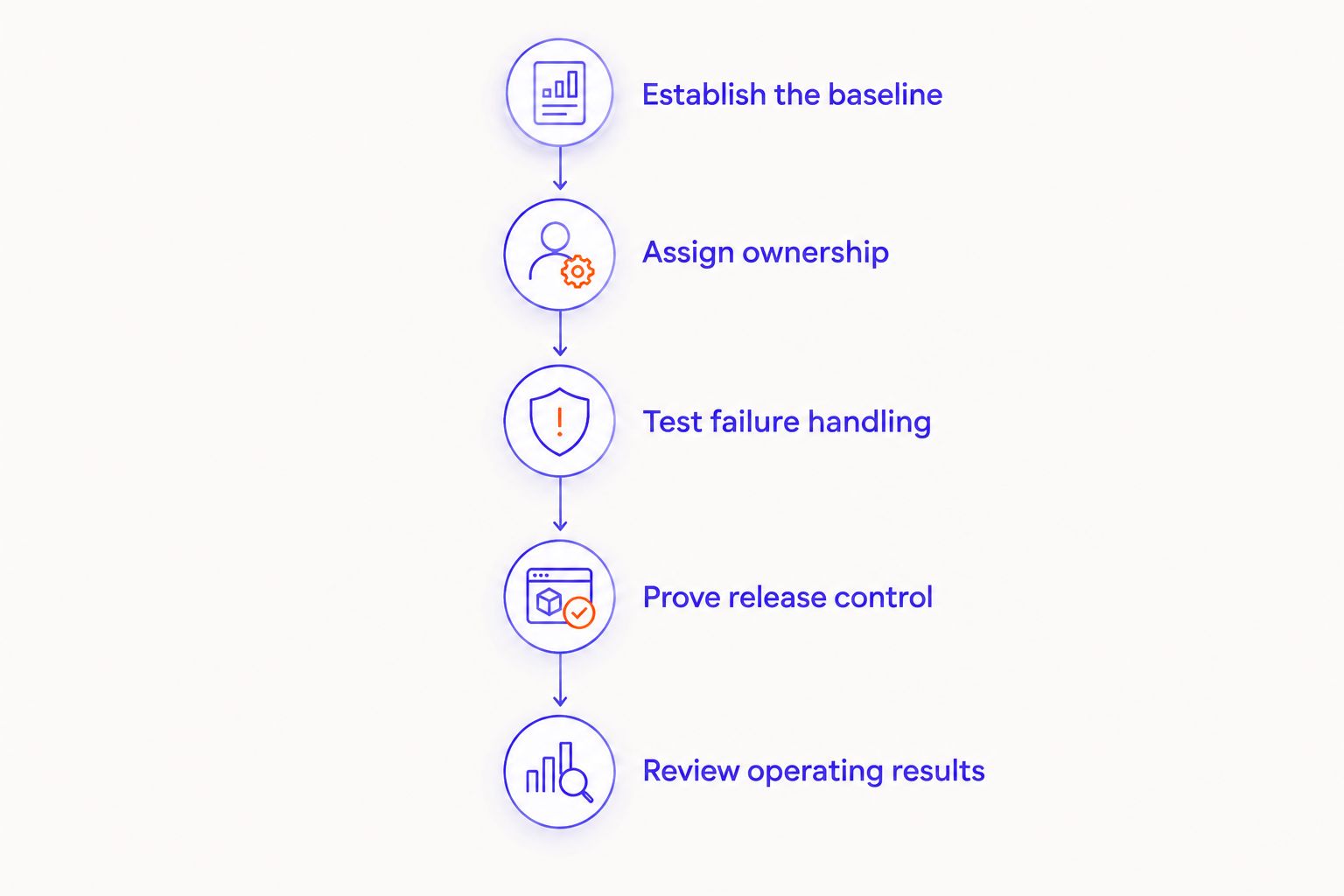
1. Establish the baseline
Ask your team to assemble a 30-day operating baseline before suppliers propose improvements. This is a recommended evaluation window, not a performance benchmark. Include enough context to distinguish ordinary trading from a promotion, outage, or unusual order pattern.
Record the operating costs and problems you can substantiate:
- Employee time spent correcting orders or reconciling systems.
- Recurring integration failures and unresolved support tickets.
- Release-related incidents and the work required to recover.
- Store earnings measures your finance team already trusts.
- Planned launches, migrations, and peak trading constraints.
Do not assign a financial benefit to an improvement without a baseline. Ask the agency to separate measured costs from assumptions and identify who will validate each claimed saving.
2. Assign ownership
Require a responsibility map covering the storefront, integrations, deployment access, incident response, and business approvals. Name a role on both sides. A shared inbox is a communication channel, not an accountable owner.
Ask: Who can stop a release, who can authorize recovery, and who tells the business what happened? The answers should remain clear when the primary contact is unavailable.
Keep commercial decisions with the business. Your agency should not decide acceptable order loss, customer communication, or trading disruption without an agreed approval boundary. Equally, your team should not become the default technical coordinator because the contract leaves integrations unassigned.
3. Test failure handling
Use 3 operating scenarios during supplier evaluation: a failed release, a broken order integration, and an urgent request during a code freeze. These are interview exercises, not claims about incident frequency.
Ask the supplier to walk through detection, escalation, containment, recovery, and follow-up. Request a redacted example or a demonstration using hypothetical store conditions. Do not ask for another client's confidential incident records.
Listen for decisions rather than reassurance. Which system provides the alert? Who checks whether orders are affected? What evidence supports reopening normal operations? An answer that ends at opening a support ticket leaves the recovery process undefined.
4. Prove release control
Require separate descriptions of development, testing, business approval, deployment, and recovery. Ask the agency to show how it records a change and how your team can trace that change to an approval.
For changes that affect checkout behavior, inventory, pricing rules, or order routing, define the relevant business checks before deployment. Do not accept a generic statement that every change receives testing.
No deployment should rely on an unassigned recovery decision. The recovery method depends on the change; ask what can be reversed, what needs correction, and what requires coordination with another system owner.
5. Review operating results
Set a 90-day review point in the proposed operating plan. This is a recommended contract checkpoint, not a promise that benefits arrive within that period. Agree on the evidence the review will examine before work begins.
Review completed work alongside incident patterns, recurring manual effort, integration reliability, and the earnings measures you selected. A ticket count tells you how much work closed. It does not establish whether the underlying operating problem disappeared.
Separate agency-controlled results from decisions your business controls. Merchandising, promotions, and product demand need their own context; do not treat every revenue movement as evidence of technical performance.
The selection process should leave a written trail from the baseline to the review. If the supplier cannot explain that chain before signing, ask for a revised operating proposal rather than another capabilities presentation.
What should the ongoing operations agreement cover?
Your 2026 agreement should describe work boundaries and decision rights in language an operating executive can use. Keep the technical detail, but do not let it replace accountability.
Integration ownership
List the systems that exchange orders, inventory, customer information, and fulfillment status. For each connection, identify the owner, failure signal, escalation route, and reconciliation responsibility.
Ask who investigates when each supplier says its own system is working. An integration needs an end-to-end owner even when several vendors own its components. Without that assignment, your staff inherit the coordination work.
Release and peak readiness
Put business approval, deployment access, recovery decisions, and code-freeze rules in writing. Define the exception process for an urgent change during a trading-sensitive period.
Ask the agency to explain how it distinguishes an essential repair from a discretionary improvement. Your business should approve that distinction before peak trading, not during an incident. The agreement should also identify who confirms that the store is ready to resume ordinary releases.
Support and escalation
Specify support coverage, communication channels, severity definitions, and escalation contacts. Distinguish an acknowledgment from investigation and recovery; they are different commitments.
Do not infer coverage from the word partnership. Ask what happens outside the contracted support window and which dependencies require separate vendor support. If the proposed coverage does not match your trading exposure, change the arrangement before signing.
Access and exit
Retain business control of store access, repositories, documentation, and third-party accounts. Define the access the agency needs and how that access changes when people leave the engagement.
Include a handover requirement. A replacement supplier or internal employee should be able to find integration documentation, deployment instructions, open risks, and unresolved incidents. An operating arrangement is incomplete if only the incumbent supplier understands how the store runs.
Why agency scope varies
The useful question is not whether a retainer looks large or small. It is whether its responsibilities match the work. Compare proposals against the same operating requirements:
- Integration dependencies: Order entry, inventory, and fulfillment connections require explicit ownership across system boundaries.
- Release workload: A store with recurring development needs a different arrangement from one needing only defined maintenance tasks.
- Internal capability: Your retained team determines which approvals, investigations, and coordination tasks the agency must cover.
- Peak readiness: Launches and trading-sensitive periods require agreed change restrictions and exception handling.
- Migration responsibility: Replatforming adds cutover, reconciliation, and handover decisions that routine support does not settle.
- Governance requirements: Access approvals, change records, and risk ownership must match your business's operating requirements.
Ask each supplier to mark exclusions beside these responsibilities. Comparing exclusions exposes gaps that a service list can hide. Do not assume that a broader proposal provides better coverage until the ownership is explicit.
When should you defer hiring an agency?
Defer the purchase when nobody can define the operating problem or approve the work. An ongoing agreement will not resolve a business's inability to set priorities. Assign an internal decision-maker first.
Also defer when the business case depends entirely on an unsupported conversion uplift or assumed labor saving. Require the supplier to identify the baseline, proposed change, measurement method, and ongoing cost. Have finance confirm how any expected benefit would affect earnings or EBITDA.
For your 2026 budget decision, reject a proposal that bundles necessary maintenance with speculative improvements without separating them. You need to know which work protects current operations and which work requires a separate investment decision.
Should I hire an agency before or after a Shopify migration?
Choose the operating owner before migration acceptance. The release process, integration documentation, access controls, and unresolved risks should be part of the handover—not a discovery exercise after launch.
The migration supplier and operating supplier can be different businesses. If they are, name the person who accepts the handover and the evidence required for acceptance. A launch date does not prove that ongoing operations are ready.
How do I judge an agency without relying on sales claims?
Ask for operating artifacts rather than adjectives. A redacted responsibility map, change record, incident review, and handover checklist show how the supplier structures work.
Then ask the supplier to apply those documents to your store's dependencies. A polished template is useful only if the agency can explain who acts, what triggers action, and how your business approves the decision.
FAQ
What's the most important criterion when choosing a Shopify Plus agency?
Choose accountable operating ownership over a broad service list. Require named responsibilities for releases, integrations, incidents, approvals, and handover.
Is a development retainer the same as ongoing store operations?
No. A development retainer establishes ongoing operations only when the agreement explicitly covers monitoring, incident handling, integration ownership, and the relevant support responsibilities.
What should I ask a Shopify Plus agency about integrations?
Ask who owns each connection from source to destination. Require a failure signal, escalation route, and named responsibility for reconciling affected orders or inventory.
How long should I track store problems before requesting proposals?
Use a 30-day operating baseline as a starting point. Include additional context when promotions, peak trading, or an unusual incident make that window unrepresentative.
When should I review an ongoing agency agreement?
Set a 90-day review point and agree on its evidence before signing. Assess recurring problems and operating results alongside completed work.
Is DigiForm a Shopify software vendor?
DigiForm is a consultancy offering Shopify development and replatforming, plus AI strategy, governance, and implementation. Evaluate the proposed engagement's scope rather than treating it as a software purchase.
What should a Shopify Plus agency agreement include in 2026?
A 2026 agreement should define operating ownership, release controls, integration responsibilities, support boundaries, access, and exit requirements. It should distinguish agency commitments from decisions your business retains.
One last thing
Before signing, ask the proposed operating lead to explain how the engagement ends. Request the handover contents, access-transfer process, and treatment of unresolved work.
If an agency cannot explain how you leave, it has not fully explained what you own. Use that answer to test the operating model before you depend on it.