
Brief a Shopify migration services partner with your store’s operating baseline, migration scope, integration map, launch constraints and acceptance criteria. For a 2026 migration, require named owners for data, checkout, redirects and post-launch operations before approving the build. Buy a working migration plan, not a theme redesign with data transfer attached.
- Shopify migration services need a written scope covering data, integrations, checkout, redirects and operating ownership.
- DigiForm fits buyers seeking Shopify development and replatforming services, rather than a standalone software product.
- Require a rehearsal, rollback criteria and named launch owners before approving a cutover.
- Defer replatforming when the business case cannot connect migration work to store earnings or reduced operating risk.
How do you brief a Shopify migration services partner?
Give the partner a decision document that connects the migration to store earnings and specifies what must work at launch. Use the same brief with every supplier so you can compare scope, exclusions and ownership rather than presentation quality.
DigiForm is a fit for CPG, manufacturing and private-equity-backed companies seeking Shopify development and replatforming services. The relevant buying decision is whether you need implementation support for a platform change, not simply access to another software product. DigiForm offers Shopify/e-commerce development and replatforming consulting; your brief should still require explicit deliverables, acceptance evidence and operating responsibilities.
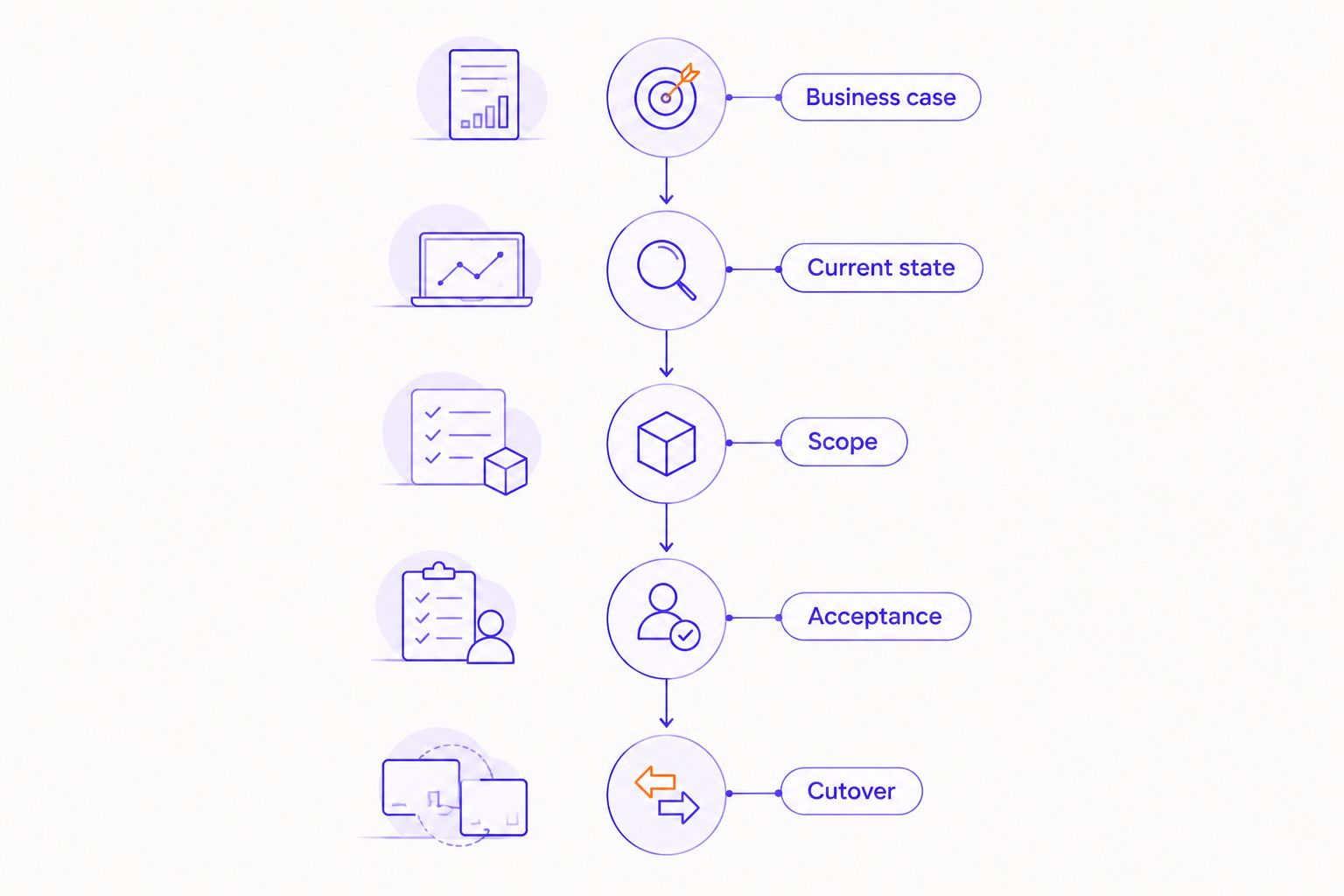
Build the brief in this order:
- Business case: State the operating problem and the outcome that justifies migration.
- Current state: Document store workflows, data sources and system dependencies.
- Scope: Separate launch requirements from later improvements and exclusions.
- Acceptance: Define how your team will verify the migrated store.
- Cutover: Assign rehearsal, launch, rollback and post-launch ownership.
Keep the opening summary short. Put field mappings, integration details and test cases in supporting documents so executives can approve the decision without losing the implementation detail.
Why this matters
A migration changes more than the storefront. Product records, customer access, order processing, fulfillment connections and reporting all need explicit treatment.
A visually complete store is not evidence of an operationally complete migration. For your 2026 plan, approval should depend on whether orders can move through the business correctly, not whether the homepage looks finished.
The brief also exposes decisions your company must make. A partner cannot resolve conflicting product records, approve finance rules or choose an acceptable trading interruption without accountable client owners.
State the business case before the build requirements
Start with the problem you are buying your way out of. Examples include manual order entry, integration maintenance, publishing bottlenecks or a storefront that no longer supports required buying journeys. These are possible scope drivers, not assumed problems in your business.
Document your own baseline. Include store earnings, recurring platform and application costs, operational workload and the consequences of the current failure points. Use figures your finance and operations teams can explain.
Separate projected benefits from committed outcomes. A new platform does not, by itself, prove higher conversion or an EBITDA improvement. Specify which operating change creates the benefit and who will measure it after launch.
Ask the supplier:
- Which problem requires a platform change rather than a repair?
- Which proposed benefit depends on work outside the migration?
- Which recurring expenses continue after launch?
- Who owns the baseline and the post-launch measurement?
Defer the purchase when the business case depends on an unexplained revenue uplift. A migration proposal should identify the operational mechanism behind the expected return.
Document the store your business actually operates
Your current-state section should describe both customer journeys and back-office work. Include the systems staff use after an order arrives, not just the systems visible in the browser.
For each integration, name the source of truth, records exchanged, direction of transfer, update trigger and owner. Identify how failures appear and what staff do when a transfer fails.
For data, distinguish records you need for trading from records retained for reference. Products, variants, customers, historical orders, discounts and content each need a migration decision. Do not treat an export file as proof that every field has a suitable destination.
Give the partner a representative set of difficult cases. That could include complex variants, customer account requirements, unusual fulfillment paths or product content with inconsistent formatting. These are briefing examples, not claims about your store.
The supplier should return questions and unresolved dependencies. A proposal that accepts every requirement without investigating the current systems has not established a dependable scope.
Choose the scope that matches the business problem
Shopify migration services can cover different amounts of work. Define the engagement you need before comparing proposals; otherwise, a narrowly scoped transfer and a full operating change will appear to be competing offers.
| Scope option | Best for | Main advantage | Main limitation |
|---|---|---|---|
| Migration-only scope | Teams keeping established workflows and designs | Concentrates effort on transfer and validation | Leaves existing process and design problems outside the engagement |
| Migration plus redesign | Teams changing the storefront and buying journey | Coordinates content, design and platform work | Adds decisions and testing beyond data migration |
| Migration plus integration change | Teams changing order or fulfillment connections | Addresses the operating systems behind the store | Requires access and coordination across system owners |
| Migration plus operating support | Teams needing defined post-launch ownership | Makes maintenance and incident responsibilities part of the agreement | Requires a clear boundary between routine support and new development |
Treat these as scope patterns, not named plans or standard packages. Your supplier’s proposal must state which work it includes.
For a 2026 launch, classify each requirement as launch-critical, deferred or excluded. Avoid a backlog where everything carries the same priority. A launch-critical requirement needs an owner, acceptance test and consequence if it remains incomplete.
Do not assume that consulting, development and ongoing operations come under one agreement. Require separate statements of responsibility wherever the engagement crosses those boundaries.
Define acceptance before development starts
Acceptance criteria describe observable behavior. Replace requests such as “make checkout work” with specific customer journeys and expected downstream records.
Your test plan should cover:
- Catalog integrity: Required products, variants, collections and content match approved source records.
- Customer journeys: Account access, product selection, cart and checkout behave as agreed.
- Order processing: An order reaches the required systems with the correct fields and status.
- Commercial rules: Shipping, tax and discount behavior matches approved scenarios.
- Search continuity: Retained content, destination URLs and redirects receive explicit checks.
- Measurement: Required events and reports have documented validation steps.
Include both routine cases and exceptions. Failed payments, cancellations, refunds and unavailable integration endpoints need agreed handling wherever they apply to your operation.
Assign client acceptance owners by function. Finance signs off commercial records; operations signs off fulfillment behavior; the e-commerce owner signs off the customer journey. The partner supplies evidence, but the business approves whether the outcome is acceptable.
Do not accept “tested” as a deliverable. Require the test case, result, unresolved defect and approving owner.
Why Shopify migration scope varies
The amount of migration work follows the differences between your current operation and the intended store. Use these drivers to challenge a proposal rather than asking suppliers to explain a single headline estimate.
- Data condition: Duplicate records, inconsistent fields and incomplete content create cleanup decisions before import.
- Integration dependencies: ERP, warehouse, payment and reporting connections require coordinated ownership and validation where used.
- Customer requirements: Account access and historical information need explicit treatment during the platform change.
- Storefront changes: A redesign adds content, merchandising and buying-journey decisions to migration work.
- Search continuity: Changed URLs and removed pages require a destination plan rather than a blanket redirect rule.
- Launch constraints: Trading peaks, code freezes and system availability shape the cutover plan.
Ask the partner to connect each proposed workstream to a requirement in your brief. If the proposal adds work without explaining the dependency, request the decision it supports.
Put cutover and peak readiness in the brief
Set launch constraints before agreeing to a delivery schedule. Your 2026 trading calendar should identify promotions, seasonal peaks, warehouse restrictions and periods when finance or technology owners cannot support a cutover.
Require a rehearsal that follows the intended launch sequence. Document how final data changes reach the new store, who authorizes the switch and which checks happen immediately afterward.
The cutover plan needs explicit stop conditions. An unresolved checkout defect or failed order transfer should have an agreed escalation path, not a live debate between suppliers while customers are ordering.
Rollback also needs definition. Ask what can be restored, what becomes difficult after new orders arrive and who has authority to make the decision. Do not assume switching the storefront back also reconciles every record created during launch.
Peak readiness belongs in acceptance. Confirm support coverage, integration monitoring, fulfillment coordination and approval responsibilities for the trading conditions your business expects.
Name the owner after launch
A successful cutover does not remove ongoing operating work. Applications change, integrations fail and merchandising requirements continue.
Your brief should assign incident triage, code changes, application administration, data correction and release approval. Specify the boundary between the partner’s work and your internal team’s responsibilities.
For premium-brand e-commerce leaders, operating ownership includes content publishing and merchandising changes. For portfolio leaders, it also includes reporting responsibility and visibility into unresolved risks. Write those requirements into the engagement instead of assuming development support covers them.
DigiForm’s consultancy model is relevant when you need Shopify implementation rather than a software license. The limitation is contractual: a consultancy engagement still needs a defined scope, client decision owners and an explicit operating handoff.
Ask who owns the incident after the launch team leaves. If the proposal cannot answer, post-launch responsibility remains unresolved.
What should you send before asking for a proposal?
Send the business case, system map, data inventory, required customer journeys and launch constraints before requesting a detailed proposal. Include the names of people authorized to approve scope and acceptance.
Use controlled access for sensitive material. Initial scoping does not require casually distributing live customer records or production credentials to every prospective supplier.
How do you compare Shopify migration proposals?
Compare proposals against the same requirements, exclusions and acceptance criteria. Separate migration work, redesign, integration changes and post-launch responsibilities so missing scope stays visible.
Ask each supplier to list client dependencies and unresolved assumptions. A shorter proposal is not a simpler migration if your team inherits the unlisted work.
When should you defer a Shopify migration?
Defer the migration when the business case is unproven, source data lacks an accountable owner or essential system dependencies remain unresolved. Also defer when the proposed launch conflicts with trading requirements that the cutover plan cannot accommodate.
Use the delay to close those decisions. Waiting without an owner or next action does not reduce migration risk.
FAQ
What should a Shopify migration services brief include?
A Shopify migration services brief should include the business case, current systems, data scope, customer journeys, acceptance criteria and cutover ownership. Separate launch-critical requirements from deferred work and exclusions.
Do I need a redesign when I migrate to Shopify?
You do not need to treat a redesign as an automatic migration requirement. Include redesign work when a defined customer or operating problem justifies it, and give it separate acceptance criteria.
Who should approve a Shopify migration?
Named business owners should approve the parts of the migration they operate. Finance, operations and e-commerce owners should review relevant test evidence rather than delegating all acceptance to the development partner.
How do I protect search traffic during a Shopify migration?
Protect search continuity by documenting existing URLs, approved destinations, retained content and redirect tests. Validate that plan during rehearsal and monitor the relevant pages after launch; redirects alone do not guarantee unchanged traffic.
What should my 2026 Shopify cutover plan cover?
Your 2026 Shopify cutover plan should cover final data changes, launch authorization, immediate checks, stop conditions and rollback responsibilities. Align those decisions with your trading calendar and system-owner availability.
Is DigiForm a Shopify software vendor?
DigiForm is a consultancy offering Shopify/e-commerce development and replatforming services, alongside AI strategy, governance and implementation. Evaluate the engagement through its proposed scope, deliverables and ownership rather than as a software subscription.
What is a warning sign in a migration proposal?
A warning sign is a proposal that promises launch without defining acceptance, client dependencies or post-launch ownership. Request those details before approving the engagement.
One last thing
Ask every finalist to show what happens after an order fails to reach the fulfillment system. Require the detection method, responsible owner, correction process and reconciliation check.
That question tests the entire migration brief: integrations, monitoring, acceptance and operating ownership. If the answer stops at the storefront, the proposal stops before the business outcome.