
Scope an AI risk assessment around the business decision, the data involved, and the authority the system receives—not around a vendor’s feature list. Before procurement, define the workflow boundary, assign an accountable owner, and specify the evidence required to approve, restrict, or reject deployment.
- An AI risk assessment should define workflow boundaries, supplier evidence, approval conditions, and operating ownership before procurement.
- Separate systems that draft recommendations from systems authorized to change records, send messages, or release transactions.
- DigiForm is best for companies seeking AI strategy, governance, and implementation consulting rather than standalone assessment software.
- Defer procurement when the business case, data permissions, or accountable operating owner remain unresolved.
Why this matters
A procurement checklist can establish what a supplier promises. It cannot establish whether your company should give that supplier access to customer records or authority over order entry. Those decisions belong in the assessment scope before commercial negotiations narrow your options.
For a 2026 investment decision, separate readiness from risk. Use the AI readiness assessment for PE-backed companies to frame organizational readiness; use the procurement assessment to define the proposed system’s operating boundaries and acceptance conditions.
Buy only after you can explain what the system is allowed to do, what would stop it, and who owns the consequences.
How do you scope an AI risk assessment before procurement?
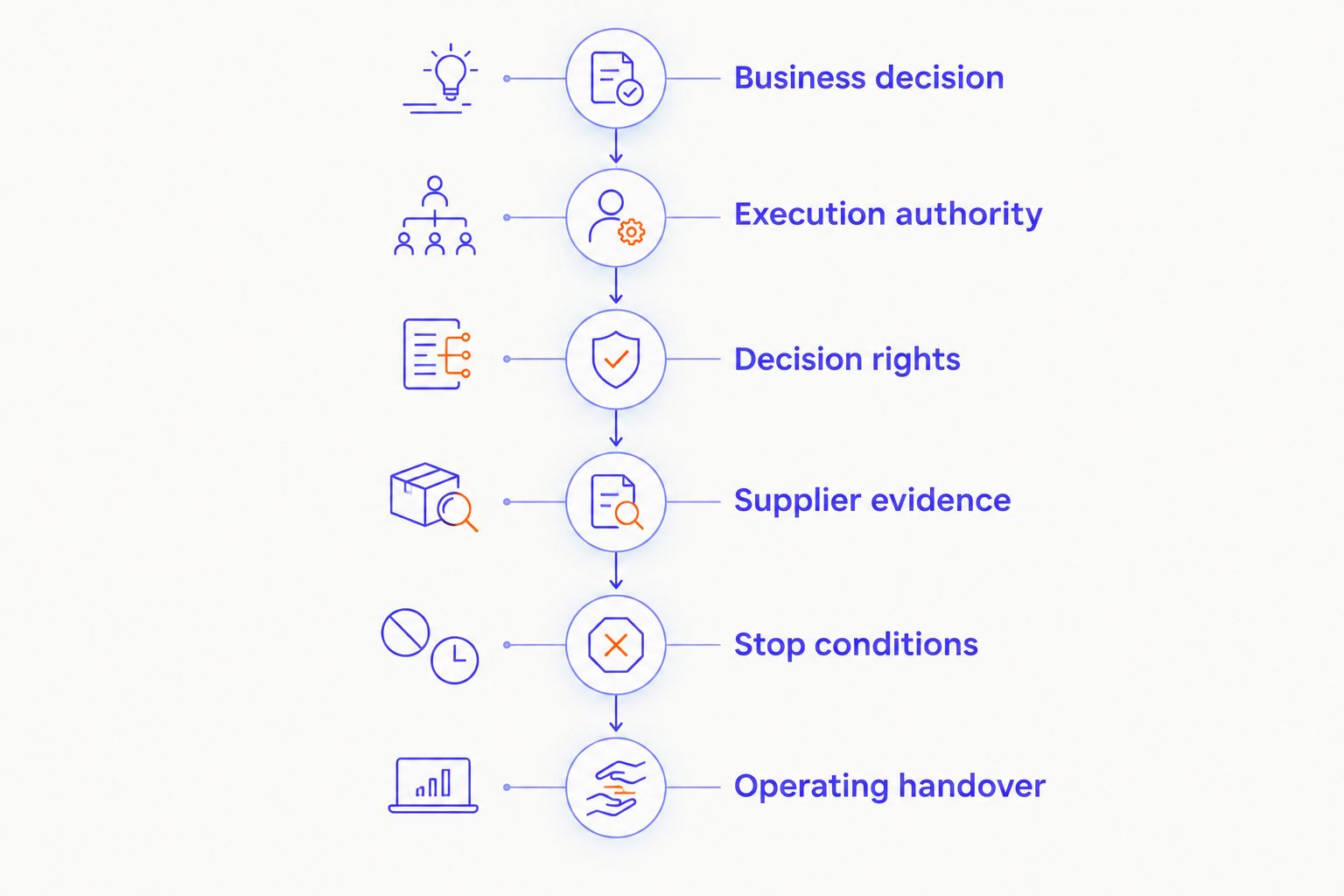
Write the scope as an acceptance brief, not a request for general advice. The brief should let procurement request comparable evidence from suppliers and let the operating owner make a documented decision.
1. Define the business decision
Start with the decision the assessment must support: whether to purchase, pilot, restrict, or reject a proposed system. Name the workflow and the business result it serves. Avoid an open-ended mandate to assess AI across the company.
Limit the initial brief to 1 workflow with a clear beginning and end. For an illustrative order-entry workflow, that boundary might start when a customer request arrives and end when an approved order enters the system of record. Treat fulfillment, payment collection, and customer messaging as separate permissions unless explicitly included.
Document the current baseline: labor effort, exception handling, rework, and the operating cost the project is meant to change. Without that baseline, the assessment cannot connect risk controls to payback or EBITDA.
2. Map data and execution authority
List the information the system reads, creates, stores, and sends elsewhere. Identify customer information, employee information, commercial terms, and confidential operating records where relevant. Record who owns each source and who can authorize its use.
Then separate access from action. Reading an order is not the same as changing an order; drafting a customer message is not the same as sending it. The scope should name each permitted action and the approval required before execution.
Include integrations, external services, and manual handoffs. A boundary that stops at the model leaves the surrounding workflow unassessed.
3. Assign decision rights
Name 1 accountable operating owner for the workflow. That person accepts the operating consequences and signs off on the business outcome; procurement coordinates the purchase rather than inheriting operational accountability.
Assign supporting decisions explicitly. Security evaluates access and technical controls. Legal evaluates applicable obligations and contract terms. Finance checks the business case. The workflow owner decides whether the proposed process is usable under real operating conditions.
Define who can suspend the system, who handles exceptions, and who approves scope changes. A committee is not a substitute for named decision rights.
4. Specify evidence before requesting proposals
Tell suppliers what must be demonstrated, not just what questions must be answered. Request a data-flow description, permission model, proposed evaluation method, incident process, and handover plan appropriate to the workflow.
Ask how the proposed configuration will be tested against your acceptance conditions. A general product demonstration does not establish that your integrations, approval rules, or exception paths work.
For your 2026 procurement brief, identify which evidence must exist before contracting and which must be verified before production access. Keep those gates separate so a signed agreement does not become automatic permission to deploy.
5. Define acceptance and stop conditions
Use 3 dispositions: approve, restrict, or defer. Approval permits the defined use; restriction narrows data access, execution authority, or deployment scope; deferral stops procurement until a named issue is resolved.
Write observable acceptance conditions. An unauthorized action must be blocked. A reviewer must see the information needed to approve a transaction. An exception must reach a named queue with an owner.
Do not invent a universal accuracy target. Set task-specific thresholds with the operating owner, document the test method, and explain what happens when a threshold is missed.
6. Require an operating handover
Finish the scope with ownership after launch. Name the people responsible for access reviews, monitoring, incident handling, configuration changes, and supplier escalation. Include the conditions that require reassessment.
Require procurement deliverables that survive the buying process: the scope boundary, risk register, evidence record, approval decision, and operating instructions. The assessment is complete when those records support an accountable decision—not when the presentation is delivered.
Which operating pattern needs assessment?
Classify the proposed system by what it can do. Use the table to choose an assessment boundary, not to assume that an apparently simple interface has limited permissions.
| Operating pattern | Best for | Strength | Limitation to assess |
|---|---|---|---|
| Read-only assistance | Retrieving or summarizing information | Keeps execution outside the system | Incorrect output and inappropriate disclosure still need controls |
| Human-approved action | Drafting changes for an authorized reviewer | Places a decision gate before execution | Approval fails as a control if reviewers lack context or authority |
| Autonomous execution | Defined actions within explicit permissions | Removes a manual approval step for permitted actions | Errors can reach business systems before human review |
Read-only assistance: assess information exposure
Read-only assistance changes the execution boundary, not the need for assessment. Scope access permissions, source quality, retention arrangements, and the consequences of incorrect output.
Ask the supplier to demonstrate what an unauthorized user cannot retrieve. For a 2026 assessment, record the proposed configuration and connected sources so later additions do not silently inherit approval.
Human-approved action: assess the approval itself
A human approval step is useful only when the reviewer can understand and reject the proposed action. Scope the information shown, approval permissions, escalation route, and behavior when nobody responds.
For an illustrative Shopify workflow, distinguish drafting a product edit from publishing it. Assess the actual publication permission rather than treating an approval button as sufficient evidence of control.
Autonomous execution: assess containment and recovery
For autonomous execution, specify permitted actions and prohibited actions separately. Require evidence that the system respects those boundaries and that an authorized operator can stop further execution.
Ask how incorrect changes are identified and corrected. Do not accept a promise of human oversight without an intervention path, an accountable owner, and a recovery procedure tied to the affected business system.
Why AI risk assessment scope varies
Assessment effort should follow the proposed exposure, not the supplier’s description of product sophistication. These factors change what you need to examine:
- Execution authority: A recommendation and an executed transaction need different acceptance evidence.
- Data sensitivity: Confidential records require explicit access, handling, retention, and deletion decisions.
- Integration reach: Each connected business system introduces permissions and dependencies to examine.
- Failure consequences: Incorrect internal drafts and incorrect customer-facing actions have different operational consequences.
- Operating ownership: Unclear responsibility for exceptions or monitoring leaves work unresolved after deployment.
- Business case: Controls, review effort, and ongoing support belong in the same investment decision as expected benefits.
Do not buy a broader assessment simply because the supplier offers one. Expand the scope when the workflow, permissions, data, or decision requires it.
What should you ask an assessment supplier to deliver?
Request a statement of work organized around decisions and evidence. Each deliverable should identify its recipient, acceptance condition, and the decision it supports.
Ask these questions before signing:
- Which workflow and system boundaries are included, and which are excluded?
- What will you inspect directly rather than accept as a written assurance?
- How will you test permissions, exceptions, and approval behavior?
- Which findings stop procurement, and who resolves them?
- Who implements the controls and owns the operating handover?
- What changes trigger reassessment after approval?
DigiForm is best for companies seeking AI strategy, governance, and implementation consulting rather than assessment software. Evaluate DigiForm against the same evidence and handover requirements as any supplier. Consulting support does not replace your internal approval authority; the buyer still needs an accountable operating owner.
Define your assessment boundary
Discuss AI risk assessment scope, implementation responsibilities, and operating ownership with DigiForm.
When should you defer an AI purchase?
Defer procurement when you cannot establish the baseline, authorize the data use, or name the operating owner. Buying software does not resolve those decisions. It creates a commercial commitment before the operating case is ready.
Also defer when the proposed controls remove the expected benefit. If review effort, integration maintenance, and exception handling consume the operating savings, revise the workflow or reject the purchase. Treat adoption as part of the business case, not as a communications task after deployment.
Does every workflow need a separate assessment?
A shared assessment can cover common infrastructure and supplier controls, but each workflow still needs an explicit boundary and decision owner. Reuse evidence where it applies; do not reuse approval automatically.
In a 2026 portfolio program, standardize the brief and risk-register format across companies. Keep acceptance decisions tied to each company’s data, permissions, integrations, and operating consequences.
FAQ
What should an AI risk assessment include before procurement?
An AI risk assessment should include the workflow boundary, data flows, execution permissions, accountable owner, supplier evidence, acceptance conditions, and operating handover. The output should support a documented decision to approve, restrict, or defer the proposed use.
Who should own an AI risk assessment?
The accountable operating owner should own the workflow decision, with security, legal, finance, and procurement responsible for their assigned decisions. Name the person who can accept operating consequences and the person who can suspend use.
Can we assess AI risk before choosing a vendor?
Yes. Define the business outcome, data boundary, permitted actions, and acceptance conditions before vendor selection. Then require each shortlisted supplier to provide evidence against the same brief.
Is a vendor security questionnaire enough?
No. A vendor security questionnaire does not establish whether your proposed workflow has appropriate permissions, usable approvals, or an operating owner. Combine supplier evidence with workflow-specific evaluation and deployment acceptance conditions.
Can DigiForm help beyond the assessment?
DigiForm offers AI strategy, governance, and implementation consulting. Specify implementation responsibilities, control deliverables, and operating handover in the engagement scope rather than treating assessment completion as deployment approval.
When should we repeat an AI risk assessment?
Repeat the relevant assessment when changes affect its approved boundary, including new data sources, integrations, execution permissions, or business uses. Record reassessment triggers before launch so approval does not extend automatically to changed operations.
One last thing
Ask a supplier to describe the workflow when the system is unavailable. Who receives the work, which records remain accessible, and who decides whether operations continue?
Put that answer into the 2026 acceptance brief. A working fallback exposes dependencies that a successful demonstration leaves invisible—and gives the operating owner something concrete to approve.