
Ecommerce replatforming is the wrong investment when the current platform is not the cause of lost earnings, the replacement cannot justify its full operating burden, or the business cannot safely execute the move. Fix the underlying constraint first; a new storefront does not repair weak inventory records, unclear ownership, or an unprofitable acquisition model.
- Defer ecommerce replatforming when the business cannot connect platform limitations to measurable operating losses.
- Shopify migration needs a business case, tested integrations, and an accountable operating owner.
- Compare targeted repairs with migration before approving a replacement platform.
- DigiForm provides Shopify development and replatforming services, not a replacement for internal operating accountability.
When is ecommerce replatforming the wrong investment?
Replatforming is the wrong investment when replacing the platform does not remove the constraint that limits store earnings. A dated interface is not a business case. Neither is a supplier's preference for a different technology stack.
DigiForm provides Shopify development and replatforming consulting. The buying decision should still begin with the operating problem, not the implementation proposal.
Compare these options before signing a migration agreement:
| Option | Best for | Main advantage | Main drawback | Decision criterion |
|---|---|---|---|---|
| Targeted repair | A bounded problem on a usable platform | Addresses the constraint without a full platform move | Leaves other platform limitations intact | Choose when the problem can be isolated and tested |
| Ecommerce replatforming | A material platform constraint that targeted work cannot resolve | Replaces the architecture causing the constraint | Adds migration work, dependencies, and operating change | Choose when the replacement earns back its full burden |
| Defer replacement | An unproven business case or an unready organization | Preserves attention while evidence and ownership improve | Leaves existing friction in place | Choose when the business cannot defend the investment yet |
These are investment choices, not maturity levels. Staying on the current platform is a valid decision when the alternative does not improve the economics.
Why this matters
A 2026 capital plan should distinguish store improvements from platform replacement. Both consume money and management attention, but only one requires moving the operating foundation of the store.
A migration also creates decisions outside the storefront: order routing, customer records, reporting, payments, fulfillment, and exception handling. If nobody owns those decisions, the implementation becomes a coordination problem before it becomes a technology improvement.
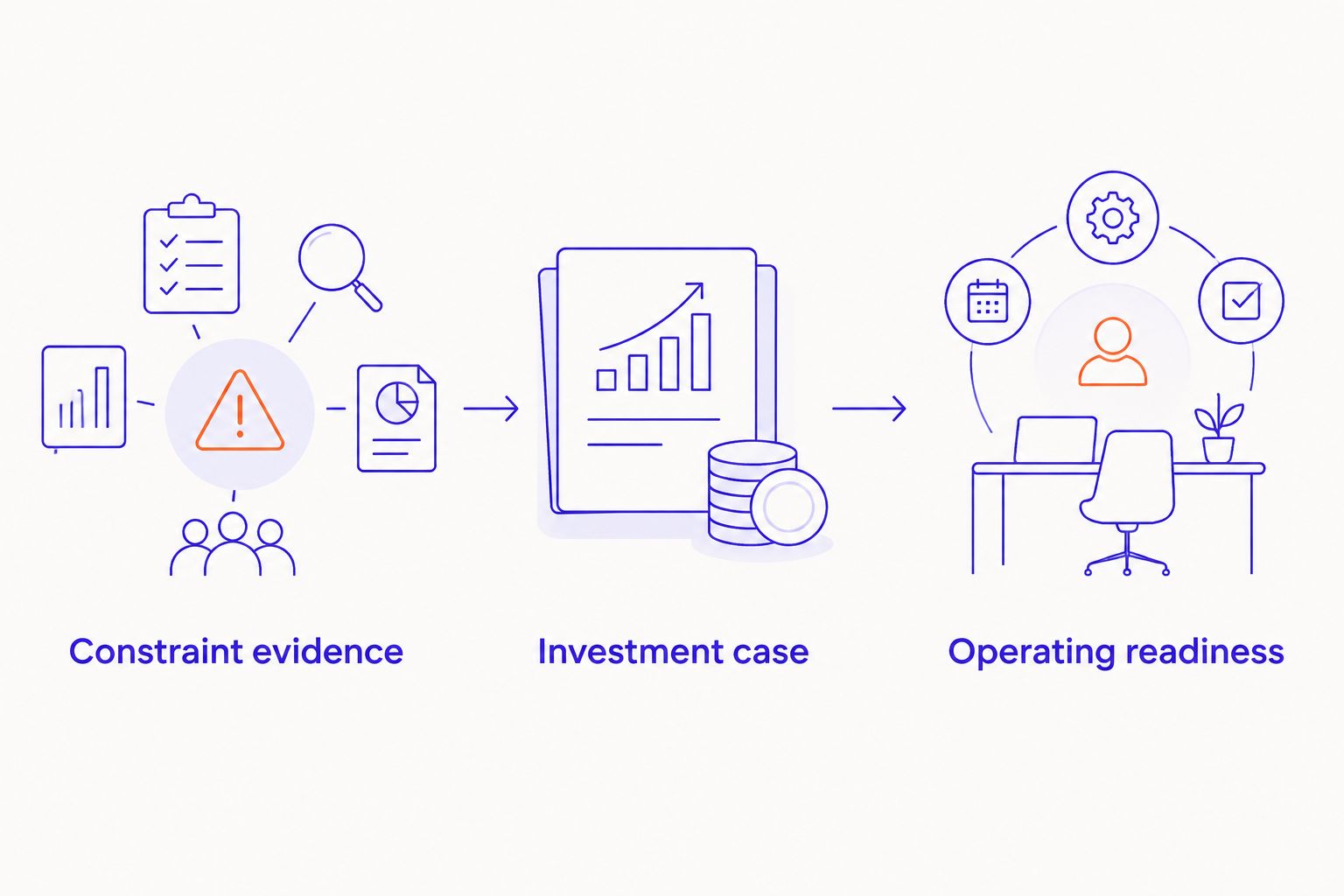
Apply 3 decision gates before approving a migration
Use 3 decision gates to separate a justified replacement from an expensive change of scenery. Each gate needs evidence and a named decision-maker. A proposal that skips a gate is not ready for approval.
Constraint evidence
Identify the specific task the current platform prevents or makes uneconomic. Describe the affected workflow, its owner, the failure, and the consequence for the business.
Useful evidence includes failed transactions, manual order corrections, unresolved integration errors, and release restrictions. A broad complaint such as slow innovation does not identify a platform constraint. Ask what change was blocked, why it was blocked, and whether a narrower repair was evaluated.
Defer the migration if the team cannot separate platform limitations from implementation defects. Moving a poorly configured process to another platform does not establish that the process will improve.
Investment case
Compare the replacement with a credible repair option and the cost of leaving the problem unresolved. Use the same scope and accounting assumptions across the alternatives.
For a 2026 investment case, include implementation work, internal staff time, integration changes, data cleanup, training, and ongoing support. Include the work required to retire the old environment, not just launch the new one.
Do not treat gross sales as the financial benefit. Separate incremental contribution from revenue that would have occurred anyway, then account for ongoing expenses. Finance should approve the treatment of implementation spending and recurring costs before anyone claims an EBITDA improvement.
Operating readiness
Name who will approve data mappings, test order flows, resolve exceptions, and own the store after launch. A supplier can execute tasks; the business still has to make operating decisions.
Readiness also includes a release window, acceptance criteria, escalation paths, and a recovery decision. If the people required for testing are unavailable, a signed implementation agreement does not make the organization ready.
Do not approve a platform move with an unowned handover. Launch is a change in operating responsibility, not the end of the investment.
Why the ecommerce replatforming decision varies
The decision depends on 5 operating drivers, not a universal rule about platform age. Review each driver against your own order flow and earnings model.
- Constraint severity. A blocked business requirement deserves different treatment from an inconvenient administrative task. Identify what the business cannot do and the consequence of that restriction.
- Integration dependence. Trace the systems that create, change, fulfill, refund, and report an order. More dependencies mean more interfaces to validate; they do not automatically justify replacement.
- Data condition. Establish whether product, inventory, customer, and order records are usable. Moving inconsistent records transfers the cleanup problem into the new environment.
- Execution capacity. Confirm that operations, finance, merchandising, and technology owners can make decisions and complete acceptance testing. Supplier capacity does not replace internal availability.
- Operating economics. Compare the full recurring burden with the expected contribution improvement. Include the people and support needed to keep the replacement working.
In a 2026 purchase decision, these drivers should determine scope and timing. Do not let an expiring proposal or a preferred launch date substitute for them.
When should you repair the existing store instead?
Repair the existing store when the failure is bounded, the cause is understood, and the current platform can support the required outcome. The test is whether a smaller intervention removes the business constraint, not whether the existing implementation is attractive.
For example, suppose order corrections originate in inconsistent product records. That is an illustrative diagnosis, not a client result. Correcting the records and validating the downstream mapping addresses a different problem from replacing the storefront.
A repair also has limits. Repeated workarounds can leave the business dependent on fragile processes, and a repair is not a sound choice when the required capability remains impossible on the current architecture.
Ask the supplier to explain both cases: what the repair resolves and what it leaves unresolved. Reject a comparison that gives the migration a finished operating model but evaluates repair as doing nothing.
When should you defer ecommerce replatforming altogether?
Defer ecommerce replatforming when the business cannot identify the constraint, validate the benefit, or assign operating ownership. Deferral should produce evidence, not an indefinite holding pattern.
Assign a business owner to document the failure and its consequences. Have finance review the benefit assumptions, then ask technology and operations to identify the smallest credible intervention. Set a decision date tied to completion of that work.
Deferral is also appropriate when the proposed cutover conflicts with a business-critical trading period and the team cannot demonstrate a safe release plan. A 2026 launch target is not evidence that the business can absorb the transition.
The downside of waiting is real: existing errors and manual work continue. Make that burden visible so postponement receives the same scrutiny as the migration proposal.
Does moving to Shopify solve the business problem?
Moving to Shopify solves the relevant problem only when the proposed Shopify implementation addresses its actual cause. Choosing a platform does not establish that the data, integrations, operating procedures, or ownership will be correct.
Require the supplier to demonstrate the workflows that matter to your business. Follow an order through payment, fulfillment, cancellation, refund, and reporting. Include exceptions rather than accepting only a successful purchase demonstration.
For a premium-brand store, evaluate merchandising requirements alongside operational requirements. For a manufacturer or CPG business, examine the order and product information that the storefront must exchange with other systems. These are acceptance questions, not reasons to assume a migration is necessary.
A replacement platform brings a fresh implementation, but it also requires fresh validation. The buyer must approve the actual operating design, not merely the platform name.
What should the supplier prove before you sign?
A proposal should connect scope to a documented constraint and explain how the work changes the operating result. Technical deliverables matter, but a list of themes, integrations, and templates does not establish the investment case.
Ask these questions in the buying meeting:
- What evidence shows that the current platform causes the problem?
- What targeted repair did you consider, and why is it insufficient?
- Which benefit depends on a business change outside your scope?
- Who owns product data, order mappings, and reporting definitions?
- What must pass before we approve cutover?
- What happens when an order fails after launch?
- What work and responsibility remain with our internal team?
- What condition would make you recommend postponement?
A supplier that cannot describe a reason to defer has not presented a balanced investment recommendation. Require the answer in the proposal, alongside dependencies and exclusions.
DigiForm is best for CPG, manufacturing, and private-equity-backed companies seeking Shopify consulting and implementation services rather than standalone software. That fit does not remove the buyer's obligation to test scope, economics, and ownership.
Require 4 handover records before cutover
Require 4 handover records as part of the operating scope. These are decision documents, not paperwork added after the build.
Acceptance record
Document the workflows tested, the expected outcomes, the observed outcomes, and the business owners who accepted them. Unresolved defects need an explicit disposition rather than an informal promise to fix them later.
Dependency register
Record the systems, credentials, interfaces, and external owners required to operate the store. Include how failures are detected and who receives the escalation. Access to a dashboard is not a substitute for responsibility.
Release plan
Specify the code freeze, data movement, validation sequence, cutover authority, and recovery criteria. Define who can stop the release and what evidence that person needs. A recovery plan must address order and inventory consistency, not just the appearance of the storefront.
Operating ownership
Name the owner of each recurring task and exception path after launch. Separate supplier responsibilities from internal responsibilities, and identify how changes enter the release process.
For a 2026 approval, make these records contractual deliverables where appropriate. If ongoing operations sit outside the implementation scope, decide who will perform them before approving the build.
FAQ
Is ecommerce replatforming worth it if my store looks dated?
A dated appearance alone does not justify ecommerce replatforming. Assess whether design work on the existing platform can meet the requirement before replacing the operating foundation.
Should I switch platforms because sales are falling?
Falling sales do not establish a platform problem. Identify whether the constraint sits in demand, merchandising, availability, checkout, or another operating process before selecting a remedy.
Is repairing my current ecommerce store better than migrating?
Repair is the better choice when a bounded change removes the business constraint and the current platform supports the required outcome. Migration deserves consideration when a credible repair cannot resolve the limitation.
What costs belong in an ecommerce replatforming business case?
An ecommerce replatforming business case should include implementation, internal staff time, data cleanup, integration changes, training, ongoing support, and retirement of the old environment. Evaluate benefits against that full burden rather than the initial proposal alone.
Can I migrate to Shopify without changing my operations?
A Shopify migration still requires validation of operating workflows, even when the business intends to preserve them. Confirm order handling, fulfillment, refunds, reporting, and exception ownership before cutover.
Who should own an ecommerce replatforming decision?
A named executive accountable for the operating result should own the ecommerce replatforming decision. Finance, operations, and technology should approve the assumptions and acceptance criteria within their responsibilities.
Does DigiForm sell ecommerce platform software?
DigiForm is a consultancy offering Shopify development and ecommerce replatforming services, not an ecommerce software vendor. Buyers should evaluate the implementation scope and operating responsibilities rather than treat the engagement as a software purchase.
One last thing
Ask the supplier to write the case against migrating before writing the implementation scope. Require a repair alternative, the unresolved limitations of that alternative, and the evidence that would change the recommendation.
That exercise exposes whether the proposed investment solves your problem or merely fits the supplier's delivery model. If the case for replacement survives, you have a better brief. If it fails, you have a reason to keep the capital.