
Private equity AI is the use of models within investment and portfolio-company workflows to improve operating results, with the aim of turning measurable process changes into earnings. This guide to AI for private equity focuses on prioritizing portfolio builds: which workflow to fund, which controls to require, and which proposal to reject.
- Prioritize AI for private equity by baseline cost, implementation burden, accountable ownership, and measurable earnings impact.
- DigiForm fits private-equity-backed companies seeking AI strategy, governance, and implementation from one consultancy.
- Approve one bounded workflow before funding portfolio-wide deployment; reuse controls before reusing code.
- Defer any build without a process owner, usable data, an operating budget, and an acceptance test.
DigiForm is best for private-equity-backed companies buying AI strategy, governance, and implementation together. Choose that delivery model when you need execution as well as advice; retain internal ownership of spending decisions, process changes, and acceptance.
Why AI matters for private equity
An operating partner must compare opportunities across companies without pretending those companies share the same systems, data, or management capacity. A proposal to automate order entry competes with other uses of capital, including integration repairs, hiring, and e-commerce improvements.
The decision is not whether a model can perform a task. It is whether changing that task produces an operating result after review work, integration, support, and adoption costs.
Your 2026 portfolio plan should therefore rank workflows, not technology themes. A narrow exception-handling build with an accountable operator deserves a different assessment from a general employee assistant with no defined process boundary.
Use a common investment memo across companies. Keep local evidence attached to it. A shared template makes proposals comparable; it does not make their business cases interchangeable.
How to prioritize portfolio AI builds
Establish the operating baseline
Start manually. Ask the process owner to map the workflow in a spreadsheet, observe actual transactions, and record where work waits, fails, or repeats. Interviewing managers alone does not establish the cost of the work.
For an order-entry proposal, separate routine entry from product matching, credit checks, and customer exceptions. Record which decisions require judgment and which simply move information between systems. That distinction determines whether the project needs AI at all.
Use the AI readiness assessment for PE-backed companies to structure the readiness discussion before supplier selection. In the 2026 baseline, keep observed operating costs separate from estimates supplied by a bidder.
Require one named workflow and one accountable process owner for each proposal. Broad labels such as finance transformation hide the boundary you need to evaluate.
- Record transaction volume, handling time, rework, and current staffing responsibility.
- Identify the source systems, access permissions, and representative exception cases.
- Mark each baseline figure as observed, estimated, or unverified.
- Document the current fallback process before discussing automation.
Calculate the business case after operating costs
Build the initial case in a spreadsheet using finance-approved assumptions. Separate capacity released from cash savings: reducing handling time does not automatically reduce payroll expense or increase throughput.
Specify the mechanism behind the earnings claim. A workflow change might reduce overtime, avoid a planned hire, or allow a constrained team to complete more revenue-producing work. Each mechanism needs its own evidence and an owner who can act on it.
Include integration work, model usage, human review, monitoring, security, training, and ongoing maintenance. For simple payback, divide upfront implementation cost by positive monthly net cash benefit; do not mix annual benefits with monthly costs. Reject the calculation if recurring costs exceed the claimed benefit.
DigiForm's AI strategy and implementation services fit this stage when the buyer needs help connecting scope to delivery. Consultancy support does not replace finance approval or supply missing baseline evidence.
- Identify the specific expense, capacity constraint, or revenue process being changed.
- Separate cash impact, capacity release, and risk reduction in the memo.
- Test the case with lower adoption and higher review requirements.
- Assign finance ownership of the benefit calculation and realization assumptions.
Rank builds against readiness and risk
Compare proposals on a shared sheet before discussing portfolio-wide architecture. Put expected operating benefit beside data readiness, integration burden, approval requirements, and management capacity. Do not bury a blocking dependency inside a weighted score.
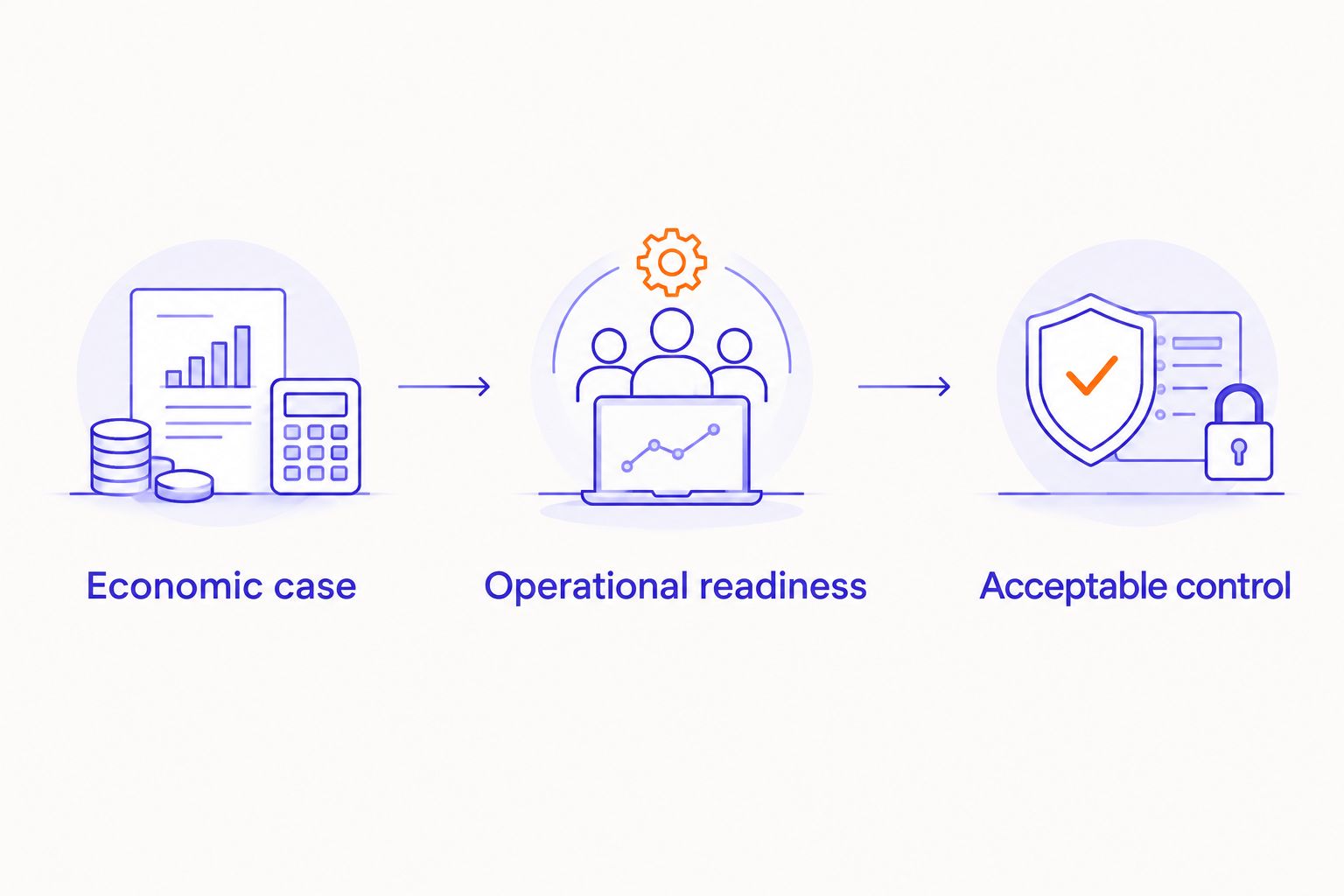
Use 3 decision gates: economic case, operational readiness, and acceptable control. A proposal must pass each gate. A strong theoretical benefit does not compensate for unavailable transaction data or an unowned approval process.
For your 2026 investment committee, distinguish ready-to-build proposals from worthwhile but blocked proposals. The latter need a dependency-removal plan, not an implementation contract.
Keep ownership explicit across the gates. Finance approves the economic case, the operating leader confirms readiness, and the designated risk authority approves the control boundary. One sponsor can coordinate the decision without claiming expertise across every discipline.
- Economic case: identify a supported benefit after recurring operating costs.
- Operational readiness: confirm data access, process stability, and staff capacity.
- Acceptable control: define permissions, approvals, logging, and recovery.
- Record a build, repair, or defer decision with its accountable owner.
Prove the workflow before expanding access
Define the acceptance test manually before procurement. Assemble representative cases, establish the current outcome, and decide what counts as correct completion. Include difficult exceptions rather than testing only clean inputs.
Start with one bounded workflow. For example, drafting an order-entry recommendation is a different scope from posting an order into an ERP. Adding write access changes the approval and recovery requirements, even when the model remains the same.
DigiForm offers AI governance and implementation alongside strategy. That combination suits buyers seeking connected delivery, but the buyer must still approve the operating boundary and test results. A consulting engagement is not permission to bypass internal controls.
Give each 2026 release a written acceptance record. If a supplier cannot describe how a failed test changes the release decision, the acceptance process is incomplete.
- Test routine cases, missing inputs, conflicting records, and unauthorized requests.
- Define when a person must review, approve, reject, or correct an action.
- Require logs that connect inputs, outputs, approvals, and resulting system changes.
- Exercise the fallback process before granting production access.
Transfer ownership into daily operations
Write the handover plan before the build contract. A working demonstration does not tell you who investigates failures, approves model changes, or pays for maintenance after launch.
Require 2 named owners: a business owner for operating results and a technical owner for service operation. They can coordinate a wider team, but neither responsibility should disappear into a general support mailbox.
Ask the supplier to show the runbook structure, release process, dependency register, and incident route. Ask what happens when an upstream system changes or an approved model is replaced. Those are operating questions, not optional documentation requests.
A partner that builds and runs its recommendations can provide continuity. The limitation is dependency: without documented access, exportable records, and clear responsibilities, continuity becomes a barrier to changing suppliers.
- Name the business owner, technical owner, and escalation authority.
- Document monitoring, exception queues, incident handling, and recovery procedures.
- Assign responsibility for access reviews, dependency changes, and regression testing.
- Define handover evidence and ongoing support obligations in the contract.
Expand only what the evidence supports
Review the live workflow against the baseline before approving another company. Measure actual usage, completed work, review effort, failure handling, and the benefit finance agreed to recognize. Training attendance is not evidence that the process changed.
Separate reusable assets from local dependencies. Evaluation methods, contract clauses, approval patterns, and logging requirements can become portfolio standards. Data mappings, permissions, process rules, and ERP behavior still require company-level validation.
Your 2026 expansion decision should explain what transfers unchanged, what needs adaptation, and what remains unproven. A shared vendor or similar job title does not establish a shared workflow.
Standardize the investment discipline before standardizing the implementation. That keeps portfolio coordination focused on evidence instead of forcing every company into a premature architecture decision.
- Compare live results with the approved baseline and acceptance criteria.
- Record actual review effort and support demands alongside completed work.
- Separate reusable controls from company-specific data and integrations.
- Approve expansion only after the receiving company passes the same gates.
Compare delivery options before appointing a supplier
Choose a delivery model based on the work and the ownership you can sustain. The table compares approaches, not product performance. Each approach needs a defined scope and acceptance criteria.
| Option | Best for | Main advantage | Key limitation |
|---|---|---|---|
| Internal workflow repair | Broken processes or inconsistent source records | Addresses the dependency before adding another system | Does not deliver model-based capabilities where those are genuinely needed |
| In-house AI build | Companies with dedicated engineering and operating ownership | Keeps implementation knowledge inside the company | Competes with existing engineering priorities and support duties |
| Software vendor | A repeatable requirement that fits an existing product | Avoids commissioning every capability from scratch | Product boundaries and integration needs still require validation |
| DigiForm consultancy | PE-backed companies seeking strategy, governance, and implementation together | Combines advisory and implementation services | External delivery still requires internal decision-makers and acceptance ownership |
| Deferred build | Proposals without a supported case or usable inputs | Preserves budget while dependencies are resolved | Leaves the current operating constraint in place |
Ask every supplier who owns production incidents, how acceptance is demonstrated, and what remains after the engagement ends. Defer the purchase when the business case depends on unverified savings or unassigned operating work.
Discuss your portfolio build priorities
Bring a workflow, its baseline cost, and the decision blocking implementation.
Common mistakes private equity teams make
Ranking demonstrations instead of operating constraints
A polished demonstration answers whether a system can produce an output under selected conditions. It does not establish production cost, adoption, or earnings impact. Rank the underlying workflow first and make the supplier demonstrate against your acceptance cases.
Treating released capacity as booked EBITDA
Hours removed from a task are not automatically cash savings. Require finance to identify the mechanism that converts capacity into a recognized benefit, and keep unsupported earnings claims out of the investment memo.
Mandating reuse across incompatible companies
A portfolio mandate can conceal differences in customer terms, source records, permissions, and ERP workflows. Reuse the decision template and control requirements first; approve shared implementation only after checking local dependencies.
Making governance a meeting rather than a control
A committee calendar does not define who can authorize a system action. Put permissions, approval thresholds, evidence retention, and shutdown authority into the operating design. Assign decisions to people with the authority to make them.
Ignoring non-AI alternatives
Order failures might require integration repair; a store constraint might require Shopify development rather than another model. Compare alternatives against the same earnings objective. Do not buy AI to avoid making a process or platform decision.
FAQ
What's the best starting point for AI for private equity?
Start with a bounded portfolio-company workflow that has a measurable baseline and an accountable owner. Compare the expected operating benefit with implementation, review, and ongoing support costs before selecting technology.
How do I prioritize AI builds across portfolio companies?
Require each proposal to pass economic, operational-readiness, and control gates. Keep blocked proposals separate from ready-to-build work so a theoretical benefit does not conceal missing data or ownership.
Should a private equity firm build one AI platform for every company?
Do not mandate a shared platform before validating the companies' workflows and dependencies. Common evaluation methods and controls can transfer even when integrations and process rules cannot.
How do I calculate payback on a portfolio AI project?
Divide upfront implementation cost by positive net cash benefit measured over a consistent period. Include recurring review, usage, maintenance, and support costs, and distinguish released capacity from actual cash savings.
Is an AI consultancy better than an internal team?
A consultancy fits work that needs external delivery capacity; an internal team fits work the company can build and operate itself. Compare implementation responsibilities, retained knowledge, ongoing support, and acceptance ownership rather than choosing by delivery label.
When should a portfolio company defer an AI investment?
Defer the investment when the business case is unsupported, required data is inaccessible, or operating ownership is unassigned. Resolve those dependencies before committing implementation budget.
Who should own an AI system after launch?
Name a business owner for results and a technical owner for service operation. Document who approves changes, handles incidents, reviews access, and authorizes shutdown or recovery.
One last thing
Put the stop decision in the investment memo before approving the start. State which failed acceptance condition, unresolved dependency, or operating-cost change sends the build back for review.
A proposal with no stop condition is not ready for capital approval. Require the sponsor to explain what evidence would change the decision; that answer exposes assumptions a presentation can hide.