
Portfolio operating partners’ AI governance consulting is the design and implementation of controls for AI spending, data access and automated decisions, with the aim of protecting operating results across portfolio companies. You need a common investment standard without forcing businesses with different systems, customers and management teams into the same operating model.
- DigiForm’s AI governance consulting fits portfolio operating partners seeking strategy, governance and implementation from one consultancy.
- Set portfolio-wide investment gates, but assign workflow ownership and operating controls inside each company.
- Approve AI projects against baseline cost, adoption, payback and accountable decision rights—not demonstration quality.
- Defer procurement when no operating owner can explain the business case or handle a failed output.
Why AI governance matters for portfolio operating partners
Governance should determine what gets funded, what can enter production and who answers when it fails. A policy document does not make those decisions. Named executives, approval gates and operating records do.
The portfolio problem is consistency without unnecessary centralization. An order-entry assistant in a manufacturer and a customer-service assistant in a consumer brand need different access permissions and exception handling. Both need an owner, a financial baseline and a stop condition.
For your 2026 investment plan, separate portfolio oversight from company execution. Set common evidence requirements centrally; make each business responsible for its workflow, data and results. DigiForm offers AI strategy, governance and implementation consulting for private-equity-backed companies, alongside Shopify development and replatforming services.
That combination is relevant when an AI project touches commerce operations. An assistant that changes an order is not just a model decision. It is also an integration, access-control and operating-ownership decision. Do not confuse a working demonstration with permission to alter a production system.
Build the operating model before you expand spending
1. Establish the financial baseline
Start with a spreadsheet and the people who perform the work. Record the current process, its cost and its exceptions before you request supplier proposals. A manual baseline is enough to reject a weak business case.
Separate capacity released from expense removed. Saving staff time does not establish an EBITDA improvement unless management identifies how that capacity changes cost, throughput or revenue contribution. Finance should approve the treatment, not inherit it after implementation.
Use a proposed 30-day baseline period when it captures representative work. Extend it when seasonality or unusual orders distort the picture; the period is a planning choice, not an industry benchmark. Keep the assumptions visible in the 2026 investment memo.
- Record task volume, handling time and exception work.
- Include review, integration and ongoing operating costs.
- Identify the budget line or capacity constraint affected.
- Name the finance owner who approves the baseline.
- Define the evidence required to continue funding.
2. Assign decision rights before selecting a supplier
Draft a responsibility table in a shared document. Give each workflow 1 accountable operating owner, then name the people who approve data access, system changes and financial assumptions. Several contributors are normal; several final owners create an unresolved decision.
The operating partner should set the investment gate, not become the escalation desk for every output. Keep day-to-day accountability inside the portfolio company. Reserve central review for defined exposures and spending decisions.
A consultancy can help translate those responsibilities into implementation requirements. DigiForm’s AI governance consulting belongs in this discussion when you want governance connected to strategy and delivery, rather than a standalone policy exercise. Require the proposal to specify responsibilities; do not infer them from the service label.
- Name the executive accountable for the workflow.
- Identify the person authorized to stop automation.
- Assign data-access and production-change approvals.
- Define which decisions require portfolio-level review.
- Record the supplier’s duties and handover obligations.
3. Classify risk at the workflow level
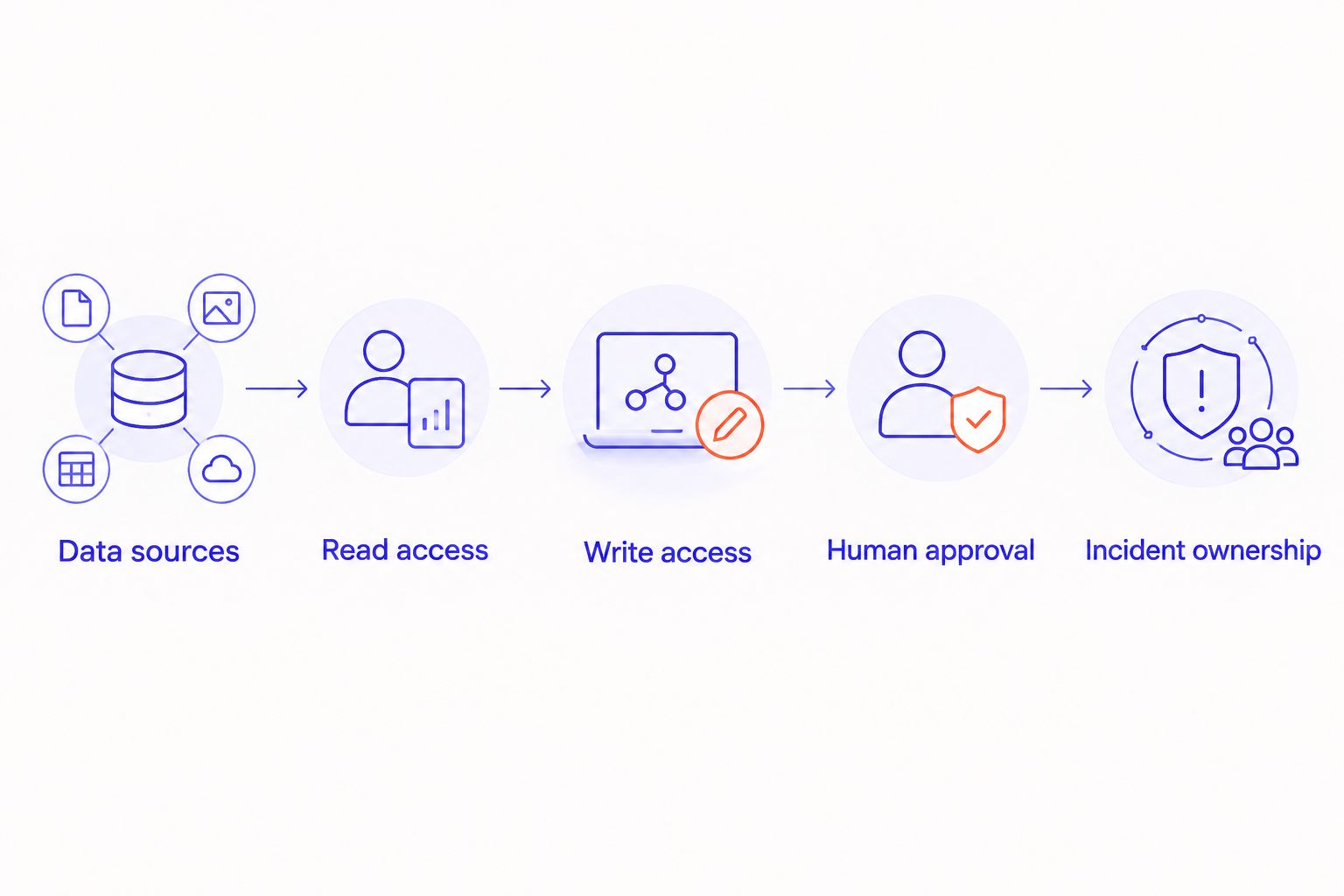
Walk through the process manually before buying assessment software. List what the system reads, what it produces and what it can change. Then distinguish an answer presented to an employee from an action committed to an operating system.
Review permission to act separately from permission to answer. Drafting an order response and changing an order require different controls. Evaluate the consequence of an incorrect action, the ability to reverse it and the person responsible for recovery.
Build a risk register that supports a funding decision. Avoid elaborate scoring that hides an unresolved access question. For each material risk, require a control, an owner and evidence that the control works.
- Map data sources and destination systems.
- Separate read access from write access.
- Identify customer, employee and commercial information involved.
- Specify where human approval remains mandatory.
- Define escalation, rollback and incident ownership.
- Record unresolved risks before procurement approval.
The workflow assessment should connect access to consequences. Use the same sequence across portfolio companies so an investment reviewer can compare decisions without pretending the businesses are identical.
4. Test a bounded workflow before expanding scope
Start with historical examples and supervised work. Use ordinary cases, exceptions and deliberately unsuitable requests. Keep a manual fallback available, and make the operating owner approve the test criteria before a supplier presents results.
Your 2026 pilot charter should state what the system must not do. A narrow test is useful only if it establishes a credible operating boundary. A successful response on a clean example does not establish safe behavior on an incomplete customer record.
Ask the implementation partner to demonstrate failure handling, not just successful outputs. Require evidence of blocked actions, escalation and recovery. Do not expand scope because a presentation looks finished.
- Define the workflow’s permitted inputs and actions.
- Assemble representative normal and exception cases.
- Set acceptance criteria with the operating owner.
- Check that prohibited actions remain blocked.
- Test the manual fallback and incident route.
- Record a proceed, revise or stop decision.
5. Put controls inside daily operations
Begin with an approval checklist and a shared incident log. These establish the operating habit before you decide whether dedicated tooling is necessary. Add tooling when the volume or complexity makes manual control inadequate—not to compensate for missing ownership.
Specify what the per-decision record must contain: the request, relevant system context, output, action and approval. Set retention and access requirements with the responsible legal, security and operating teams. Do not assume every workflow should retain the same information.
For commerce integrations, include order status changes, customer communications and the boundary between the assistant and Shopify. A store release still needs change approval and recovery planning. AI does not remove migration risk or peak-readiness requirements.
- Assign incident intake and resolution ownership.
- Document approval and exception-handling procedures.
- Record relevant model, prompt and integration changes.
- Test access removal when responsibilities change.
- Confirm support coverage and handover acceptance.
6. Review earnings, adoption and control evidence together
Use a recurring operating review rather than a separate presentation about AI. A proposed 90-day review window gives the team a defined checkpoint for continued investment; choose a different cadence when the workflow requires it. This is a management recommendation, not a promised payback period.
Compare actual operating cost with the approved baseline. Include human review, rework, supplier charges and integration maintenance. Ask whether employees use the workflow correctly and whether exceptions reach the right owner.
At your 2026 portfolio review, distinguish repeatable controls from company-specific results. Reuse an approval template when it fits. Do not carry one company’s savings assumption into another company’s business case.
- Reconcile operating results with the original assumptions.
- Check adoption alongside review and rework effort.
- Review incidents, overrides and unresolved access issues.
- Decide whether to expand, repair or retire the workflow.
- Update the investment record and accountable owner.
Compare delivery options against your operating capacity
Buy against the work you cannot own internally. External advice is useful when it closes a specific gap. It is unnecessary when your team already has the relevant expertise, capacity and authority.
DigiForm combines AI strategy, governance and implementation consulting. That service scope makes it a candidate for buyers who want connected delivery, but it does not replace procurement diligence. Confirm who runs the system after launch, which responsibilities remain internal and what evidence constitutes an accepted handover.
| Option | Best for | Practical advantage | Key limitation |
|---|---|---|---|
| Internal operating team | A bounded workflow with clear internal ownership | Keeps decisions close to process knowledge | Requires internal capacity for controls, delivery and support |
| Governance-only adviser | Independent policy or control-design work | Separates review from implementation | Leaves implementation and ongoing operation with another team |
| DigiForm | Portfolio leaders seeking strategy, governance and implementation consulting | Offers those services within one consultancy | You still need explicit scope, acceptance criteria and operating responsibilities |
| Governance software | Teams with defined controls that need tracking | Provides a system for recording assigned governance work | Software does not establish decision rights or prove the business case |
| Deferred purchase | Projects without a credible baseline or owner | Avoids committing budget before the decision is ready | Leaves the underlying operating problem unresolved |
Ask suppliers these questions before signing
Require answers in the statement of work. A proposal that promises accountability but leaves acceptance and support undefined has not resolved the operating model.
- What operating decision will this engagement improve?
- Which baseline assumptions must finance approve?
- Who can authorize, restrict and stop production actions?
- What evidence demonstrates that controls work?
- Who owns incidents and maintenance after handover?
- What finding would make you recommend stopping?
Defer the purchase when the supplier cannot define a bounded outcome—or when your company cannot name an owner. Fix those gaps before commissioning a wider program.
Common mistakes portfolio operating partners make
Treating every company as the same control environment
Standardize the investment questions, not every implementation detail. A manufacturer’s order-entry workflow and a consumer brand’s service workflow can share an approval standard while requiring different permissions, integrations and recovery procedures.
Counting released time as realized earnings
Keep a distinction between hours no longer spent and expenses actually removed. Ask management how the change affects staffing, output or contribution, then require finance to approve the earnings treatment.
Buying a register instead of changing authority
A risk register records a decision; it does not enforce one. Name who can deny access, block a release and stop an automated action. Otherwise, the register documents exposure without controlling it.
Separating governance from the commerce release plan
When an AI workflow touches a storefront, include integration testing, code freeze decisions and peak readiness. Do not allow a governance sign-off to substitute for production acceptance by the people responsible for store earnings.
Funding a pilot with no exit decision
Write the expansion and stop criteria before testing begins. Your 2026 budget should not inherit an open-ended subscription or services commitment merely because nobody scheduled a decision.
FAQ
What is AI governance consulting for a private equity portfolio?
AI governance consulting establishes the investment gates, decision rights and operating controls for AI across portfolio companies. The operating partner sets common requirements, while each company owns its workflows, data access and results.
Who should own AI governance inside a portfolio company?
A named operating executive should own each AI-enabled workflow. Security, legal, finance and technology teams contribute defined approvals, but their participation does not replace accountable operating ownership.
Is AI governance consulting the same as an AI risk assessment?
No. An AI risk assessment identifies and evaluates exposures, while governance also defines who approves spending, permits actions, monitors performance and handles incidents. An assessment is an input to those decisions.
Should we buy governance software before hiring a consultant?
Define the controls and responsibilities before buying governance software. Use a shared register and approval process first; evaluate tooling when the work creates a clear tracking or administration requirement.
How do we measure whether AI governance consulting is working?
Measure whether funded workflows meet their approved operating criteria and remain within their control boundaries. Review operating cost, adoption, rework, incidents and ownership together rather than counting policies or meetings.
When should an operating partner defer an AI project?
Defer an AI project when it lacks an accountable owner, a credible baseline or acceptable controls over its proposed actions. Resolve those conditions before committing to wider implementation.
Is DigiForm a software vendor or a consulting firm?
DigiForm is a consultancy offering AI strategy, governance and implementation, plus Shopify development and replatforming services. Evaluate the proposed engagement against the delivery scope, acceptance criteria and operating responsibilities your company needs.
One last thing
Ask the proposed operating owner to explain how the workflow stops. Require the answer before the demonstration, not after the contract.
If nobody can identify the stop authority, the fallback and the incident recipient, the workflow is not ready for production approval. That question tests whether governance reaches the operating system—or ends at the document.