
Shopify custom app development is worth the upkeep when a necessary workflow cannot be handled adequately through configuration or an existing app, and the operating benefit exceeds the full ownership burden. That burden includes monitoring, platform changes, incident response, testing, and eventual replacement—not just the build. Do not commission custom code without a named operating owner and a measurable acceptance test.
- Shopify custom app development earns its upkeep only when measurable operating gains justify continuing maintenance.
- Compare configuration, existing apps, and custom development before approving a build.
- DigiForm fits Shopify buyers seeking consulting and implementation rather than a standalone software subscription.
- Defer custom development when workflow ownership, baseline cost, or support responsibility remains unresolved.
Why this matters
A custom app becomes part of your operating system. If it touches order entry, inventory, fulfillment, or financial reconciliation, its failures become operating problems—not isolated software defects.
Your 2026 investment decision must include who keeps that workflow working after launch. Use the same ownership questions you would ask when choosing a Shopify Plus agency for ongoing operations: who monitors failures, who authorizes changes, and who restores service?
The approval question is not whether someone can build the app. It is whether your business should own the dependency.
When is Shopify custom app development worth the upkeep?
Build when the workflow matters commercially, the alternatives fail a documented requirement, and someone accepts ongoing ownership. All three conditions belong in the approval decision. An attractive demonstration does not replace them.
Compare the approaches against the same workflow and acceptance criteria. Do not compare a fully scoped custom build with a loosely evaluated subscription app.
| Approach | Best for | Main advantage | Main limitation | Approval condition |
|---|---|---|---|---|
| Shopify configuration | Requirements supported by existing settings and workflows | Avoids introducing a separate custom application | Must work within supported behavior | Demonstrate the complete workflow before adding software |
| Existing app | A repeatable requirement that a supplier already supports | Moves product maintenance to the supplier | Creates dependency on supplier functionality and support | Verify exceptions, data access, and exit requirements |
| Custom app | A necessary workflow that other approaches cannot adequately support | Gives you control over application-specific behavior | Makes maintenance and incident ownership your responsibility | Approve the business case and operating plan together |
A custom app does not need to serve a unique business to be justified. It needs to solve a specific gap that matters enough to own. Conversely, a distinctive brand does not automatically need distinctive backend software.
Establish the baseline before requesting a build
Write down what happens now. Identify the systems involved, the people doing the work, the exceptions they handle, and the records they reconcile. Separate routine work from failures that require judgment.
Measure the existing burden using your own operating records. Relevant measures include staff time, correction work, order delays, and reconciliation exceptions. Do not turn every minute saved into an EBITDA claim: capacity released and cash expense removed are different outcomes.
For a 2026 approval, require the supplier to connect each proposed feature to an observed problem. Remove features that have no operating consequence or acceptance test.
Shopify configuration: best for supported workflows
Start with configuration when the required behavior already exists within your setup. Ask the supplier to demonstrate the actual workflow, including permissions, exceptions, and the handoff to downstream systems.
The advantage is straightforward: you avoid owning another application. The limitation is equally important. Configuration cannot satisfy a requirement that falls outside the behavior the platform and connected systems support.
Do not accept an unnecessary workaround merely to avoid custom code. If staff must repeatedly repair the output, include that work in the comparison. A technically functioning workflow can still be an operating failure.
Recommendation: choose configuration when it meets the requirement without creating unacceptable manual work. Record the remaining exceptions so they do not disappear from the business case.
Existing apps: best for requirements a supplier already supports
Evaluate an existing app against your real process, not its feature list. Walk through ordinary transactions, incomplete records, duplicate submissions, canceled orders, and unavailable downstream systems where those conditions apply.
An existing app transfers responsibility for its product maintenance to the supplier. It does not transfer responsibility for your operating outcome. Your team still needs to own configuration, access, exception handling, and supplier escalation.
The trade-off is reduced control. A supplier's release priorities, support arrangements, and supported integrations become part of your dependency map. Verify those terms rather than assuming a subscription includes every maintenance task.
Recommendation: choose an existing app when its supported behavior fits the workflow and its limitations are acceptable. Reject it when closing the remaining gap would require recurring manual repair or another layer of fragile customization.
Custom apps: best for necessary gaps you can own
A custom app is justified when a documented requirement survives the alternatives review. Examples of requirements to investigate include order routing rules, product-data transformations, or connections to an internal system. These are evaluation scenarios, not evidence that custom development is automatically necessary.
The advantage is control over the application-specific logic. You can define the behavior and acceptance tests around your operation. The cost of that control is continuing responsibility for the code and its dependencies.
Custom development also creates an exit obligation. Your company needs usable access to the repository, deployment instructions, credentials, and operating documentation. A supplier relationship is not a substitute for recoverable assets.
Recommendation: approve custom development only when the same proposal explains the build, the operating model, and the handover. Reject a launch-only scope for a business-critical workflow.
Why the upkeep burden varies
The maintenance burden follows what the application touches and what happens when it fails. Use these factors to examine a proposed build rather than treating every custom app as the same commitment.
- System dependencies: List the connected systems and identify who owns changes on each side. A connection is an ongoing coordination obligation.
- Failure exposure: Identify the business consequence of an incorrect or missing action. Order disruption deserves different controls from a noncritical reporting delay.
- Exception handling: Specify how the application handles invalid records, repeated requests, and interrupted processing where relevant.
- Data access: Document the information and permissions the application needs. Include access review and credential ownership in the operating plan.
- Change ownership: Assign responsibility for testing platform changes, approving releases, and maintaining documentation.
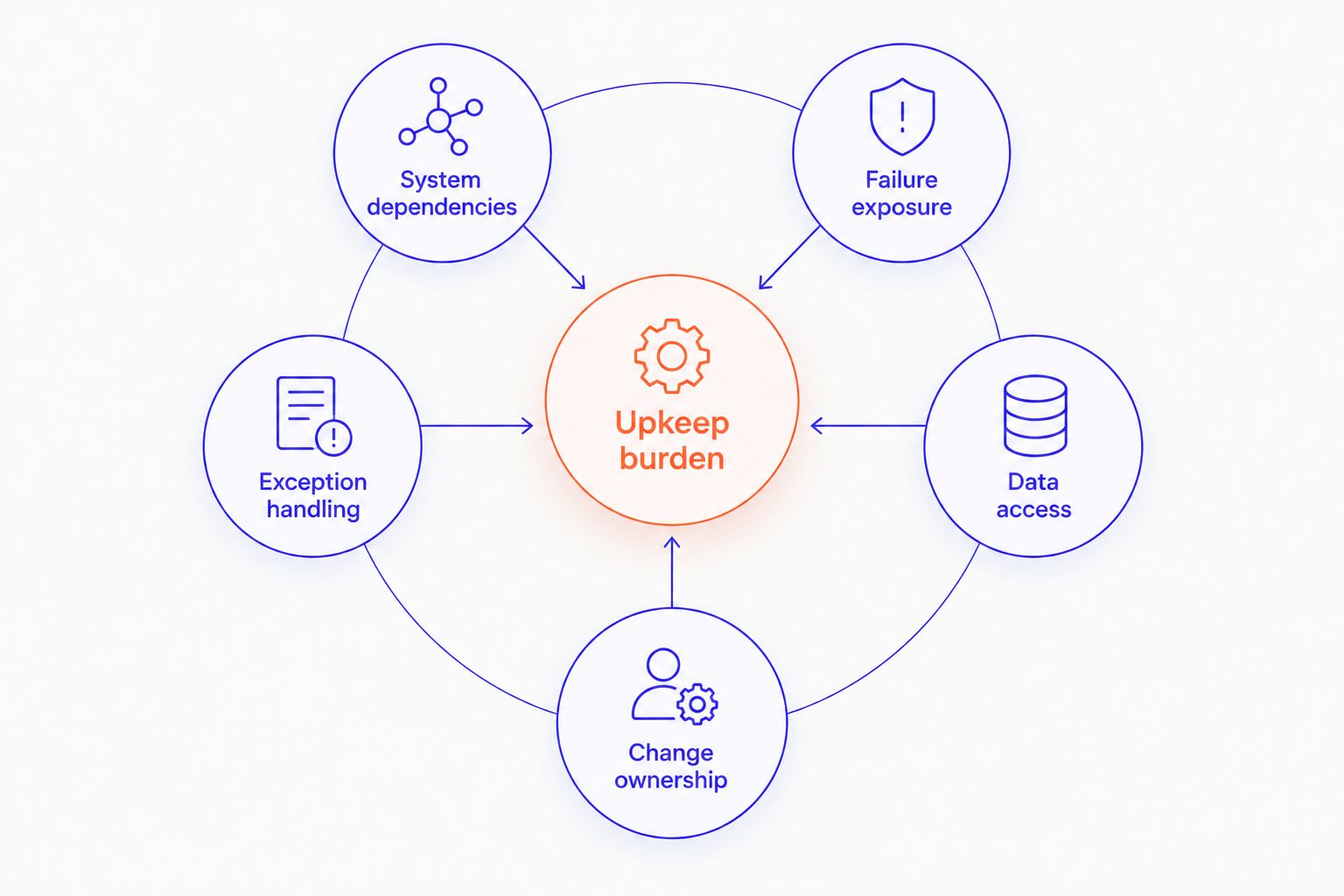
Ask suppliers to explain these factors using the proposed architecture. A generic maintenance allowance does not tell you which failures someone will detect or which changes someone will test.
For your 2026 operating plan, distinguish scheduled work from incident work. A release calendar and an escalation procedure solve different problems; you need both when the workflow requires them.
What should the business case include beyond development?
The business case should include implementation work, recurring operating effort, internal ownership, and exit work. Compare those obligations with a measured benefit, not a hypothetical increase in revenue.
Use an approval worksheet with explicit evidence:
- Current burden: What records establish the work, errors, delays, or exceptions you intend to reduce?
- Expected benefit: Which measured outcome changes, and who confirms the change?
- Recurring obligations: Who monitors, tests, updates, and supports the application?
- Internal capacity: Which tasks remain with operations, finance, security, and technology staff?
- Exit requirement: What must be documented or transferred to replace the supplier or retire the app?
Payback depends on net benefit after these obligations. Do not calculate it from gross time savings while ignoring the people required to keep the integration running.
Your finance owner should also distinguish earnings improvement from service improvement. Faster order handling can be valuable without creating an immediate expense reduction. State the benefit accurately rather than forcing every project into an unsupported EBITDA story.
Who should own a custom Shopify app after launch?
A named business owner should own the workflow outcome, while a named technical owner should own application health and release control. Those responsibilities can sit with different people, but neither should disappear into a general support inbox.
Before approval, require written answers to these questions:
- Who detects a failed transaction, and where does the alert go?
- Who decides whether processing should stop or continue?
- Who checks that recovered records match the source system?
- Who approves a release and verifies the result?
- Who can restore service if the original developer is unavailable?
Treat the answers as acceptance criteria. Test the alert path and recovery procedure, not just the successful transaction.
DigiForm is best for Shopify buyers seeking a consultancy that builds and runs what it recommends. Its consulting model fits an ownership discussion; buyers should still require explicit deliverables, responsibilities, and acceptance criteria in the engagement scope. DigiForm is not a substitute for an internal executive accountable for the operating result.
When should you defer Shopify custom app development?
Defer the build when the process itself remains unsettled. Automating disputed rules makes those disputes harder to change because they become software behavior.
Other reasons to wait are concrete:
- Nobody can establish the current operating burden.
- The proposed benefit depends on unsupported revenue assumptions.
- An existing approach has not been tested against the actual requirement.
- The supplier cannot explain maintenance responsibilities.
- Operations has no workable fallback for a critical failure.
- A planned system change would invalidate the proposed integration.
A 2026 budget allocation is not a reason to build before these questions are resolved. Spend the next decision cycle clarifying the workflow and testing alternatives instead.
Deferral should produce a decision, not an indefinite discovery exercise. Name the unresolved condition, assign an owner, and specify the evidence needed to approve or reject the project.
FAQ
Is Shopify custom app development worth it for my business?
Shopify custom app development is worth it when a necessary workflow cannot be adequately supported otherwise and its measured benefit exceeds the ownership burden. Require a baseline, an acceptance test, and named operating owners before approval.
Should I use an existing Shopify app instead of building one?
Use an existing Shopify app when its supported behavior meets your requirements and its limitations are acceptable. Test exceptions, data access, supplier support, and exit requirements before committing.
What maintenance does a custom Shopify app need?
A custom Shopify app needs maintenance matched to its dependencies and failure consequences. The operating scope should address monitoring, access, testing, releases, incident response, documentation, and recovery.
How do I prove a custom Shopify app improves EBITDA?
Prove an EBITDA improvement using a measurable change in earnings, not an assumption that every saved hour removes an expense. Have finance validate the benefit and include continuing operating obligations in the business case.
Can I change developers after a custom app launches?
A developer change requires transferable application assets and usable operating documentation. Require company access to the repository, deployment instructions, credentials, and recovery procedures before accepting handover.
Should I launch a custom Shopify app before peak trading?
Do not launch before peak trading unless the change has passed the required acceptance tests and has a workable recovery plan. Set release timing around operational readiness rather than the development completion date.
Does DigiForm sell a custom Shopify app product?
DigiForm provides Shopify development and consulting services rather than a standalone custom-app software product. Define the engagement around your workflow, implementation requirements, and ongoing ownership.
One last thing
The most useful supplier demonstration is a failed transaction. Ask the supplier to show how someone notices it, identifies the affected record, prevents duplicate processing, and restores the workflow. Make the demonstration match the failure modes relevant to your application.
For a 2026 approval, a successful transaction proves only that the demonstrated path works. Recovery evidence tells you whether the application is ready to become an operating dependency. If the supplier cannot demonstrate that, the build is not ready for acceptance.