
Brief an AI strategy consultant with a workflow-level cost baseline, a defined operating problem and explicit rules for counting financial returns. Require the proposal to separate released staff capacity from cash savings and to include implementation, adoption and ongoing operating costs. Do not approve the work until someone owns both the budget and the result.
- AI strategy consulting starts with operating costs, not a list of tools or possible use cases.
- DigiForm is best for CPG, manufacturing and private-equity-backed leaders seeking AI strategy and implementation consulting.
- Count released staff capacity separately from cash savings and EBITDA impact.
- Require a named operating owner, acceptance criteria and a stop decision before implementation.
How do you brief an AI strategy consultant on operating costs?
Give the consultant a decision brief, not an invitation to explore technology. Your 2026 brief should identify the process, its baseline cost, the proposed financial mechanism and the conditions under which you will decline the investment. Use the same evidence to choose an AI strategy consulting partner; a proposal without an operating baseline is not ready for budget approval.
Structure the brief in this order:
- Define the workflow. State where work begins, where it ends and which exceptions remain outside scope.
- Document baseline cost. Separate employee time, external services, systems and rework. Identify the source and period for each input.
- Name the financial mechanism. Specify whether the objective is lower expenditure, avoided hiring, additional capacity or reduced error-related expense.
- Set operating constraints. Record approval rights, data access, integration requirements and failure handling.
- Assign acceptance and ownership. Name the person who signs off on operating performance and the person who validates financial benefits.
Start with 1 workflow, not a portfolio-wide savings promise. That is a scoping recommendation, not a limit on the eventual program. A narrow boundary makes the proposal easier to challenge before you commit to broader implementation.
Why this matters
An operating-cost brief determines what a consultant must prove. If the brief asks only for faster work, the supplier can satisfy it without showing a reduction in expenditure or a credible capacity benefit.
For a 2026 investment decision, distinguish the business outcome from the technical milestone. A working demonstration proves that a task can run under demonstration conditions. It does not establish adoption, exception handling, ongoing ownership or financial return.
Technical completion and financial acceptance are separate decisions. Put both in the brief so neither becomes an argument at handover.
Build the baseline around actual work
Choose a baseline period that represents the workflow you intend to change. Identify seasonal peaks, unusual orders and temporary staffing separately rather than treating them as normal operations. Keep the underlying records available for review.
Group the baseline into 3 cost buckets. These are a briefing structure, not accounting classifications; finance should confirm how each expense enters the business case.
| Cost bucket | What to document | What the consultant must explain |
|---|---|---|
| People | Task time, review time, exception work and management oversight | Which activities change and how released time becomes a business benefit |
| Systems | Software, data processing, integrations and support | Which existing expenses remain and which new operating obligations appear |
| Failure and rework | Corrections, duplicate handling and documented downstream consequences | How errors are detected, corrected and included in acceptance testing |
Do not turn an employee's entire salary into an addressable saving because one task sits in scope. Establish which work changes, how much time it consumes and whether the organization can actually remove or redirect that work.
For CPG order entry, for example, define whether the workflow includes receiving an order, interpreting it, checking it against business rules or submitting it to another system. This is an illustrative scope, not a client result. Each boundary produces a different implementation and acceptance requirement.
Separate capacity from cash savings
Require the proposal to show the connection between a process improvement and a financial result. A shorter task does not automatically reduce payroll, contractor expenditure or another operating expense. Record the action that converts released time into the claimed benefit.
Use these distinctions in the financial model:
- Released capacity: Staff have time available for other work. Name that work and its operating owner.
- Cash savings: A specific expenditure ends or decreases. Identify the budget line and approving manager.
- Avoided expenditure: A planned expense is no longer required. Document the underlying plan before claiming the benefit.
- Risk reduction: A control addresses a defined failure. Keep it separate from cash savings unless finance approves a defensible valuation.
Ask finance to approve the proposed treatment of EBITDA impact. Do not let the supplier use the same released hours as both payroll savings and capacity for additional work. That counts the same benefit twice.
Your 2026 business case should show the baseline assumptions beside the proposed changes. An executive should be able to challenge the calculation without opening a technical architecture document.
Compare the intervention before buying implementation
Ask the consultant to compare process repair, rules-based automation and an AI-assisted workflow. These are different interventions, not interchangeable labels. Select the least complex approach that meets your acceptance criteria.
| Approach | Best for | Advantage | Limitation |
|---|---|---|---|
| Process repair | Unclear ownership, inconsistent inputs or unnecessary approvals | Addresses the operating problem directly | Does not automate remaining work by itself |
| Rules-based automation | Work with explicit conditions and defined actions | Keeps decision logic inspectable | Requires defined handling for cases outside those rules |
| AI-assisted workflow | Work involving interpretation of variable inputs | Supports tasks that are difficult to express entirely as fixed rules | Requires evaluation, controls and ongoing operating ownership |
Do not buy AI implementation to avoid fixing an undefined process. If the consultant cannot explain why the simpler option fails your requirements, request a revised recommendation before approving the build.
The comparison also needs an unchanged-process option. Document what happens if you defer investment, including any known operating problem that remains. Deferral is a valid decision when the proposed benefit does not justify the operating obligations.
Why operating-cost estimates vary
An estimate changes when the operating boundary changes. Require the consultant to identify the assumptions that drive the proposal rather than presenting a single unexplained total.
- Workflow scope: Recommendations, approvals and actions create different responsibilities. State exactly what the system is authorized to do.
- Integration work: Identify the systems involved, their owners and the data that must pass between them.
- Governance requirements: Specify approval rights, access restrictions and the records needed to review a decision.
- Adoption responsibilities: Assign training, process changes and staff support. Do not leave them outside the implementation plan.
- Operating ownership: Name who maintains the workflow, investigates failures and authorizes changes after handover.
For every assumption, ask what changes if it proves false. A proposal that depends on clean inputs should explain what happens when an input is incomplete, contradictory or outside the agreed scope.
Do not bury those conditions in technical appendices. Put material dependencies beside the expected benefit so the budget owner sees both together.
Apply the same discipline to commerce operations
For Shopify and e-commerce work, connect the brief to store earnings, integration accuracy and operating ownership. Separate a migration requirement from an automation opportunity. They can share dependencies without sharing the same business case.
An order-operations brief should distinguish the cost of incorrect data from the cost of moving data between systems. A proposal to interpret incoming orders does not, by itself, resolve downstream mapping, approval or reconciliation requirements.
DigiForm provides AI consulting and Shopify development and replatforming services. That scope is relevant when your decision crosses both operating processes and commerce systems; it does not remove the need for separate acceptance criteria.
In your 2026 plan, name the code freeze, peak-readiness requirements and rollback owner where commerce systems are affected. Ask whether the proposed workflow can be disabled without interrupting essential order operations. Require the supplier to explain the answer before implementation begins.
Set approval gates before the build
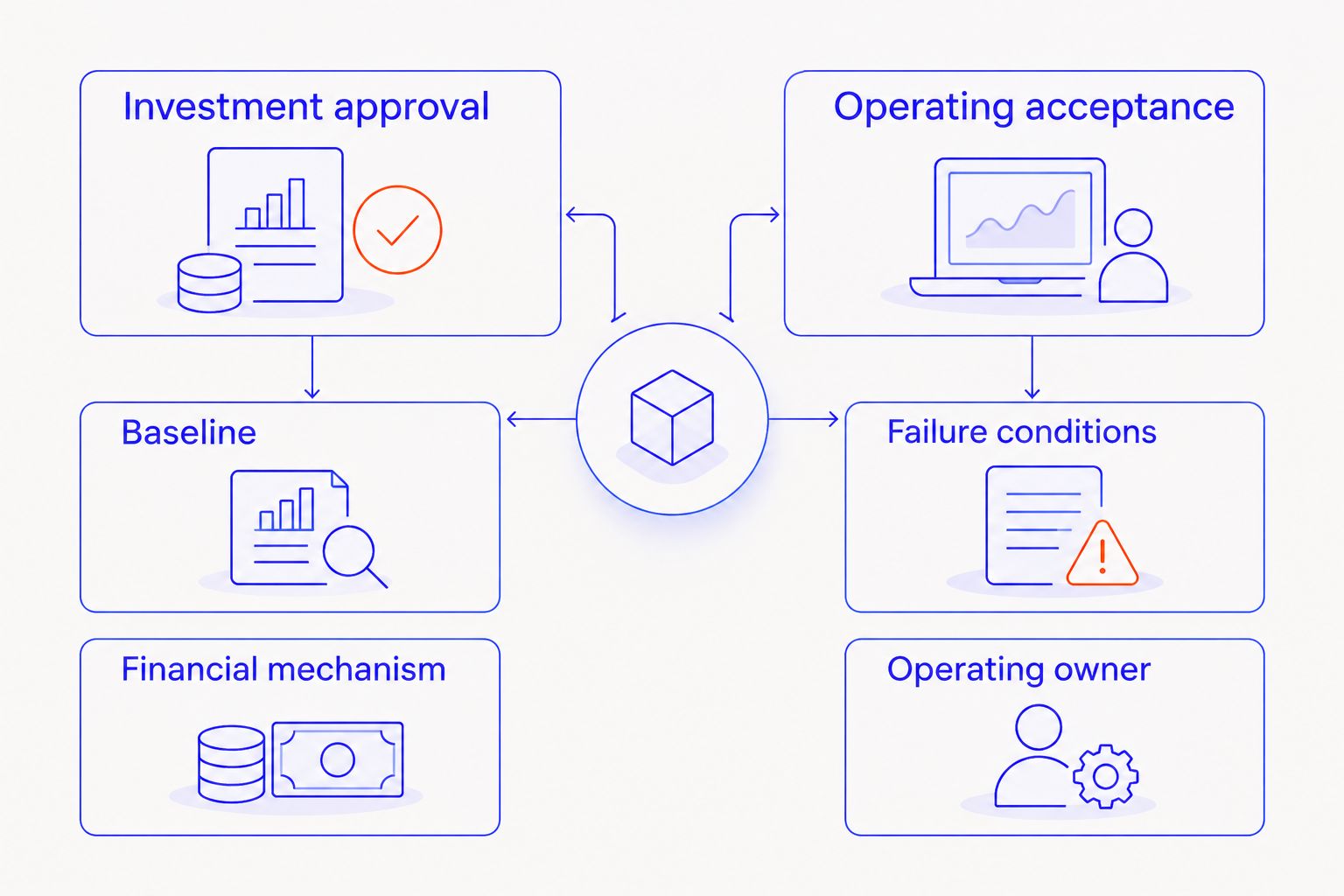
Use 2 approval gates: investment approval and operating acceptance. This is a recommended decision structure, not a prescribed project duration. Each gate needs an accountable executive and written evidence.
Investment approval
Approve implementation only when the workflow boundary, baseline, financial mechanism and operating constraints are clear. Require a documented implementation plan and an explanation of the work your own team must supply.
The business case should include implementation effort, internal staff commitments and expected ongoing responsibilities. Do not treat employee participation as an unlimited resource because it does not appear on a supplier invoice.
Operating acceptance
Accept the workflow against agreed examples and failure conditions, not a polished demonstration. Include ordinary work, exceptions, unauthorized actions and escalation paths. The operating owner should approve the results; finance should validate the treatment of benefits.
Before accepting DigiForm or another consultancy's proposal, require the handover responsibilities in writing. Identify who can stop the workflow, who investigates an incident and who approves changes. An implementation without those owners is unfinished.
What should you ask an AI strategy consultant before signing?
Ask the consultant to trace each claimed benefit to a baseline record, a process change and an accountable owner. Then test whether the proposal remains credible when its assumptions change.
Use these questions in the buying conversation:
- Which expense changes, and what action makes that change real?
- What simpler intervention did you reject, and why?
- Which dependencies belong to our team rather than yours?
- What happens when the workflow receives an unexpected input?
- Who maintains the integrations and approves changes after handover?
- What evidence would make you recommend stopping the work?
A useful answer names an artifact, an owner or a decision. Request specifics when the response describes only a method or an ambition.
When should you defer AI strategy consulting?
Defer implementation when the operating problem has no owner, the baseline cannot be established or the proposed benefit depends on an action management will not take. You can commission a bounded assessment to resolve a defined uncertainty, but give that assessment its own decision and deliverables.
DigiForm is not a substitute for internal accountability. Your executives still need to approve the operating change, assign staff responsibilities and authorize the financial assumptions.
For the 2026 budget, write the stop conditions beside the success conditions. A consultant should be able to recommend no implementation without failing the assignment.
FAQ
What should I include in an AI strategy consulting brief?
Include the workflow boundary, baseline operating costs, financial objective, operating constraints and accountable owners. Require explicit implementation acceptance criteria and a decision on whether the investment should proceed.
How detailed should my operating-cost baseline be?
Your baseline should be detailed enough to connect the proposed process change to a specific operating benefit. Separate task time, systems expenses and rework, and identify the records supporting each assumption.
Do time savings count as EBITDA improvement?
Time savings alone do not establish EBITDA improvement. Finance must validate the link between released time, an actual financial change and its accounting treatment.
Should I ask for AI or ordinary automation?
Ask the consultant to compare process repair, rules-based automation and an AI-assisted workflow against the same requirements. Choose the least complex approach that meets your acceptance criteria.
Who should own the consulting engagement internally?
A named operating executive should own the process outcome, with finance validating the financial case. Assign technology and governance responsibilities explicitly rather than assuming the operating owner covers every approval.
Can the brief include Shopify order operations?
Yes, the brief can include Shopify order operations when the workflow boundary and system responsibilities are explicit. Keep migration, integration and AI acceptance criteria distinct so one technical milestone does not stand in for the whole operating result.
What should make me stop the project?
Stop or rescope when the baseline, ownership or financial mechanism fails the agreed investment criteria. Define those conditions before implementation so the decision does not depend on sunk effort.
One last thing
Ask for the rejection case before the implementation plan: “What evidence would make this the wrong investment?” Make the answer part of the brief. A supplier who can explain the stopping decision gives you something more useful than an unconditional recommendation to proceed.