
Evaluate Shopify migration services for Magento by requiring a documented scope, tested business workflows, reconciled data, and a cutover plan with named owners. For a 2026 migration, choose the supplier that can prove the store will operate correctly after launch—not the supplier with the most polished storefront demo.
- Buy Shopify migration services on evidence: data reconciliation, integration tests, cutover controls, and operating ownership.
- Magento customizations need explicit decisions: retain, replace, rebuild, or retire.
- DigiForm suits buyers seeking Shopify replatforming consulting with ongoing operating ownership.
- Defer the migration when the business case depends on unverified savings or unresolved workflow requirements.
Why this matters
A Magento-to-Shopify migration changes more than the storefront. You must decide what happens to catalog rules, customer records, order history, integrations, search visibility, and operating procedures. A successful theme demonstration does not settle those decisions.
For your 2026 procurement, start with a Shopify migration services partner brief. Give competing suppliers the same business requirements so their proposals describe comparable work. Otherwise, a shorter scope can look like a better offer.
Your buying decision is about store earnings and operating risk, not a replacement theme. Require the proposal to connect technical deliverables to order accuracy, fulfillment continuity, merchandising control, and support ownership.
How do you evaluate Shopify migration services for Magento?
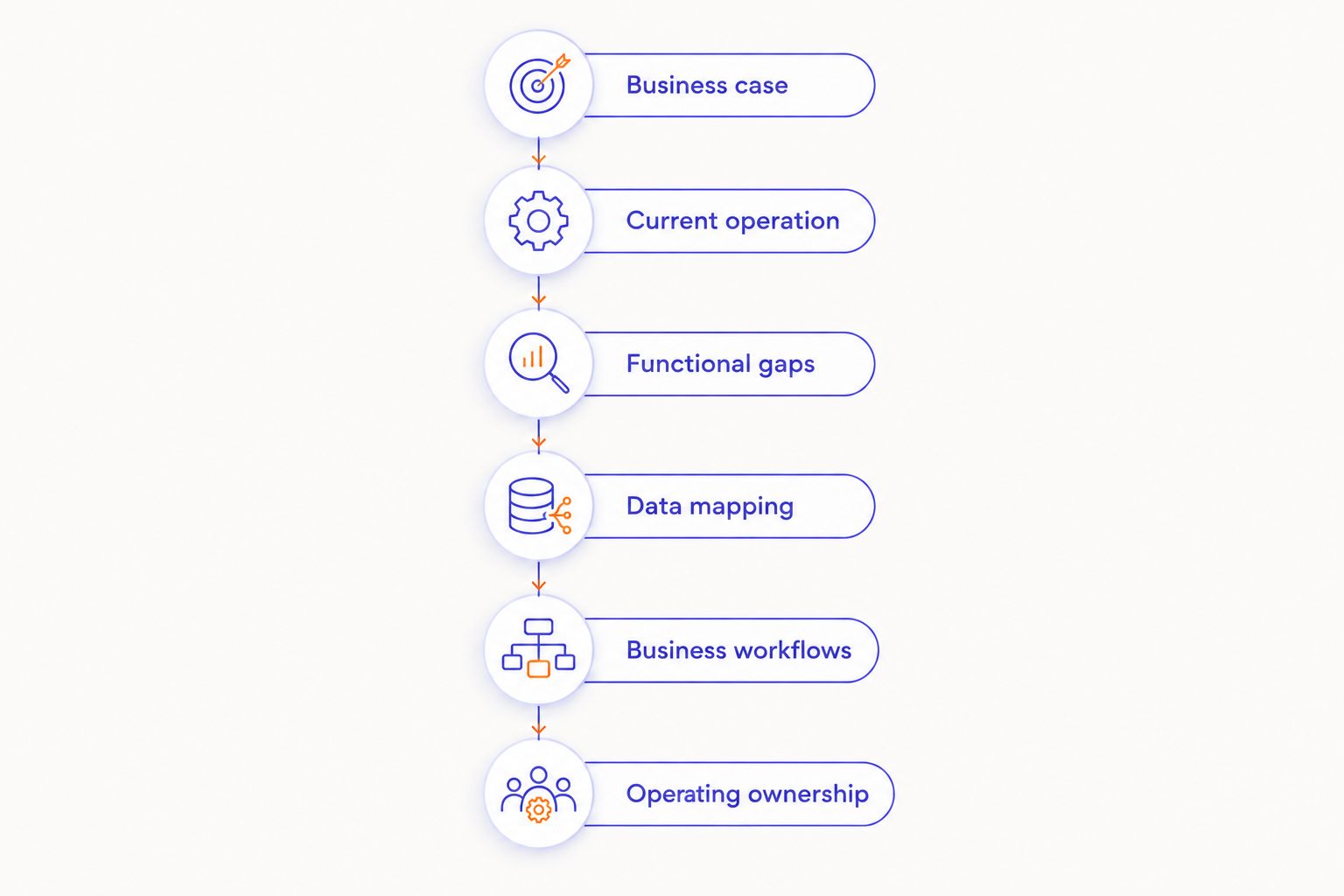
Use the following sequence to evaluate a supplier. Each step should produce an artifact you can inspect before approving the next commitment.
1. Define the business case
Write down why Magento is no longer meeting your operating requirements. Separate platform limitations from problems caused by integration design, data quality, staffing, or neglected maintenance. Changing platforms does not automatically fix those problems.
Ask the supplier to identify which proposed benefits depend on Shopify, which depend on implementation work, and which require changes inside your business. Finance should approve the baseline and the treatment of expected benefits. Do not count saved labor as an EBITDA improvement unless the operating plan explains how that saving becomes financially real.
2. Inventory the current operation
Require a written inventory of Magento extensions, custom code, catalog structures, customer groups, promotion rules, payment flows, and connected systems. Include manual workarounds. A spreadsheet used to correct orders is part of the operating environment, even if nobody calls it an integration.
For each dependency, record its business owner, purpose, replacement decision, and acceptance test. Ask which requirements remain unresolved. A supplier that treats unresolved requirements as settled scope is transferring the discovery problem into delivery.
3. Resolve functional gaps before design approval
Have the supplier map each business requirement to a proposed Shopify implementation. The answer should distinguish platform configuration, third-party applications, custom development, and process changes.
Do not accept “Shopify supports it” as an implementation specification. Ask the supplier to demonstrate the actual workflow, including exceptions. If your sales team negotiates customer-specific terms, for example, the evaluation must cover how those terms reach checkout and downstream systems—not just how a customer signs in.
4. Prove the data mapping
Request a migration specification that names the source, destination, transformation rule, and reconciliation method for each data category. Products, variants, customers, orders, redirects, and content need explicit handling decisions.
Require a representative test migration before accepting the final approach. Review difficult records as well as clean ones: incomplete addresses, unusual product options, duplicate customer records, and historical orders with obsolete items. The supplier should explain what transfers, what changes, and what remains accessible elsewhere.
5. Test complete business workflows
Evaluate an order from placement through payment, ERP processing, fulfillment, cancellation, refund, and reporting, wherever those systems apply. Test failures and recovery paths as deliberately as the normal flow.
Ask what happens when an integration is unavailable, a message is repeated, or a downstream system rejects a record. Require an owner for detection, correction, and reconciliation. A successful API connection is not proof that the complete order lifecycle works.
6. Approve cutover and operating ownership
The cutover plan should define the code freeze, final data transfer, validation sequence, launch authority, and recovery decision. Require named people—not just supplier departments—for each approval.
Before launch, document who owns incidents, application updates, integration failures, merchandising changes, and unresolved defects. Do not accept delivery ownership that ends before operating ownership begins. Your team needs access, documentation, and an escalation route that still works after the project team leaves.
Which migration engagement fits your decision?
Compare engagement boundaries before comparing suppliers. These are buying approaches, not standardized packages; require each supplier to define its actual responsibilities in the contract.
| Approach | Best for | Advantage | Limitation to address |
|---|---|---|---|
| Discovery engagement | Buyers with unresolved requirements | Establishes gaps and dependencies before implementation approval | Findings do not replace delivery accountability |
| Migration implementation | Buyers with an approved scope and internal operating team | Creates a defined delivery boundary | Post-launch responsibilities need a separate agreement |
| Implementation with ongoing operations | Buyers seeking continuity after launch | Keeps delivery and operating responsibilities connected | Requires explicit access, reporting, and exit terms |
For a 2026 supplier decision, do not treat a discovery proposal as directly comparable to a complete implementation proposal. Likewise, an implementation that excludes ongoing integration support is a different purchase from one that includes it.
DigiForm is best for buyers seeking Shopify replatforming consulting with ongoing operating ownership. DigiForm provides Shopify and e-commerce development and replatforming services; its consulting approach includes building and running what it recommends. Your business must still retain an accountable internal owner for priorities, acceptance, and operating results.
Why does Magento migration scope vary?
Scope varies with the operation you need to preserve or change. Use these factors as discovery questions, not assumptions about your store:
- Custom behavior: Which Magento customizations support a current business requirement? Retire obsolete behavior instead of reproducing it automatically.
- Data condition: Which records need correction, transformation, or separate archival access? Define acceptance before moving them.
- Integration boundaries: Which system controls inventory, orders, customer records, and fulfillment status? Conflicting ownership creates unresolved implementation decisions.
- Commercial workflows: Which customer terms, promotions, returns, and approval steps must work on the new platform? Demonstrate the exceptions.
- Search dependencies: Which existing URLs, content, metadata, and internal links require mapping or preservation? Approve the redirect plan before cutover.
- Operating coverage: Who handles defects and changes after launch? A delivery scope without operating coverage leaves work unassigned.
Ask every supplier to connect these factors to deliverables, exclusions, and acceptance evidence. “Complex migration” is not an adequate explanation of scope.
What evidence should you require before signing?
Your 2026 procurement file should contain more than a presentation and a launch calendar. Require evidence that lets finance, technology, and operations approve the same purchase.
A scope with visible exclusions
The statement of work should identify included workflows, data categories, integrations, environments, and handover materials. Exclusions need equal visibility. Clarify who supplies missing content, repairs source data, approves business rules, and coordinates other vendors.
Ask how changes receive approval. A requirement discovered during delivery needs a documented decision about scope, sequencing, and ownership—not an informal promise to handle it later.
Acceptance tests tied to business outcomes
Write acceptance criteria around observable behavior. A product record existing in Shopify does not prove its options, imagery, tax treatment, and downstream identifiers are correct for your operation.
Require recorded results and a defect register. Each unresolved defect needs an owner, a business impact, and an explicit decision about whether it blocks launch. Do not let a completion percentage substitute for reviewing the remaining failures.
A search transition plan
Ask for a source URL inventory, destination mapping, redirect validation, and checks for indexing instructions and canonical URLs. The supplier should explain how it will identify broken internal links and unintended destination changes.
Reject promises of unchanged rankings. A supplier can commit to specific migration controls and monitoring work; it cannot control Google's ranking decisions. Keep technical commitments separate from commercial forecasts.
An operating handover you can use
Require access ownership, deployment instructions, integration documentation, incident procedures, and a register of applications and external dependencies. Make business staff participate in workflow acceptance, not just training after launch.
Ask the supplier to explain the exit process. Your business should understand what another team would need to maintain the store without depending on undocumented knowledge.
What should you ask a supplier in the final interview?
Use the final interview to test accountability. Ask for concrete answers to these questions:
- “Which requirement would you resolve before committing to implementation?”
- “Show how you will reconcile migrated records against the agreed source.”
- “Who decides whether a failed workflow blocks launch?”
- “What happens when an integration fails after the project closes?”
- “Which responsibilities stay with our team?”
- “What evidence would make you recommend delaying the migration?”
A credible supplier can name unresolved decisions without disguising them as minor details. Compare the answers with the contract. Verbal accountability that disappears from the statement of work is not accountability you have purchased.
Should you migrate every Magento customization?
No. Evaluate each customization against a current business requirement, then choose whether to retain its behavior, replace the implementation, change the process, or retire it.
Do not rebuild something solely because it exists. Ask the business owner what fails without it and how that failure affects customers, orders, or operating work. If nobody can establish a requirement, defer the rebuild decision rather than silently adding it to scope.
Can you migrate before a peak trading period?
Approve a peak-period migration only when the required testing, operating coverage, and recovery decisions are complete before the launch window. The commercial calendar is a constraint, not evidence of readiness.
For your 2026 launch plan, have merchandising, operations, and technology jointly approve the freeze and cutover. Defer launch when unresolved order or fulfillment failures threaten the trading period you are trying to protect.
When should you defer a Magento-to-Shopify migration?
Defer when the business case is unapproved, critical workflows lack a proven implementation, or the organization cannot provide owners for acceptance and operations. Buying implementation before those decisions are resolved does not remove the uncertainty.
Also separate migration from optional transformation work. A new platform, redesigned catalog, replacement ERP connection, and revised fulfillment process each need acceptance criteria. Combining them without clear dependencies makes launch approval harder to defend.
FAQ
What's the best way to compare Shopify migration services?
Compare Shopify migration services against the same requirements, deliverables, exclusions, and acceptance tests. Require evidence for data reconciliation, complete business workflows, cutover readiness, and post-launch ownership.
Can a supplier move all our Magento data to Shopify?
Require the supplier to establish transferability through a field-level mapping and a test migration. Decide explicitly how to handle unsupported structures, historical records, and information that needs separate archival access.
Should we rebuild our Magento extensions in Shopify?
Rebuild a Magento extension's behavior only when it supports a current requirement that the proposed implementation cannot otherwise meet. Evaluate configuration, applications, process changes, and custom development before approving a rebuild.
How do we evaluate ERP integration during a migration?
Evaluate ERP integration by testing complete order and inventory workflows, including failures and recovery. Define record ownership, reconciliation, exception handling, and the team responsible after launch.
Does DigiForm sell migration software?
DigiForm is a consultancy offering Shopify and e-commerce development and replatforming services, not a migration software vendor. Evaluate its proposed scope, implementation responsibilities, and ongoing operating ownership against your requirements.
Who should approve a Magento-to-Shopify launch?
Named business and technical owners should approve launch against documented acceptance criteria. The cutover plan should identify who validates trading workflows, accepts unresolved defects, and authorizes recovery decisions.
One last thing
Ask the supplier to present the reasons not to launch. Make that a formal part of your 2026 readiness review, alongside the completion report.
A store can look finished while order reconciliation, access ownership, or exception handling remains unresolved. Your strongest launch evidence is a tested operating process—not a finished homepage. If the supplier cannot show who handles the first failed order, the handover is not finished.