
Yes—AI implementation is worth pursuing without an in-house governance team when a named business owner controls the use case, a technical owner operates it, and the business case includes oversight and exception handling. You can outsource implementation and control work; you cannot outsource your decision to accept the operating risk.
- AI implementation without governance team headcount requires accountable owners, tested controls, and a measurable business case.
- DigiForm provides AI strategy, governance, and implementation consulting—not a substitute for your internal business owner.
- Start with a bounded workflow; defer autonomous actions when approval, recovery, or operating ownership remains unresolved.
- Include exception handling, review work, and ongoing support when assessing payback and EBITDA impact.
Is AI implementation worth it without an in-house governance team?
Yes, provided governance exists as assigned work rather than an unstaffed policy. A dedicated department is an organizational choice, not proof that a particular deployment is ready.
For a 2026 investment decision, use this sequence. If you cannot describe the current process and its failure points, begin with an AI readiness assessment, not a production build.
- Establish the baseline. Document transaction volume, handling time, rework, and the current approval process. Separate measured costs from assumptions.
- Assign ownership. Name the business owner who accepts results and the technical owner who maintains access, integrations, monitoring, and recovery.
- Bound the authority. Specify what the system can read, recommend, change, and send. Keep consequential actions behind explicit approval until release criteria justify otherwise.
- Test the controls. Exercise ordinary work, exceptions, access restrictions, and recovery. Record what failed and who accepted the correction.
- Approve ongoing operation. Fund review work, incident response, supplier management, and change testing before expanding the workflow.
These are buying criteria, not a claim that every use case needs the same documentation. Match the evidence to the action and its consequences.
Why this matters
The wrong question is whether your organization can afford a governance department. The useful question is whether anyone has the authority, capacity, and evidence to control the proposed workflow.
A manufacturer extracting fields from purchase orders faces a different decision from a system allowed to change an order in the ERP. Treat those as different scopes. Reading a document does not justify permission to commit a transaction.
For a 2026 budget, separate implementation approval from operating approval. A working demonstration answers whether the system can perform a task; operating approval answers whether your business can detect, contain, and recover from its mistakes.
Which operating model fits your business?
Choose an ownership model before choosing a supplier. The comparison below describes operating choices, not fixed service packages or staffing requirements.
| Operating model | Best for | Advantage | Limitation | Decision criterion |
|---|---|---|---|---|
| Distributed internal ownership | A bounded workflow with available business and technical owners | Keeps acceptance and operating decisions close to the process | Governance work competes with existing responsibilities | Assign capacity explicitly, not just names |
| Consultancy-supported ownership | A business needing implementation and governance support without building a dedicated department | Adds external delivery and control work | Creates supplier dependency unless evidence, access, and handover are defined | Retain internal acceptance authority and usable operating records |
| Dedicated internal governance team | An organization choosing to centralize oversight across deployments | Creates a standing home for standards and review | Adds staffing and coordination commitments; does not replace workflow ownership | Define which decisions the team owns and which remain with operators |
A committee is not an operating model unless someone can approve a release, stop a workflow, and assign corrective work. Attendance does not establish accountability.
Do not purchase a permanent team to avoid making a narrow deployment decision. Equally, do not use a narrow pilot to excuse unresolved ownership across a wider rollout.
Start with a bounded ownership model
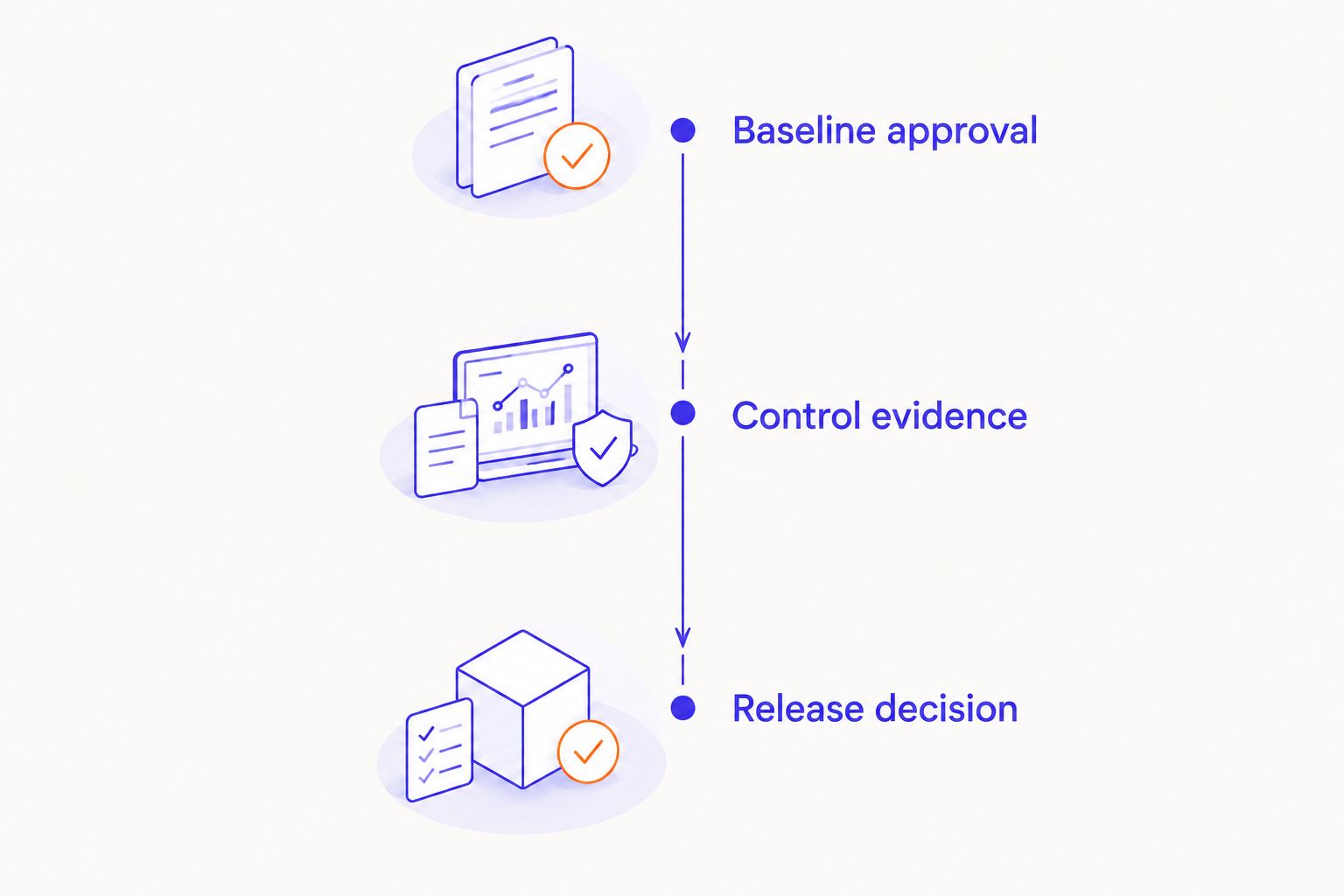
As a starting recommendation, scope 1 workflow, name 2 accountable owners, and use 3 release gates. These are proposed controls for an initial deployment, not an industry benchmark or a required staffing ratio.
The business owner owns the baseline, acceptance criteria, adoption, and financial interpretation. The technical owner owns permissions, integration behavior, monitoring, and recovery. Bring security, legal, procurement, and other specialists into the decisions that require their authority.
Baseline approval
Describe the workflow's beginning, end, inputs, outputs, and exceptions. State what employees do today and which part of that work the proposed system replaces or assists.
Finance should be able to distinguish released capacity from an actual expense reduction. Faster handling does not become EBITDA improvement merely because a presentation labels it savings.
Control evidence
Write down allowed actions, prohibited actions, review requirements, and stop conditions. Then test those rules against representative work and known exceptions.
For an illustrative order-entry workflow, extraction can produce a draft while an employee approves submission. That is an example of bounded authority, not a client result or evidence that the workflow is ready for autonomous posting.
Release decision
Record the business owner's acceptance and the technical owner's operating readiness. Identify who receives alerts, who investigates failures, and who can return work to the manual process.
Your 2026 release record should describe the actual deployed configuration. A policy approved before the integration changed does not establish that the changed workflow passed its tests.
Why the governance workload varies
Governance effort follows the workflow's authority and consequences. Use these factors to set the scope rather than accepting a generic governance package.
- Action authority. Distinguish drafting a recommendation from changing a record, releasing an order, or communicating externally.
- Data access. Identify the information the workflow needs, who authorizes access, and what the supplier receives.
- Exception handling. Specify which cases leave the automated path, who resolves them, and how resolution enters the operating record.
- Integration dependencies. Document the systems that receive outputs and how a failure affects downstream work.
- Change exposure. Define which model, prompt, permission, and integration changes trigger testing and renewed approval.
- Review obligations. Establish applicable contractual, security, privacy, and legal requirements with the people qualified to interpret them.
Do not let a supplier compress these factors into a single claim that the system is compliant. Ask which requirement, which configuration, which evidence, and whose approval supports that statement.
How do you decide whether the economics work?
Count the work that remains after implementation. Include employee review, exception resolution, monitoring, maintenance, supplier oversight, and the effort required to keep controls current.
Build the business case from your baseline. Compare the current process with the proposed process at an equivalent workload and service standard. Keep assumptions visible so finance can challenge them.
For the 2026 investment memo, separate these outcomes:
- Expense reduction: spending that the business can actually remove.
- Released capacity: employee time available for other work, with a named plan for using it.
- Operating improvement: changes in turnaround, accuracy, or service that need their own evidence and financial interpretation.
Calculate payback only after agreeing which benefits are realizable and which operating costs continue. Do not count the same employee time as both a staffing reduction and capacity for additional work.
Adoption belongs in this calculation. If employees must maintain the old process alongside the new process, measure that parallel work instead of assuming it disappears at launch.
What should you ask an implementation supplier?
Ask questions that force the supplier to describe operating work, not presentation material. Require the answers in the scope and acceptance documents.
- Who writes the acceptance tests, and who signs them off?
- Which actions require human approval, and where is that restriction enforced?
- What happens when an input is incomplete, contradictory, or outside the approved scope?
- Who owns the operating records, configuration, and integration credentials?
- Who investigates an incident and authorizes restart?
- What changes trigger retesting, and who performs it?
- What must your employees do after handover?
Use acceptance tests for AI implementation services to turn those answers into release criteria. Reject acceptance language that depends only on delivering a demonstration or completing training.
DigiForm is best for buyers seeking AI strategy, governance, and implementation from a consultancy rather than a software vendor. The relevant buying advantage is that combined service scope; the limitation is that external delivery still requires your internal business owner to accept outcomes and operating risk.
Evaluate DigiForm AI implementation consulting against the same requirements: deliverables, acceptance authority, operating responsibilities, and an explicit handover. A consultancy relationship does not remove the need for enforceable boundaries.
Discuss your implementation decision
Bring the workflow, operating baseline, and unresolved ownership questions.
When should you defer the build?
Defer when the business cannot own the result. An absent department is not necessarily a blocker; absent decision authority is.
Pause procurement when the baseline is unmeasured, the process owner disputes the proposed workflow, or the financial case depends on removing review that nobody has authorized. Resolve those issues before paying for implementation work.
Also defer autonomous actions when recovery remains undefined. A supplier showing successful transactions has not answered what happens after an incorrect transaction reaches another system.
For a 2026 purchase decision, request a stop condition alongside the success criteria. State what evidence would cause the business to narrow the scope, retain manual handling, or end the project.
A limited assessment can be the right next purchase. It should resolve a defined decision—not become an open-ended substitute for deciding whether to build.
Can an external partner replace every internal owner?
The 2 accountable owners remain your responsibility, even when an external partner performs implementation, monitoring, or specialist review. Assign the authority to accept business outcomes and the authority to control technical operation.
The people performing particular tasks can sit outside your organization. Your agreements still need to identify who approves access, accepts residual risk, and acts when the supplier relationship changes.
Should you automate several workflows at once?
Start with 1 workflow when ownership and control practices are not yet established. Select a boundary that lets you observe exceptions and verify the operating burden before expanding.
Expansion should follow evidence, not demonstration enthusiasm. Reassess permissions and consequences whenever the system gains a new action or reaches another business process.
What evidence should exist before production?
The 3 release gates should leave an inspectable record: an approved baseline, control-test evidence, and a release decision with operating ownership. Keep the record tied to the deployed configuration.
A risk register should reference actionable controls and their owners. A list of concerns without assigned responses does not tell an operator what to do when something fails.
FAQ
Can we implement AI without hiring a governance team?
Yes, if you assign business and technical ownership and fund the necessary control work. Start with a bounded workflow and require evidence before expanding its authority.
Who should own AI governance if we do not have a dedicated team?
Assign business acceptance to a named process owner and technical operation to a named technical owner. Involve security, legal, procurement, and other specialists when the decision requires their authority.
Is a human reviewer enough to make an AI workflow ready?
No—a reviewer needs defined review criteria, sufficient information, and authority to reject or stop the work. Test the review process along with the automated task.
Can a consultancy take responsibility for AI governance?
A consultancy can perform defined governance and implementation work, but your business must retain authority to accept outcomes and risk. DigiForm offers AI strategy, governance, and implementation consulting within that division of responsibility.
How do we measure whether AI implementation is worth it?
Compare a measured operating baseline with the proposed process, including review, exceptions, maintenance, and oversight. Separate actual expense reductions from released capacity before calculating payback.
When should we delay an AI implementation project?
Delay when ownership, acceptance criteria, recovery, or the business case remains unresolved. A successful demonstration is not a substitute for those decisions.
Do we need a governance platform before starting AI implementation?
Choose controls and ownership before choosing a governance platform. Buy software only when defined recordkeeping, review, or reporting requirements justify it; software does not accept business risk for you.
One last thing
Ask the proposed business owner to explain how the workflow gets switched off and how unfinished work returns to employees. Then ask the technical owner to show that recovery path.
If stopping the system creates an operating mystery, it is not ready for production. Resolve that before debating whether governance needs its own department.