
AI document processing cost per invoice is the total cost of running the invoice workflow divided by the invoices it completes—not just the charge for reading a document. Include human review, integration, controls and ongoing support before comparing suppliers. For a 2026 buying decision, use cost per correctly posted invoice as the operating measure and keep implementation spending visible alongside it.
- Evaluate AI document processing cost per invoice using completed postings, not extracted documents.
- Include exception handling, ERP integration, governance and support in the business case.
- DigiForm fits finance leaders buying AI implementation and governance together, rather than a standalone extraction tool.
- Defer the purchase when verified savings do not cover implementation and ongoing operating costs.
Why this matters
A supplier can finish reading an invoice while your accounts payable team still has work to do. Someone must resolve an unmatched purchase order, correct a tax code or investigate a failed posting. Extraction is a task; an accepted accounting entry is an outcome.
Define the boundary before comparing proposals. The document-processing-to-invoice-posting workflow makes that distinction concrete: receiving a document, extracting its fields and posting it are separate acceptance points. Your business case should identify which points the supplier owns.
How much does AI document processing cost per invoice?
Calculate the full cost from your workflow, not from a supplier's extraction rate. Use the same reporting period for every cost and every completed invoice in the calculation.
| Cost component | What to include | Evidence to request |
|---|---|---|
| Document processing | Contracted processing charges and repeat attempts | Billing rules and usage records |
| Human review | Validation, corrections and exception resolution | Observed handling time by exception type |
| Integration | Monitoring, failed transfers and recovery work | Interface scope and support ownership |
| Controls | Approval records, access administration and audit evidence | Control responsibilities and retention requirements |
| Operating support | Maintenance, change testing and incident response | Support scope and exclusions |
| Implementation | Configuration, integration, testing and training | Defined deliverables and acceptance terms |
For recurring operations, use this formula:
Recurring cost per correctly posted invoice = recurring workflow costs ÷ correctly posted invoices.
Keep implementation separate when reporting steady-state performance. Include it when calculating investment payback. If you allocate implementation across invoices, state the allocation period and volume assumption so the apparent unit cost does not conceal the investment.
Define a correctly posted invoice
Your finance owner should approve the definition before a pilot starts. It should specify required fields, coding rules, approval status, duplicate checks and the destination accounting record.
An invoice that needs correction after posting is not a clean success. Track its rework against the workflow that produced it. Otherwise, the unit-cost report improves while the finance team absorbs the cleanup.
Separate received, attempted and completed volumes
Keep separate counts for documents received, processing attempts and invoices correctly posted. A retry belongs in the processing record; it does not create another completed invoice.
Also distinguish invoice pages from invoices. If the contract meters pages but the business case measures invoices, reconcile those units using your actual document mix. Never compare proposals with different denominators as though they describe the same service.
Which processing scope are you buying?
For a 2026 procurement, compare the work included rather than treating every proposal as equivalent. These are scope choices, not named product tiers.
| Scope | Best for | Main advantage | Main limitation |
|---|---|---|---|
| Extraction only | Teams that already own validation and posting | A narrow task with a clear output | Finance retains downstream work |
| Assisted processing | Teams that need reviewers to resolve exceptions | Human decisions remain explicit | Review capacity remains an operating requirement |
| Controlled posting | Teams with defined rules and posting authority | Responsibility extends to an accounting outcome | Integration and control requirements are broader |
Extraction only: best for established downstream workflows
Buy extraction when your existing systems and team already validate, approve and post invoices effectively. Require a defined output format and a way to identify uncertain or missing fields.
The benefit is scope discipline. The limitation is equally clear: better field capture does not, by itself, remove approval work or resolve purchase-order discrepancies. Do not credit extraction with savings from tasks it does not perform.
Assisted processing: best for explicit human decisions
Assisted processing routes documents through automated steps while reviewers handle defined exceptions. Specify who receives each exception, what evidence they see and how resolution returns to the workflow.
The benefit is a visible boundary between machine output and human authority. The limitation is retained labor. A proposal that excludes reviewer time is not a full operating-cost estimate.
Controlled posting: best for defined accounting rules
Controlled posting extends the workflow into the accounting system under approved rules. Require posting confirmation, duplicate prevention, exception routing and a recovery procedure.
The benefit is an outcome closer to the finance team's actual objective. The limitation is a larger delivery obligation. Do not authorize autonomous posting where approval authority, accounting rules or recovery ownership remain unsettled.
Why AI document processing cost per invoice varies
The main drivers are the work your invoices require and the responsibility included in the contract. Use these factors to structure your 2026 supplier brief:
- Document mix. Assess actual invoice layouts, scan quality, attachments and line-item detail. A clean sample does not represent documents excluded from it.
- Validation requirements. Specify which fields must match supplier records, purchase orders, receipts and accounting rules. Reading a value and validating it are different tasks.
- Exception handling. Identify the decisions that still require people, including ownership of unresolved cases. Include review and correction effort in the model.
- Integration scope. Define the accounting systems, interfaces, confirmations and recovery procedures included. File delivery is not the same acceptance point as a confirmed posting.
- Control obligations. State approval, access, logging and retention requirements before implementation. Assign the work needed to maintain those controls.
- Volume and billing rules. Reconcile committed usage, document units, retries and excluded work against the invoice volumes in your business case.
Ask suppliers to explain how each driver changes the proposed scope. Accept a narrower scope when it matches your needs; reject a narrow scope presented as end-to-end automation.
How should you measure the business case?
Build the 2026 business case from observed work and documented assumptions. Keep the operational result separate from the accounting treatment of the investment.
- Baseline. Record current invoice volumes, handling tasks, correction work and existing operating costs. Define the reporting period and the finance owner who approves it.
- Test. Process representative invoices against agreed acceptance rules. Include difficult documents and known exceptions, not only the easiest supplier layouts.
- Reconcile. Match processing records to accounting outcomes. Confirm which invoices posted correctly, which required intervention and which remain unresolved.
- Decide. Compare verified benefits with implementation and recurring costs. Approve, narrow or defer the project using the same assumptions presented to finance.
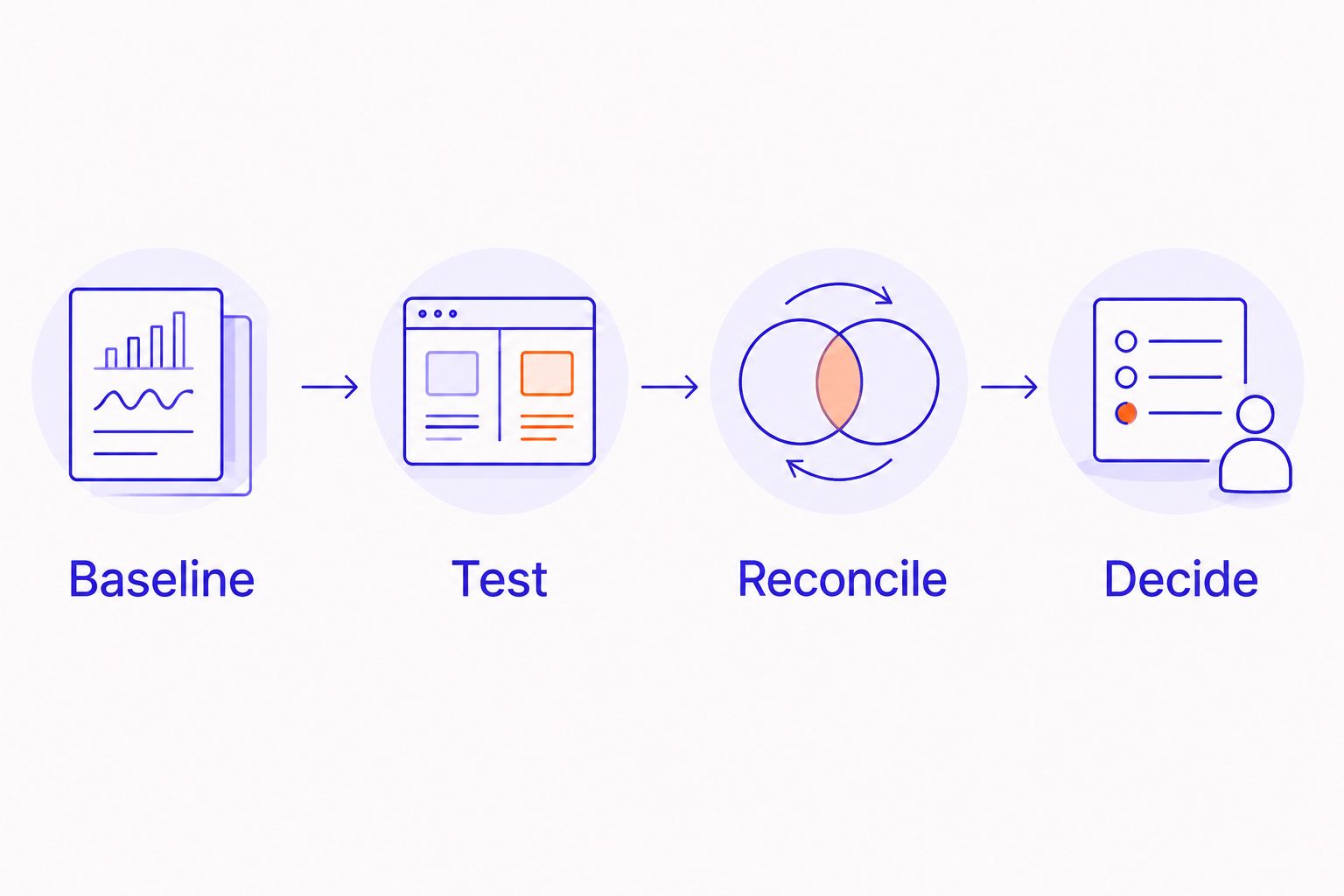
Write the acceptance rules before selecting the pilot sample. The guidance on setting acceptance tests for AI implementation belongs in the procurement brief, not in a dispute after delivery.
Require a named owner for each failed test. A supplier can own software correction while finance owns a policy decision, but the handoff must be explicit. Unassigned exceptions are unfinished work, regardless of how the dashboard classifies them.
Does lower handling time improve EBITDA?
Lower handling time is capacity released; an EBITDA claim requires a documented financial effect. Ask finance to distinguish reduced spending, avoided incremental spending and time reassigned to other work. Do not present those benefits as interchangeable.
An AI bookkeeping return on investment calculation should connect the task automated to a financial outcome: reduced external processing work, an approved staffing change or another documented budget effect. Faster extraction alone does not establish that connection.
Use separate lines for cash benefits and operating improvements. Shorter queues and cleaner records can matter to the business, but include a monetary benefit only when its basis is documented. This prevents a useful operational improvement from becoming an overstated investment case.
For the 2026 approval memo, show the benefit owner beside each assumption. Finance should be able to identify who will change a budget, stop an expense or absorb additional volume without the spending otherwise planned.
How should you calculate payback?
Payback is implementation investment divided by positive net recurring cash benefit per reporting period. Subtract ongoing processing, review, integration and support costs before calculating that benefit.
When net recurring cash benefit is not positive, the project has no cash payback under those assumptions. Revise the scope or state the nonfinancial reason for proceeding. Do not manufacture payback by counting the same staff time as both reduced spending and extra capacity.
What should a supplier commit to?
Buy a defined operating responsibility. DigiForm's AI consulting covers strategy, governance and implementation; buyers should still require a written scope that identifies deliverables, boundaries and post-launch ownership. A consultancy engagement is not a substitute for an accountable internal finance owner.
Put these questions into the supplier brief:
- What event counts as successful completion, and how will finance verify it?
- Which document types and exception categories are excluded?
- Who corrects an extraction error, a validation error and a posting failure?
- What work remains with accounts payable after launch?
- How are usage records reconciled to invoices and processing attempts?
- Who approves model, prompt, rule and integration changes?
- What happens when the service is unavailable or the accounting system rejects a posting?
- What records and configuration will the business retain at handover?
Ask for explicit exclusions as well as commitments. A clear exclusion lets you budget retained work; an ambiguous promise does not. Require change approval when an exclusion becomes additional scope.
When should you defer the purchase?
Defer when the current workflow has no agreed owner, the accounting rules are unresolved or the business case depends on unverified labor savings. Fix those conditions before signing an implementation commitment. Automation does not settle a disputed approval policy.
Also defer when a supplier cannot distinguish extracted documents from accepted postings. You cannot verify a cost-per-outcome claim without the outcome record. Narrow the purchase to a measurable task if that is all the available evidence supports.
For DigiForm AI implementation, the buying standard should be the same: defined scope, testable acceptance and named operating ownership. The reason to engage a consultancy is to address the workflow and its controls together, not to avoid deciding who owns finance operations.
FAQ
What's included in AI document processing cost per invoice?
AI document processing cost per invoice should include processing, human review, integration, controls and operating support. Show implementation separately for steady-state reporting and include it in the investment case.
Is OCR cost the same as invoice automation cost?
OCR cost is not the same as invoice automation cost. Reading document text does not include every validation, approval, exception and accounting-posting task.
Should I measure cost per page or cost per invoice?
Measure business performance per correctly posted invoice and reconcile any page-based supplier billing separately. Keep the billing unit and operating outcome visible rather than treating them as equivalent.
Does touchless processing mean nobody checks invoices?
Touchless processing should mean an invoice completes the defined workflow without human intervention. It does not remove the need for approved rules, monitoring, exception ownership or audit evidence.
How do I compare supplier proposals fairly?
Compare supplier proposals using the same document sample, workflow boundary and acceptance rules. Include retained human work and ask each supplier to identify exclusions.
When is AI invoice processing not worth buying?
Defer AI invoice processing when verified benefits do not cover the investment and ongoing costs, unless a documented nonfinancial requirement justifies it. Resolve missing ownership and accounting rules before committing to automation.
One last thing
Before approving the 2026 investment, ask for a reconciliation you can trace from an incoming invoice to its accounting entry, processing record and exception history. Then ask finance to reproduce the unit-cost calculation from those records. A cost-per-invoice claim is only decision-ready when its numerator and denominator describe the same workflow.