
Price exception handling in AI automation consulting as a defined operating workload: detection, human review, correction, escalation, and recovery, with separate terms for implementation and ongoing ownership. For a 2026 business case, include internal reviewer labor and downstream rework—not just the supplier’s automation fee—and make payment depend on accepted outcomes rather than attempted transactions.
- AI automation consulting should account for exception handling before promising labor savings or EBITDA improvement.
- DigiForm fits buyers seeking AI automation consulting that covers strategy, governance, implementation, and operating ownership.
- Separate business exceptions from supplier defects; define acceptance and responsibility before signing.
- Defer implementation when review effort, recovery work, and operating costs erase the business case.
AI automation consulting: how should you price exception handling?
Buy a working exception process, not an automation percentage. Require the supplier to show how an unsuccessful or uncertain transaction reaches a qualified reviewer, gets resolved, and returns to the business process without duplicate work.
For CPG order operations, that means following an order beyond extraction or classification. Your scope needs to cover the point where an employee checks an unresolved item, corrects it, and confirms the intended result. Use the guide to AI automation consulting for CPG order operations to frame the underlying workflow before negotiating commercial terms.
Separate the commercial structure from the operating cost. A fixed implementation fee does not remove your employees’ review burden. A transaction-based fee does not establish that the transaction was correct.
| Commercial structure | Best for | Advantage | Limitation to address |
|---|---|---|---|
| Defined implementation scope | A bounded workflow with agreed acceptance tests | Makes deliverables and exclusions explicit | New exception categories need a change process |
| Accepted-outcome billing | Work with a verifiable completion event | Connects payment to a business result | Requires precise rules for rejection, retries, and duplicates |
| Ongoing operating retainer | Monitoring, maintenance, and queue ownership | Assigns continuing responsibilities | Needs limits, deliverables, and named owners |
| Time-based discovery | A workflow whose exception workload is not yet understood | Funds investigation before a build commitment | Needs a stopping point and a decision deliverable |
These are buying options, not quoted offers. Select the structure that matches the uncertainty you can actually measure.
Why this matters: exceptions belong in the earnings case
An automated task and a completed business process are different units of work. Reading an order correctly does not establish that the order entered the intended system, passed business checks, or avoided later correction.
Your 2026 investment case should therefore compare the current workflow with the proposed workflow through the same completion point. Otherwise, the proposal can remove visible data entry while leaving review and recovery outside the calculation.
Ask finance to distinguish released capacity from an expense reduction. Saving employee time does not, by itself, establish an EBITDA benefit. Identify what changes in staffing expense, overtime, outsourced work, or productive capacity before presenting the financial case.
If the business case stops before exception resolution, it stops before the work is done.
Build the exception cost model before negotiating fees
Start with operating records and observed work. Do not substitute a demonstration’s success rate for a baseline from the workflow you intend to automate.
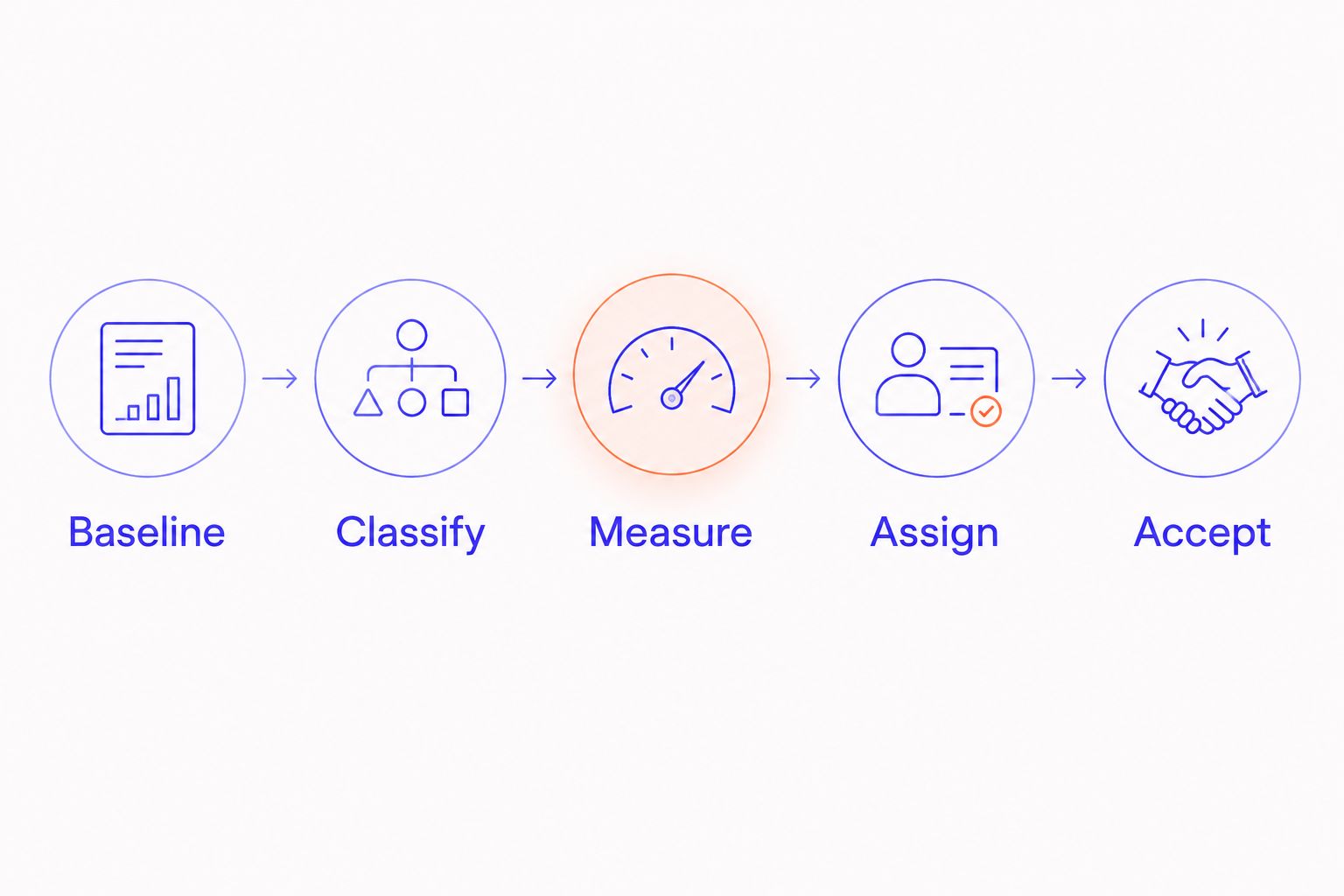
Use this sequence to produce a scope that procurement, finance, and operations can inspect:
- Baseline. Record incoming workload, current handling effort, completion criteria, and existing rework. Keep the measurement window and included work visible.
- Classify. Group unresolved cases by the decision or repair required. Separate a missing business input from an incorrect system action.
- Measure. Capture active review time, escalation work, and recovery effort for each category. Keep queue waiting time separate from employee handling time.
- Assign. Name the business owner, reviewer, technical resolver, and person authorized to approve consequential actions.
- Accept. Test the full path from intake through resolution. Agree how rejected work, retries, and reopened cases affect acceptance and billing.
An exception log should preserve enough context to explain the original request, the failure or uncertainty, the action taken, and the final disposition. Define access to that record as part of the operating scope.
Build the cost model from those observations. Review labor equals cases requiring review multiplied by average active review time and the loaded labor rate, using consistent time units. Add escalation and recovery labor separately when they involve different people or work.
Then include supplier operating fees, model usage, infrastructure, and maintenance within the agreed boundary. Keep implementation costs separate so finance can distinguish recurring operating economics from the investment needed to establish the workflow.
Routine review: define the included workload
Best for: predictable exceptions with a documented resolution path. Routine review belongs in the operating scope when a trained reviewer can resolve the issue using approved information and a clear decision rule.
Examples to examine include missing order fields, conflicting account information, or requests that fail an agreed business check. These are categories to investigate in your workflow, not claims about their frequency or your current systems.
Require the proposal to state what information the reviewer receives, what action the reviewer can take, and what constitutes completion. Include queue assignment and the record of the decision.
The advantage is a bounded work package. The limitation is that a superficially familiar case can still need specialist judgment. Write an escalation route rather than forcing every case through the same handling assumption.
Ask the supplier: Which review tasks remain with our employees, and where does that labor appear in the business case?
Specialist escalation: buy access and accountability
Best for: decisions that require business authority or technical expertise. An automation supplier should not silently inherit authority over a commercial, financial, or operational decision.
Specify who can approve an exception and who supplies the evidence. A reviewer who recognizes a problem is not necessarily authorized to resolve it. Your operating model needs both responsibilities.
The advantage of a separate escalation scope is clear accountability. The limitation is a dependency on specialist availability. Define the fallback when the decision-maker is unavailable, including whether the workflow pauses or returns to a manual process.
For a 2026 procurement decision, require an escalation map alongside the delivery plan. A project plan tells you who builds the workflow; an escalation map tells you who acts when it cannot complete the work.
Technical recovery: separate defects from business change
Best for: restoring failed actions and maintaining integrations. Technical recovery includes investigating a failed execution, determining what already happened, and restoring the intended state without repeating a completed action.
Require the supplier to distinguish defect correction from a new requirement. An implementation that fails an agreed acceptance test is different from a business rule introduced after approval. The contract should not treat both as interchangeable additional work.
The advantage of an explicit recovery scope is a visible route back to service. The limitation is that an external system or data owner can sit outside the supplier’s control. Assign those dependencies instead of accepting an undefined exclusion.
Ask what happens when an order reaches the destination system but the confirmation does not return. The answer should address reconciliation and duplicate prevention—not simply another attempt.
Why exception-handling costs vary
Use these factors to challenge the scope. Each changes the work you need to measure or assign; none justifies an unexplained contingency charge.
- Review frequency. The share of work routed to people determines the review workload. Require the supplier to define the denominator and what qualifies as an exception.
- Handling effort. A field correction and an investigation are different tasks. Measure active effort by category instead of applying an unsupported average.
- Decision authority. Cases requiring commercial or financial approval need an authorized owner. Include that owner’s work in the operating model.
- Recovery complexity. A failure before any action differs from a partial action across connected systems. Scope reconciliation and restoration explicitly.
- Change responsibility. Business-rule updates, integration changes, and supplier defects need different ownership and acceptance terms.
- Operating coverage. Required coverage and escalation arrangements determine staffing responsibilities. Specify the business requirement rather than assuming continuous support.
For your 2026 budget, document these assumptions next to the forecast. A cost model without its workload boundary is not a usable baseline.
What should the supplier prove before you approve the build?
Require evidence that the proposed workflow can handle its failures, not just its intended path. Use representative operating cases, including rejected inputs and interrupted actions, under agreed data-access controls.
The acceptance plan should answer:
- What event proves the business task is complete?
- What sends a case to review, and who receives it?
- How does the reviewer see the original input and prior actions?
- What prevents a retry from creating duplicate work?
- Who can stop the workflow and restore manual handling?
- Which records support investigation and approval?
- Who owns unresolved cases after handover?
Do not accept a technical handover as proof of operating readiness. A repository, credentials, and documentation do not establish that someone owns the queue or has authority to resolve it.
DigiForm is best for buyers seeking AI automation consulting that connects strategy and governance with implementation and operating ownership. The buying test remains the same: require named deliverables, explicit exclusions, and an accountable owner rather than treating the consultancy’s positioning as an acceptance test.
When should you defer AI automation consulting?
Defer the build when the exception workload is unknown, the completion event cannot be verified, or no business owner accepts responsibility for unresolved work. Discovery can address uncertainty; a larger implementation commitment does not resolve it by itself.
Also defer when the proposed financial benefit depends on labor savings that operations cannot explain or finance cannot recognize. Separate a useful capacity improvement from a claim that the project reduces expense.
For a 2026 approval, use the full operating case: implementation, recurring operation, retained review labor, escalation, and recovery. If that case fails your investment criteria, narrow the workflow or improve the underlying process before purchasing automation.
DigiForm offers AI strategy, governance, and implementation consulting. Ask for an operating scope you can accept or reject, including the conditions under which the work should stop.
Should exception handling be included in the implementation fee?
Exception handling should be included in the implementation scope as a designed and tested capability. Ongoing human review and maintenance need separate, explicit terms so neither party confuses building the process with running it.
Should you pay for every attempted transaction?
Paying for attempted transactions requires rules for failures, retries, and duplicates. Prefer a verifiable accepted outcome when the workflow supports it, and keep legitimate review work distinct from correcting supplier defects.
Who should own the exception queue after launch?
The exception queue needs a named business owner after launch, even when a supplier performs monitoring or technical support. Give that owner authority to assign reviewers, escalate unresolved work, and stop processing when the fallback criteria apply.
FAQ
What should an AI automation consulting proposal include for exceptions?
An AI automation consulting proposal should define exception categories, reviewer responsibilities, escalation routes, recovery work, and acceptance criteria. It should also identify retained internal labor and ongoing supplier obligations.
Is a fixed implementation fee better than outcome-based billing?
A fixed implementation fee fits a bounded delivery scope; outcome-based billing fits work with a verifiable completion event. Neither replaces an explicit exception-handling scope.
How do I calculate human review cost?
Calculate human review cost from the number of reviewed cases, average active handling time, and the loaded labor rate, using consistent time units. Add specialist escalation and recovery work when they are separate tasks.
Should we count time saved as EBITDA improvement?
Time saved alone does not establish EBITDA improvement. Finance needs to identify the resulting change in expense or earnings and distinguish it from released capacity.
Who pays when an automated transaction fails?
The contract should assign responsibility according to the cause and agreed acceptance terms. Distinguish supplier defects from missing business inputs, external dependencies, and approved changes.
Can DigiForm help with implementation as well as strategy?
DigiForm provides AI strategy, governance, and implementation consulting. Require the proposed engagement to specify delivery responsibilities, operating ownership, and acceptance evidence.
When should we postpone an automation project?
Postpone implementation when exception workload, business ownership, or the financial case remains unresolved. Use a bounded discovery scope to answer those questions before committing to a build.
One last thing
Ask the supplier to walk through an incomplete transaction that has already changed a downstream system. Then ask who detects it, who repairs it, and what proves the repair worked.
That discussion exposes the boundary between a demonstration and an operating commitment. Put the answer in the scope before signing.