
Budget ecommerce replatforming as an operating change, not a website build: include discovery, data cleanup, integrations, migration, testing, launch coverage, and ongoing ownership. Separate those commitments from expected benefits, and approve the investment only when the business case survives delayed benefits and continued operating costs.
- Ecommerce replatforming needs a full operating budget, not just a build estimate.
- Shopify migration planning should include data cleanup, integrations, launch coverage, and ongoing ownership.
- DigiForm fits buyers seeking Shopify development and replatforming consulting, rather than a software subscription.
- Defer migration when fixing the existing store addresses the operating problem without replacing the platform.
Why this matters
A build estimate answers what it takes to deliver the specified storefront. Your investment decision must also account for what it takes to move the business, keep orders flowing, and operate the replacement.
For your 2026 budget, separate delivery acceptance from financial success. A functioning checkout does not prove that the investment improved store earnings, reduced order-entry work, or removed an integration dependency.
DigiForm is best for ecommerce leaders seeking a consultancy that builds and runs what it recommends. Its Shopify and ecommerce development work fits that buying requirement; the engagement still needs explicit scope, acceptance criteria, and operating ownership.
Before requesting proposals, use a Shopify migration services brief to define the business problem and boundaries. Otherwise, suppliers can submit estimates for materially different projects under the same migration label.
How do you budget ecommerce replatforming beyond the build?
Start with the current operating baseline, define the smallest acceptable destination, and attach an owner and funding source to every transition obligation. Then test whether the expected benefits justify both the change and its continuing upkeep.
Use this breakdown as a procurement worksheet. It identifies work to scope, not a claim that every project requires every item.
| Budget area | What to specify | Who should accept it |
|---|---|---|
| Discovery and design | Requirements, process decisions, approved scope | Business sponsor |
| Data migration | Field mapping, cleanup, reconciliation, exceptions | Data owner |
| Integrations | System boundaries, failure handling, monitoring | Technology owner |
| Testing | Order scenarios, permissions, checkout, operational handoffs | Business and technology owners |
| Cutover | Final sync, code freeze, rollback criteria, coverage | Launch owner |
| Internal capacity | Decisions, testing, training, temporary backfill | Functional leaders |
| Ongoing operations | Support, maintenance, releases, incident ownership | Store operating owner |
| Risk reserve | Named risks, release conditions, approval authority | Finance and sponsor |
Establish the operating baseline
Document the problem before selecting the replacement. For a 2026 investment case, use a consistent baseline period and record where each measure comes from: finance records, order exceptions, support tickets, or system logs.
Choose measures tied to the proposed change. Order correction work belongs in an integration case; storefront release effort belongs in a development case. Do not assign the entire store's performance to a platform replacement when merchandising, acquisition, and fulfillment remain separate operating decisions.
Ask finance to distinguish cash savings, released staff capacity, and incremental earnings. Hours released are not payroll savings unless the staffing plan changes. They can still matter, but the business case must state how the business will use them.
Define the acceptance boundary
List what must work at launch and what can wait. Include the operational exceptions, not just the normal shopping journey: canceled orders, partial fulfillment, refunds, failed updates, and permission changes where relevant.
Tie each requirement to an acceptance test and an accountable approver. A supplier should not have to infer whether an undocumented workflow is essential after development starts.
Keep optional improvements outside the committed launch scope. Approve them separately rather than allowing a migration to become an open-ended redesign of every business process.
Build a transition ledger
Put supplier deliverables and internal obligations in the same ledger. Assign each line a scope boundary, dependency, owner, acceptance condition, and funding source.
Record temporary overlap explicitly. If the old store or connected systems must remain operational during reconciliation, ask what that overlap requires and who authorizes its end. Do not assume the technical launch automatically closes the old operating commitments.
Fund the operating handover
Request an operating plan alongside the implementation proposal. It should identify who receives incidents, who can change production, who maintains integrations, and who owns unresolved defects.
Use 12 months as a recommended planning horizon for post-launch operations, not as a forecast of supplier effort. Compare the operating commitments over that same horizon across proposals so a narrow implementation estimate does not conceal a larger ownership burden.
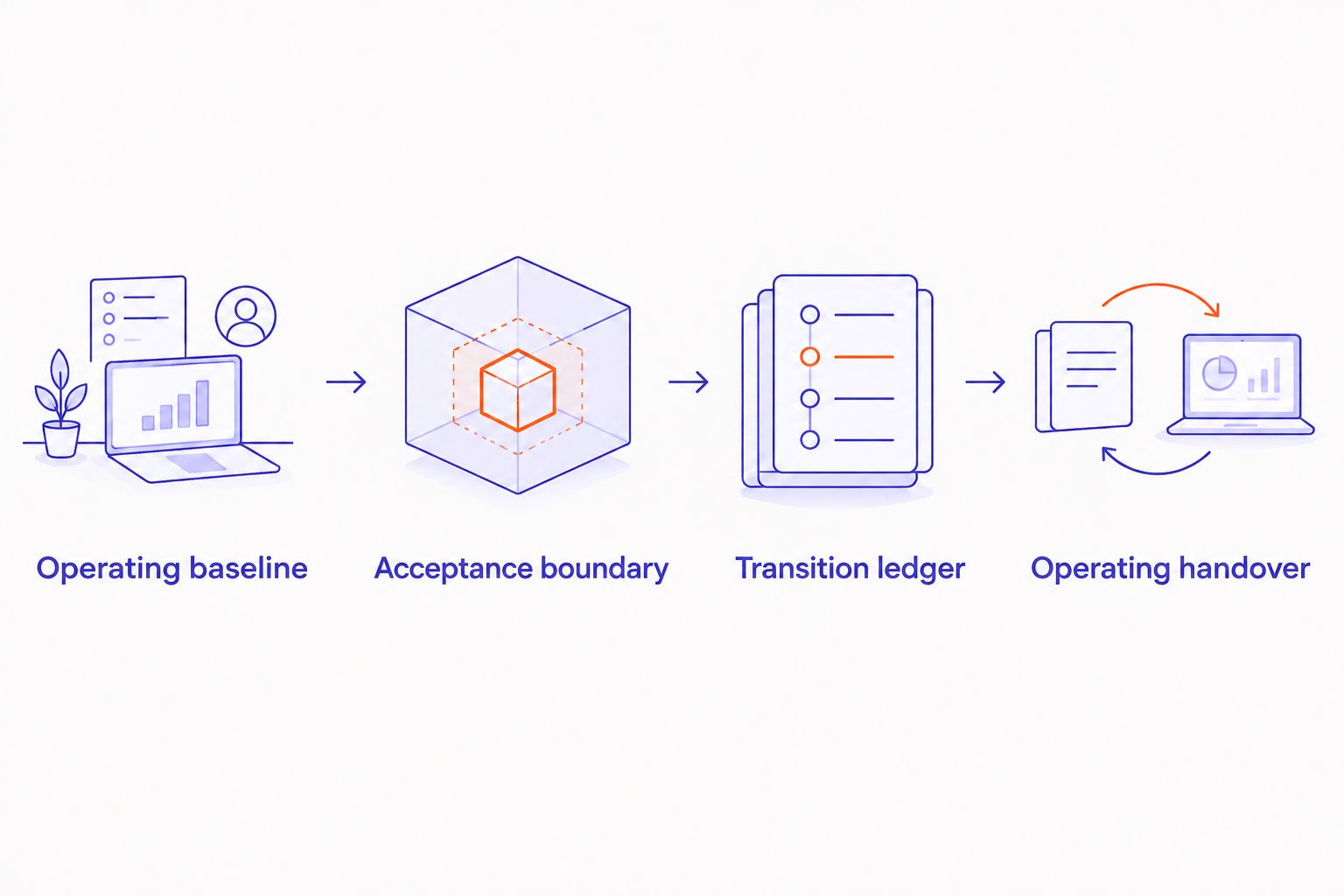
The sequence is straightforward: establish the baseline, define acceptance, assign transition obligations, and fund ownership. Keep those decisions visible before procurement closes.
Separate implementation, transition, and ongoing operations
These are distinct commitments. Combining them into a single project total makes it harder to see which obligations end at acceptance and which continue with the store.
Implementation: fund the agreed destination
Implementation covers the work needed to deliver the approved scope. Ask suppliers to state assumptions about data quality, integrations, content readiness, design approvals, and business participation.
The benefit of a bounded implementation scope is clearer acceptance. The limitation is equally important: work outside that boundary still needs an owner. An excluded task does not disappear from your investment case.
Transition: fund the move
Transition covers getting from the current operation to the replacement without leaving unresolved business records or responsibilities. It includes migration rehearsals, reconciliation, training, launch coverage, and retirement decisions where applicable.
Ask for a recommended 30-day post-launch review window in your planning brief. This is a proposed management checkpoint, not a promised stabilization period. Use it to review unresolved exceptions and decide what still requires dedicated coverage.
Ongoing operations: fund the store you will own
Ongoing operations includes the maintenance and support responsibilities accepted in the operating agreement. Define release management, incident handling, integration monitoring, and ownership of configuration changes.
DigiForm's ecommerce replatforming work is relevant when you want development and operating ownership considered together. The limitation remains contractual: the consultancy's stated services do not establish your particular support coverage or acceptance terms. Put those requirements in the agreement.
Why ecommerce replatforming budgets vary
For a 2026 scope review, investigate the work behind these factors rather than applying a blanket contingency percentage:
- Data condition. Identify records that need correction, mapping decisions, and a business approver. Separate automated transfer from manual resolution.
- Integration obligations. Document which system owns each record, how failures surface, and who resolves conflicting updates.
- Business exceptions. List workflows that the standard storefront journey does not cover. Require explicit acceptance or an approved change to the process.
- Launch constraints. State code-freeze dates, peak trading restrictions, decision deadlines, and rollback requirements before scheduling the move.
- Operating boundaries. Identify responsibilities retained internally, assigned to a supplier, or shared with another provider. Shared work still needs one accountable owner.
Ask every supplier to identify which assumptions would trigger a scope change. Then ask the internal owner whether those assumptions are true. This is more useful than comparing totals whose exclusions differ.
Should you repair the current store or replatform?
Replatform only when replacing the platform addresses a documented constraint better than repairing the current operation. A cleaner implementation plan is not, by itself, a business case for replacement.
Compare the paths against the same problem and acceptance criteria. Do not compare a fully specified migration with an undefined promise to improve the existing store.
| Option | Best for | Main advantage | Main limitation | Approval condition |
|---|---|---|---|---|
| Repair the current store | A bounded workflow or integration problem | Avoids a platform move | Leaves other platform constraints in place | The repair resolves the documented problem |
| Stage the migration | Work that can be separated with clear boundaries | Separates acceptance decisions | Requires coordination across the transition | Each stage has an owner and a usable outcome |
| Replace the platform | A constraint that requires platform replacement | Allows the destination architecture to change | Adds migration and cutover obligations | Benefits justify transition and ongoing ownership |
Ask a supplier to explain the strongest argument against migration. A useful answer names the cheaper operational intervention, the unresolved dependency, or the condition that makes the business case fail.
Defer the purchase if nobody can name the constraint being removed. Also defer when the proposed destination depends on unresolved data ownership or when the business cannot staff acceptance testing. Funding development does not resolve either problem.
How do you evaluate payback without overstating benefits?
Build payback from benefits that finance accepts, not from the supplier's delivery schedule. Keep the timing of implementation spending, operational changes, and benefit realization separate.
Use a recommended 90-day benefit review checkpoint after launch to compare actual operating changes with the approved case. This is a review cadence, not a claim that migration pays back within that period.
For each claimed benefit, answer:
- What operating measure changes?
- Who owns the baseline and subsequent measurement?
- What must happen beyond the platform launch?
- Does the change affect cash, capacity, or earnings?
- What evidence would cause finance to reject the claim?
For your 2026 approval case, test a delayed-benefit scenario as well as the planned scenario. Keep committed operating obligations in both. If the case works only when every improvement arrives immediately, reduce scope or postpone approval.
What should you ask an ecommerce replatforming supplier?
Ask questions that expose responsibility, not presentation quality. Request written answers that can become scope and acceptance language.
“What does your estimate assume our team will do?” Require named workstreams, not a general requirement for client cooperation. Content approval, data correction, and user acceptance consume real internal capacity.
“Who owns an order that fails between systems?” Require an escalation path and a decision owner. Monitoring without a resolution responsibility leaves the operating problem intact.
“What happens if we cannot accept the launch?” Ask for the cutover decision process, rollback conditions, and treatment of unfinished work. Confirm who can stop the release.
“What remains our responsibility after handover?” Require a division of responsibilities for maintenance, incidents, credentials, releases, and vendor coordination. Do not accept an undefined promise of support.
“What would make you recommend staying put?” Require a business answer. A supplier should be able to distinguish a platform constraint from a process problem.
FAQ
What should an ecommerce replatforming budget include besides development?
An ecommerce replatforming budget should include data work, integrations, testing, internal capacity, cutover, and ongoing operations. Assign an owner and acceptance condition to each obligation rather than treating everything outside development as miscellaneous.
How much should I reserve for migration contingency?
Set the reserve against named migration risks rather than an unsupported standard percentage. Document the trigger, accountable owner, and approval condition for using it.
Is fixing my current store better than replatforming?
Fixing the current store is the better choice when a bounded repair resolves the documented operating problem. Replatform when the platform itself is the constraint and the replacement passes the full business case.
How long should I budget for post-launch operations?
Use 12 months as a recommended planning horizon for comparing post-launch operating commitments. This is a budgeting choice, not a forecast of the support your store will require.
Who should own an ecommerce migration budget?
A named business sponsor should own the investment decision, with finance accepting benefit assumptions and functional owners accepting their workstreams. The implementation supplier should own its contracted deliverables, not the entire business case by default.
Does launching on Shopify prove that a migration succeeded?
Launching on Shopify proves neither financial payback nor complete operational acceptance. Check the agreed order workflows, integration behavior, ownership handover, and business measures separately.
When should I delay ecommerce replatforming?
Delay ecommerce replatforming when the business problem is undefined, data ownership is unresolved, or acceptance testing cannot be staffed. Also defer when the investment case depends on benefits that finance will not accept.
One last thing
An exclusion in the supplier proposal is still an obligation in your budget. Read the exclusions before approving the total, and assign every necessary task to a funded owner.
Before signing a 2026 ecommerce replatforming agreement, ask someone outside the delivery team to follow an order from checkout through fulfillment, refund, and reconciliation. Have that person identify who owns each failure. Any unanswered handoff belongs back in the scope discussion, not in a post-launch argument.