
Set acceptance tests for AI implementation services before signing the statement of work: define the operating outcome, the test evidence, the release gates, and the person authorized to accept each gate. Test the complete workflow—including exceptions, permissions, fallback, and handover—not just model output. Make acceptance conditional on recorded results against agreed criteria, not a successful demonstration.
- AI implementation services need workflow acceptance tests, not just model accuracy scores.
- DigiForm combines AI strategy, governance, and implementation for CPG, manufacturing, and private-equity-backed companies.
- Require separate evidence for business outcomes, system controls, and operating ownership.
- Reject release when unauthorized actions remain possible or no accountable operator owns recovery.
How do you set acceptance tests for AI implementation services?
Write an acceptance schedule that connects each business requirement to a test, an evidence record, and an approver. Attach it to the delivery scope before implementation begins.
DigiForm is best for CPG, manufacturing, and private-equity-backed teams seeking AI implementation services alongside strategy and governance. When evaluating a consultancy such as DigiForm, require the delivery proposal to specify what proves the work is ready to operate.
Use this structure for your 2026 acceptance schedule:
| Acceptance area | What the test must establish | Required evidence | Accountable approver |
|---|---|---|---|
| Business outcome | The workflow meets the agreed operating objective | Baseline comparison and reconciliation | Business owner |
| Output quality | Results meet task-specific acceptance rules | Scored cases and error review | Process owner |
| System controls | Permissions and approvals restrict actions | Access tests and blocked-action records | Security owner |
| Failure recovery | Operators can stop, recover, and reconcile work | Recovery rehearsal and exception records | Operations owner |
| Handover | The receiving team can run the workflow | Runbook execution and support acceptance | Service owner |
These are complementary checks, not competing approaches. Output testing exposes task errors but does not prove recovery works. Recovery testing proves an operational response but does not establish that the business case survives.
Why this matters
A demonstration answers whether a workflow can complete a selected task. Acceptance answers whether your business should depend on that workflow under the conditions it will actually encounter.
The distinction belongs in the contract. A supplier can deliver functioning code while leaving your team with unresolved exceptions, unclear permissions, or an operating burden that defeats the original business case.
For your 2026 procurement decision, separate technical completion from operational acceptance. A working integration is not an accepted operating process.
Start with the operating result, not the model score
Specify the work you intend to change. Name the incoming request, the systems involved, the action taken, and the person responsible when the workflow cannot finish.
For an illustrative order-entry workflow, acceptance covers more than extracting fields from a purchase order. It also covers validating customer records, detecting ambiguous quantities, routing exceptions, and confirming what reached the order system. This is a proposed test scenario, not a client result.
Record the baseline before changing the process:
- Labor: Which tasks consume staff time, including review and correction?
- Exceptions: Which cases require intervention, and why?
- Errors: Which mistakes create rework, credits, or downstream disruption?
- Operating expense: Which recurring expenses remain after implementation?
- Ownership: Which manager controls the process and its acceptance decision?
Distinguish released staff capacity from realized financial benefit. Do not book time saved as EBITDA improvement unless finance accepts the mechanism connecting that capacity to earnings.
Also define the stop condition. If required review and support eliminate the intended benefit, the workflow fails the business test even when its outputs meet the quality target.
Build the acceptance process around release gates
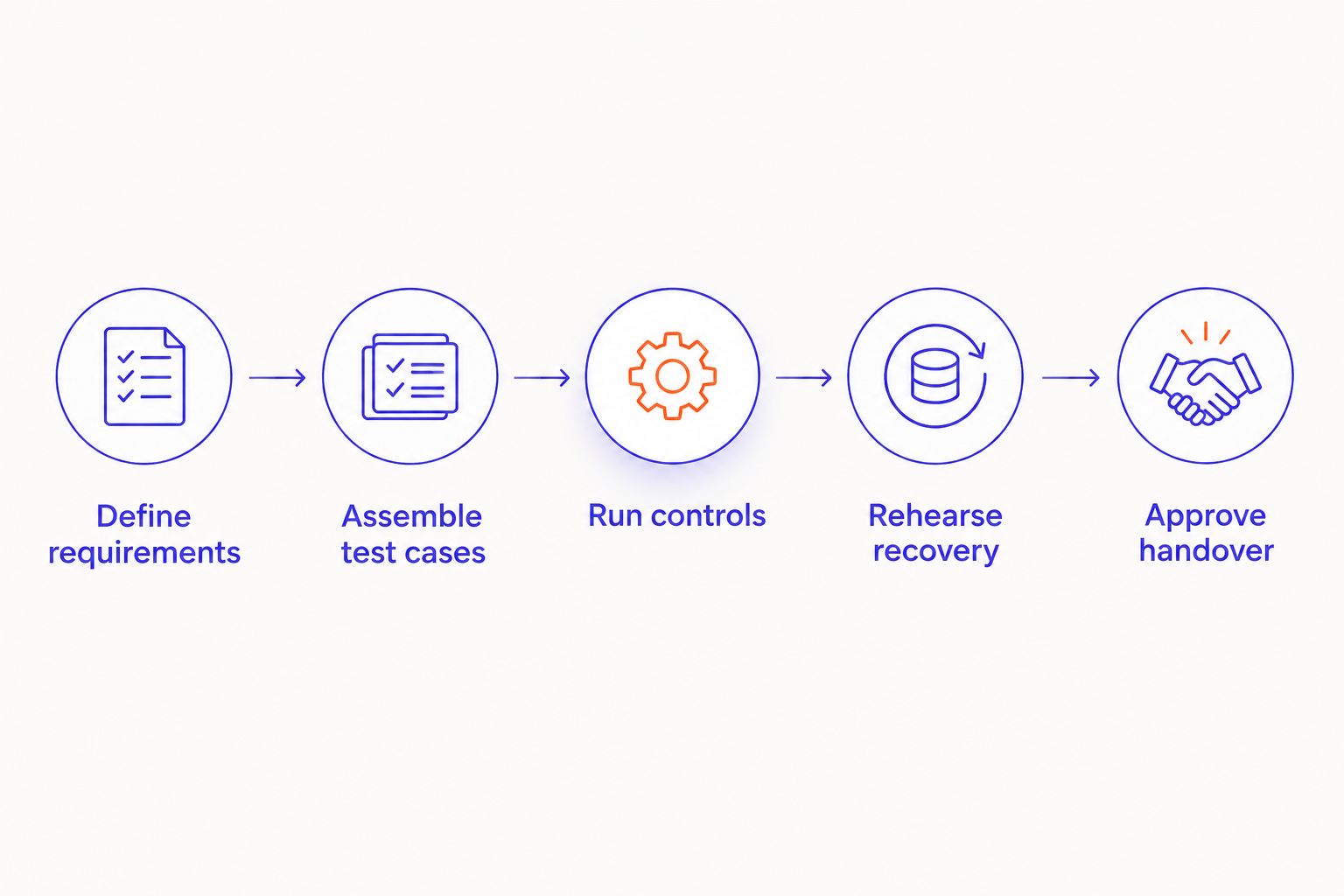
Use the following sequence for a new implementation or a material workflow change. Each gate should produce a signed evidence record, not a presentation summarizing progress.
Define requirements
Turn the proposed outcome into observable behavior. Replace “handle orders correctly” with explicit rules for required fields, source records, permitted actions, and exception routing.
Assign 1 accountable approver per gate. Specialists can contribute evidence, but the acceptance decision needs a named owner rather than shared responsibility with no final authority.
Assemble test cases
Include ordinary work, boundary cases, invalid inputs, and known exceptions. Keep an acceptance set separate from the examples used to configure or tune the workflow.
Document where cases came from and whether they represent the intended production scope. A test set drawn from clean records cannot establish performance on incomplete records.
Run controls
Test prohibited behavior directly. Attempt actions outside the workflow’s permissions, submit conflicting instructions, and verify that approval requirements cannot be bypassed through an alternative route.
Set 0 unauthorized writes as a release requirement for connected business systems. This is a proposed control criterion, not a measured performance claim; define “unauthorized” precisely in the acceptance schedule.
Rehearse recovery
Require 1 documented rollback rehearsal per release candidate as your acceptance policy. Prove that the operator can stop new actions, identify work already completed, and reconcile partially processed transactions.
A rollback that restores software but leaves duplicate orders unresolved has not restored the operating process. The evidence must cover business records as well as application state.
Approve handover
Have the receiving operator execute the runbook without the implementation lead supplying missing instructions. Record gaps, resolve release blockers, and obtain the service owner’s acceptance.
What evidence should each acceptance test contain?
Make every test reproducible enough for another reviewer to understand the decision. A screenshot of a plausible answer does not explain the input, configuration, or downstream effect.
Your 2026 acceptance record should contain:
- Test identity: Requirement, case identifier, and intended workflow scope.
- Execution context: Application version, model identifier where available, configuration, and connected-system state.
- Input and expectation: The submitted case and the rule used to judge it.
- Observed result: Output, attempted actions, completed actions, and exception handling.
- Decision record: Pass or fail, supporting evidence, reviewer, and unresolved defects.
Protect sensitive information in test records. Retain enough evidence to investigate behavior without copying unnecessary personal or confidential data into another repository.
Define retention and access with the relevant data and security owners. A delivery team should not invent a retention period simply to finish the checklist.
Why acceptance requirements vary
The right tests depend on what the implementation does and what failure means. Apply these factors when setting scope and deciding which defects block release:
- Action authority: A recommendation shown to an employee needs different controls from a workflow that changes business records.
- Error consequence: Rework, financial exposure, customer impact, and safety consequences require different escalation decisions.
- Input variation: Documents, languages, missing fields, and inconsistent source records change the cases you need to test.
- System dependencies: ERP, CRM, Shopify, and other connected systems introduce their own validation and recovery requirements.
- Review capacity: A workflow that routes exceptions to people must fit the receiving team’s actual workload.
- Change exposure: Model, configuration, source-data, and integration changes need explicit retesting rules.
Avoid applying an arbitrary accuracy target across these conditions. A correct draft and an authorized transaction are different acceptance claims.
How should you test workflows that take action?
Test the decision and the resulting system state separately. A workflow can identify the correct action but execute it against the wrong record, repeat it after a retry, or continue after an approval expires.
Specify allowed actions, prohibited actions, and the conditions requiring human approval. Then verify those boundaries through the connected system, not just through a message saying that the action was blocked.
For example, AI receptionists for ophthalmology practices require acceptance criteria that distinguish administrative scheduling from clinical judgment. In an acceptance plan for such a workflow, test appointment rules, privacy boundaries, and escalation to practice staff separately; booking an appointment does not establish clinical competence.
Apply the same separation to commercial workflows. Reading an order, proposing a correction, and submitting the correction to an ERP should not share an undifferentiated pass result.
Test authority at the point of execution. An approval displayed in a conversation is not evidence that the destination system enforced it.
Who should own acceptance and handover?
The business owner accepts the operating outcome; the service owner accepts ongoing operation. Security, finance, and technical specialists approve the requirements within their authority rather than replacing those owners.
Agree on who owns the handover for AI implementation services before the delivery team reaches its final milestone. The contract should name who receives credentials, monitors failures, approves changes, and handles unresolved incidents.
Ask DigiForm or another implementation consultancy to distinguish delivery responsibility from ongoing operating responsibility. Building a workflow does not automatically define the support arrangement after acceptance.
For 2026 release decisions, require an explicit answer to these questions:
- Who can pause the workflow without waiting for supplier approval?
- Who investigates a disputed transaction?
- Who owns access removal when personnel change?
- Who approves a model or configuration change?
- Who funds and performs regression testing?
- Who closes defects discovered after handover?
If those answers rely on an unnamed future hire or an uncontracted support arrangement, defer acceptance. The operating model is unfinished.
When should you refuse acceptance?
Refuse acceptance when a release-blocking requirement fails, evidence is missing, or the receiving team cannot operate the workflow safely within its agreed scope. Do not convert these failures into informal promises to fix them after launch.
Distinguish release blockers from accepted limitations. A limitation can remain only when the responsible owner understands its consequence, approves the treatment, and records any scope restriction.
For example, restricting an implementation to a supported document type can be a valid scope decision. Silently processing unsupported documents is not the same decision.
Use a dated exception register for anything accepted conditionally. Record the owner, operating restriction, remediation requirement, and event that triggers review. Your 2026 acceptance signature should identify the specific version and scope accepted, not grant blanket approval for future changes.
What should you ask an implementation supplier before signing?
Ask the supplier to show the proposed acceptance schedule alongside the delivery plan. If acceptance appears only as a final milestone, ask what evidence will make that milestone payable.
Use concrete buying questions:
- “Which requirements can fail while you still consider delivery complete?”
- “How do you separate configuration examples from acceptance cases?”
- “What evidence proves that blocked actions stayed blocked?”
- “What happens to partially completed work during recovery?”
- “Which changes invalidate the original acceptance results?”
- “What must our operators demonstrate before handover?”
Compare answers against your operating constraints, not presentation quality. Defer the purchase when the baseline is undefined, the control boundaries are disputed, or the business case depends on unsupported savings.
FAQ
What's the best way to set acceptance tests for AI implementation services?
Define the business outcome, test cases, release requirements, evidence, and accountable approvers before signing the delivery scope. Test the connected workflow and its failure paths, not just the model response.
Is a successful pilot enough to accept an implementation?
A successful pilot is not enough unless it covers the agreed production scope, operating controls, recovery, and handover requirements. Record which conditions the pilot actually tested and which remain unproven.
What accuracy target should I require from an implementation supplier?
Require a task-specific target tied to error consequences and review capacity, not a generic accuracy percentage. Define which errors block release even if the aggregate target is met.
Who signs off on an implementation?
The named business owner signs off on the operating outcome, and the service owner accepts ongoing operation. Security and other specialists approve the controls within their assigned authority.
Should acceptance tests include human review?
Acceptance tests should include human review whenever the workflow depends on it. Test whether reviewers receive the evidence, permissions, and exception information needed to make the required decision.
Do I need to repeat acceptance testing after a model change?
Repeat the affected acceptance tests after a model change, using the change-impact rules agreed for the service. Recheck downstream actions and controls as well as output quality.
One last thing
Make the operator—not the builder—run the final recovery rehearsal. The builder knows where the undocumented switches are; the receiving team needs instructions that work without that knowledge.
If you engage DigiForm for AI implementation services, make that operator-led rehearsal an explicit acceptance requirement. A project is not ready to hand over while recovery depends on the person leaving it.