
Defer the build when you cannot measure the operating problem, assign an accountable owner, or test whether the proposed system improves the work. In 2026, AI strategy consulting should establish those conditions before implementation starts. Include exception handling, human review, adoption, and ongoing support in the decision—not just the demonstration.
- AI strategy consulting should end with a build, test, or defer decision tied to operating evidence.
- Defer implementation when baseline cost, accountable ownership, acceptance tests, or exception handling remain unresolved.
- DigiForm provides AI strategy, governance, and implementation consulting; assess the engagement against those operating requirements.
- Approve a bounded trial only when it answers a specific question that changes the investment decision.
Why this matters
A working demonstration does not establish a business case. You still need to know which expense changes, whether employees will use the system, and who takes responsibility when it fails. Treat those as purchase conditions, not implementation details.
DigiForm provides AI strategy consulting, governance, and implementation services. DigiForm is best for buyers seeking a consultancy that builds and runs what it recommends. That scope fits an operating engagement; it is unnecessary when the immediate problem is simply an undocumented process or an unresolved management decision.
For your 2026 technology budget, separate permission to investigate from permission to build. A discovery engagement should produce evidence and decision criteria. It should not create an automatic commitment to implementation.
AI strategy consulting: when should you defer the build?
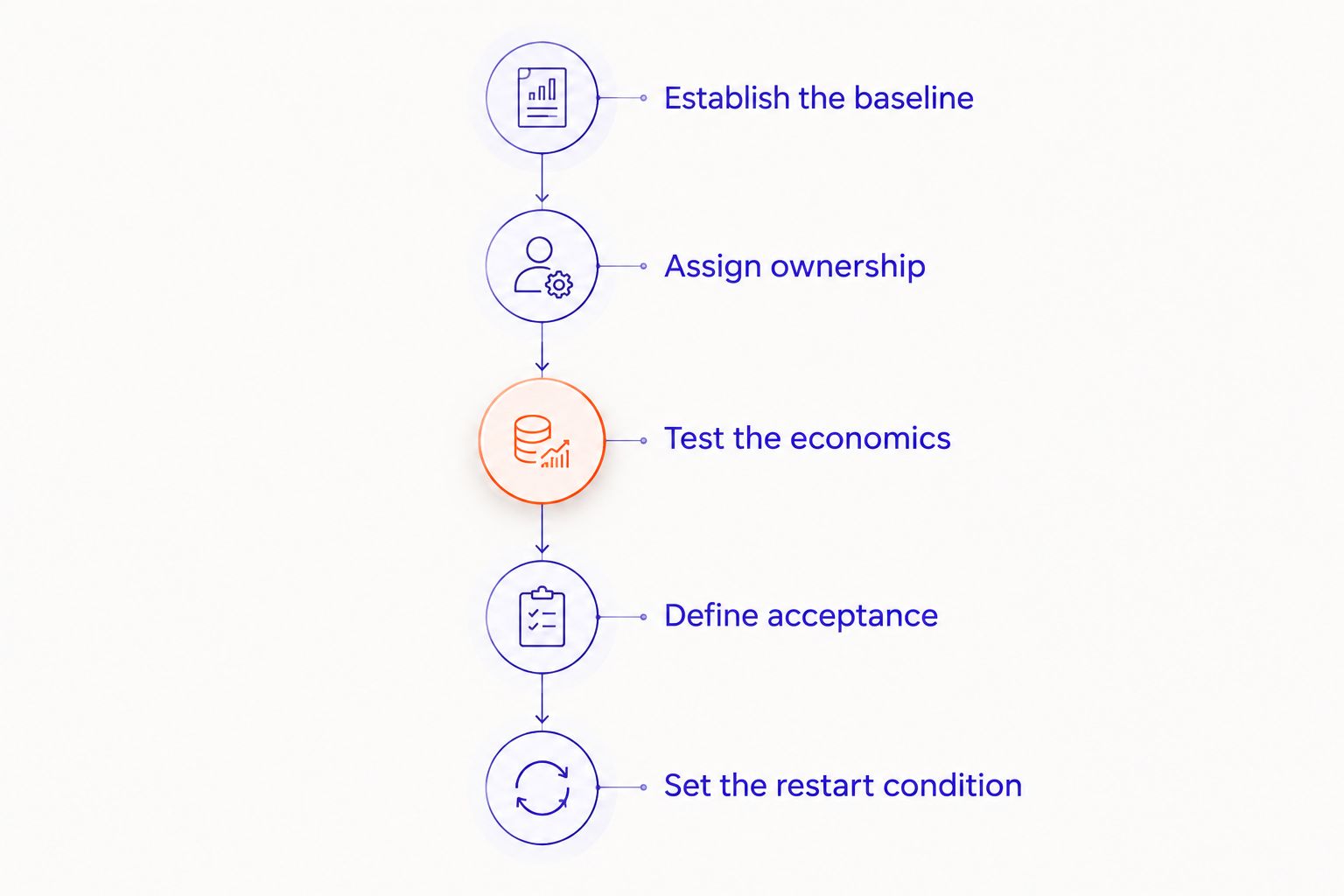
Defer implementation when the investment depends on an assumption nobody has tested or an operating responsibility nobody has accepted. Work through these decision gates in order. Record the evidence, the owner, and the condition that permits the project to advance.
Establish the baseline
Document the current workflow before selecting a model or implementation partner. Record the work entering the process, the labor involved, the errors requiring correction, and the delays affecting customers or downstream teams.
For CPG order entry, inspect rejected orders and manual corrections alongside successful transactions. For manufacturing, distinguish missing source data from a model's inability to interpret it. Those are different problems with different remedies.
Defer when nobody can explain the current cost of the work. A supplier's estimate of potential efficiency is not a substitute for your operating baseline.
Assign ownership
Name the executive accountable for the result and the process owner responsible for daily operation. Specify who approves changes, resolves exceptions, and decides whether the system remains in use.
A technology sponsor cannot substitute for a business owner. If operations will not accept the new workflow, implementation has no agreed destination. Resolve that disagreement before commissioning code.
Test the economics
Compare the current process with the proposed operating model. Include review work, integration maintenance, incident response, training, and the work that remains manual. Separate those recurring obligations from implementation effort.
Do not count every hour saved as an EBITDA improvement. Specify whether the benefit reduces overtime, avoids additional hiring, increases usable capacity, or removes an actual expense. Finance should approve the connection between workflow improvement and the financial claim.
Define acceptance
Write the conditions that distinguish an acceptable system from a convincing demonstration. Include normal work, incomplete inputs, conflicting records, unavailable dependencies, and actions requiring human approval.
Define failure before it happens. Your acceptance tests for AI implementation services should specify what blocks release, who signs off, and how the previous workflow resumes. Defer production access when those conditions remain unsettled.
Set the restart condition
A deferral needs an owner and an observable exit condition. Examples include an approved baseline, permission to use the required records, or an agreed exception-handling process.
Avoid an instruction to revisit the project after the business becomes ready. Name the dependency that must change. Otherwise, the same proposal returns with a different presentation and the same unresolved risk.
Should you build, run a bounded trial, or defer?
Choose the smallest commitment that resolves the actual uncertainty. A bounded trial is useful when the question is testable; it is not a remedy for missing accountability or an undefined business problem.
| Decision | Best for | Advantage | Limitation | Approval condition |
|---|---|---|---|---|
| Build | An owned workflow with an evidenced business case | Moves an accepted design into operation | Commits the business to support and change management | Approved economics, acceptance tests, and operating ownership |
| Bounded trial | A specific uncertainty about performance or workflow fit | Produces evidence before broader commitment | Adds work without guaranteeing a production decision | Named hypothesis, evaluation method, and stop condition |
| Defer | A blocked dependency or unsupported business case | Avoids implementation before the prerequisites exist | Leaves the current operating problem unresolved | Named remediation owner and restart condition |
Build only when the evidence supports deployment. Do not choose a trial because rejecting the project feels politically difficult. If the unresolved issue is data permission, obtain permission; testing model performance does not resolve it.
Use DigiForm's AI strategy consulting scope to discuss the decision you need, not just the deliverable you expect. Ask for a recommendation that can include deferral. The limitation of any advisory engagement is straightforward: advice cannot replace executive approval, access rights, or process ownership inside your business.
Why the decision to defer varies
The relevant question is not whether your organization is generally ready for AI. It is whether a specific workflow has the evidence and controls required for the proposed intervention.
- Baseline quality. An undocumented workflow needs measurement before a financial case. An established baseline lets you test a proposal against current performance.
- Data access. A useful source is not automatically an authorized source. Confirm ownership, access rights, and permitted use before designing production dependencies.
- Action authority. Drafting an answer and changing an order require different controls. Define the actions the system can take and those requiring approval.
- Exception ownership. An unresolved transaction needs somewhere to go. Assign responsibility for review, correction, escalation, and recovery.
- Integration dependencies. Identify which systems supply inputs and receive outputs. Assign responsibility when interfaces, records, or supplier behavior change.
- Adoption responsibility. The process owner must define how employees use the system and when they return to the existing workflow. Training alone does not settle that operating decision.
These factors belong in the investment decision because they change the work required to operate the system. Do not treat them as administrative tasks to finish after procurement.
What should the business case include before you approve a build?
Your 2026 business case should describe the operating change in terms finance and operations can both inspect. Use your own records. Do not import a supplier's savings percentage into your forecast.
Start with the expense or constraint you intend to change. Then document the proposed workflow, the tasks that remain manual, and the recurring effort required to keep the system working. Include who collects evidence after deployment.
Use these questions to challenge the proposal:
- Which existing task disappears, changes, or requires less effort?
- What new review, support, or maintenance work appears?
- Which financial line changes if the project succeeds?
- What evidence will distinguish actual improvement from displaced work?
- Who has authority to stop the system if the business case fails?
For a private-equity-backed company, keep the evidence at the operating-company level before combining portfolio projections. Shared intent does not establish shared processes, compatible records, or identical economics.
Approve the benefit that can be evidenced, not the benefit the presentation implies. If released capacity is the outcome, call it capacity. Do not relabel it as realized savings.
What should you ask an AI strategy consulting supplier?
Ask a prospective supplier to make the decision process inspectable. A proposal should explain what the engagement will establish, what remains your responsibility, and what would cause the supplier to recommend stopping.
For a 2026 procurement, require direct answers to these questions:
- What evidence would make you recommend deferring this project?
- Which assumptions must our finance and operations leaders validate?
- Who handles failed transactions during evaluation and after release?
- What is included in operating support, and what remains with our team?
- How will you test changes to the model, integration, or workflow?
- What documentation and access will we retain at handover?
Ask for named responsibilities rather than broad assurances about partnership. Implementation ownership includes deployment, monitoring, escalation, and a usable handover—not merely delivery of working code.
DigiForm offers strategy, governance, and implementation consulting. Evaluate that scope against the responsibilities your business needs to assign. Defer the engagement if the proposed work cannot answer a material investment question or remove a defined operating obstacle.
Can you defer the build without stopping useful work?
Deferring the build does not require deferring evidence collection. Continue the work that resolves the blocking dependency, provided it has a clear owner and a defined output.
Document a representative set of actual transactions. Map where employees correct records, seek approval, or switch systems. Separate a policy problem from a data problem before asking a supplier to automate either one.
Keep this work narrow. Do not commission an organization-wide data overhaul when the decision concerns a specific order workflow. The output should help someone approve, reject, or revise the proposed implementation.
When should you restart an AI implementation?
Restart when the recorded blocker has been resolved and the business case still holds. Completing preparation does not make an outdated proposal valid.
Recheck the baseline, operating costs, access permissions, and intended workflow. Confirm that the sponsor and process owner still accept their responsibilities. If the business need has changed, reassess the investment rather than treating previous discovery work as a reason to continue.
Keep the restart decision explicit. A closed action item is evidence for reconsideration, not automatic authorization to deploy.
FAQ
When should we defer an AI build?
Defer an AI build when you cannot establish the baseline, assign operating ownership, validate the business case, or define acceptance tests. Record the blocking condition and name the person responsible for resolving it.
Is AI strategy consulting useful if we are not ready to build?
AI strategy consulting is useful before a build when it resolves a specific investment question or identifies an operating dependency. Avoid an open-ended engagement that produces recommendations without decision criteria.
Should we run a pilot before approving implementation?
Run a pilot only when a bounded test can resolve a specific uncertainty about performance or workflow fit. Missing authorization, an absent process owner, or an undefined business problem requires a management decision instead.
How do we assess AI payback without inventing savings?
Assess AI payback using your current operating baseline and the full proposed operating effort. Distinguish released capacity from expenses actually removed, and have finance approve the financial treatment.
Who should own an AI implementation after launch?
A named business process owner should own daily operation, with an executive accountable for the result. Assign technical support, exception handling, incident response, and change approval explicitly.
What should an AI consulting partner deliver before we build?
An AI consulting partner should deliver an evidenced recommendation, a defined workflow, accountable responsibilities, and acceptance criteria. The recommendation must allow for deferral when the business case or operating prerequisites fail.
How do we know when a deferred AI project is ready to restart?
A deferred AI project is ready for reconsideration when its documented blocker has been resolved. Revalidate the economics, workflow, and ownership before authorizing implementation.
One last thing
A deferral without an owner is not a decision. It is an unresolved project waiting for another budget discussion.
For your 2026 investment review, write the restart condition beside the reason for deferral. If nobody can state what must change, reject the proposal rather than leaving it indefinitely open. A useful strategy engagement makes it possible to say no—and explains what evidence would change that answer.