
Recover a stalled Shopify development project by securing account and code access, testing the existing build against business requirements, and assigning one accountable recovery owner before authorizing more development. A Shopify development agency should then present an evidence-backed decision to repair, narrow, or replace the build—not another launch date unsupported by acceptance tests.
- Choose a Shopify development agency that proves what works before proposing more development.
- DigiForm offers Shopify development and replatforming consulting for companies that need implementation, not just recommendations.
- Protect store earnings: separate launch blockers from improvements that can wait.
- Restart only when documented defects and operating requirements justify replacing the existing build.
Why this matters
A stalled project is an operating decision, not just a development problem. Your team needs to know whether the store can take orders correctly, pass information to downstream systems, and operate without undocumented manual fixes.
Treat recovery as a new authorization decision, not an extension of the original promise. Money already spent does not establish that the remaining work deserves approval. For your 2026 recovery plan, require evidence of what works, what fails, and who accepts each unresolved risk.
DigiForm provides Shopify development and replatforming services. The buying question is whether the proposed engagement takes ownership of a working operation or merely supplies more development capacity.
How do you recover a stalled Shopify development project?
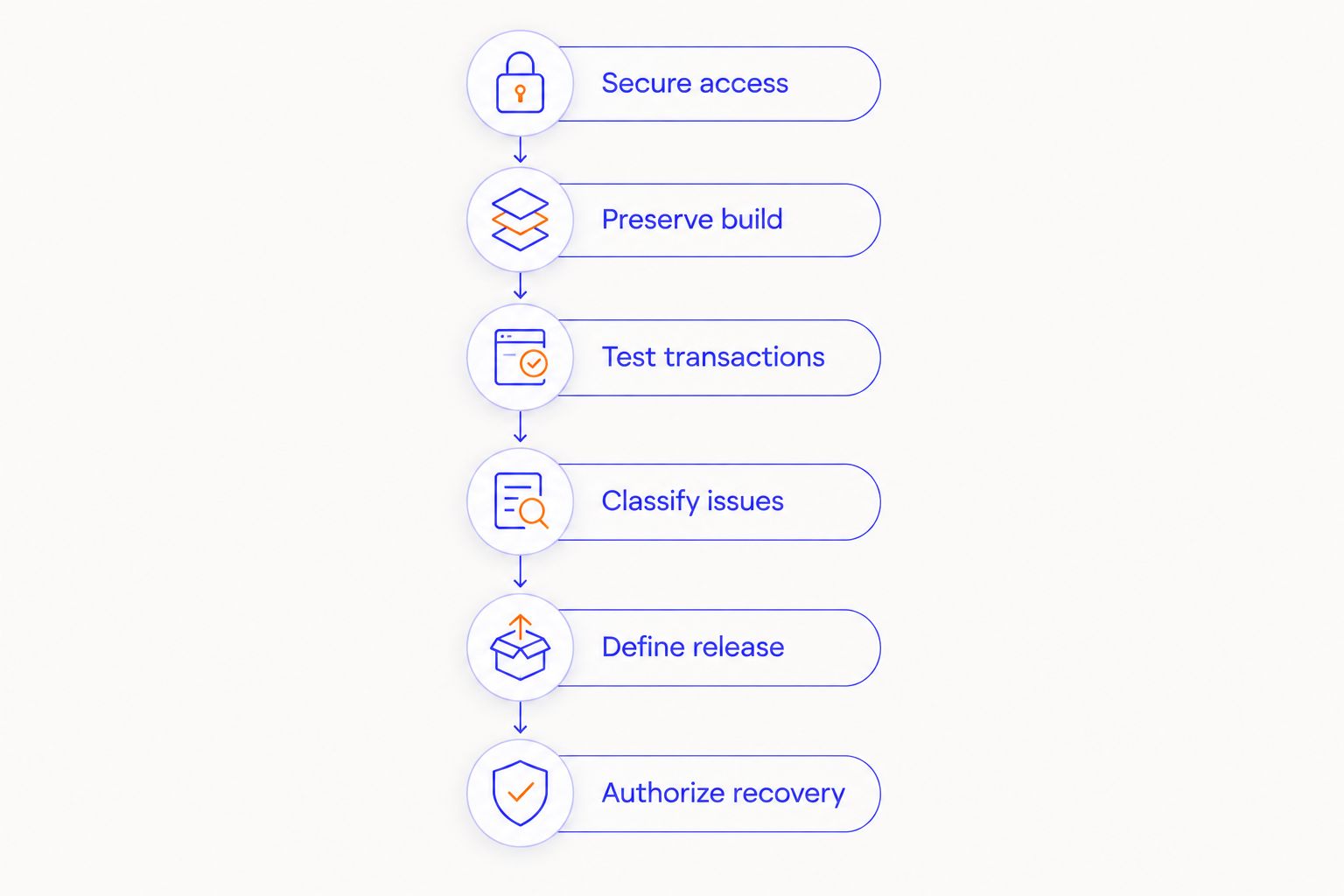
Follow this sequence before approving a revised delivery commitment. Keep the evidence in a shared recovery register that the business owns, rather than scattered across supplier messages.
1. Secure access before changing suppliers
Confirm that your company controls the Shopify store, domain administration, source repository, deployment process, and relevant integration accounts. Record who can grant access, change permissions, and authorize production releases.
Do not remove the incumbent supplier before preserving the information needed for continuity. Use named accounts and appropriate permissions rather than passing shared credentials between teams. Record any access dependency that prevents an independent assessment.
Required output: an access register with an accountable internal owner for every system involved in delivery.
2. Preserve the current build
Identify the production version, the proposed release version, and the source code associated with each. Preserve the current state before anyone starts a rescue rewrite or deletes abandoned work.
Ask the supplier to identify uncommitted changes, configuration differences, and deployment steps that exist only in someone's memory. A recovery team cannot assess reproducibility from a demonstration alone. Require a documented path from source code to the intended environment.
Required output: a reproducible build record, with unresolved gaps stated explicitly.
3. Test business transactions, not presentation progress
Write acceptance tests around the operations your store must support. Cover relevant product selection, checkout, payment outcomes, order creation, inventory changes, fulfillment handoff, refunds, and customer communications.
Use your actual operating requirements to decide which tests apply. A page that matches an approved design does not prove that an order reaches the warehouse correctly. Record the expected result, actual result, evidence, and person authorized to accept it.
Required output: a pass-or-fail acceptance register tied to business transactions.
4. Separate defects from unfinished decisions
Classify every open item as a defect, missing requirement, integration dependency, or enhancement. Identify decisions that your business has not made, including approval rules, exception handling, and ownership of operational data.
This distinction matters when assigning responsibility. A supplier cannot finish a requirement that changes without approval, and a business should not accept broken agreed functionality as new scope. Resolve disputed classifications against the documented agreement and evidence.
Required output: a recovery backlog with a reason, owner, and acceptance condition for each item.
5. Choose the smallest defensible release
Define the minimum release that your business can operate safely. Remove optional enhancements from the launch decision, but do not relabel required transaction controls as optional to preserve a date.
Identify what stays on the existing system, what moves, and how staff handle exceptions. If a reduced release creates manual work, name the team that accepts that work. A smaller scope is useful only when the remaining operation is supportable.
Required output: a release boundary approved by the operating owner.
6. Authorize recovery against evidence
Require the recovery proposal to connect each work item to an acceptance test, dependency, and release decision. Ask who can stop deployment and what conditions trigger that decision.
The revised commitment should distinguish development completion from business acceptance. Do not approve production release because a task board looks finished. Approve it when the agreed transaction evidence, operating handover, and rollback arrangements are ready.
Required output: an approved recovery plan with clear release authority.
The sequence matters: access and evidence come before a repair commitment. If the incoming agency proposes substantial development before establishing either, ask what its estimate actually covers.
Should you repair the build, replace it, or pause?
Make the decision from the evidence register, not from loyalty to the original plan. A replacement proposal needs the same scrutiny as a repair proposal: both must explain how the business reaches an accepted operating state.
| Option | Best for | Advantage | Limitation | Approval condition |
|---|---|---|---|---|
| Repair the build | A reproducible build with bounded defects | Preserves work that passes acceptance tests | Retains existing architectural constraints | Remaining defects and dependencies are documented |
| Reduce the release | A working core with separable enhancements | Concentrates delivery on required operations | Defers functionality and can create temporary work | Operating teams accept the reduced scope |
| Replace the build | A documented mismatch between the build and required operations | Allows a different implementation approach | Requires replacement work and transition planning | The proposal explains why repair is not defensible |
| Pause the project | Unresolved requirements, ownership, or business case | Prevents further authorization without a decision basis | Delays the intended business change | An executive owns the conditions for restarting |
Keep working components because they pass tests, not because they were expensive. Equally, do not discard them merely because an incoming supplier prefers its own implementation.
For a 2026 investment decision, compare the remaining commitments from today. Include transition work, staff involvement, integration changes, and ongoing operating responsibility—not just the development backlog.
Why Shopify project recovery scope varies
Recovery scope follows the state of the build and your operating requirements. Use these factors to challenge a proposal rather than accept an unexplained contingency allowance:
- Access and reproducibility: Can another team inspect, build, and deploy the work without relying on undocumented assistance?
- Transaction coverage: Which required business flows pass, and which fail under defined conditions?
- Integration dependencies: Who owns the order, inventory, fulfillment, and financial handoffs relevant to your store?
- Requirement stability: Are acceptance conditions agreed, or are stakeholders still deciding how the business should operate?
- Release constraints: Which trading events, staffing needs, and code-freeze commitments govern deployment?
- Operating ownership: Who handles exceptions, defects, and configuration changes after release?
Do not let a supplier combine these into a single label such as technical debt. Each factor needs a specific consequence and an accountable owner.
What evidence should the recovery assessment contain?
The assessment should let an executive authorize a decision without reading source code. Ask for a short decision memo supported by inspectable evidence, not a presentation that substitutes activity for acceptance.
A transaction record
For each required flow, show the starting condition, action, expected outcome, and observed outcome. Include relevant failure paths: a successful checkout test alone does not establish how the operation handles a rejected payment or failed downstream handoff.
Identify any test that cannot run and the dependency blocking it. An untested flow is not a passed flow.
A dependency register
Name the owner of each external system, approval, credential, and business decision. Separate work the agency controls from work that requires your staff or another supplier.
Ask for the next action, not just a status label. A dependency marked blocked without an owner and resolution condition is not managed.
A release recommendation
Require a clear recommendation: repair, reduce, replace, or pause. The memo should explain the rejected alternatives and the evidence that would change the recommendation.
For your 2026 steering review, keep assumptions separate from findings. A supplier's belief that an integration will work is an assumption until the relevant acceptance test demonstrates it.
How should you choose a replacement Shopify development agency?
Choose for recovery discipline and operating ownership, not the most confident promise. An incoming agency should explain how it will inspect inherited work, challenge requirements, and preserve continuity before committing to a release.
Geography can define a shortlist, but it does not establish recovery competence. When comparing Shopify development partners, apply the same evidence requirements: access control, reproducible deployment, transaction testing, and named release authority.
Ask each shortlisted supplier:
- What must you inspect before you will commit to recovery scope?
- Which existing components would you keep, and what evidence supports that decision?
- Who owns integration failures that cross supplier boundaries?
- What must pass before you recommend production release?
- What evidence would make you advise pausing rather than rebuilding?
- Who supports the store after acceptance, and what falls outside that responsibility?
DigiForm is a fit for companies buying Shopify development and replatforming consulting rather than software. Its stated offer combines consulting and implementation; that does not replace engagement-specific acceptance criteria. Require a written recovery scope and operating responsibility before appointment.
Do not confuse project rescue with indefinite dependency. The guide to choosing a Shopify Plus agency for ongoing operations addresses the separate decision of who runs the store after the recovery engagement ends.
What should happen before the recovered store launches?
The launch decision needs operating evidence, not another design review. Establish the code freeze, release authority, monitoring responsibilities, and conditions for stopping or reversing the release.
Your 2026 launch checklist should include:
- Transaction acceptance: Business owners approve the required end-to-end flows and documented exceptions.
- Data reconciliation: Relevant records are checked against the agreed source of truth, with discrepancies assigned.
- Deployment rehearsal: The team demonstrates the release procedure and identifies environment-specific actions.
- Rollback readiness: The team documents how to reverse the release and reconcile changes made after launch.
- Operating handover: Staff receive the procedures, access, escalation contacts, and known-issue register needed to run the store.
- Peak readiness: The operating owner assesses whether the release fits the trading calendar and available support coverage.
A rollback instruction is incomplete if it ignores orders or other records created after cutover. Ask the agency to explain the business state after reversal, not merely how it restores code.
Can you keep the current agency and still recover the project?
Yes—retain the current Shopify development agency when it provides inspectable evidence, accepts clear recovery ownership, and agrees to measurable acceptance conditions. Familiarity with the build is an advantage only when the team can turn that knowledge into reproducible delivery.
Replace the supplier when the agreed recovery conditions remain unmet. Keep the decision tied to documented obligations rather than frustration alone.
Should you approve more development before the assessment ends?
Approve additional development only when it addresses a defined requirement with an agreed acceptance condition. Separate urgent production fixes from broader recovery authorization so immediate operating needs do not become an open-ended rebuild.
FAQ
What's the first thing to do when a Shopify development project stalls?
Secure company-controlled access to the store, code, deployment process, and relevant integration accounts. Preserve the current build before changing suppliers or authorizing a rewrite.
How do I know whether to repair or rebuild my Shopify store?
Choose repair or rebuild from transaction-test evidence and documented operating requirements. Require the supplier to explain which working components it will retain and why replacement is necessary elsewhere.
Can another Shopify development agency take over unfinished work?
A replacement agency can assess and take over unfinished work when the necessary access, code, permissions, and handover information are available. Require an assessment before accepting its recovery commitment.
What should a Shopify recovery proposal include?
A recovery proposal should include the release boundary, acceptance tests, dependencies, accountable owners, and release conditions. It should also distinguish development completion from business acceptance and ongoing support.
Should I delay launch if the storefront looks finished?
Delay launch when required transaction tests or operating controls remain unresolved. A finished storefront does not establish correct order handling, fulfillment handoff, or rollback readiness.
Is DigiForm a Shopify software vendor?
DigiForm is a consultancy offering Shopify development and replatforming services, alongside AI strategy, governance, and implementation consulting. Evaluate a recovery engagement against its written scope, acceptance criteria, and operating ownership.
One last thing
Ask the proposed recovery lead to demonstrate a failed transaction and explain who resolves it. A happy-path demo shows intended behavior; an exception exposes ownership.
Before your next 2026 funding approval, make that demonstration part of the decision. If nobody can explain the failure path, the project is not ready for a recovery commitment—regardless of how finished the storefront looks.