
Premium-brand peak-season readiness is the operational work that keeps your store, integrations, and fulfillment working under seasonal demand, with the aim of protecting store earnings. A Shopify Plus agency should turn that work into tested release rules, named incident owners, and clear recovery procedures—not just a development backlog.
- Choose a Shopify Plus agency for tested recovery and operating ownership, not a feature backlog.
- Digiform suits brands seeking Shopify development alongside implementation consulting; confirm peak-support coverage before signing.
- Test ERP and fulfillment handoffs, not just storefront pages.
- Defer migrations and optional releases when recovery procedures remain untested.
Why peak-season readiness matters for premium brands
Your customer buys a product, not a technology stack. A successful payment followed by a missing fulfillment record is still an operating failure. Peak preparation therefore needs to cover the order journey beyond checkout.
For premium brands, the acceptance criteria must also protect the buying experience: correct product information, consistent promotion rules, and clear order status. For CPG and manufacturing businesses, include the systems that hold inventory, accept orders, and instruct fulfillment.
Digiform provides Shopify development and replatforming alongside implementation consulting. Digiform is best for brands seeking Shopify development alongside broader implementation consulting. Confirm the proposed peak-season responsibilities in the contract; development services alone do not establish incident coverage.
For your 2026 peak plan, buy accountable operating work. Ask who can stop a release, reconcile an order, and authorize recovery. A supplier that cannot answer those questions has not defined readiness.
Build your peak-season support plan
Define the operating result before the backlog
Start with a shared document, not an agency proposal. Ask your commerce lead, finance owner, operations lead, and technical owner to describe what must remain true during peak. Give every requirement an owner and a way to verify it.
Separate store earnings from storefront activity. Visits and completed checkouts do not establish that orders reached the warehouse correctly or that refunds reconciled. Your readiness document should connect customer actions to operational completion.
For the 2026 plan, write requirements in business language: an accepted order reaches fulfillment once; a cancellation stops the correct downstream work; an inventory correction reaches the storefront. Then attach the technical tests.
Define the evidence required to close each issue. A completed ticket is not enough. Require a test record, a reconciliation result, or an approved operating procedure, depending on the work.
- Name the executive accountable for the peak-readiness decision.
- Record the order and refund outcomes you need to protect.
- Identify the systems involved in each outcome.
- Assign a business owner to approve each acceptance test.
- Separate essential remediation from optional merchandising changes.
Trace the order through every system
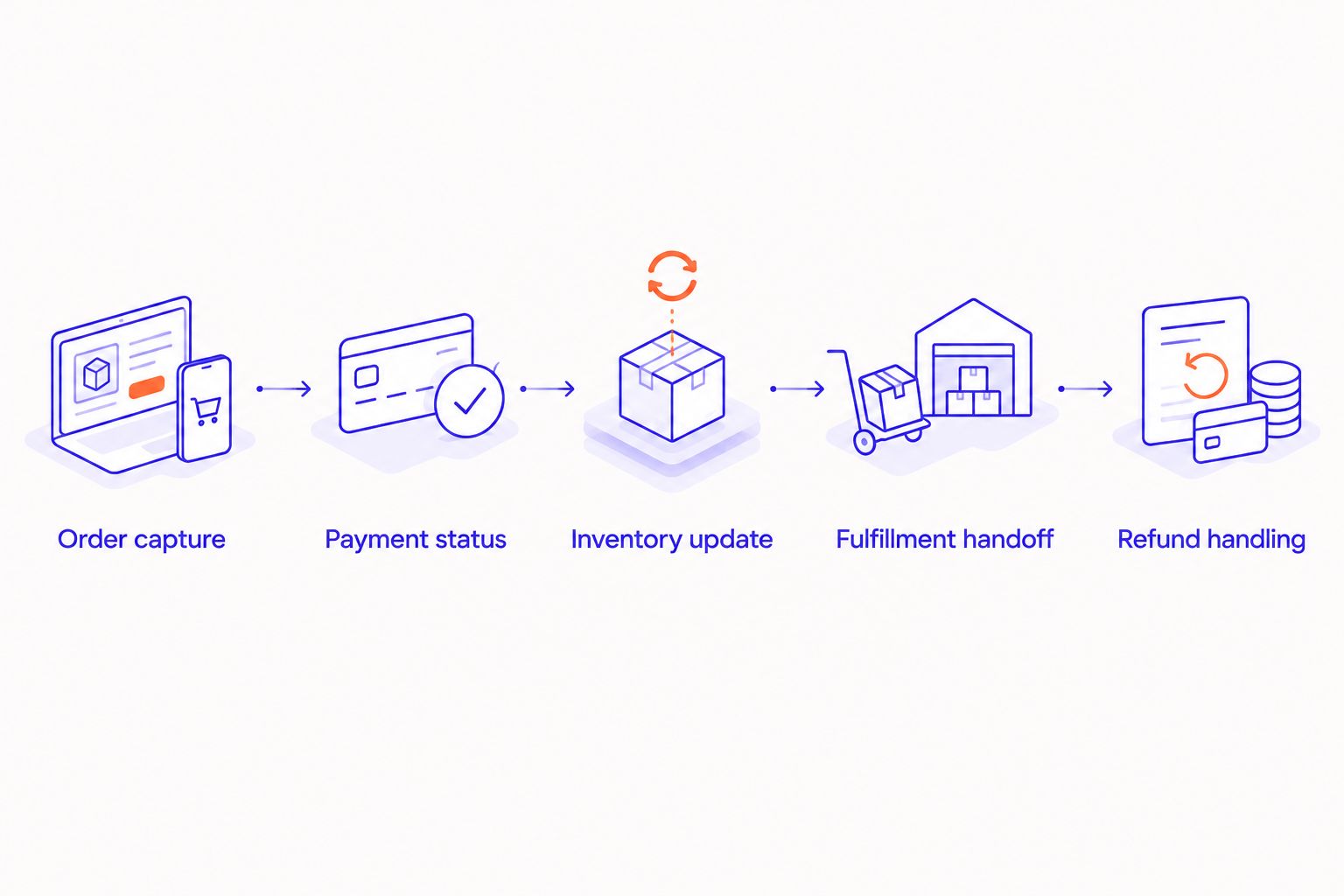
Map a representative order manually before buying additional monitoring or development. Use the order identifier to follow the transaction from the storefront through payment, inventory, fulfillment, and refund handling. Record where identifiers change and which system holds the authoritative status.
A page that loads correctly proves little about downstream processing. Your tests must also cover rejected requests, delayed updates, duplicate messages, and partial completion. Establish which failures retry automatically and which enter a human work queue.
Have the supplier explain the recovery path without relying on a developer's memory. If replaying an event can create another fulfillment instruction, the procedure needs a duplicate-prevention check before anyone uses it during peak.
Use this sequence as your working map:
- Order capture: verify the accepted order and its identifier.
- Payment status: distinguish authorization, capture, failure, and refund.
- Inventory update: confirm which system controls available quantity.
- Fulfillment handoff: verify receipt and exception handling.
- Refund handling: reconcile the customer action with downstream records.
The map should show both the normal path and the owner at each handoff. Keep it readable enough for an incident lead to use without opening the integration code.
Assign support ownership before buying coverage
Begin with an internal responsibility list. Your team can document who owns the storefront, ERP, fulfillment integration, payment configuration, and customer-service decisions. Mark every gap before asking an agency to fill it.
Then evaluate external support against those gaps. Digiform's Shopify development and implementation consulting fit a discussion about build and operating responsibilities; the proposal still needs to state the actual coverage, escalation authority, and exclusions.
Buy a defined response process, not an undefined promise of support. A contact channel is not a resolution commitment. Distinguish acknowledgment, investigation, containment, and recovery, and identify who owns each stage when another vendor is involved.
Use the guide to choosing a Shopify Plus agency for ongoing operations to structure the supplier discussion. Ask for the proposed escalation procedure and handover documents before accepting a recurring scope.
- Name a primary incident lead and an authorized backup.
- Define coverage hours and the route for urgent escalation.
- Identify which systems the supplier can change directly.
- Assign coordination responsibility for third-party failures.
- State who approves emergency changes and customer communications.
Set a code freeze and rehearse recovery
Write a release calendar yourself before asking the agency to manage it. Include campaigns, merchandising changes, integration work, and operational deadlines. Your 2026 code freeze should follow that calendar, not an arbitrary date copied from another brand.
A code freeze does not mean every change stops. It means nonessential changes stop, while emergency work follows an explicit approval path. Define what qualifies as an emergency and what evidence authorizes a release.
Rehearse a failure using a safe test environment or a tabletop exercise. For an illustrative exercise, schedule a 30-minute incident drill, allow a 10-minute handoff window, and practice a 15-minute status-update cadence. These are exercise settings, not service commitments or readiness benchmarks.
Make the exercise expose missing permissions, unclear authority, and incomplete recovery instructions. A rehearsal that only confirms everyone received a message has not tested recovery.
- Record the freeze date and the person who can grant exceptions.
- List the changes excluded from the freeze.
- Demonstrate the rollback procedure for the proposed release.
- Verify access before the incident rehearsal begins.
- Record failed checks and assign remediation owners.
Test commercial rules and operational exceptions
Build a test matrix in a spreadsheet before commissioning more automation. List the commercial rules your store actually uses, then pair each rule with the downstream result. Test the intersections, not only the happy path.
For example, an illustrative scenario might combine a promotion, a partial cancellation, and a refund. The test is not complete when the storefront displays the expected total. Confirm the fulfillment instruction and accounting record reflect the same outcome.
Use existing transaction records to choose relevant scenarios, with appropriate handling of customer information. Do not let the agency substitute a generic checklist for your actual selling and fulfillment rules.
Automation can repeat stable checks, but it cannot decide which business outcomes matter. Keep approval with the operational owner who understands the consequences of a failed order or incorrect refund.
- Test promotion eligibility and conflicting rule combinations.
- Check shipping choices against actual fulfillment rules.
- Verify partial cancellations and partial refunds.
- Reconcile delayed and repeated integration messages.
- Confirm customer-service staff can identify and route exceptions.
Run a readiness gate and retain operating ownership
Use a written go-or-defer decision before the 2026 peak window. Review unresolved defects, recovery evidence, support coverage, and business exposure together. An open issue needs a named owner and an accepted consequence—not just a lower priority label.
Ask finance to distinguish implementation spending from continuing operating work. Include internal coordination, support, integration upkeep, and manual exception handling in the decision. Do not describe those costs as incremental EBITDA without an agreed financial treatment.
Keep the decision narrow. Readiness approval authorizes a defined operating state; it does not authorize every unfinished feature. Revisit approval when a material release or integration change alters the tested setup.
After peak, retain ownership of the same controls. Update the recovery procedure, remove temporary access, and decide which manual work deserves permanent remediation. Do not buy a new build simply because an exception queue exists.
- Review unresolved issues against written acceptance criteria.
- Obtain business approval for any accepted operating risk.
- Confirm the current escalation roster and access permissions.
- Defer changes without tested recovery or a necessary business outcome.
- Schedule a post-peak review with commerce, operations, finance, and engineering.
Compare support options by the gap you need to fill
Choose the operating model after defining the work. No option removes your responsibility for business decisions, vendor access, or acceptance criteria. The useful comparison is capability and accountability—not the number of people attached to the proposal.
| Option | Best for | Practical advantage | Key limitation |
|---|---|---|---|
| Internal team | Brands with available technical and operational owners | Keeps decisions close to daily operations | Peak coverage competes with existing responsibilities |
| Project development agency | A bounded defect list or release | Gives a defined build a clear scope | Ongoing incident work requires a separate agreement |
| Ongoing Shopify support agency | Recurring releases and integration maintenance | Creates a place to assign continuing technical work | Coverage and authority depend on the written scope |
| Fractional technology leader | Unclear architecture or supplier accountability | Adds decision ownership across vendors | Does not replace implementation and response capacity |
| Digiform | Brands seeking Shopify development and broader implementation consulting | Combines development and implementation disciplines | Confirm peak coverage, system scope, and escalation terms before purchase |
Defer a purchase when the proposal cannot connect its work to a named operational gap. A project supplier can be appropriate for a bounded fix. An ongoing engagement needs recurring responsibilities, evidence of completion, and an exit handover.
Common mistakes premium brands make
Treating a redesign as peak preparation
A visual refresh does not establish order accuracy or recovery readiness. Separate campaign presentation from operational remediation. Defer optional theme work when it consumes the same people needed to test critical order paths.
Leaving fulfillment outside the acceptance test
A completed checkout is not proof of a completed handoff. Require a matching downstream record and a documented exception path. Include the warehouse or fulfillment owner in approval, rather than asking the storefront developer to approve the whole journey.
Accepting shared responsibility without a lead
Several vendors can contribute to an incident without anyone owning recovery. Name the coordinating lead before peak. That person needs authority to obtain evidence, call vendors, and request business decisions—not merely forward messages.
Bundling a migration into an untested peak plan
A migration changes the operating setup you need to trust. Treat it as a separate investment decision with its own acceptance criteria. If the business case does not justify the timing and recovery risk, defer the move rather than compress testing.
FAQ
What should a Shopify Plus agency do before peak season?
A Shopify Plus agency should test critical order paths, resolve essential defects, document recovery, and define support ownership within its agreed scope. Readiness must include integrations and fulfillment handoffs, not just storefront checks.
Is an ongoing agency retainer better than a one-off project?
An ongoing retainer fits recurring operating work; a one-off project fits a bounded deliverable. Choose from the responsibilities you need covered, and state incident coverage separately rather than assuming it comes with either arrangement.
When should we freeze code before peak season?
Set the code freeze from your campaign calendar, test requirements, and recovery needs. Stop nonessential changes while retaining a controlled approval path for emergency fixes.
Can our internal team handle peak readiness without an agency?
Your internal team can own peak readiness when it has the necessary system knowledge, access, testing capacity, and coverage. Use an agency to fill identified gaps rather than duplicate work your team already owns.
What should we ask Digiform about Shopify support?
Ask Digiform to define the Shopify development scope, integration responsibilities, operating handover, and any proposed peak-support coverage. Confirm escalation terms in writing rather than inferring them from its consulting services.
Should we migrate to Shopify Plus immediately before peak?
Defer a pre-peak migration when testing, reconciliation, or recovery remains unproven. Proceed only after the business owner accepts the timing and the operating team approves the migration evidence.
How do we judge whether peak-season support worked?
Judge support against the acceptance criteria agreed before peak, including order handoffs, exception resolution, and release control. Reconcile operational records and costs before attributing an earnings improvement to the engagement.
One last thing
Your peak-season runbook is not finished until someone other than its author can use it. Give the recovery procedure to the backup incident lead and ask that person to walk through an exception without coaching. Record every unanswered question as unfinished readiness work.
For 2026, make that handover a release condition. A document that depends on one person's memory is not a dependable operating procedure.