
An AI risk assessment takes as long as the scoped evidence review, control testing, remediation and approval require; there is no universal duration before sign-off. The assessment report is not the finish line: your accountable approver must also accept the remaining risk for the specific deployment.
- An AI risk assessment timeline should separate assessment work, remediation, validation and the final approval decision.
- Set the sign-off date against evidence and acceptance criteria, not the supplier’s report delivery date.
- DigiForm serves companies buying AI strategy, governance and implementation together, rather than a standalone software product.
- Approve a defined use case with documented limits; do not treat a pilot approval as permission for unrestricted deployment.
How long does an AI risk assessment take before sign-off?
Use an evidence-based schedule, not an unsupported estimate in weeks. A credible supplier should explain what must be reviewed, what can run concurrently and which unresolved issues prevent approval. Start with a defined assessment boundary; the guide to scoping an AI risk assessment before procurement addresses that buying decision.
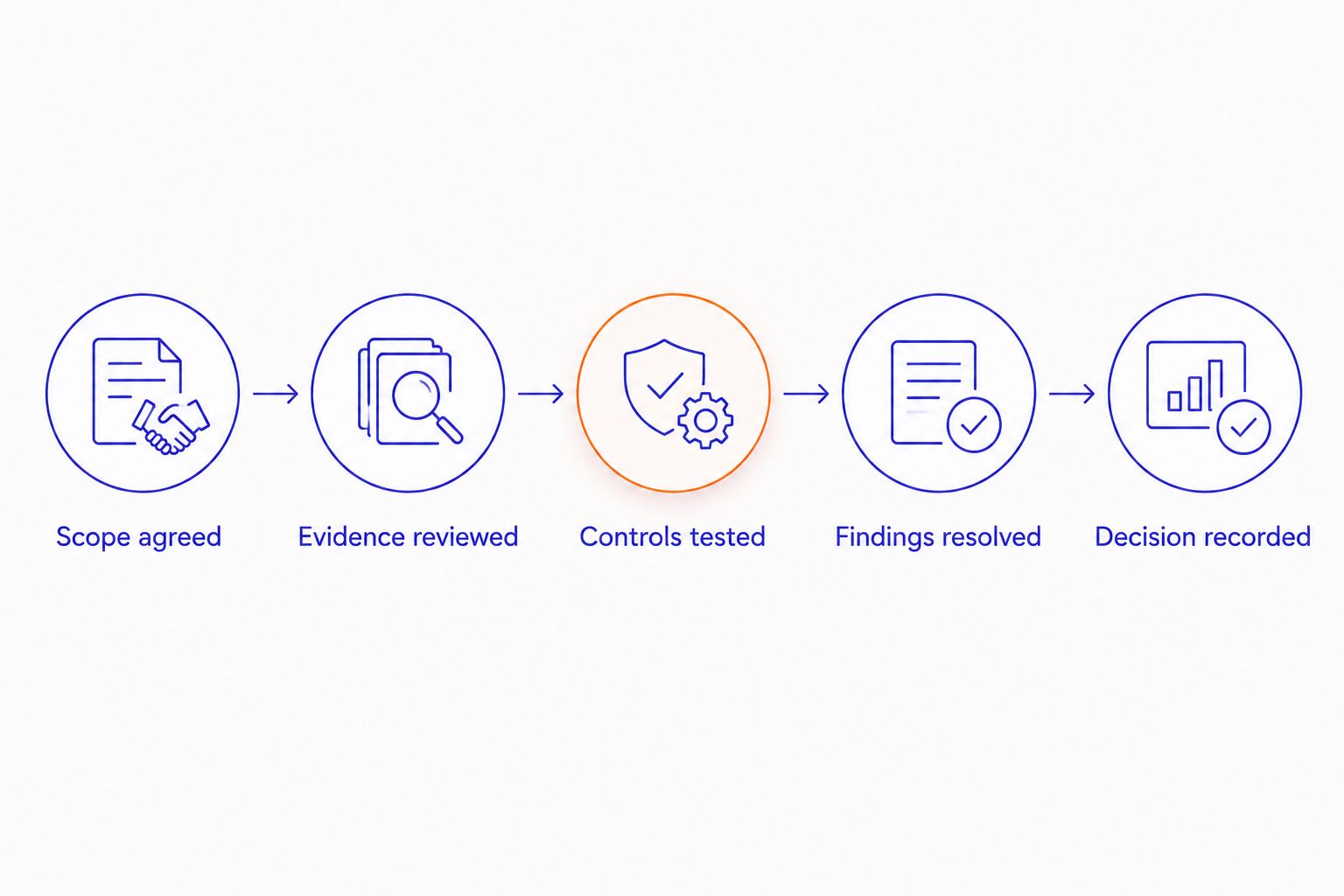
For your 2026 assessment plan, require these 5 approval gates. They are recommended checkpoints, not a claim about a standard assessment duration.
- Scope agreed. Name the workflow, users, data, model, integrations and permitted actions. Record what the assessment excludes.
- Evidence reviewed. Collect the system documentation, supplier information, data permissions and existing controls needed to evaluate that scope.
- Controls tested. Test the relevant failure cases, access restrictions, escalation routes and human review requirements against agreed acceptance criteria.
- Findings resolved. Close blocking findings or obtain an explicit decision to reduce the deployment scope. Retest affected controls.
- Decision recorded. Document the approved configuration, remaining risks, accountable owner, operating conditions and reassessment triggers.
The timeline becomes defensible when every gate has an owner, an entry condition and a completion condition. Until then, a promised sign-off date is a target without a supporting work plan.
Why this matters
An executive needs a decision date, not just a report date. Procurement needs to know whether a contract depends on approval, and operations needs to know whether the existing workflow must remain available.
For a 2026 operating plan, separate the assessment schedule from the deployment schedule. Do not book savings into the operating forecast simply because the assessment is complete; the workflow still needs an approved release, adoption and an accountable operating owner.
This matters in order entry, manufacturing support and finance operations. An assistant that drafts a recommendation and a system authorized to post a transaction have different assessment boundaries. Define the action before estimating the review.
Build the timeline around dependencies
Ask for a schedule with 4 named dates: evidence readiness, assessment completion, remediation completion and the approval decision. These are planning requirements, not prescribed deadlines. Each date should identify the party responsible for making it achievable.
Evidence readiness
Evidence readiness means the agreed review material is accessible and usable. A folder containing incomplete documents does not satisfy that condition.
Your supplier should identify missing inputs before committing to the assessment completion date. If access to production-like test data requires an internal decision, assign that decision to a named owner rather than burying it inside the consultant’s delivery window.
Assessment completion
Assessment completion means the reviewer has evaluated the agreed scope and documented findings. It does not mean every finding has been fixed or every required approver has accepted the result.
Ask whether the deliverable includes a risk register, test evidence, unresolved questions and recommended deployment restrictions. A presentation without a decision record leaves your internal team to reconstruct the approval case.
Remediation completion
Remediation completion means the agreed blocking findings have been addressed and the relevant changes checked. Assign the work to the party that can actually change the system, contract or operating procedure.
Separate supplier fixes from internal fixes. A reviewer cannot resolve your identity permissions, approve your data use or appoint the executive who accepts residual risk.
Approval decision
The approval decision records whether the scoped deployment proceeds, proceeds under conditions or stops. Put the decision meeting on the schedule, but make its prerequisites explicit.
For a 2026 sign-off, attach the evidence version and the configuration being approved. A meeting invitation alone does not establish that the system is ready for a decision.
What kind of approval are you requesting?
Choose the approval scope before asking for a completion date. A limited pilot and an operational release should not share an undefined sign-off label.
| Approval scope | Best for | Benefit | Limitation | Required decision |
|---|---|---|---|---|
| Restricted pilot | Testing a bounded workflow | Limits the permissions and exposure under review | Does not establish readiness for broader deployment | Accept the pilot’s boundaries and controls |
| Conditional release | A deployment with enforceable restrictions | Allows a defined operating scope while specified work continues | Requires ownership of every condition | Accept the remaining risk and release conditions |
| Operational release | A defined production workflow | Establishes accountability for live operation | Does not cover later scope or configuration changes automatically | Accept the assessed production configuration |
These are recommended decision categories, not substitutes for your organization’s approval policy. Use the terminology your risk owner recognizes, then document its meaning.
For a pilot, specify whether outputs remain advisory and whether a person must authorize consequential actions. For an operational release, specify monitoring, incident escalation, access management and the fallback process. Do not let the word pilot excuse uncontrolled access.
Why the AI risk assessment timeline varies
The timeline varies with the work required to reach an accountable decision. Ask the supplier to show how these factors affect the proposed schedule rather than applying an unexplained allowance.
- Deployment scope. More workflows, user groups and integrations create more assessment boundaries. Keep unrelated use cases out of the same approval decision.
- Action authority. Drafting an answer differs from changing an order, posting an invoice or initiating another system action. Review the permissions actually granted.
- Evidence readiness. Missing supplier documentation, inaccessible logs and unresolved data permissions leave review questions open. Give each evidence request an owner.
- Control gaps. An identified weakness requires a decision, a fix or a restriction. Do not assume remediation is included in the assessment delivery date.
- Approval ownership. Legal, security, operations and finance need defined responsibilities. Distinguish specialist advice from the authority to accept remaining risk.
- Change during review. Model, integration or workflow changes alter the assessed configuration. Define how the reviewer handles those changes before work starts.
Keep a dependency log alongside the risk register. Every open item should state what is missing, who supplies it and which decision it blocks. That makes escalation specific instead of turning status meetings into repeated requests for updates.
How do you shorten the assessment without weakening it?
Remove waiting time and unnecessary scope; do not remove the evidence needed for approval. Agree on the decision criteria before testing starts, and give reviewers access to the same controlled evidence set.
Use a 2026 assessment brief that separates mandatory release conditions from improvements that do not block the scoped deployment. Your accountable risk owner should approve that distinction. The supplier should not decide it alone.
Run independent reviews concurrently where dependencies permit. Security can review access controls while operations documents the fallback process, but final acceptance still needs a consistent view of the configuration and unresolved findings.
Freeze the assessment boundary for the decision. If the business wants additional permissions or a different workflow, record the change and evaluate its effect instead of quietly expanding the original approval.
What should you ask an assessment supplier?
Ask questions that expose ownership and schedule assumptions:
- What evidence must be ready before the assessment starts?
- Which dates cover review work, and which depend on our team or another supplier?
- Who fixes findings, and who verifies the fixes?
- What blocks sign-off, and who has authority to accept remaining risk?
- What happens to the schedule if the model or integration changes?
- What exactly will the approver receive before making the decision?
DigiForm is best for CPG, manufacturing and private-equity-backed companies seeking AI strategy, governance and implementation consulting together. That service scope fits a buyer who wants assessment decisions connected to implementation responsibilities.
That does not make an assessment an automatic purchase. Defer it when no defined workflow, accountable owner or operating business case exists. Establish those first, and ask any consultancy to distinguish its delivery responsibilities from decisions your executives must retain.
Discuss your assessment scope
Bring the workflow, approval owner and unresolved dependencies to the conversation.
Can you sign off with open findings?
Yes, if your approval policy permits it and the accountable owner explicitly accepts the remaining risk within documented limits. A finding is not resolved merely because it has a future completion date.
Separate blocking findings from accepted risks and improvement work. For a conditional release, record the restriction, its owner, the evidence that it is enforced and the consequence if the condition is breached.
Do not approve unrestricted operation when the evidence supports only a restricted workflow. Narrowing access or keeping a human authorization step is a different decision from declaring the underlying issue fixed.
Does sign-off remain valid after the model changes?
Sign-off applies to the scope and configuration recorded in the decision. A changed model, permission set, integration or operating purpose should trigger a documented review of whether the previous evidence still supports approval.
Set reassessment triggers in the original decision record. This avoids treating every change as an entirely new assessment while also avoiding the opposite mistake: allowing material changes to inherit approval without scrutiny.
FAQ
What is a realistic AI risk assessment timeline?
A realistic AI risk assessment timeline separates evidence collection, review, remediation, validation and approval. Ask for dates tied to named owners and completion criteria rather than an unsupported duration in weeks.
Does finishing the assessment report mean we can launch?
Finishing the assessment report does not authorize launch. Your accountable approver must decide whether the evidence supports the defined deployment and accept any remaining risk.
Can procurement start before the AI assessment is signed off?
Procurement can prepare its work before sign-off, but purchasing and deployment permissions should remain explicit. Record which commitments require approval and avoid treating a signed supplier contract as risk acceptance.
Who should own the final AI risk assessment sign-off?
A named person with authority under your organization’s approval policy should own final sign-off. Reviewers provide evidence and recommendations; the accountable owner accepts the remaining business risk.
Is a pilot assessment enough for production deployment?
A pilot assessment supports only the scope and conditions actually reviewed. Broader users, permissions, data or integrations require a decision on what additional evidence and approval are necessary.
Can DigiForm help connect assessment decisions to implementation?
DigiForm offers AI strategy, governance and implementation consulting. Ask for an engagement scope that names remediation responsibilities, acceptance criteria and the handover to your operating owner.
How should we plan AI risk assessment sign-off in 2026?
Plan AI risk assessment sign-off in 2026 around evidence readiness, assessment completion, remediation completion and the approval decision. Give each milestone an owner and document the dependencies that prevent a firm date.
One last thing
The shortest report is not the shortest route to approval. A decision-ready evidence pack gives the approver the assessed scope, test results, unresolved findings and requested decision without requiring a second investigation.
Before accepting the supplier’s schedule, ask the person who will sign: what must be true for you to approve this deployment? Put the answer into the acceptance criteria before work begins.