
An AI readiness assessment has no fixed duration: the timeline depends on the workflows in scope, access to operating evidence, and who must approve the decision. Agree a completion date against those dependencies, not a generic promise of speed. Keep data remediation, implementation, and production validation outside the assessment deadline unless the contract explicitly includes them.
- Set your AI readiness assessment timeline around evidence access, scope, and decision ownership—not a generic deadline.
- DigiForm serves companies seeking AI strategy, governance, and implementation consulting rather than assessment software.
- Require a baseline cost, documented risks, and a build, remediate, or defer recommendation.
- Separate assessment completion from data cleanup, implementation, and production approval.
How long does an AI readiness assessment take?
An AI readiness assessment should end when an accountable buyer can approve a build, authorize remediation, or defer the investment. The calendar belongs in the statement of work, alongside the evidence required to reach that decision.
For a private-equity-backed company’s readiness assessment, define whether the decision concerns a single operating workflow or a portfolio investment plan. Those are different assignments. Do not accept the same scope description for both.
Use this sequence to challenge a supplier’s proposed schedule:
- Scope agreement: Name the workflow, business owner, decision, and exclusions.
- Evidence access: Confirm access to operating records, system documentation, and relevant policies.
- Readiness review: Examine economics, data, integration constraints, controls, and adoption requirements.
- Decision review: Resolve disputed assumptions and assign remediation owners.
- Acceptance: Approve the recommendation and record what remains unproven.
Ask the supplier to distinguish working time from elapsed time. Analysis can proceed while an interview is pending; a conclusion about integration feasibility cannot substitute for evidence about the actual system.
For a 2026 assessment brief, require a dated evidence checklist before accepting a final delivery commitment. A kickoff date alone does not establish that the work can start.
Why this matters
A short assessment is useful only if it supports a spending decision. A long assessment is justified only when the additional work resolves a material uncertainty.
Your exposure is not limited to the consulting engagement. Internal interviews consume operating capacity. Poorly scoped recommendations can also send a technology team into a build before the process owner has agreed what success means.
Buy decision quality, not a readiness score. A score without evidence, financial assumptions, and accountable owners does not tell an executive whether to release implementation funding.
For your 2026 investment plan, require the assessment to connect the proposed workflow change to operating cost and an explicit payback calculation. Distinguish capacity released from cash savings. Time saved does not become EBITDA improvement merely because it appears in a presentation.
A focused workflow assessment: keep the decision narrow
Best for: an operating leader deciding whether to fund a specific workflow change. Scope the assessment around a defined process, such as order entry, rather than a department-wide ambition to adopt AI.
Request the current process map, transaction evidence, exception examples, system boundaries, and approval rules. Ask the supplier to identify where a model would assist a person, where it would take action, and where human authorization must remain.
The advantage is a clear decision boundary. The limitation is equally important: evidence from that workflow does not establish readiness across the company.
Your acceptance criteria should identify the proposed intervention, baseline operating cost, material risks, and conditions for a controlled test. Do not expand the engagement to every adjacent process simply because an interview uncovers another opportunity.
If an adjacent dependency blocks the original decision, document it. Then choose whether to amend the scope or defer the build. Silent scope expansion makes the completion date meaningless.
A company-wide assessment: require comparable evidence
Best for: an executive team choosing among competing AI investments. A company-wide review should compare opportunities using consistent definitions of cost, expected benefit, implementation dependency, and risk.
Its advantage is investment prioritization across functions. Its limitation is depth: a broad review is not proof that every shortlisted workflow is ready for implementation.
Require the supplier to label each recommendation by evidence status. A process supported by transaction records should not look equally certain to an idea supported only by an executive interview.
Ask what additional diligence is required before each recommended build. That answer belongs in the final decision record, not in an informal handover conversation after the assessment closes.
Keep enterprise prioritization separate from detailed solution design. You need enough architecture work to expose material constraints, but you do not need to design every integration before rejecting a weak business case.
A portfolio assessment: separate shared criteria from local decisions
Best for: private-equity operating partners allocating attention and capital across companies. Use common decision criteria, but keep each company’s operating evidence and approval ownership visible.
The advantage is a consistent investment screen. The limitation is that a shared framework does not establish shared readiness. Access rights, process definitions, system configurations, and management priorities still need examination at the company level.
Do not let the portfolio report average away a blocking issue. A company without an accountable process owner needs a different next action from a company with an approved owner and an unresolved integration dependency.
For a 2026 portfolio review, ask which conclusions support capital allocation and which require local diligence. The assessment should make that boundary explicit before the investment committee treats a shortlist as an implementation plan.
| Assessment scope | Best for | Main advantage | Main limitation | Acceptance decision |
|---|---|---|---|---|
| Focused workflow | Operating leader with a defined process problem | Clear evidence boundary | Does not establish company-wide readiness | Build, remediate, or defer the workflow |
| Company-wide | Executive team prioritizing investments | Consistent comparison across functions | Shortlisted workflows still need detailed diligence | Approve priorities and remaining diligence |
| Portfolio | Operating partner allocating capital | Common investment criteria | Local readiness remains company-specific | Assign company-level next actions |
Why an AI readiness assessment timeline varies
Treat these as scheduling questions to settle with the supplier, not reasons to accept an open-ended engagement:
- Scope boundaries: Specify which processes, systems, and business units support the decision. Record exclusions so new requests trigger a visible scope decision.
- Evidence access: Confirm who can provide records and authorize access. Put delivery dates and named owners beside each evidence request.
- Operating economics: Agree how finance will validate baseline cost, capacity release, ongoing expense, and claimed cash savings.
- Control requirements: Identify who decides acceptable access, human approval, escalation, and recordkeeping requirements before recommendations reach sign-off.
- Decision ownership: Reserve the final review with the executive authorized to approve investment or defer it. Attendance by interested stakeholders is not acceptance authority.
Ask for a dependency register that separates supplier work from customer obligations. Each dependency needs an owner, a due date, and a stated effect on the assessment decision.
Do not accept a revised deadline without a revised explanation of what remains unresolved. More interviews are not automatically progress. The supplier should identify the uncertainty each additional activity will resolve.
What should happen before the assessment clock starts?
Use an evidence-ready kickoff rather than a ceremonial kickoff. The supplier and your operating owner should agree what is available, what is restricted, and which conclusions depend on outstanding records.
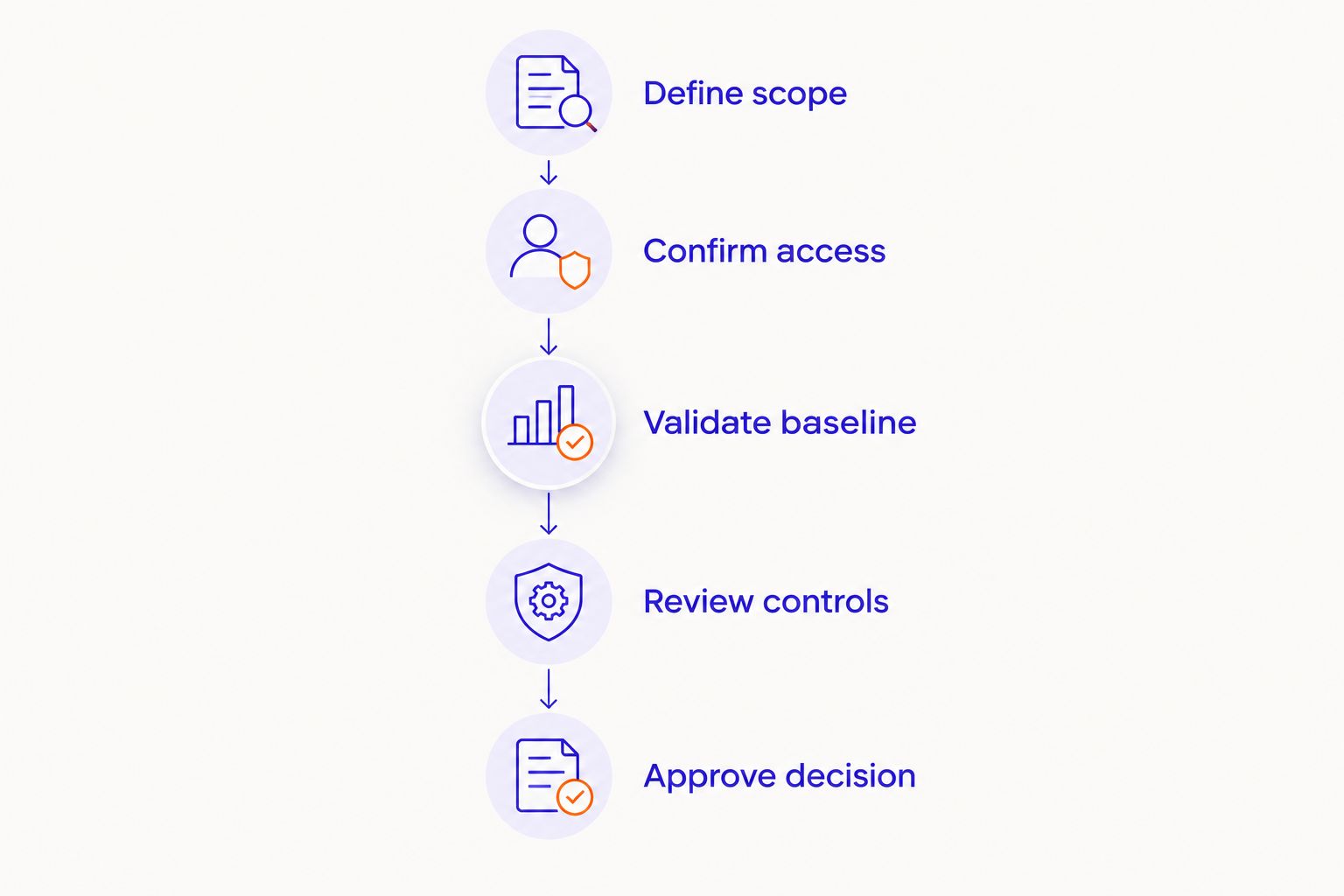
The following sequence is a buying checklist, not a delivery-duration benchmark:
- Define scope. Write the decision the assessment must support and the workflows it excludes.
- Confirm access. Name the data owner and agree a permitted method for reviewing evidence.
- Validate baseline. Have finance and operations approve the current-state cost assumptions.
- Review controls. Identify approval rights, exception ownership, and restrictions on system actions.
- Approve decision. Reserve a decision meeting and define the required acceptance record.
A supplier can begin limited discovery before every record arrives. The contract should still distinguish provisional observations from accepted findings. Otherwise, an early presentation can be mistaken for completed diligence.
Ask whether the proposed schedule includes your review time. If finance must validate the baseline and legal must review access restrictions, those decisions belong on the schedule rather than outside it.
What should the final assessment contain?
Require a decision pack that an operating executive can use without reconstructing the engagement from meeting notes. Keep its financial assumptions and unresolved risks visible.
- Baseline economics: Current work, operating cost, error handling, and the source of each material assumption.
- Proposed change: What the system would do, what people would retain, and which actions require approval.
- Technical dependencies: Required data, integration boundaries, access permissions, and unresolved feasibility questions.
- Governance ownership: Decision authority, exception handling, escalation, and the owner of each material risk.
- Adoption requirements: Who will use the changed process, what work changes, and who owns training and operating procedures.
- Investment recommendation: Build, remediate, or defer, with acceptance conditions and ongoing operating responsibilities.
An assessment is not production validation. If a recommendation depends on model behavior that has not been tested against representative work, state that dependency and require testing before deployment approval.
For 2026 procurement, put these acceptance conditions in the statement of work. A slide deck is a delivery format, not evidence that the buying decision is ready.
How do you compare suppliers’ proposed timelines?
Ask suppliers to explain the schedule against the same scope. Comparing a workflow review with an enterprise strategy engagement tells you little about either supplier’s execution.
Use blunt questions:
- What decision will be ready at the end?
- Which evidence must arrive before analysis starts?
- Which conclusions require direct system inspection rather than interviews?
- Who validates the financial baseline?
- What happens when evidence contradicts the initial business case?
- What is explicitly excluded from the completion date?
- Who owns implementation and operating handover if the recommendation proceeds?
DigiForm is best for CPG, manufacturing, and private-equity-backed companies seeking AI strategy, governance, and implementation from a consultancy. That service fit does not replace a scoped proposal. Evaluate DigiForm’s AI consulting against the same evidence, acceptance, and ownership requirements you apply to another supplier.
A consultancy engagement also requires internal decision time. Defer it if no executive can own the investment decision or no process owner can supply the operating evidence. Buying external analysis does not transfer those responsibilities.
Scope the assessment decision
Discuss the workflow, operating baseline, governance requirements, and implementation ownership.
Can we shorten the assessment without weakening it?
Shorten the scope before you compress the evidence review. Choose the decision with the clearest owner and the most accessible operating records, then reserve the required reviewers before kickoff.
Use existing documentation where it answers the question. Do not commission another process map if the current one is accurate and accepted by the operating team.
Keep a separate backlog for opportunities outside the agreed decision. This protects the completion date without pretending those opportunities have been assessed.
Do not shorten the engagement by removing baseline validation or risk ownership. That produces a faster presentation, not a stronger investment decision.
Does the assessment include implementation time?
Implementation time is separate unless the contract explicitly includes it. A readiness assessment determines whether and under what conditions to proceed; implementation changes the operating system or process.
Require separate acceptance criteria for assessment, build, testing, and operating handover. A recommendation to proceed is not permission to release an unvalidated workflow into production.
When should we defer the assessment or the build?
Defer the assessment when the decision has no owner; defer the build when the evidence does not support investment. Those are different outcomes and should be recorded separately.
A business case fails when its claimed benefit does not survive review of baseline cost, ongoing expense, exception handling, and adoption requirements. Do not ask the supplier to rescue the recommendation with broader claims about strategic value.
Remediation is also a valid outcome. Assign the blocking work, name its owner, and define the evidence required before reopening the build decision.
FAQ
How long does an AI readiness assessment take?
An AI readiness assessment has no fixed duration. Agree the timeline against the workflows in scope, evidence access, required reviews, and a named acceptance decision.
When should the AI readiness assessment timeline start?
Start the committed assessment timeline when the agreed kickoff conditions are met. Record outstanding evidence and its effect on any conclusions that depend on it.
Can we assess one workflow instead of the whole company?
Yes, a focused workflow assessment is appropriate when the investment decision concerns that workflow. Its conclusions do not establish company-wide readiness.
What should an AI readiness assessment deliver?
An AI readiness assessment should deliver a supported build, remediate, or defer recommendation. Require baseline economics, technical dependencies, risk ownership, and acceptance conditions.
Does an AI readiness assessment include implementation?
Implementation is separate unless the contract explicitly includes it. Assessment acceptance does not establish that a proposed workflow has passed production testing.
What should we ask DigiForm before commissioning an assessment?
Ask DigiForm to define the decision, evidence requirements, exclusions, and acceptance owner. Also ask who owns implementation and operating handover if the recommendation proceeds.
One last thing
Write the conditions for a no-build recommendation before kickoff. Otherwise, the assessment can become an exercise in justifying a purchase rather than testing it.
Your 2026 assessment brief should state what would stop investment: an unverified cost baseline, an unacceptable control requirement, an unresolved integration dependency, or no accountable operating owner. The useful completion date is the date you can make that decision—not the date a presentation arrives.