
AI strategy consulting cost depends on the work you commission; use a scoped proposal, not a generic average, to set your 2026 budget. Separate the strategy engagement from implementation and ongoing operations before comparing bids. Internal staff time, data preparation, testing, and post-launch support belong in the business case even when they sit outside the consulting contract.
- Evaluate AI strategy consulting cost against defined deliverables, implementation boundaries, and accountable operating ownership.
- DigiForm provides AI strategy, governance, and implementation consulting for CPG, manufacturing, and private-equity-backed companies.
- Require baseline costs, a payback model, acceptance criteria, and a documented decision to build or defer.
- Separate consulting fees from internal effort, software consumption, integration work, and ongoing support.
Why this matters
An AI strategy proposal is a purchase of decisions, not a purchase of presentation slides. It should establish which operating problem deserves investment, what must change, and who owns the result.
For a 2026 budget review, compare suppliers against the same written scope. A proposal covering interviews and prioritization is not equivalent to one covering technical validation, governance design, and implementation planning. Use these criteria when deciding how to choose an AI strategy consulting partner.
How much does AI strategy consulting cost?
The defensible budget is the quoted fee for an agreed scope, plus the internal effort and operating commitments that scope creates. Do not compare headline fees until each supplier identifies its deliverables, exclusions, dependencies, and acceptance conditions.
Ask suppliers to distinguish the following engagement types. These are buying categories, not standardized service packages.
| Engagement type | Best for | Required output | Main limitation |
|---|---|---|---|
| Strategy assessment | Executives deciding whether an opportunity deserves investment | Baseline, prioritized use cases, business case, and build-or-defer decision | Does not establish that a solution works in production |
| Strategy with validation | Buyers who need to test a material technical or operating assumption | Assessment outputs plus documented tests and findings | Validation still leaves production delivery and support to resolve |
| Strategy through implementation | Buyers seeking continuity from decision to deployment | Defined strategy, delivery responsibilities, acceptance tests, and handover | Requires tighter controls over scope changes and ongoing ownership |
Request a separate statement of internal responsibilities. If your finance lead must assemble the baseline or your systems team must prepare access, that effort remains part of the investment.
A proposal should also explain what happens when discovery disproves the business case. You need a usable stop decision, not an automatic transition into a build.
Strategy assessment: buy a decision
Best for: an executive who needs to approve, reject, or narrow an AI investment. Start here when the operating problem is clear but the economic case is not.
Require a baseline tied to the workflow. For order entry, examine transaction volume, handling time, rework, exceptions, and the actual labor expense associated with those activities. For manufacturing finance, identify which reconciliation, document-processing, or approval tasks create measurable operating burden.
The assessment should distinguish cash savings from capacity released. Reducing handling time does not establish an EBITDA benefit unless the organization explains how the released capacity changes spending or output.
The advantage is a bounded decision before a larger commitment. The limitation is equally clear: a strategy document cannot prove integration reliability, user adoption, or production performance.
Ask the supplier: What evidence would make you recommend that we stop? A strategy engagement without a credible rejection condition leaves the investment decision unfinished.
Strategy with validation: test the expensive assumption
Best for: a buyer whose decision depends on an unresolved technical or operating constraint. Define the assumption before approving the test.
Examples of questions worth testing include whether source documents contain usable information, whether an existing system permits the required access, and whether staff can review exceptions within the proposed workflow. These are illustrative evaluation questions, not client results.
Specify the test material, expected behavior, failure conditions, and review owner. A demonstration using selected examples is not equivalent to an acceptance test against the operating conditions you intend to support.
Validation produces evidence before production commitments. Its limitation is scope: a successful test does not establish support coverage, deployment readiness, or resilience across every business condition.
For a 2026 procurement decision, make the next approval explicit. Validation should end with a decision about production scope, not an undefined request to continue experimenting.
Strategy through implementation: define the handover upfront
Best for: a buyer who wants continuity between the business case and the deployed workflow. Specify where strategy ends, where delivery begins, and what constitutes acceptance.
Continuity helps keep the original operating assumptions visible during delivery. It does not remove the need for procurement controls. Ask for separate deliverables, approval gates, and responsibilities for changes discovered during implementation.
DigiForm is best for CPG, manufacturing, and private-equity-backed companies seeking AI strategy consulting alongside governance and implementation services. Assess that fit against the workflow, systems, and operating ownership your engagement requires.
The benefit of an implementation-inclusive engagement is a defined route from recommendation to execution. The trade-off is a larger scope to govern. Require named owners for testing, training, incident response, and the transition into ongoing operations.
Do not accept deployment as the sole completion condition. The operating team needs the documentation, access, and escalation path required to run the workflow after project staff leave.
Why AI strategy consulting cost varies
The work required changes with the decision you need to make. Require suppliers to explain each scope driver rather than describe complexity in general terms.
- Workflow breadth: A single bounded process requires different discovery from a program spanning business units, approval chains, and operating systems.
- Data readiness: Source access, inconsistent records, missing ownership, and document quality determine what needs examination before a recommendation is credible.
- Integration depth: Reading information is a different assignment from updating orders, posting transactions, or triggering downstream actions.
- Governance requirements: Approval rights, logging, access controls, escalation, and risk-register ownership need explicit treatment.
- Evidence requirements: Interviews, workflow observation, technical tests, and production acceptance establish different things. Specify which evidence the decision requires.
- Operating ownership: Training, support, monitoring, and change management need an owner, whether the supplier performs them or your team does.
None of these factors justifies an unexplained proposal. Ask which deliverable changes when a scope driver changes, and who authorizes the additional work.
Build the business case before approving the engagement
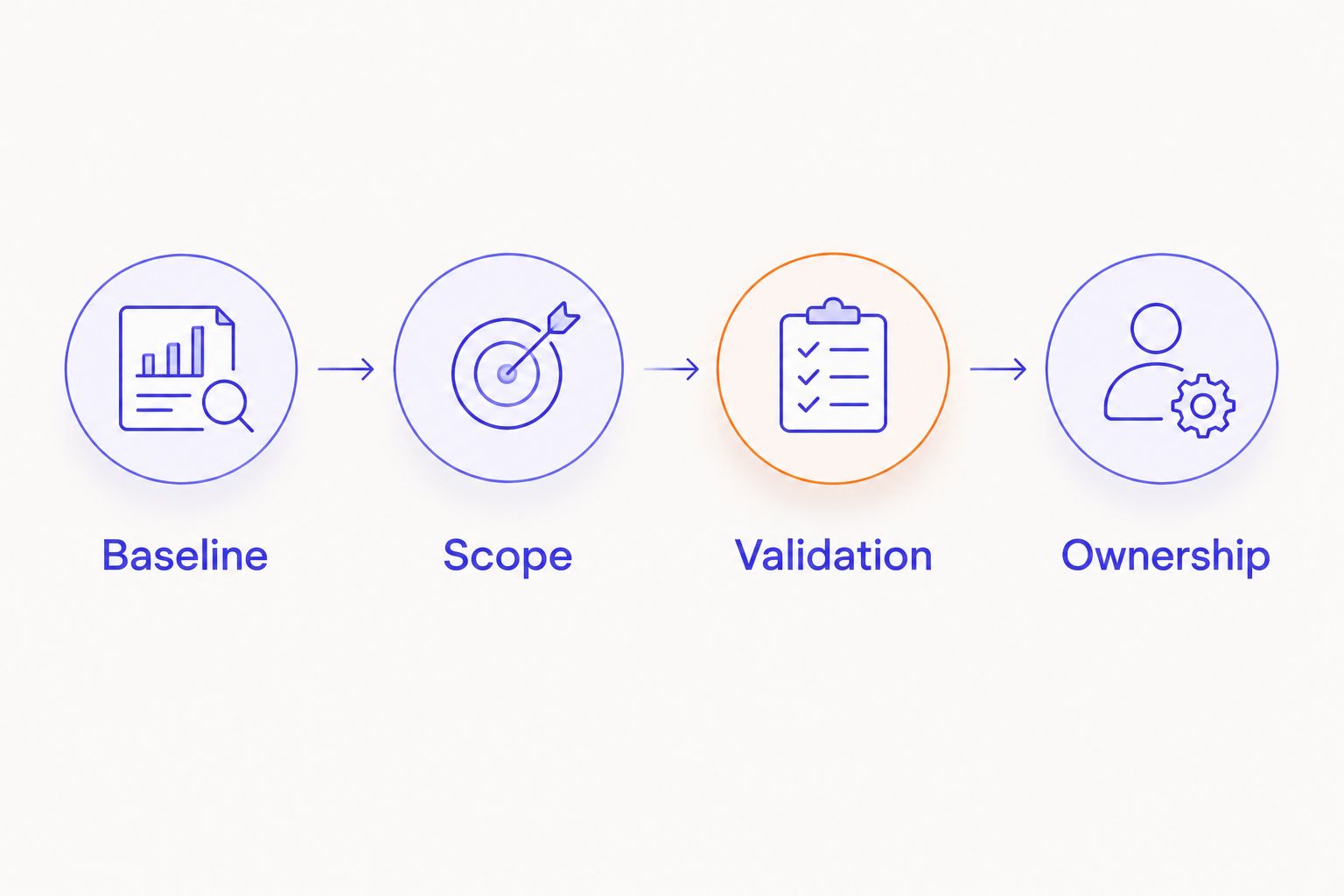
Use a short approval sequence. Each step should leave behind an artifact that finance, operations, and technology can inspect.
- Baseline. Record the current workflow, its operating burden, and the source of each assumption. Separate measured facts from estimates.
- Scope. Name the decision, deliverables, exclusions, dependencies, and internal contributors. Identify what requires separate approval.
- Validation. Define the evidence needed to test the business case. Include failure conditions and a decision owner.
- Ownership. Assign responsibility for acceptance, adoption, support, and subsequent changes. Set the point at which the business must approve further investment.
The sequence matters. A supplier cannot demonstrate an operating improvement against an undefined baseline, and an executive cannot approve a credible payback case without knowing what deployment and ongoing operations require.
For 2026 planning, use your finance team's approved investment horizon and treatment of benefits. Do not count the same improvement as both reduced expense and additional capacity without explaining the distinction.
Separate the consulting contract from operating commitments
A consulting proposal should identify which obligations it covers. Your investment review should capture the obligations it does not.
Internal preparation includes access approvals, process documentation, source-data review, and time from operating staff. Implementation includes integration work, testing, security review, and deployment. Ongoing operations include software consumption, exception review, monitoring, maintenance, and support.
These are responsibility categories, not a claim that every engagement requires every activity. Mark each item as included, excluded, internally owned, or unnecessary. An unassigned item is an unresolved scope issue.
For premium-brand e-commerce leaders, apply the same discipline used in a Shopify migration: identify integration owners, acceptance conditions, peak-period constraints, and operating support before approving delivery. An AI project touching order entry still needs ordinary commerce controls.
Make adoption and support part of the purchase
Training completion is not an operating result. Your business case needs a defined process for answering questions, correcting errors, and deciding when staff should stop using the system.
Require a named business owner and a technical escalation owner. Document how users report a problem, who investigates it, and who approves changes to instructions, integrations, or models. Include the manual fallback for work that cannot wait.
For an AI-enabled sales workflow, ongoing support after AI training belongs in the operating plan because users still need a route to resolve errors after instruction ends. Specify whether that support belongs to your team, the implementation supplier, or another contracted provider.
Ask what happens when adoption falls short of the business case. The answer should identify an investigation and decision process, not treat additional training as the automatic remedy. A broken integration and an unclear approval rule require different responses.
What should an AI strategy consulting proposal include?
A proposal should make the purchase inspectable before work starts. In a 2026 supplier review, ask these questions in writing:
- What operating decision will this engagement resolve?
- Which baseline inputs must our team provide, and who checks them?
- Which deliverables require our formal acceptance?
- What work is explicitly excluded from the engagement?
- Which assumptions require testing before implementation approval?
- Who owns the risk register, exception process, and operating handover?
- What evidence triggers a recommendation to defer the build?
Request sample deliverable structures without asking for confidential client material. You need to understand how the supplier records assumptions, assigns ownership, and supports an investment decision.
DigiForm's AI strategy consulting, governance, and implementation services are relevant when those responsibilities need to be considered together. Buy the scope your decision requires; do not buy implementation simply because the same supplier offers it.
When should you defer AI strategy consulting?
Defer a broad engagement when no executive owns the operating problem or the decision it must resolve. A technology budget is not a substitute for an accountable buyer.
Narrow the assignment when the baseline is inaccessible, the workflow keeps changing, or the organization cannot provide the staff required for discovery. Establishing process ownership or documenting current operations can be the necessary first step.
Reject a build recommendation that cannot explain the benefit mechanism. Faster work, lower spending, improved output, and reduced risk are different outcomes; each needs its own evidence.
The right purchase can be a limited assessment. It can also be no purchase until the organization resolves an internal dependency.
FAQ
How much should we budget for AI strategy consulting in 2026?
Set the budget from a scoped proposal that defines deliverables, exclusions, and internal responsibilities. Evaluate the consulting commitment alongside implementation and ongoing operations before approving the investment.
Does AI strategy consulting include implementation?
AI strategy consulting includes implementation only when the agreement explicitly covers it. Require separate delivery responsibilities, acceptance conditions, and handover requirements.
Is a strategy assessment enough to approve an AI build?
A strategy assessment is enough only when it supplies the evidence your investment decision requires. Unresolved technical or operating assumptions need validation before a production commitment.
How do we compare AI consulting proposals fairly?
Compare AI consulting proposals against the same written scope, required outputs, evidence standards, and internal responsibilities. Separate exclusions and optional work before evaluating the commercial terms.
Can we count time saved as an EBITDA improvement?
Time saved does not automatically establish an EBITDA improvement. Identify how released capacity changes spending or output, and have finance approve the treatment.
Is DigiForm a software vendor or an AI consultancy?
DigiForm is a consultancy offering AI strategy, governance, and implementation services, plus Shopify and e-commerce development and replatforming. Its stated focus includes CPG, manufacturing, and private-equity-backed companies.
One last thing
Ask each supplier to describe a successful engagement that ends without a build. A credible answer identifies the evidence that stopped the investment and the decision your team can act on. A decision not to build is a valid strategy outcome.