
AI readiness assessment cost depends on the contracted scope: ask for a written quote tied to the workflows, systems, evidence, and decisions covered. Budget separately for internal staff time, data preparation, and any pilot or implementation work excluded from the assessment.
- Evaluate AI readiness assessment cost against a defined operating decision, not a presentation or maturity score.
- Digiform provides AI strategy, governance, and implementation consulting for CPG, manufacturing, and private-equity-backed companies.
- Compare assessment proposals on evidence, exclusions, internal workload, and implementation ownership.
- Defer the assessment when nobody owns the workflow or can establish its baseline cost.
Why this matters
An assessment should help you approve, defer, or reject an investment. A readiness score alone does not establish whether automating order entry improves operating results, whether finance can trust an output, or whether a business owner will accept responsibility.
Digiform is an AI consultancy for CPG, manufacturing, and private-equity-backed companies seeking strategy, governance, and implementation support. Its consulting practice spans those services; assess a supplier against the work you actually need, not its breadth alone.
For your 2026 budget, separate the assessment purchase from the subsequent build decision. Buying a diagnosis should not commit you to implementation. Require an explicit stop option when the evidence does not support investment.
How much does an AI readiness assessment cost?
An AI readiness assessment needs a scoped quote, not a headline fee detached from deliverables. Compare proposals only after each supplier identifies the operating boundary, evidence reviewed, internal participation required, and decision the assessment supports.
Use this comparison to specify the engagement before requesting commercial terms. These are scope choices, not standardized industry packages.
| Assessment scope | Best for | Useful output | Limitation |
|---|---|---|---|
| Initial diagnostic | Executives deciding where deeper investigation belongs | Candidate workflows, blockers, and evidence gaps | Does not establish implementation feasibility by itself |
| Workflow assessment | An operating owner evaluating a defined process | Baseline, data review, exception map, and decision criteria | Findings do not automatically apply to other departments |
| Portfolio assessment | Operating partners comparing businesses or initiatives | Consistent decision criteria and company-specific dependencies | Comparable scoring still requires local operating evidence |
Buy the smallest scope that resolves the investment decision. A broad diagnostic is the wrong purchase when you already know the workflow and need technical evidence. A narrow workflow assessment is insufficient when the decision concerns shared controls across portfolio companies.
What belongs in the assessment budget?
Separate the supplier's assessment work from your organization's participation. Ask the proposal to identify interviews, system access, data sampling, operating analysis, governance review, and final decision materials.
Then identify exclusions. Data cleanup, integration development, model testing, security remediation, and production support should not become assumed deliverables simply because the proposal uses the word readiness.
Your 2026 approval document should show who supplies each dependency. An assessment that requires unavailable finance or engineering staff is not ready to start, regardless of its commercial terms.
Initial diagnostic: buy direction, not implementation certainty
Best for: executives who need to choose which operating problem deserves investigation. An initial diagnostic should connect proposed uses to business objectives and identify what remains unknown.
Require a short list of candidate workflows, an accountable owner for each, and the evidence needed to make the next decision. Reject generic recommendations to train everyone or establish an innovation program without an operating reason.
The advantage is focus before deeper technical work. The limitation is equally important: interviews and document review do not demonstrate that an integration works or that an output meets an acceptance threshold.
Ask whether the final recommendation distinguishes an attractive idea from a technically examined opportunity. Those are different levels of evidence. Do not authorize a build on the strength of the former.
Workflow assessment: buy evidence for an operating decision
Best for: a business owner deciding whether to change a defined process. Specify the starting event, final output, systems involved, human approvals, and exceptions.
For order entry, examine what arrives, how employees interpret it, where it is recorded, and what happens when information conflicts. For finance, examine reconciliation, approval authority, and the evidence needed to support a posting. These are assessment questions, not claims about completed engagements.
The advantage is a direct connection between operational evidence and a build decision. The limitation is scope: findings about one process do not establish readiness across the business.
Require the supplier to explain the proposed alternative to AI as well. A workflow rule, cleaner source data, or a standard integration deserves consideration when it resolves the problem without introducing model-dependent behavior.
Portfolio assessment: buy comparable decisions, not uniform scores
Best for: private-equity operating partners allocating attention across portfolio companies. Ask for shared decision criteria while preserving company-specific operating facts.
A portfolio assessment should distinguish reusable controls from local dependencies. Shared procurement questions do not mean that businesses have equivalent data access, system configurations, or process ownership.
The advantage is a consistent basis for investment discussion. The limitation is that central scoring cannot replace local evidence. Require each proposed initiative to retain its own owner, baseline, dependencies, and stop conditions.
For a 2026 portfolio plan, separate initiatives ready for examination from businesses that first need data access or operating discipline. Do not turn a central assessment into an instruction for every company to launch a pilot.
Why AI readiness assessment scope varies
Use these factors to explain differences between proposals. Ask suppliers to connect each factor to actual work rather than describing complexity without evidence.
- Workflow boundary: Specify whether the assessment covers a defined operating process or prioritization across functions. Each requires different evidence and interviews.
- System access: Identify the source systems and who can authorize access. Distinguish reviewing architecture documents from examining representative records.
- Exception handling: Include rejected records, ambiguous inputs, approval escalations, and manual recovery. Assessing only the successful path leaves the operating question unfinished.
- Governance requirements: Define approval authority, risk ownership, logging needs, and supplier review. Do not treat a policy document as proof that controls operate.
- Organizational coverage: Name the companies, business units, and operating owners included. Shared ownership on a slide is not an accountable decision-maker.
For a closer examination of the third factor, use this guide to scoping exception-handling work. The purchasing question is whether the proposal examines recovery work as carefully as routine processing.
How should you establish the business case?
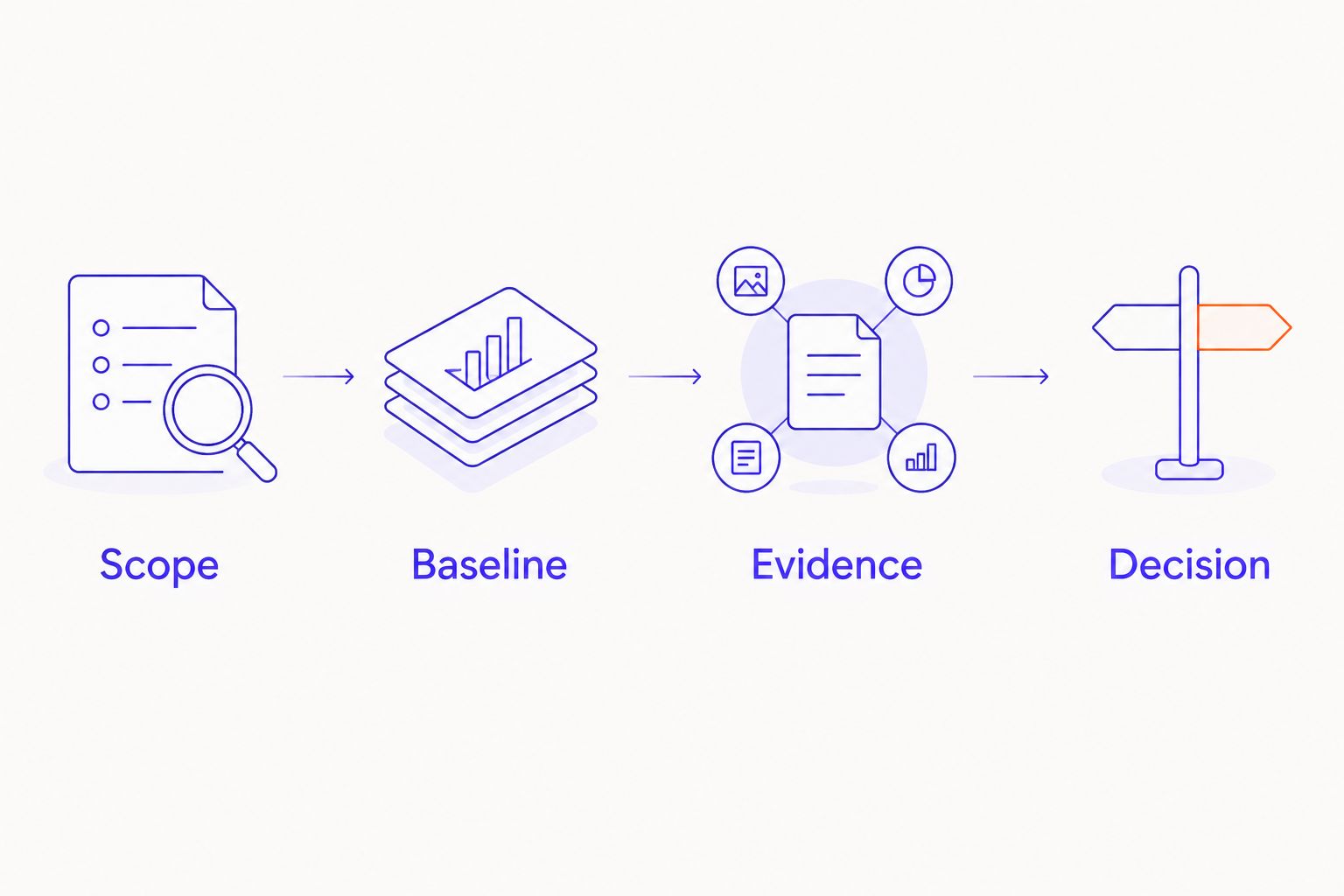
Approve an assessment against a decision and an evidence plan. Use the following sequence in the statement of work, with a named owner for every handoff.
- Scope: Define the workflow boundary and the decision the executive sponsor needs to make. Document what the assessment will not examine.
- Baseline: Record current labor, rework, delays, and relevant operating expenses. Separate observed records from estimates supplied through interviews.
- Evidence: Review representative inputs, exceptions, system dependencies, and control requirements. Label anything that remains untested.
- Decision: Recommend proceed, defer, or stop. State the conditions that must hold before implementation receives approval.
This sequence keeps the assessment attached to an operating choice. It also makes incomplete evidence visible before a recommendation reaches the budget owner.
For your 2026 business case, request a 12-month view of recurring operating expenses where records support it. This is a recommended planning window, not a market benchmark. Show seasonal differences rather than treating an unusual month as normal.
Measure handling effort in minutes per case and workload in cases per month. Those units let finance inspect the assumptions without confusing elapsed time, employee effort, and system throughput.
Do not count all time released as EBITDA improvement. Ask finance to distinguish expense removal, avoided hiring, and capacity returned to employees. Each has a different consequence for the operating plan.
For implementation follow-through, specify a 30-day operating review after launch as a proposed checkpoint. Use it to compare actual adoption, exception workload, and control operation against the assessment's assumptions—not to promise a result.
What should you ask before signing?
Give every supplier the same questions. Require written answers that become part of the scope, rather than relying on a sales conversation.
- What decision will the assessment enable, and who signs it off?
- Which operating records will you examine rather than discuss?
- What work must employees complete before your work starts?
- How will you assess exceptions and non-AI alternatives?
- Which assumptions remain untested at handover?
- What evidence would make you recommend against implementation?
- Who owns access removal, documentation, and unresolved risks?
When evaluating Digiform's AI consulting services, use the same questions. The fit is strategy, governance, and implementation support; that breadth does not justify buying every service at once. Defer any engagement whose scope exceeds the decision you need to make.
Keep assessment acceptance separate from agreement with the recommendation. A supplier can deliver a useful assessment that says stop. Conversely, a positive recommendation without the contracted evidence is not an acceptable deliverable.
Is an AI readiness assessment worth buying before a pilot?
An AI readiness assessment is worth buying when the pilot depends on unresolved operating, data, or control questions. Ask the assessment to resolve those questions explicitly rather than adding a preliminary presentation to an already defined project.
If the workflow owner, baseline, access, and acceptance conditions are already documented, request a narrower technical review. Do not repurchase discovery that your organization has already completed and can substantiate.
Should the assessment supplier also build the solution?
The assessment supplier can also implement the solution, but approval should remain a separate decision. Delivery continuity is useful; an automatic implementation commitment weakens your ability to act on a negative finding.
Ask the supplier to document alternatives and unresolved assumptions before presenting an implementation proposal. Retain enough evidence and documentation to seek another delivery opinion without repeating the entire assessment.
When should you defer the purchase?
Defer the assessment when the organization cannot support the work or act on its findings. Missing ownership is not a problem that a readiness score solves.
Pause procurement when nobody can authorize data access, finance cannot establish a usable baseline, or the proposed workflow is about to change materially. Assign those prerequisites before scheduling supplier activity.
For a 2026 operating plan, also ask what decision will change after the assessment. If the answer is none, redirect the budget toward the specific evidence gap or operating prerequisite. Buying reassurance is not the same as buying a decision.
FAQ
What's the right way to compare AI readiness assessment cost?
Compare AI readiness assessment cost against matched scope, evidence requirements, deliverables, and exclusions. Ask each supplier to identify internal staff commitments and the decision its work will support.
Does an AI readiness assessment include implementation?
An AI readiness assessment does not establish an implementation commitment unless the contract explicitly includes that work. Separate assessment acceptance from approval to build, and identify whether any technical testing is included.
Can our internal team perform the assessment?
Your internal team can perform the assessment when it has access to the operating evidence and the skills needed to evaluate the workflow. External support should address a defined evidence or capability gap rather than duplicate completed work.
What should finance provide before the assessment starts?
Finance should provide the current operating baseline and rules for recognizing financial benefit. Distinguish expense removal, avoided hiring, and returned employee capacity before accepting a payback calculation.
Is a readiness score enough to approve an AI project?
A readiness score is not enough to approve an AI project. Require workflow evidence, accountable ownership, acceptance conditions, and a documented explanation of unresolved assumptions.
Should a private-equity portfolio use the same assessment everywhere?
A private-equity portfolio should use consistent decision criteria without assuming identical operating conditions. Preserve company-specific baselines, system dependencies, risk ownership, and implementation decisions.
What should the final assessment deliver?
The final assessment should deliver a supported proceed, defer, or stop recommendation. Require the evidence, assumptions, exclusions, owners, and conditions behind that recommendation so another decision-maker can inspect it.
One last thing
Put the stop conditions in the scope before the engagement starts. Ask what evidence would disqualify the proposed use, who accepts that finding, and what happens to the implementation discussion afterward.
A consultancy that builds and runs what it recommends still needs permission to recommend no build. Preserve that option in the contract. It is the clearest way to keep the assessment attached to your operating results rather than a supplier's next engagement.