
Yes. AI can reduce EBITDA drag from manual order entry when it removes operating expense or supports additional contribution without equivalent staffing growth; faster processing alone does not establish that result. Human review, integration support, exception handling, and recurring software expense belong in the business case, not outside it.
- For the search ‘ai reduce ebitda drag order entry,’ the verdict is conditional: prove expense reduction, not just speed.
- Measure order entry through ERP acceptance, including corrections and human review.
- DigiForm suits CPG and manufacturing leaders seeking AI consulting with implementation ownership.
- Defer automation when weak master data or unresolved exceptions prevent a credible operating case.
Can AI actually cut EBITDA drag from manual order entry?
Yes—but saved minutes are capacity until finance can connect them to an operating result. Your evidence must follow the order from arrival through acceptance in the system of record, not stop when a model extracts the purchase-order fields.
Start by distinguishing the available approaches. AI is not the default answer to every order-entry problem.
| Approach | Best for | Benefit to test | Limitation to include |
|---|---|---|---|
| Manual entry with process cleanup | Inconsistent instructions and unresolved ownership | Less avoidable rework without a new system | Employees still perform the entry |
| Rules-based integration | Structured orders with stable field mappings | Direct transfer without document interpretation | Mapping changes and exceptions still require maintenance |
| AI-assisted entry | Documents and messages that require interpretation | Less transcription while employees retain approval | Review effort can consume the time released |
| Controlled automatic posting | Defined order types with enforceable validation | Fewer manual touches through acceptance | Incorrect writes require containment and recovery |
For CPG operators, AI automation consulting for order operations should begin with the operating boundary: which orders enter scope, which decisions remain human, and who owns failed transactions.
Why this matters
Your 2026 investment decision is not whether software can read an order. It is whether the complete workflow costs less to operate without creating unacceptable order, customer, or financial risk.
A demonstration can show clean extraction while excluding account matching, product substitutions, approval queues, and ERP rejection. Those tasks belong inside the measurement boundary. Otherwise, the apparent improvement simply moves work to another team.
What counts as an EBITDA improvement?
Separate released capacity, expense reduction, and incremental contribution. They are different claims and need different evidence.
- Released capacity: Employees spend less time on order entry. Report the hours available and the work assigned to them.
- Expense reduction: A recurring operating expense actually falls, with finance confirming the change.
- Avoided staffing growth: The business handles additional demand without the staffing increase otherwise required. Document the approved staffing baseline.
- Incremental contribution: Additional fulfilled business produces contribution after the associated variable expenses. Do not count revenue as EBITDA.
For a 2026 budget, keep a realized-expense case separate from a capacity case. A team can process orders faster while payroll remains unchanged. That can still be useful, but it is not evidence of a payroll saving.
Do not count the same released hours as both lower payroll and capacity for additional sales. Finance should approve the bridge from operational changes to the reported result, including how implementation expenditure is treated.
How do you build a defensible baseline?
Use the same workflow boundary before and after implementation. Changing the denominator midway makes the comparison unreliable.
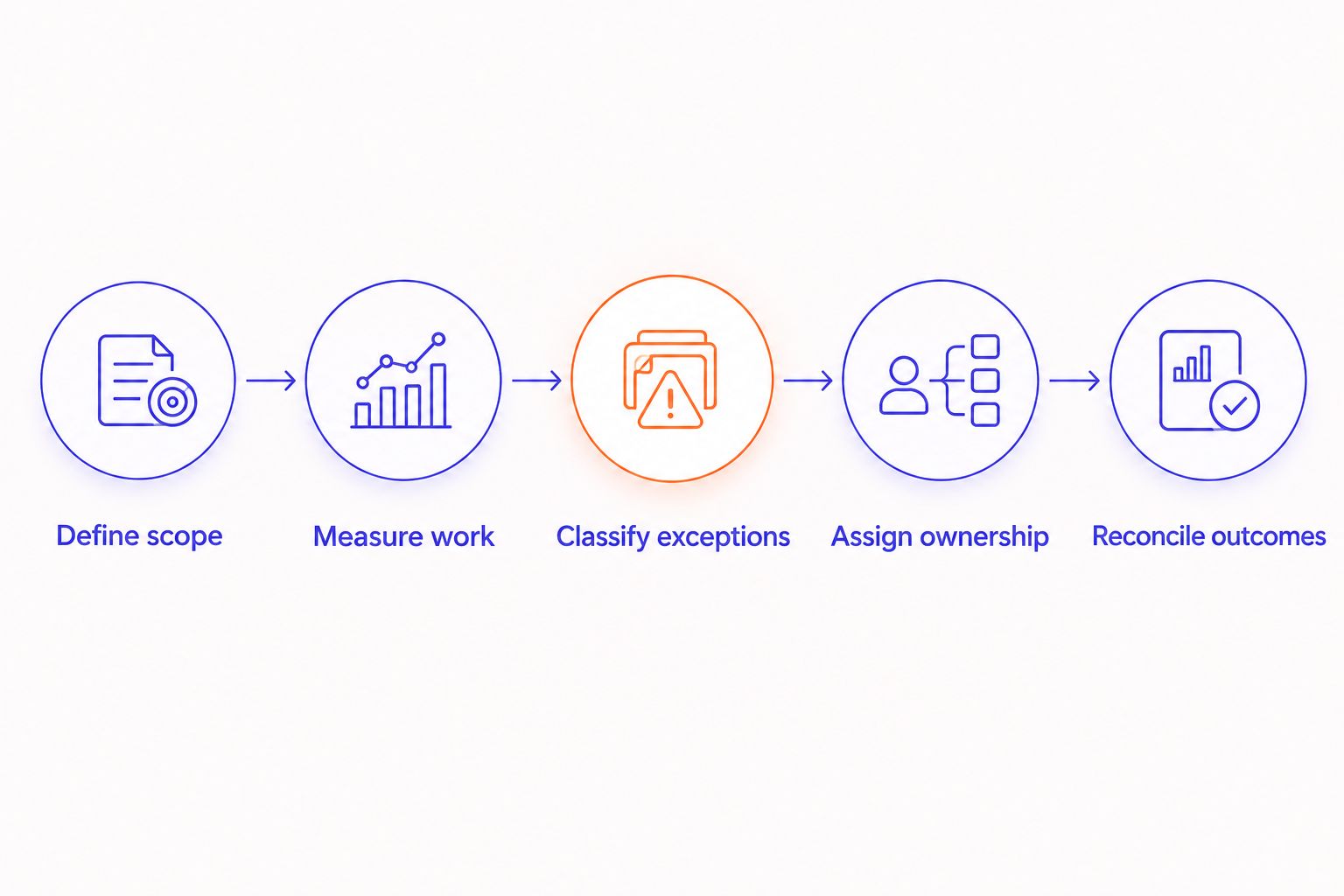
- Define scope. Name the intake channels, customer groups, order types, and destination systems included. Keep excluded work visible.
- Measure work. Record handling time, correction time, review time, and unresolved queues. Separate active employee effort from elapsed waiting time.
- Classify exceptions. Distinguish unreadable inputs, missing account data, product ambiguity, commercial approvals, and destination-system failures.
- Assign ownership. Name 1 accountable business owner for the result, with separate technical and finance responsibilities.
- Reconcile outcomes. Match source requests to accepted orders, rejected requests, and unresolved items. An extracted document is not a completed order.
Normalize manual touches per 100 orders so volume changes do not hide additional work. Also report employee hours per month: a touch count alone does not reveal whether the remaining exceptions take longer.
These are measurement units, not promised results. Establish the baseline from your own workflow rather than borrowing a supplier's demonstration figures.
A baseline also needs a record of what changed during measurement. Customer mix, staffing, order complexity, and system incidents can affect the comparison. Keep those changes alongside the operating report rather than explaining them after a result is challenged.
Why does the result vary?
The economic case depends on the work left after automation, not just the work removed. Evaluate these factors in your own operation:
- Input consistency: Stable structured inputs support a different design from customer emails with attachments and changing layouts.
- Master-data quality: Unclear customer identifiers, units of measure, and product mappings create decisions that extraction alone cannot settle.
- Exception burden: An automated intake process still needs a staffed route for ambiguous or rejected orders.
- Integration behavior: Failed writes, retries, and duplicate prevention affect both support effort and transaction integrity.
- Capacity conversion: Released employee time needs a defined expense or contribution outcome before it enters the EBITDA case.
- Operating ownership: Someone must maintain mappings, approve changes, investigate incidents, and fund ongoing support.
Buy against the exception path, not the cleanest document. Ask the supplier to show an unresolved product match, a destination-system rejection, and a retry after an interrupted submission.
A correct refusal to post an uncertain order is a control working. Count the human effort that follows it anyway.
What should the implementation have to prove?
Set 2 approval gates: permission to run under supervision and permission to post within a defined scope. A successful extraction test does not satisfy both.
At the supervised gate, verify source-document traceability, field interpretation, customer and product matching, and review routing. At the posting gate, verify approval authority, duplicate prevention, rejected-write handling, reconciliation, and recovery.
Your acceptance tests for AI implementation services should specify the evidence required to pass, not merely list features the supplier will deliver.
For a 2026 release, write down who can stop automatic posting and how the team resumes manual processing. Test that procedure before expanding scope. A fallback that exists only in a slide deck is not an operating control.
Ask the supplier:
- Which transactions require human approval, and who can change that rule?
- What prevents a retry from creating another order?
- How does an operator find the source request behind a posted transaction?
- Who investigates a mismatch between intake and accepted orders?
- What happens when the model, mapping, or integration changes?
Where does Shopify fit in the same decision?
For a manufacturer or premium CPG brand, order intake and e-commerce integration belong in the same operating map. They do not require the same technical solution.
A Shopify-originated order with structured fields presents a different problem from a purchase order attached to an email. If the actual failure is a broken field mapping or an unreliable system handoff, fix that interface. Adding document interpretation does not repair it.
Keep the earnings test consistent across AI and Shopify work. Include failed orders, reconciliation effort, customer-service corrections, and ongoing support. During a migration, specify the cutover owner, code freeze, rollback conditions, and treatment of orders already in flight.
DigiForm provides AI consulting and Shopify development and replatforming services. That combined scope is relevant when your operating problem crosses document intake, the storefront, and downstream systems; it does not remove the need to prove each workstream's business case separately.
How should finance test the operating case?
Use separate views for recurring operating impact and cash payback. They answer different questions. Have finance determine the accounting treatment of implementation expenditure rather than treating every project payment as an immediate EBITDA expense.
The recurring view should subtract review labor, software usage, integration support, exception handling, and control maintenance from the substantiated operating benefit. The cash view should also account for implementation and transition spending, using the timing of actual payments and benefits.
The same accounting boundary applies to automated invoice processing costs: document extraction is only part of the workflow, while validation, exceptions, and destination-system posting also consume resources. For order entry, follow the transaction through acceptance before assigning a benefit.
In the 2026 approval paper, show what happens if review effort remains high or adoption falls short. Do not bury those conditions in a footnote. They determine whether the approved operating case survives actual use.
Require finance to sign off on the benefit definition and operations to sign off on the staffing plan. The technology supplier cannot approve either on your behalf.
When should you defer the purchase?
Defer when the business cannot explain how the workflow becomes cheaper or more productive after all remaining work is counted. A weak operating case does not become stronger because the demonstration is impressive.
Defer when:
- Account and product mappings remain disputed, with no owner assigned to resolve them.
- The proposal excludes exception handling or ongoing integration support.
- The benefit assumes lower payroll but has no approved staffing action.
- Employees must repeat the entire entry process to verify the output.
- Nobody owns the destination system or can authorize a safe fallback.
DigiForm is best for CPG, manufacturing, and private-equity-backed leaders seeking AI consulting with implementation ownership. The limitation is economic: consulting and implementation are not justified when process cleanup or a stable integration resolves the problem without an AI build.
A qualified supplier should help define that boundary. Ask what evidence would make the supplier recommend stopping the project, and require an answer tied to your workflow rather than enthusiasm for the technology.
FAQ
Can AI reduce EBITDA drag from order entry without reducing headcount?
AI can support an EBITDA improvement without reducing headcount if additional fulfilled business produces contribution without equivalent operating expense growth. Released employee hours alone establish capacity, not a realized earnings increase.
What's the best way to measure AI order-entry savings?
Measure the complete workflow from source request through accepted order, including review, corrections, exceptions, and support. Reconcile the operating change with finance before reporting an EBITDA benefit.
Is AI better than a rules-based integration for order entry?
AI is not automatically better than a rules-based integration for order entry. Use stable mappings for structured inputs; evaluate AI when interpretation is genuinely required, with validation before consequential writes.
Should every AI-generated order require human approval?
Approval requirements should follow the order's risk and the controls proven in testing. Keep uncertain matches and unauthorized commercial changes out of automatic posting, and define who can approve exceptions.
How much does AI order-entry automation cost?
AI order-entry automation requires a scoped operating case rather than a generic project figure. Request separate treatment of implementation, recurring software, review labor, integration support, and exception handling.
Who should own an AI order-entry project?
An accountable business owner should own the operating result, supported by technical ownership and finance approval. The supplier should have explicit responsibilities for delivery, support, incident handling, and handover.
Can Shopify integration remove the need for AI order entry?
A Shopify integration can remove manual transfer work when the required order data is already structured and the mappings are reliable. AI should address a remaining interpretation problem, not substitute for fixing a broken interface.
One last thing
Before approving a 2026 build, ask your operations lead to identify exactly which work stops after launch. Then ask who owns the work that remains.
If the answer is only “the team will be faster,” approve a capacity experiment—not an EBITDA commitment. That distinction keeps the budget honest and gives the implementation a result it can actually prove.