
AI for regulated industries is safe to deploy only when the specific use, data access, failure modes, and operating controls have been validated and approved for that workflow. A capable model is not enough: you also need evidence that errors are contained, decisions are traceable, and someone can stop the system when it fails.
- AI for regulated industries needs workflow-specific validation, accountable governance, and a working shutdown path before deployment.
- Separate draft assistance from decision authority; permission to read does not mean permission to act.
- DigiForm fits CPG and manufacturing leaders seeking AI strategy, governance, and implementation consulting.
- Defer deployment when exception handling and oversight erase the operating benefit.
Why this matters
Your purchase decision is not whether a model performs well in a demonstration. It is whether the complete workflow can operate within your legal obligations, risk tolerance, and staffing model.
For a 2026 deployment, start with an AI risk assessment before procurement. Define the decision being changed before selecting the supplier. Otherwise, procurement evaluates a product while operations inherits an undefined liability.
Approve a bounded workflow, not a general claim that the technology is safe. The same model can draft an internal summary or trigger an irreversible action. Those uses need different controls, evidence, and approval authority.
Is AI safe to deploy in regulated industries?
Yes, when the deployment has a defined purpose, tested limits, appropriate controls, and accountable ownership. No, when safety rests on a vendor assurance or an employee remembering to check the output.
Use the following deployment modes to separate assistance from authority. These are buying and design choices, not regulatory classifications.
| Deployment mode | Best for | Main advantage | Main limitation | Approval condition |
|---|---|---|---|---|
| Draft assistance | Preparing internal work for review | Keeps action authority outside the model | Review effort remains; reviewers can miss errors | A qualified person checks the result before use |
| Decision support | Presenting evidence to an accountable decision-maker | Makes supporting material available at the decision point | Incomplete or misleading evidence can influence judgment | Reviewers can inspect sources and reject the recommendation |
| Bounded automation | Executing narrowly defined, reversible tasks | Removes an approved manual step | Errors can reach connected systems | Permissions, exception routing, monitoring, and reversal are tested |
None of these modes is automatically compliant. Ask counsel and the relevant control owners to identify the requirements that apply to your jurisdiction, activity, data, and organizational role.
A useful starting question is blunt: What is the worst action this system is authorized to take? If the supplier cannot answer precisely, the scope is not ready for approval.
Draft assistance: keep the release decision outside the model
Draft assistance is the narrower starting point when your objective is to reduce preparation work without delegating the final decision. Examples include preparing a summary from approved documents or drafting a response for a trained employee to review. These are illustrative workflow designs, not reported client results.
Specify what the reviewer must verify. Checking whether prose sounds plausible is not a control; checking source references, required fields, calculations, and prohibited content is an executable task.
The drawback is operating overhead. If reviewers must reconstruct every answer from the original records, the deployment has not removed much work. Measure that review burden before approving expansion.
For your 2026 plan, reject the phrase human in the loop unless the design names the person, the review standard, and the point at which work stops without approval.
Decision support: make the evidence inspectable
Decision support keeps the decision with a person while allowing the system to assemble or interpret information. The approval package should explain which evidence the system uses, what it excludes, and how uncertainty or conflicting records reach the reviewer.
Do not treat a displayed confidence score as proof of reliability. Require testing that shows how the workflow handles missing information, contradictory records, and requests outside its approved purpose.
This mode is best for decisions where an accountable employee can inspect the evidence before acting. Its limitation is influence: a recommendation can shape judgment even when the software has no permission to execute anything.
Give reviewers authority to disagree. Record overrides and their reasons so the operating owner can distinguish a model problem from a source-data problem or an unclear policy.
Bounded automation: test the action, not just the answer
Bounded automation is best for a narrow task with explicit permissions and a tested recovery path. The system should execute only actions your organization has authorized, against records it is permitted to access.
For example, an illustrative order-entry workflow can prepare a proposed transaction while routing exceptions for approval. Expanding that workflow to write into an ERP changes the risk: output quality is no longer the only concern. Permissions, duplicate prevention, transaction state, and recovery now belong in the acceptance tests.
The advantage is less manual handling of approved work. The limitation is exposure to downstream effects when an incorrect action passes through connected systems.
Do not approve write access because read-only testing looked good. Test the actual action boundary, including failed connections, repeated requests, rejected transactions, and the ability to stop execution without losing the record of what happened.
Why deployment risk varies
The industry label does not define the whole risk. The workflow does. Review these factors before deciding how much authority to delegate:
- Decision consequence. An internal draft and a decision affecting an individual require different scrutiny. Document the harm a wrong result can cause.
- Data exposure. Identify the records the system reads, where they travel, who can access them, and what contractual restrictions apply.
- Action authority. Separate permission to retrieve information from permission to change records, send communications, or trigger transactions.
- Error detection. Decide how an incorrect result becomes visible and whether detection happens before or after an action.
- Reversibility. Specify what can be undone, what requires manual repair, and what cannot be recalled.
- Supplier change. Establish how changes to models, integrations, and processing arrangements trigger review.
Put these factors in the risk register in operational terms. An entry should identify the affected workflow, the control, the control owner, and the evidence needed to show that the control works.
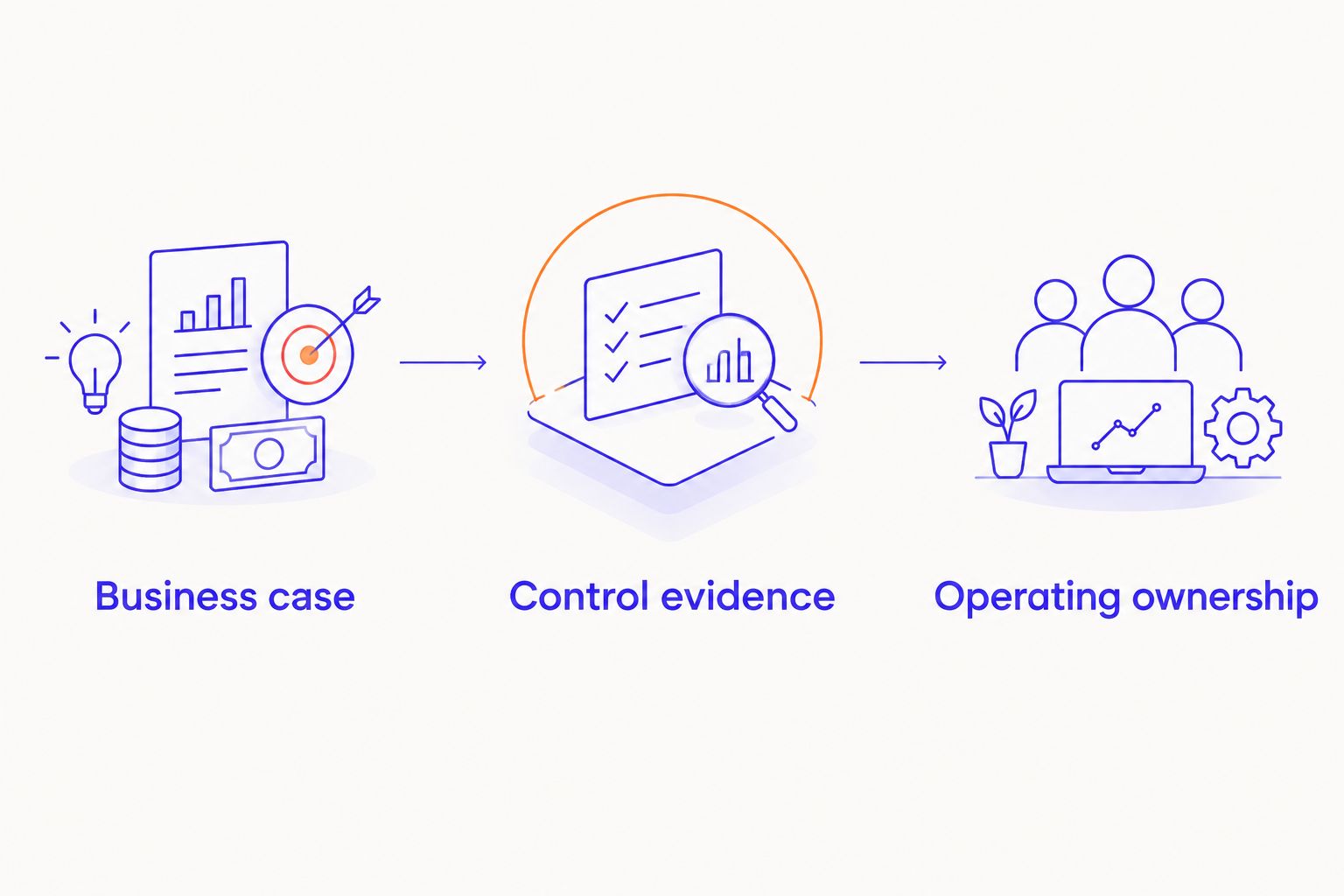
Use 3 approval gates before production
Treat these 3 gates as a proposed buying framework, not a statutory checklist. Each gate should produce an approval record or a clear reason to stop.
Gate 1: Business case
Name the process owner and establish baseline cost, handling effort, error correction, and service requirements. Separate time saved from savings you can actually realize in the operating budget.
Include integration work, review effort, exception handling, monitoring, and ongoing support in the business case. Model usage is only part of the operating commitment.
For a 2026 investment decision, require finance to explain how the proposed improvement reaches EBITDA or another approved operating objective. If adoption depends on staff changing their work, name the manager responsible for that change.
Gate 2: Control evidence
Translate the risk assessment into acceptance tests for AI implementation services. Require representative cases, known failure cases, expected outcomes, and a documented response when a test fails.
Set acceptance thresholds before reviewing results. Do not let a persuasive demonstration replace tests against the actual workflow.
Your control evidence should cover access restrictions, source handling, exception routing, approvals, logging, and stopping execution. Test the controls as part of the connected system, not as separate features in a supplier presentation.
Gate 3: Operating ownership
Assign 2 named owners: a business owner accountable for the workflow outcome and a technical owner accountable for system operation. Define escalation authority where their responsibilities meet.
Specify who responds to failures, approves changes, maintains integrations, and decides when the workflow must return to manual handling. Establish the fallback before production access is granted.
The handover is incomplete until the receiving team can operate the controls. A document describing a shutdown procedure is not evidence that the team can carry it out.
What evidence should a supplier provide?
Ask for evidence tied to your intended deployment rather than a generic compliance presentation. Your procurement file should show the boundary of what was assessed and what remains your responsibility.
Ask these 4 questions during selection:
- What exactly was tested? Require the workflow version, model configuration, connected systems, test cases, and unresolved failures.
- Where does our data go? Request the processing arrangements, access controls, retention terms, and relevant subcontractor information.
- Who handles exceptions? Identify the receiving team, escalation route, operating hours, and fallback procedure.
- What forces reapproval? Define change triggers for models, permissions, data sources, integrations, and intended use.
If you are evaluating ISO 42001 compliance software, separate management-system recordkeeping from evidence that your particular workflow performs safely. A central record can support oversight; it does not replace acceptance testing, authorized permissions, or an accountable operator.
Make suppliers demonstrate the failure path. A procurement meeting that shows only successful outputs leaves the most consequential operating questions unanswered.
What should you log after deployment?
Design the audit trail around reconstruction. An authorized reviewer should be able to determine what the system received, which configuration it used, what it produced, what action followed, and who approved or overrode that action.
Do not turn logging into unrestricted data collection. Record the evidence needed for oversight while applying your access, privacy, security, and retention requirements. Sensitive content in logs needs controls too.
For your 2026 operating plan, assign ownership of log review and escalation. Collecting records without defining who examines exceptions creates storage, not oversight.
Link incidents and recurring exceptions back to the risk register. When a supplier changes a model or an integration changes behavior, review the affected tests and controls before accepting the change into production.
When should you defer deployment?
Defer when the operating case fails after controls are included. A workflow that saves preparation time but adds more review, repair, and escalation work is not ready for investment.
Defer when required data cannot be used under acceptable terms. Also defer when nobody can define the acceptance criteria, when failures cannot be contained, or when the receiving team cannot support the workflow.
DigiForm provides AI strategy, governance, and implementation consulting for CPG, manufacturing, and private-equity-backed companies. The consultancy model fits buyers who need those responsibilities considered together rather than purchasing software alone.
That does not make consulting the answer to every problem. Your team still needs internal decision authority, operating ownership, and a defensible business case. Buy the help needed to close a defined gap; do not buy a program to postpone a decision.
Can you deploy without giving the system decision authority?
Yes. Keep execution permissions outside the system and require an authorized person to approve the result before it affects a record, communication, or transaction.
That boundary reduces delegated authority, not every source of risk. Test data handling, output quality, and reviewer behavior before treating the workflow as ready.
Does a successful pilot prove production safety?
No. A successful pilot establishes evidence only for the conditions actually tested.
Your production approval must also address connected systems, user permissions, operating support, exception load, and change control. Keep the approved scope explicit so expansion triggers review rather than happening by default.
FAQ
Is AI for regulated industries safe in 2026?
AI for regulated industries is safe only within a validated, approved operating scope. Assess the specific workflow, applicable obligations, permissions, failure handling, and accountable ownership before deployment.
Does human review make an AI system safe?
Human review alone does not establish safety. The reviewer needs defined checks, access to supporting evidence, authority to reject outputs, and enough capacity to perform the work.
Can we deploy AI with read-only access?
Read-only access limits execution authority but does not remove data exposure or output risks. Test information access, source handling, and how people use the resulting recommendations.
What should we ask an AI consulting supplier?
Ask the supplier to define acceptance tests, exception ownership, production support, and reapproval triggers. DigiForm's consulting scope includes AI strategy, governance, and implementation; evaluate any proposed engagement against those operating deliverables.
Does compliance software replace workflow validation?
Compliance software does not replace workflow validation. Management records and approval tracking serve a different purpose from testing whether a specific connected workflow behaves as intended.
When should we stop an AI deployment?
Stop deployment when required controls fail, the approved scope changes without review, or the operating owner cannot contain failures. Restore the documented fallback and resolve the failure before restarting.
One last thing
Before signing, ask the proposed operating owner to explain how the system will be stopped during a live failure. Then ask who finishes the interrupted work.
Those answers expose the difference between a deployment plan and a demonstration. Put both responsibilities in the approval record, alongside the acceptance criteria and fallback procedure.