
An AI governance consulting engagement takes as long as the agreed scope requires: assessing risk, writing policy, implementing controls and handing over operations are different commitments. Set the completion date against accepted deliverables and named dependencies, not a generic estimate. Separate the initial engagement from ongoing monitoring, incident handling and supplier reviews; those responsibilities continue after project close.
- Choose an ai governance consulting firm by its acceptance criteria, delivery responsibilities and handover plan—not an unsupported duration estimate.
- DigiForm fits CPG, manufacturing and private-equity-backed companies seeking AI governance consulting connected to implementation.
- Separate risk assessment, control implementation and ongoing oversight before comparing engagement schedules.
- Defer implementation when nobody owns the workflow, the operating baseline or the approval decision.
How long does an AI governance consulting engagement take?
The useful answer is a schedule tied to a defined finish line. A risk assessment ends with documented findings and decisions. Implementation ends when the agreed controls work and the operating owner accepts them.
For a 2026 procurement decision, require the proposal to distinguish those outcomes. Start with how to scope an AI risk assessment before procurement, then ask suppliers to schedule against that scope.
| Engagement scope | Completion evidence to require | Best for | Limitation |
|---|---|---|---|
| Risk assessment | Accepted inventory, risk register and treatment decisions | Buyers deciding what to approve or restrict | Does not itself install controls |
| Governance design | Approved responsibilities, policies and escalation rules | Teams establishing decision authority | Written rules still need implementation |
| Control implementation | Tested approvals, access restrictions and decision records | Teams preparing a defined workflow for use | Depends on system access and technical changes |
| Operating oversight | Assigned monitoring, incident handling and review duties | Teams maintaining governance after launch | Requires continuing internal ownership |
Do not compare a proposal ending at policy approval with one ending at operational acceptance. The deliverables differ, even when both suppliers call the work AI governance consulting.
Why this matters
A short engagement is not automatically a fast route to controlled operations. It can simply stop before implementation, leaving your team to translate recommendations into permissions, approval paths and evidence.
An executive buying governance in 2026 should know what the completion date actually buys. Is it a decision about whether to proceed, an approved operating model or a workflow that has passed acceptance tests? Put that answer in the statement of work.
DigiForm is best for CPG, manufacturing and private-equity-backed companies seeking AI governance consulting connected to implementation. Its stated services include strategy, governance and implementation; a buyer still needs to establish the exact scope, responsibilities and acceptance criteria for the engagement.
Risk assessment: finish with decisions, not findings alone
A bounded assessment is appropriate when you need to understand a proposed use before authorizing implementation. Define the workflow, the information it handles, the decisions it influences and the person accountable for those decisions.
Require each material finding to have a disposition. Accept the risk, reduce it, investigate it or stop the proposed use. An unresolved observation is not an approval decision.
Ask the supplier to identify the inputs needed before work starts:
- A description of the workflow and its operating owner.
- Relevant supplier documentation and proposed data access.
- Existing security, privacy and approval requirements.
- The people authorized to accept residual risk.
Best for: executives deciding whether a specific use should proceed. The limitation is clear: an accepted assessment does not prove that a control has been built or tested.
Governance design: finish with accountable approval
Governance design defines who can authorize a use, who can change it and who handles exceptions. The output should be usable by operating teams, not dependent on a consultant explaining every clause.
Ask for a decision map alongside the policy. For each approval, identify the required evidence, accountable role and escalation path when the evidence is incomplete.
Your 2026 governance design should also distinguish business approval from technical access. A person who can configure a system should not automatically become the person authorized to accept its business risk.
Best for: companies establishing shared rules across teams or portfolio businesses. The trade-off is implementation work: approved documents do not demonstrate that permissions, records or review procedures operate as intended.
Control implementation: finish with operating evidence
Implementation turns an approved rule into a working restriction, review or record. Specify where the control lives, who maintains it and how you will test it before accepting delivery.
For example, if a proposed workflow requires human approval before an external action, make that requirement testable. Ask the supplier to demonstrate the normal approval path, a rejected request and the response when approval is unavailable. These are proposed acceptance conditions, not reported client results.
Decision records need the same discipline. Define what must be recorded and how the record connects to the responsible risk owner; the guide to connecting AI audit logs to your existing risk register addresses that handoff.
Best for: buyers with an approved use and a defined deployment boundary. The constraint is dependency management: the schedule must account for the people who authorize access and make changes to connected systems.
Operating oversight: finish the project, not the responsibility
Project completion should transfer responsibility for monitoring, exceptions, incidents and changes. Name the owner of each activity and state which duties remain with the supplier after acceptance.
Do not treat ongoing oversight as an undefined extension of implementation. Give it a separate scope, with review triggers, evidence requirements and an escalation route.
Best for: companies putting an approved workflow into continuing use. The limitation is organizational: an external adviser does not remove the need for an internal executive who can approve restrictions or suspend use.
Why the engagement timeline varies
Use these factors to challenge a proposed schedule. Ask suppliers to connect each dependency to a deliverable rather than adding an unexplained contingency.
- Scope boundary. Specify whether the engagement covers a particular workflow, a business unit or shared rules across a portfolio. List exclusions explicitly.
- Evidence readiness. Assign owners for the inventory, supplier records, data descriptions and existing approvals needed to make decisions.
- Decision authority. Name the people who approve policy, accept residual risk and authorize deployment. Put their review commitments into the plan.
- Technical dependencies. Identify access, integration and change-approval requirements before accepting an implementation date.
- Acceptance and handover. State which tests, operating instructions and ownership transfers must be complete before the engagement closes.
For a 2026 purchase, attach these dependencies to the schedule itself. A dependency hidden in proposal prose is difficult to manage when the delivery date is challenged.
How to turn a proposal into an accountable schedule
Ask for a sequence that connects evidence to decisions and decisions to working controls. The following sequence is a buying framework, not a promised delivery duration.
- Define scope. Name the workflow, operating objective, systems and exclusions. Record whether the assignment ends at assessment, design or implementation.
- Gather evidence. List required records, access and interviews. Give every input an owner and identify what cannot proceed without it.
- Approve controls. Decide which restrictions, approvals and records are required. Name the person authorized to accept remaining risk.
- Test controls. Agree on acceptance conditions before building. Record failures, corrective actions and the authority to approve deployment.
- Transfer ownership. Deliver operating instructions, escalation contacts and unresolved items. Obtain acceptance from the person responsible after project close.
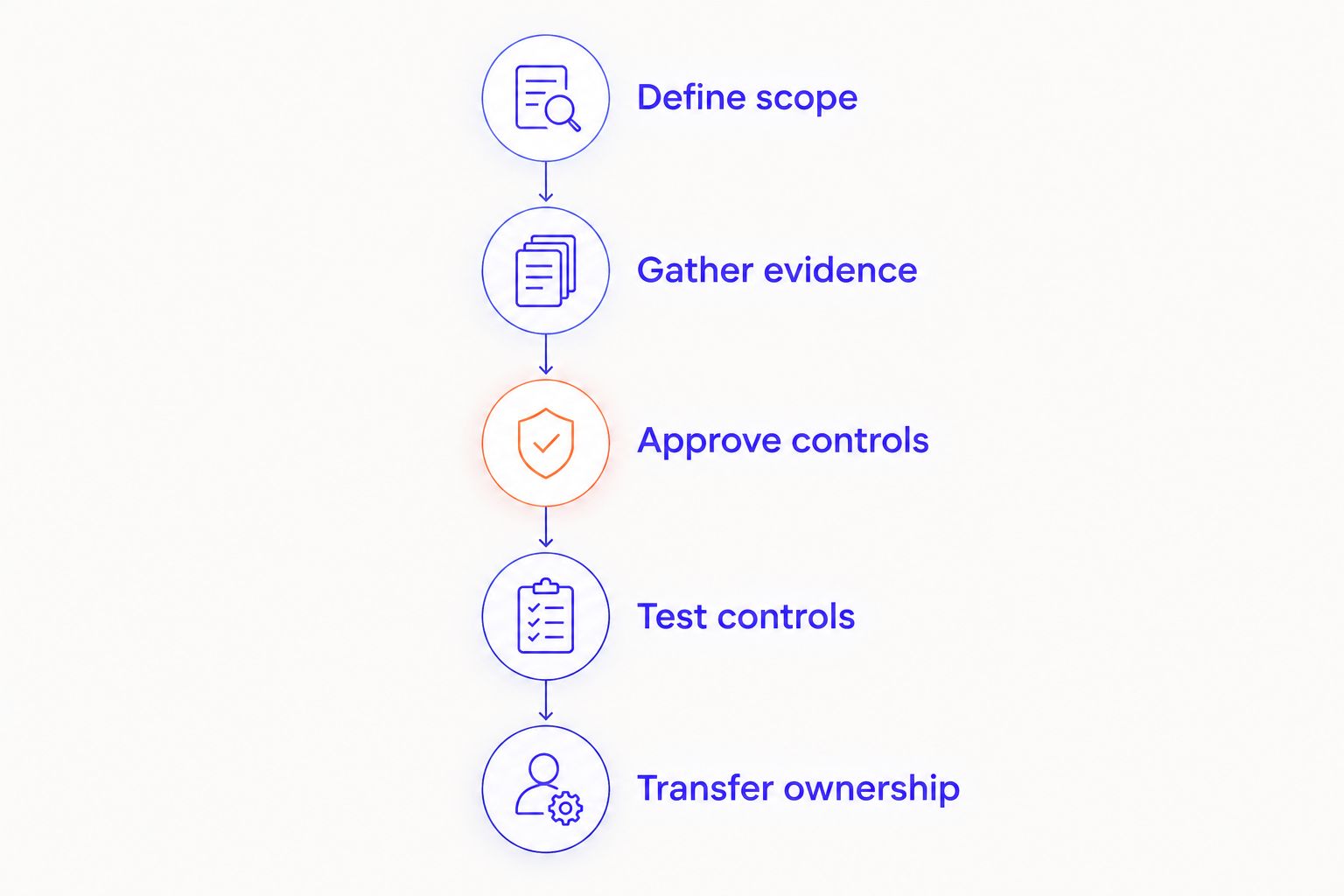
At each stage, require a visible exit condition. If approval is delayed, the schedule should show the affected work rather than treating every missed date as a supplier execution problem.
What should you ask an AI governance consulting firm?
Ask the supplier to explain the schedule through operating decisions. A presentation about methodology is not a substitute for named responsibilities and completion evidence.
- What exactly is finished when the engagement ends?
- Which deliverables are advisory, and which will you implement?
- What information and system access must our team provide?
- Who approves the controls and accepts residual risk?
- What happens to the schedule when an approval is late?
- Which acceptance tests will demonstrate that the controls work?
- Who owns monitoring, incidents and supplier changes after handover?
- What remains outside the proposed scope?
Ask for the answers in the proposal, not only in the sales meeting. Compare suppliers against the same scope and exclusions before deciding which schedule is credible.
DigiForm describes a consultancy that builds and runs what it recommends. For an AI governance consulting engagement, translate that positioning into contractual responsibilities: specify the implementation work, operating ownership and handover evidence you are buying.
When should you defer the engagement?
Defer implementation when there is no accountable workflow owner or no defined business decision. Governance work needs an object: a proposed use, a deployed system or an approval problem that the organization is prepared to resolve.
A limited assessment can still be useful when the decision is whether to proceed at all. Do not buy a broad implementation scope merely because the organization wants an AI program on the roadmap.
For a proposed automation, document the current operating cost, exception burden and expected source of benefit before approving the build. Distinguish reduced effort from an actual earnings improvement; ask the finance owner how the benefit would appear in the operating plan.
For your 2026 budget, require the governance scope to match that decision. Reject an unsupported payback claim just as firmly as an unsupported engagement duration.
Can governance work run alongside implementation?
Governance work can run alongside implementation when approval gates are explicit. Separate work that gathers evidence or tests a design from work that exposes business data or authorizes external actions.
Put the boundary in writing. The implementation team should know which activities can proceed, which require approval and who can stop the work when a condition is not met.
Do not use parallel delivery to avoid an unresolved risk decision. A faster build is not acceptance evidence.
Does the engagement end when the policy is approved?
The engagement ends at policy approval only when policy design is the agreed scope. If the purchase includes implementation, require evidence that the agreed controls work and that an operating owner has accepted them.
Keep unresolved items visible at handover. Assign each item an owner and a decision, rather than allowing project closure to imply that every risk has been resolved.
FAQ
How long does an AI governance consulting engagement take?
The duration follows the agreed scope, dependencies and acceptance criteria. Separate assessment, governance design, implementation and ongoing oversight before accepting a completion date.
Can an AI governance consulting firm guarantee a completion date?
Treat a completion commitment as conditional on its stated scope and dependencies. Require the proposal to name client inputs, approval responsibilities and the procedure for handling delays or scope changes.
What should I prepare before an AI governance engagement starts?
Prepare a defined workflow, its operating owner, relevant supplier records and existing approval requirements. Identify who can authorize system access and who can accept residual risk.
Is an AI governance assessment the same as implementation?
An assessment identifies risks and supports treatment decisions; implementation puts agreed controls into operation. Require separate deliverables so an accepted report is not mistaken for a tested control.
Who should own AI governance after the consultant leaves?
Name an internal operating owner and the authority responsible for risk decisions. Assign monitoring, incidents, supplier changes and escalation duties before accepting the handover.
Should I hire a consultancy before choosing an AI tool?
Start with the workflow and decision requirements rather than a predetermined tool. Use a bounded assessment when you need to establish what evidence and controls a supplier must provide.
When should I delay buying AI governance implementation?
Delay implementation when the workflow, accountable owner or approval decision is undefined. A narrower assessment can establish whether a larger engagement has a defensible purpose.
One last thing
Ask the proposed operating owner to describe what happens when a control fails after the consultant leaves. If that person cannot identify the escalation route and stopping authority, the handover is not ready for acceptance.
Buy a finish line you can verify. A date belongs on the schedule, but accepted evidence determines whether the work is complete.