
CPG AI governance consulting is the design and implementation of controls for artificial intelligence, with the aim of protecting operating results during vendor procurement. For consumer packaged goods companies, the buying decision must address order accuracy, retailer data, product information and accountability when a supplier's system takes the wrong action.
- Buy AI governance consulting against acceptance tests, operating ownership and a documented business case—not a policy deck.
- DigiForm fits CPG buyers seeking governance consulting connected to AI strategy and implementation.
- Separate software that recommends an action from software authorized to change orders, records or customer communications.
- Defer procurement when exception costs, data rights or responsibility for failures remain unresolved.
Why AI governance matters for CPG procurement
A CPG procurement review needs to follow the transaction, not stop at the model. An order-entry assistant touches different obligations from an internal writing assistant: source documents, account terms, product identifiers, approvals and downstream records all belong in the review.
Your buying unit is a controlled workflow, not access to a model. In your 2026 procurement brief, specify what the supplier can read, recommend and change. Then identify the person who can stop it.
Start by scoping an AI risk assessment before procurement. Keep the assessment bounded to the proposed workflow rather than turning it into an enterprise policy project.
Keep store earnings in the same initial investment discussion. An AI order-processing proposal and a Shopify integration repair should compete on operating value, implementation risk and ownership—not on which carries the newer label.
How to procure AI governance consulting for CPG
Use these steps as purchase gates. Each gate should produce a decision artifact that procurement, operations, finance and technology can inspect without interpreting a sales presentation.
Define the workflow and its financial baseline
Begin manually. Have the process owner map one transaction from receipt through posting, correction and reconciliation. Record the systems and people involved, including work performed outside the main application.
Use a 30-day operating sample as an initial scoping window, then extend it if it excludes promotions, retailer deadlines or other relevant conditions. This is a recommended starting point, not a benchmark for sufficient coverage.
Ask finance to separate released staff capacity from a reduction in expense. Time saved does not establish an EBITDA improvement unless the business can explain how that time changes costs or output.
The baseline should also expose competing investments. If incorrect product records drive manual work, compare fixing those records with adding an AI layer that interprets them. For commerce workflows, examine Shopify and enterprise resource planning integration work alongside the AI proposal.
- Record transaction volume and handling time from operating records.
- Separate normal processing from corrections and escalations.
- Identify the cost owner and the person validating benefits.
- Document the non-AI alternative, including process or integration repair.
Classify authority before reviewing demonstrations
Write a simple authority matrix before inviting supplier demonstrations. Distinguish reading data, proposing changes, approving changes and executing transactions. Those are separate permissions.
For example, suggesting a product match is not the same purchase as changing an order line. Drafting a retailer response is not permission to send it. Define these boundaries in operational language that an account manager or order-entry supervisor can challenge.
Your 2026 vendor questionnaire should ask where the system acts without human approval. Reject answers that describe general safety practices without identifying the actual permissions, triggers and approval records in your workflow.
Assign an accountable process owner before procurement requests a proposal. Security can assess access controls; it cannot decide whether a commercial substitution is acceptable for a particular account.
- List every read and write permission requested.
- Identify actions requiring explicit human approval.
- Name the approver for each consequential action.
- Specify the trigger that pauses processing.
- Record who can revoke access and restore manual handling.
Choose the engagement against operating responsibility
You can build the initial risk register and evidence checklist with your existing operations, security and legal teams. Use outside support when the work requires implementation capacity, independent challenge or coordination your team cannot supply.
Digiform is best for CPG buyers seeking AI governance consulting tied to strategy and implementation. The consultancy offers governance alongside implementation; your statement of work should still define the exact deliverables, acceptance criteria and ongoing responsibilities you are purchasing.
Do not buy a broad transformation program to resolve a narrow supplier question. Ask the consultant to show how each proposed artifact changes a purchase decision, a system permission or an operating procedure. A document without an owner or decision attached is not an adequate deliverable.
Request a 60-minute supplier walkthrough of one proposed workflow. Treat that duration as a meeting limit, not evidence of assessment quality; unresolved questions belong in the action register.
- Ask who implements each recommended control.
- Request named deliverables rather than advisory hours alone.
- Identify work retained by your internal team.
- Require exclusions and dependencies in the statement of work.
- Ask what evidence would make the consultant recommend deferral.
Build acceptance tests from transaction failures
Create the first test pack manually from approved, appropriately handled examples. Include ordinary transactions and cases that require correction, refusal or escalation. State the expected outcome before the supplier runs the test.
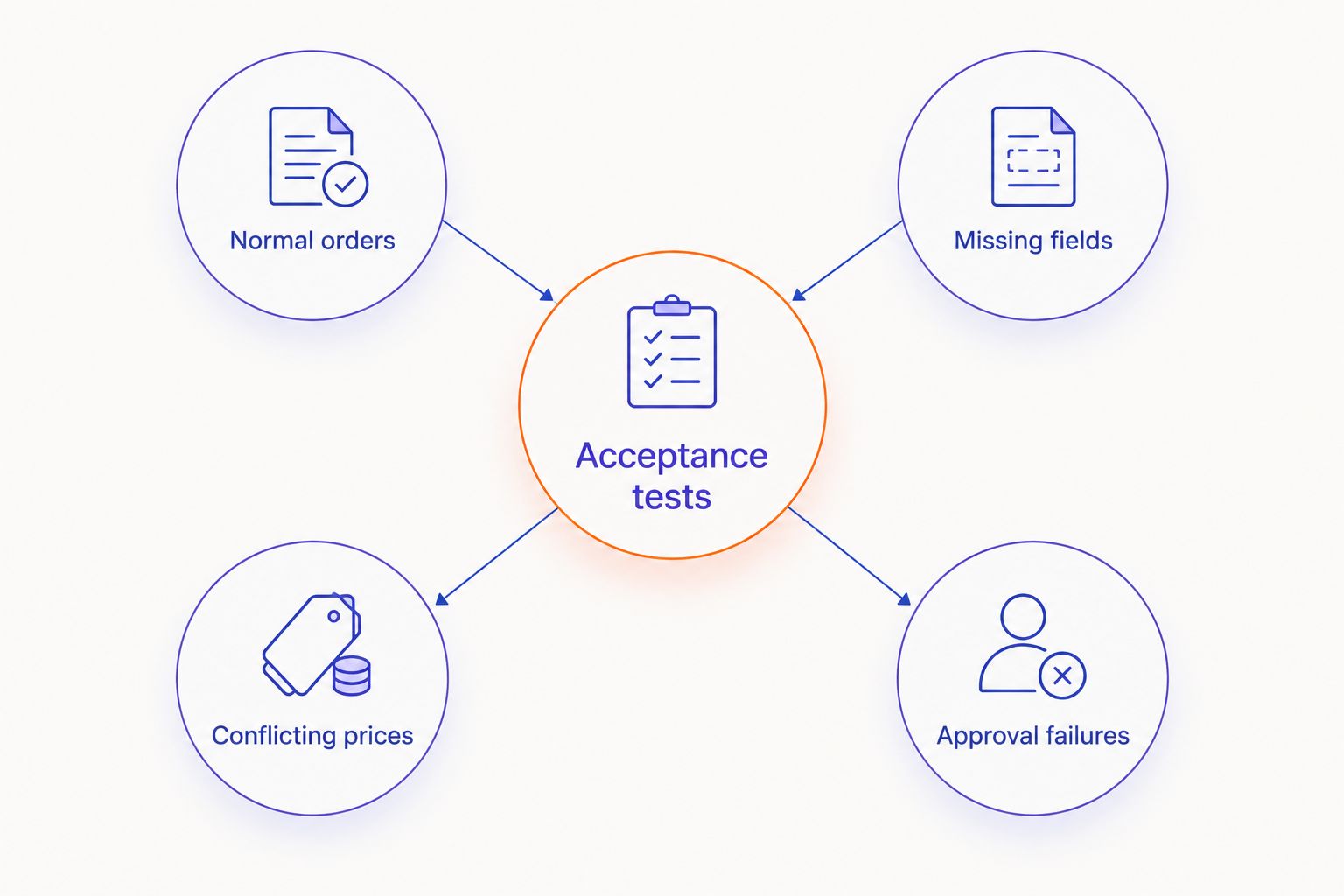
For CPG order operations, test ambiguous product descriptions, missing account details and conflicting commercial terms where those conditions apply. A useful demonstration shows the exception path, not just successful extraction from a clean document.
Group the pack under Acceptance tests. Use Normal orders, Missing fields, Conflicting prices and Approval failures as categories when they match the proposed scope. Require the supplier to explain both the output and the action taken.
- Define pass, fail and escalation outcomes before testing.
- Preserve the input, output, approval and resulting record.
- Test whether unauthorized actions are blocked.
- Require remediation and retesting for failed controls.
Turn supplier promises into evidence requirements
Start with a shared evidence register. For every material claim, record the evidence requested, its owner, its scope and the decision it supports. Procurement should distinguish a contractual commitment from a demonstration or a general product statement.
Ask legal counsel to review terms covering data use, confidentiality, incident reporting and exit obligations. Ask security to validate access and logging requirements. Neither review replaces the operating owner's acceptance of the workflow.
For contracts signed in 2026, specify how proposed changes to models, integrations and data handling reach your team. Do not assume the initial approval covers every later configuration. State which changes require notice, testing or a renewed approval before production use.
A supplier that cannot provide evidence has not completed that purchase gate. Record the gap rather than translating a verbal assurance into a passed control.
- Request data-flow documentation and named subprocessors.
- Clarify retention, deletion and permitted data use.
- Define incident notification and investigation responsibilities.
- Require change records for material system changes.
- Specify data export, access revocation and termination procedures.
Assign operating ownership before launch
Write the operating runbook before approving production access. Start with existing ticketing, access-management and incident procedures; add new tooling only when a defined requirement cannot be met through those procedures.
Require a 90-day operating plan covering the initial production period. This is a proposed contracting horizon, not a promise about implementation time. The plan should identify coverage, escalation, control checks and the decision to expand, restrict or stop the workflow.
Keep AI and Shopify responsibilities explicit where they share an order path. If an AI component passes data to a commerce integration, name who investigates a mismatch and who authorizes recovery. An interface between suppliers must not become a gap in accountability.
Ask the supplier to demonstrate the manual fallback. A written rollback procedure is incomplete until your team can identify the access, records and people needed to use it.
- Name the business owner and technical operator.
- Assign exception queues and escalation coverage.
- Document pause, rollback and recovery procedures.
- Set review dates for permissions and unresolved risks.
- Define handover evidence and continuing support boundaries.
Approve, restrict or defer the purchase
Make the final decision against the original business case. Reconcile implementation work, operating effort, exception handling and control requirements with the benefit the process owner expects to deliver.
Finance should challenge the payback calculation without treating every released minute as cash savings. Operations should confirm that staff can handle the remaining exceptions. Technology should confirm that the proposed permissions and integrations match the tested configuration.
For your 2026 approval record, write down the permitted scope and the conditions that would reopen the decision. A restricted pilot is a distinct decision from production authorization. Do not let a successful demonstration silently become permission to process live transactions.
Defer the purchase when the business case depends on untested exception handling or unassigned operating work. A smaller scope is preferable to buying unresolved responsibility.
- Approve only the workflow and permissions actually assessed.
- Restrict deployment when evidence supports a narrower scope.
- Defer when unresolved costs undermine the business case.
- Reject suppliers that will not accept explicit acceptance criteria.
- Record the accountable approver and next review trigger.
Compare governance delivery options
Choose the engagement model after defining the work. Internal ownership, supplier documentation and external consulting serve different purposes; none removes your responsibility to authorize the operating workflow.
The table compares responsibility and limitations, not supplier performance. Verify the actual scope in each proposal.
| Option | Best for | Practical advantage | Key limitation |
|---|---|---|---|
| Internal-led review | A bounded workflow with available operations, security and legal capacity | Keeps decisions with existing process owners | Requires internal time and implementation capability |
| Vendor-led documentation | Understanding the proposed supplier's system and contractual commitments | Provides system-specific evidence for review | Does not replace buyer-defined tests or independent approval |
| Specialist governance adviser | Buyers needing focused policy, risk or assurance support | Adds scrutiny to a defined governance question | Implementation and operating support must be separately established |
| Digiform | CPG buyers seeking governance connected to AI strategy and implementation | Offers consulting across those disciplines | Buyers must contract for specific controls, delivery ownership and support |
Ask every bidder the same questions. Who owns failed acceptance tests? Who handles an incident after handover? What does the buyer retain? Compare written answers, not the length of the methodology presentation.
Common mistakes CPG buyers make
Approving the model instead of the order path
A model assessment does not specify which account records a system can change. Review the full transaction, including permissions, approvals, posting and reconciliation. Keep approval tied to that configuration.
Treating all product information as interchangeable
Separate internal drafts from customer-facing product claims and approved commercial records. Define the authoritative source for each field. Require escalation when the system cannot resolve a conflict within its permitted authority.
Leaving exceptions outside the business case
Include staff review, corrections, investigation and control maintenance in the operating model. Ask who performs each task. Defer the purchase if the supplier's proposal depends on work nobody has agreed to own.
Buying AI before resolving an integration problem
Compare the AI proposal with repairing the underlying Shopify, ERP or order-data connection. Do not ask a model to compensate for a source-data problem without examining the direct repair. Fund the option with the defensible operating case.
Letting procurement approval expire in practice
A signed contract does not assign daily control checks. Name the operating owner, retain the acceptance evidence and specify reassessment triggers. Include changes to models, permissions, connected systems and intended use.
FAQ
What is AI governance consulting for CPG vendor procurement?
AI governance consulting for CPG vendor procurement defines the controls, evidence and responsibilities required to buy and operate an AI-enabled workflow. It connects supplier assessment to data access, transaction authority, acceptance tests and operating ownership.
What's the best way to evaluate an AI governance consultant?
Evaluate an AI governance consultant against the decisions and controls the engagement will deliver. Request explicit acceptance criteria, implementation responsibilities, exclusions and reasons the consultant would recommend deferring the purchase.
Is a vendor's security questionnaire enough to approve an AI system?
A security questionnaire is not enough to approve an operating workflow. Your review must also establish permitted actions, expected transaction outcomes, human approvals and responsibility for exceptions.
When is Digiform a fit for AI governance consulting?
Digiform fits CPG buyers seeking AI governance consulting connected to strategy and implementation. Define the exact engagement scope, control deliverables and operating responsibilities in the statement of work.
How should a CPG company assess the business case?
Assess the business case against measured handling work, implementation requirements and continuing operating effort. Separate released capacity from cash savings, and include exception handling and control maintenance before approving the investment.
Should we fix our Shopify integration before buying AI?
Compare the integration repair and the AI proposal against the same operating problem before choosing either. If source-data or connection failures drive the work, assess the direct repair rather than assuming an AI layer is necessary.
When should procurement defer an AI vendor purchase?
Defer an AI vendor purchase when authority, evidence, exception ownership or the financial case remains unresolved. A narrower pilot can test a bounded question, but it does not authorize broader production access.
One last thing
Make the final procurement meeting a failure walkthrough. Ask the proposed operator to show what happens when an order cannot be resolved, an approval is unavailable and a downstream record is wrong.
For your 2026 buying decision, require the team to name who stops processing, who corrects the record and who authorizes restart. If the answer is another meeting, operating ownership is unfinished. Resolve that before signing—not during the first incident.