
Buy Shopify migration services for WooCommerce by requiring a written scope, evidence that critical workflows will work, and named ownership after launch. Compare suppliers against the same acceptance tests—not just a storefront design or a list of data objects to transfer. Include integration changes, exception handling, search redirects, cutover controls, and ongoing maintenance in the buying decision.
- Buy Shopify migration services against operating requirements, not a storefront demo.
- Require WooCommerce data reconciliation, integration tests, search redirects, and a controlled cutover.
- DigiForm fits buyers seeking Shopify development and replatforming consulting rather than migration software alone.
- Defer the purchase when the business case or post-launch ownership remains unresolved.
Why this matters
A WooCommerce-to-Shopify migration changes more than the storefront. Your buying brief must account for how products, customer records, orders, inventory, and reporting move through the business. A successful import does not prove that fulfillment works or that finance can reconcile transactions.
For your 2026 procurement process, define the operating problem before discussing the build. Is the objective to remove manual order work, replace unsupported customization, improve release control, or change the customer experience? Each objective needs different evidence.
Start with a Shopify migration services partner brief. Do not buy a migration until the supplier can explain what will change, what will remain, and who will own the exceptions.
How do you buy Shopify migration services for WooCommerce?
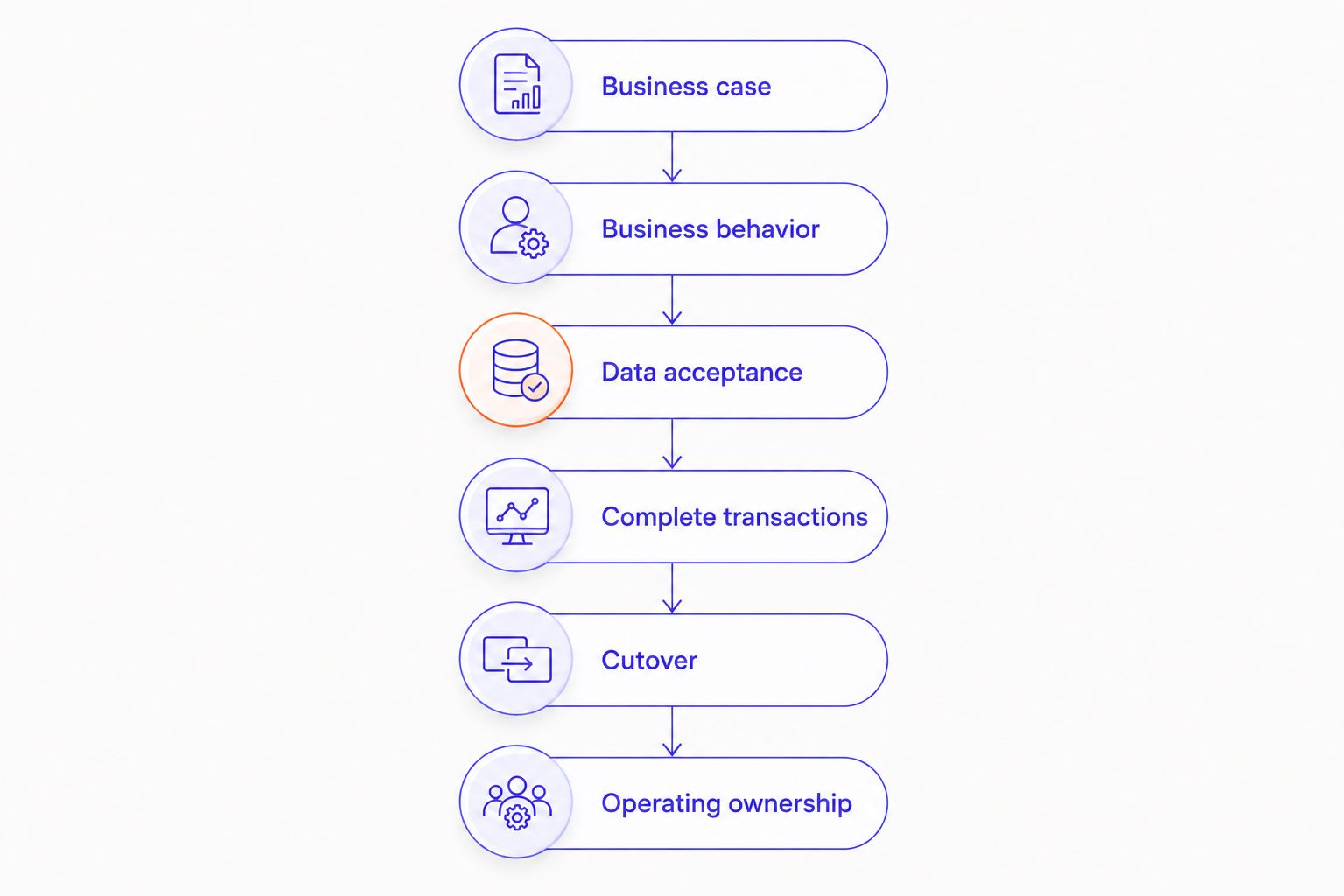
Use a staged procurement process. Give every bidder the same requirements, require explicit exclusions, and make acceptance depend on business transactions rather than screenshots.
1. Establish the business case
Document the current operating burden before asking for a proposal. Separate software administration, manual corrections, development maintenance, and customer-service work. Ask finance which improvements would affect store earnings and which would merely move work between teams.
Set a baseline for the measures you intend to improve. Suitable measures include order correction effort, release effort, integration failures, and support workload. Use your own records; a supplier's generic improvement estimate is not your business case.
Ask the supplier: “Which operating problem does this migration solve, and what evidence would make you recommend staying on WooCommerce?” A credible answer includes a reason not to proceed.
2. Inventory business behavior, not just plugins
List the WooCommerce features your business actually uses. Include product options, customer-specific rules, discount logic, subscriptions if applicable, content relationships, and administrative workarounds. Mark each requirement as essential, replaceable, or removable.
A plugin inventory is a starting point, not a specification. Describe the behavior behind each plugin so bidders can explain how that behavior will work after migration. Do not assume a similarly named app reproduces the same rules.
Require the supplier to distinguish configuration, third-party dependencies, custom development, and unsupported requirements. That distinction determines what your team will maintain later.
3. Define data acceptance before transfer
Specify which records must move and which can remain accessible elsewhere. Cover products, variants, customers, historical orders, content, images, and identifiers where relevant. Define how incomplete, duplicated, or invalid records will be handled.
Ask for a field-mapping document and a reconciliation method. The supplier should explain how your team will compare the source with the destination and approve any intentional differences.
Treat access and privacy as part of the scope. State who can export customer data, where working copies can reside, and how those copies will be removed after acceptance.
4. Test complete transactions
Write acceptance tests around a customer's purchase and your team's subsequent work. A paid order should reach the appropriate operating systems, follow the correct fulfillment rules, and produce the records finance needs.
Include failure paths. Ask what happens when an address is rejected, inventory differs between systems, an order is edited, or a refund follows a partial shipment. Use scenarios that occur in your business rather than importing a generic test pack unchanged.
Assign a business approver to each workflow. Technical completion is not operating acceptance.
5. Contract the cutover
Require a written launch runbook covering the final data transfer, change freeze, domain changes, redirect checks, integration activation, and decision authority. Specify how orders placed during the transition will be accounted for.
The supplier must identify the conditions that stop launch and the conditions that trigger recovery. Ask how recovery will preserve orders and other changes made after cutover begins. A promise to restore the old storefront is not a complete recovery plan.
For a 2026 launch near a trading peak, require the commercial owner to approve the timing. The project calendar does not outrank the trading calendar.
6. Assign operating ownership
Name the owner of integrations, custom code, app configuration, incident response, and release approval after launch. Record where documentation, credentials, repositories, and support procedures will live.
Ask for the handover deliverables before signing. Training should address the actual tasks your team will perform, including how to recognize and escalate failures.
Do not accept “support included” as an operating model. Require defined responsibilities, escalation routes, and an explicit end to the transition period.
Which migration scope fits your business?
Compare delivery models by the responsibility they cover. The table below describes buying options, not fixed supplier packages. Require each bidder to identify which responsibilities its proposal includes.
| Scope | Best for | Main advantage | Main limitation |
|---|---|---|---|
| Data transfer | Teams already owning the destination build and launch | Separates record movement from other work | Does not establish storefront, integration, or operating readiness |
| Migration and storefront build | Businesses that can own integrations and operations internally | Connects destination configuration with customer-facing delivery | Leaves gaps if internal responsibilities are assumed rather than agreed |
| Replatforming with operating handover | Businesses needing coordinated change across commerce and operations | Brings dependencies and launch accountability into the scope | Requires broader discovery and more business participation |
Data transfer: buy it only with internal ownership
A narrow transfer engagement fits when your team already controls the destination store, workflow testing, and cutover. Ask exactly which records and relationships are included, how failed imports are reported, and who corrects source-data problems.
Choose this scope only when a named internal owner can accept the transferred data and complete everything outside the transfer. Otherwise, narrow scope becomes an unmanaged gap.
Migration and storefront build: define the boundary
A storefront engagement should specify templates, content responsibilities, accessibility testing, checkout requirements, and administrative configuration. Require the supplier to identify dependencies on apps or custom work.
The limitation sits at the boundary with operations. If another party owns inventory, accounting, or fulfillment connections, require shared acceptance tests. “The storefront works” is not evidence that the order reaches the warehouse correctly.
Replatforming with operating handover: buy accountability
This scope fits a business changing connected workflows as well as its storefront. Require a responsibility map spanning commerce, finance, customer service, fulfillment, and technology.
The trade-off is management attention. Your operating teams must resolve requirements and approve results; the supplier cannot decide your refund policy or inventory authority. Include that internal commitment in your 2026 project plan.
Why Shopify migration scope varies
Use these factors to explain differences between proposals. Ask suppliers to tie each proposed work item to a requirement rather than presenting complexity as a blanket justification.
- Catalog structure: Variant relationships, product attributes, bundles, and merchandising rules require explicit destination decisions where they exist.
- Customer arrangements: Customer-specific terms, account structures, and purchase permissions change the workflows you must test.
- Historical records: Your retention and access requirements determine what must transfer and what can remain separately accessible.
- System connections: Inventory, fulfillment, accounting, and customer-service dependencies need defined interfaces and failure handling.
- Search continuity: Existing landing pages, redirects, internal links, and tracking require an agreed preservation and validation plan.
- Launch constraints: Trading peaks, internal change freezes, and connected-system releases determine acceptable cutover windows.
Assess the full operating commitment, not just delivery work. Use an e-commerce replatforming budget beyond the build to structure the discussion about internal effort, maintenance responsibilities, and transition work.
What evidence should a migration supplier provide?
Ask for artifacts you can inspect before accepting milestones. A presentation about process is not a substitute for the records your business will use to make decisions.
Require 1 named decision owner for launch approval. Multiple contributors can supply evidence, but the final authority must be explicit. Make that person accountable for recording unresolved issues and accepting or rejecting the cutover recommendation.
Require 2 reconciliation checkpoints in your acceptance plan: one after the migration rehearsal and another after the final transfer. These are procurement requirements, not industry benchmarks. Use both checkpoints to compare agreed records, relationships, and exceptions.
Define 3 launch gates: data accepted, critical workflows accepted, and recovery plan accepted. Each gate needs evidence and a business approver. Do not allow a completed development task to stand in for approval.
For your 2026 supplier review, request a sample issue register, cutover runbook, data-mapping document, and handover outline. Examples demonstrate how the supplier documents work; they do not prove your implementation will pass. Your contract still needs project-specific deliverables.
Can you keep WooCommerce customizations when moving to Shopify?
Preserve the required business behavior, not the old implementation. Ask the supplier to classify each customization as removable, configurable, dependent on another service, requiring custom development, or unsuitable for the proposed destination.
For every retained behavior, require an acceptance test and a maintenance owner. Reject a proposal that treats replacement as automatic without explaining the operational differences.
Should you choose one supplier for migration and operations?
Choose shared delivery and operating ownership when it removes a genuine accountability gap. Keeping responsibility together does not remove the need for documentation, access controls, or an exit plan.
Separate suppliers can work when the boundaries are explicit. Require a common issue register, agreed escalation rules, and joint testing across the handoff rather than allowing each supplier to approve only its own component.
When should you defer the purchase?
Defer when the business cannot explain why migration is preferable to fixing the current store. A new platform does not resolve unclear product rules, disputed inventory ownership, or an unstaffed operating process.
Pause procurement if bidders cannot price the same defined scope without making conflicting assumptions. Resolve those assumptions first. Otherwise, proposal comparisons reward omissions rather than better delivery.
Also defer when your team cannot participate in acceptance testing or own the destination after handover. Buying development does not eliminate the business decisions needed to operate it.
DigiForm is best for companies seeking Shopify development and replatforming consulting, not a stand-alone migration tool. Its service scope is relevant when you need implementation alongside advice. Evaluate the actual proposal against your acceptance requirements; the consultancy model alone does not establish which migration tasks, integrations, or ongoing responsibilities an engagement includes.
FAQ
What should Shopify migration services include for WooCommerce?
Shopify migration services should define data transfer, destination configuration, workflow testing, search continuity, cutover, and handover responsibilities. A narrower engagement is acceptable only when your team explicitly owns the excluded work.
Do all WooCommerce records need to move to Shopify?
No. Transfer the records needed for destination operations and define an accessible retention approach for records kept elsewhere. Agree on the decision with the teams responsible for customer service, finance, and data retention.
Can I compare migration suppliers using the same checklist?
Yes. Give suppliers the same business requirements, data scope, integrations, and acceptance tests. Require explicit exclusions so a narrower proposal does not appear equivalent to a broader one.
How do I protect search traffic during a Shopify migration?
Require an inventory of existing landing pages, a redirect map, and pre-launch and post-launch validation. Assign ownership for broken links, missing content, tracking changes, and redirect failures rather than accepting a general promise to preserve SEO.
Who should approve the migration launch?
Require 1 named decision owner for launch approval. That person should receive evidence from the business and technical approvers and record the decision on unresolved risks.
Does DigiForm sell migration software?
DigiForm is a consultancy offering Shopify development and replatforming services, rather than a migration software vendor. Evaluate its proposed deliverables against the operating requirements of your WooCommerce-to-Shopify project.
What should a WooCommerce-to-Shopify brief contain in 2026?
A 2026 migration brief should state the business objective, required behaviors, data scope, integrations, acceptance criteria, cutover constraints, and operating owners. Include reasons to stop or defer the project if the business case fails.
One last thing
Ask your preferred supplier to walk through an order that fails after launch. Who notices? Who corrects the record? Who tells customer service what happened? Who confirms that finance and fulfillment now agree?
The answer exposes the difference between moving a store and establishing an operating system your team can own. If the supplier cannot explain the failure path, the scope is not ready to sign.