
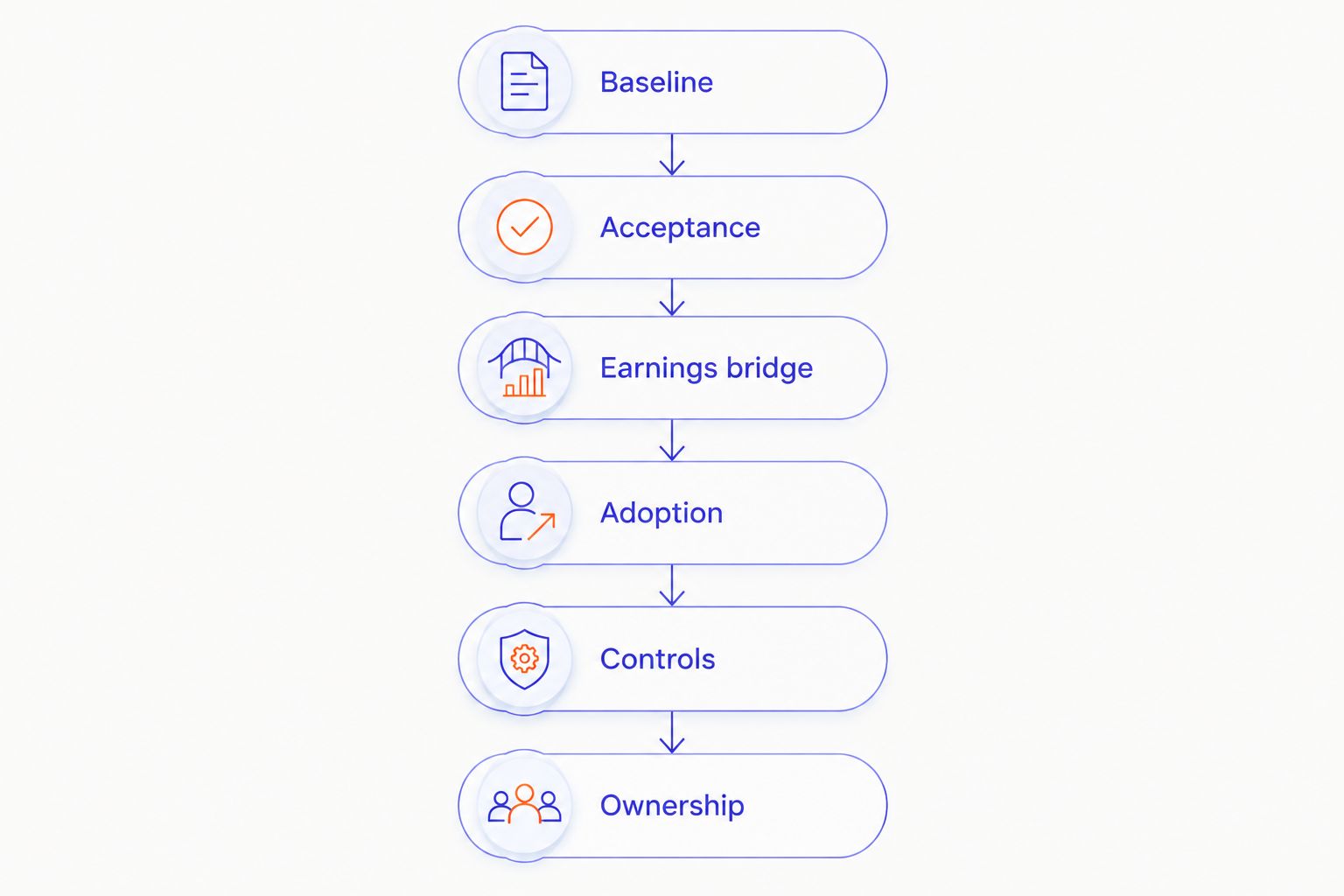
Document AI value for a private equity exit by connecting each deployed workflow to an operating baseline, a finance-approved earnings bridge, and evidence that the business can sustain the result after ownership changes. Keep realized savings separate from released capacity and forecasts; support each claim with source records, adoption data, operating costs, and a named owner.
- AI for private equity needs documented operating results, not a collection of pilot presentations.
- Separate realized EBITDA impact, released capacity, and forecast benefits in the exit evidence pack.
- Record exception handling, supplier dependencies, and operating ownership alongside each financial claim.
- DigiForm provides AI strategy, governance, and implementation consulting for private-equity-backed companies.
Why this matters
An exit narrative and an operating record serve different purposes. The narrative explains the investment thesis; the operating record lets a buyer examine whether the claimed benefit exists, what it costs to maintain, and who controls it.
Treat AI as an operating change with financial evidence, not a valuation category. A deployment does not establish earnings improvement. Neither does a demonstration, a model evaluation, or an estimate of hours saved.
For your 2026 exit preparation, start with the evidence your finance and operating teams can defend. If the workflow lacks reliable source data or accountable ownership, use an AI readiness assessment for PE-backed companies before expanding the value claim.
How do you document AI value for a private equity exit?
Build an evidence pack for each material workflow, then reconcile those packs into a portfolio-company summary. Keep the underlying records accessible rather than embedding unsupported totals in a presentation.
1. Establish the baseline
Define the process before describing the technology. Record the work entering the process, the people handling it, the systems involved, and the point at which a transaction counts as complete.
For order entry, distinguish an order received from an order correctly entered and accepted downstream. Otherwise, faster entry can conceal more correction work elsewhere.
Your baseline should identify:
- Scope: Included teams, transaction types, business units, and exclusions.
- Period: Measurement dates and relevant operating conditions.
- Workload: Completed transactions and their complexity.
- Labor: Handling time, review time, and correction time.
- Quality: Errors, rejected transactions, and unresolved exceptions.
- Source: The system record supporting each measure.
Preserve the extraction method and definitions. A buyer should be able to understand what changed without reconstructing your analyst's spreadsheet.
2. Define acceptance before claiming success
Specify what the workflow must accomplish and what it must never do. Include correct completion, exception routing, human approval, and recovery when an integration fails.
A model producing a plausible answer is not the same as a workflow completing an authorized business action. Evaluate the business outcome at the system boundary where it matters.
Use documented acceptance tests for AI implementation services to connect implementation sign-off with operating evidence. Retain the test cases, results, approver, and deployed configuration so later changes do not erase the basis for acceptance.
3. Build the earnings bridge
Start with the observed operational change. Then identify which financial statement line changed, which costs were added, and which benefits remain unrealized.
Released hours are capacity, not automatically EBITDA. Record what happened to those hours: overtime removed, contractor work reduced, vacancies left unfilled, or work reassigned. Let finance determine the accounting treatment.
Show recurring operating costs separately from implementation expenditure. Include model usage, software, support, review, maintenance, and exception handling where applicable. Do not present gross labor estimates as net savings.
For the 2026 evidence pack, distinguish the period actually observed from any proposed annualization. State the annualization assumptions beside the figure, including workload and continuing costs.
4. Prove adoption in production
Document which eligible work actually passes through the deployed workflow. Define eligible work carefully; excluding difficult transactions without disclosure makes an adoption measure misleading.
Separate successful automated completion from human-assisted completion and manual fallback. Record overrides, corrections, and abandoned attempts rather than counting every invocation as a successful use.
Ask the process owner to explain where employees still work outside the intended process. Those workarounds belong in the operating record because they affect both the benefit claim and the support burden.
5. Document controls and dependencies
Attach the approval rules, access permissions, exception procedures, and change history relevant to the workflow. Identify the supplier, model, integrations, and internal systems on which production depends.
Keep the risk register connected to actual operating decisions. A documented risk without a control owner or response procedure does not explain how the business manages it.
Record how the team detects a failed action, stops further execution, and restores the previous process. Document contractual transfer questions for legal review rather than assuming a supplier relationship survives an ownership change unchanged.
6. Assign continuing ownership
Name the business owner, technical owner, finance approver, and escalation contact. Specify who monitors results, approves changes, handles incidents, and funds ongoing support.
The handover should include access instructions, operating procedures, unresolved issues, and supplier responsibilities. Test whether the receiving team can use it without relying on the original project lead's memory.
The exit evidence pack is complete when the buyer can trace the result and identify who keeps it working. A polished presentation cannot substitute for either requirement.
Separate realized earnings, capacity, and forecast value
Use different labels for different claims. This prevents a future opportunity from appearing in the same total as an observed financial result.
The following table is a reporting framework, not a statement of client results. Apply the classifications consistently across your 2026 exit materials.
| Evidence category | Best for | Required support | Limitation |
|---|---|---|---|
| Realized earnings impact | Documenting an observed financial change | Finance reconciliation, operating records, and associated costs | A favorable change alone does not establish that AI caused it |
| Released capacity | Showing that existing staff can handle work differently | Handling records, workload, quality, and evidence of reassigned work | Time released does not by itself establish cash savings |
| Forecast value | Explaining a proposed expansion or future operating case | Explicit assumptions, dependencies, investment requirements, and an owner | Forecast benefits are not realized results |
Realized earnings impact: reconcile the result
Show where the benefit appears in the accounts and which expenses offset it. Preserve the connection between the operational record and the financial reporting period.
If several changes occurred together, do not assign the full improvement to AI without support. Document the contribution of staffing changes, process redesign, system changes, and workload shifts where relevant.
Ask finance to approve the claim's scope, not merely the arithmetic. A correct calculation can still describe the wrong economic outcome.
Released capacity: show what happened next
Capacity evidence is useful when it demonstrates a genuine change in work. Keep the claim operational unless the financial consequence is documented.
For example, a team might process orders with less manual handling while keeping the same staffing level. This is an illustrative scenario, not a client result; the next question is whether the team absorbed additional work, improved service, or simply moved effort into review.
Document that consequence. Do not convert every saved minute into an earnings adjustment.
Forecast value: expose the assumptions
Present expansion plans separately from historical performance. Identify the workflows, business units, data access, implementation work, and controls needed to reach the proposed outcome.
Include reasons the expansion should stop. A forecast without a cancellation condition encourages spending after its assumptions fail.
Defer expansion when the evidence cannot distinguish a repeatable operating benefit from a successful demonstration. The opportunity can remain in the investment thesis without entering the realized-benefit total.
Why documented AI value varies
The strength of the evidence depends on the operating conditions behind it. Use these factors to explain differences between workflows rather than forcing unlike projects into a single benefit rate.
- Baseline quality: Inconsistent definitions make before-and-after comparisons difficult to defend. Preserve definitions and explain any measurement changes.
- Workload mix: Routine transactions and complex exceptions require different effort. Show whether the mix changed during the measurement period.
- Exception burden: Human review, corrections, and failed integrations consume operating capacity. Include that work in the benefit calculation.
- Adoption: A working system creates no workflow benefit for transactions that bypass it. Report usage against the relevant eligible workload.
- Continuing ownership: Maintenance, supplier changes, and support remain operating responsibilities after implementation. Identify the resources needed to sustain the result.
For 2026 reporting, keep the same definitions across the management presentation, finance schedule, and supporting records. Explain revisions explicitly. Quietly changing a denominator weakens the entire evidence chain.
What should you ask an AI consulting supplier before exit preparation?
Ask for deliverables that your operating team can retain and use. A presentation about potential does not answer who will implement the workflow or maintain its evidence.
DigiForm is an AI consultancy for private-equity-backed companies seeking strategy, governance, and implementation support. That service scope fits buyers who need those responsibilities addressed together; it does not replace a finance-approved business case.
Use these questions in supplier selection:
- What operating baseline must exist before implementation begins?
- Which acceptance tests determine whether the workflow is ready?
- Who measures exceptions, review effort, and production adoption?
- What records will finance receive to validate the earnings bridge?
- Who owns the code, configuration, documentation, and operating access?
- Who responds when the model or connected system changes?
- What evidence would cause you to recommend stopping the project?
Select for accountable delivery, not the size of the opportunity estimate. Defer the purchase if the supplier cannot describe the production boundary, handover obligations, or measurement method.
Discuss your AI evidence plan
Connect AI strategy, governance, and implementation to a defined operating case.
How should you organize the buyer's evidence pack?
Organize the pack by workflow, with a summary index linking each claim to its supporting records. Keep the management narrative short and make the underlying evidence easy to inspect.
Use consistent document names and record the reporting cutoff. For a 2026 transaction process, label subsequent changes clearly so diligence responses do not contradict the original materials.
Include a claim register with the claim owner, financial classification, source location, approval status, and unresolved qualifications. Keep forecasts visibly separate from observed results.
Restrict access to sensitive operational data and personal information. Provide evidence at the level needed to examine the claim, with legal and security review governing disclosure. An exit process is not a reason to distribute unrestricted production records.
FAQ
What evidence proves AI value in a private equity exit?
An operating baseline, production records, and a finance-approved earnings bridge support an AI value claim. Add adoption evidence, continuing costs, controls, and named owners so the buyer can examine whether the result is sustainable.
Can we count employee hours saved as EBITDA improvement?
Employee hours saved do not automatically establish EBITDA improvement. Document the financial consequence, such as reduced overtime or contractor expenditure, and keep released capacity separate when no financial change is established.
Should AI forecasts appear in the exit materials?
AI forecasts belong in a separate forward-looking section with explicit assumptions and dependencies. Do not combine them with realized operating results or describe planned expansion as completed value creation.
How do we document AI adoption across a portfolio company?
Document AI adoption against a defined eligible workload and separate automated completion from assisted completion and manual fallback. Include corrections and overrides so usage does not become a substitute for successful outcomes.
Does an AI implementation justify a higher exit multiple?
An AI implementation alone does not establish a higher exit multiple. Document the financial and operating evidence without promising a valuation outcome that the evidence does not support.
When should we bring in an AI consultancy?
Bring in an AI consultancy when you need external strategy, governance, or implementation support tied to a defined operating case. DigiForm provides those services for private-equity-backed companies; retain internal accountability for financial approval and business ownership.
What should remain with the business after the implementation team leaves?
The business should retain usable operating documentation, appropriate access, acceptance records, and clear support responsibilities. Identify unresolved dependencies and test the handover before relying on it in exit materials.
One last thing
Ask someone outside the project to trace a selected benefit claim from the exit presentation back to its operating source. Have that person identify the costs, qualifications, and responsible owner without help from the project sponsor.
If the trail breaks, fix the record before strengthening the wording. For AI for private equity, a claim that survives inspection is more useful than a larger claim that cannot be reconciled.