
Choose a fractional CTO when your scaling brand lacks accountable technology leadership; choose a Shopify agency when your team has clear priorities but needs delivery capacity. Use both when a migration or integration program needs executive decisions and hands-on implementation. Neither arrangement works unless someone inside your business owns the commercial outcome and can approve trade-offs.
- A fractional CTO fits unresolved technology decisions; a Shopify agency fits an approved delivery backlog.
- Use both when leadership gaps and implementation demands exist together, with separate decision rights.
- DigiForm fits brands seeking Shopify consulting and implementation, rather than a software product.
- Defer either purchase when you cannot name the operating problem, accountable owner, or acceptance criteria.
Why this matters
A Shopify rebuild does not settle who owns technology investment. A technology roadmap does not ship a working store. Buying the wrong service leaves your original problem intact while adding another supplier to manage.
For your 2026 operating plan, separate decisions from deliverables before requesting proposals. DigiForm provides Shopify development and replatforming alongside AI strategy, governance, and implementation consulting. That combination is relevant when store operations and broader automation need coordinated ownership, not when you simply need more tickets closed.
Fractional CTO vs Shopify agency: which does a scaling brand need?
Buy leadership for unresolved decisions. Buy delivery for defined work. Buy both only when your operating problem genuinely spans those responsibilities.
The comparison below describes responsibilities to specify in a contract, not guarantees attached to either job title. An agency can offer technical leadership, and a fractional CTO can manage implementation. Ask what the named team will actually own.
| Option | Best for | Responsibilities to require | Advantage | Limitation |
|---|---|---|---|---|
| Fractional CTO | Brands without accountable technology leadership | Investment priorities, architecture decisions, supplier oversight, technical risk | Connects technology decisions to operating results | Leadership alone does not supply development capacity |
| Shopify agency | Brands with an agreed roadmap and delivery owner | Store development, migration, integrations, testing, release support | Provides implementation against a defined scope | A delivery contract does not automatically include company-wide technology ownership |
| Fractional CTO plus Shopify agency | Brands with both leadership and delivery gaps | Separate decision authority, build responsibility, and escalation paths | Covers executive choices and implementation | Adds coordination work and overlapping-scope risk |
Start with the work that remains unresolved after your current team meets. If the same investment decision keeps returning without an owner, investigate the leadership gap. If decisions are settled but releases remain blocked by missing skills or capacity, investigate the delivery gap.
Do not use revenue alone to choose. The relevant questions concern system dependencies, operating risk, internal capability, and the decisions your executives cannot currently resolve.
When a fractional CTO is the right choice
A fractional CTO is best for a brand that needs someone to make and defend technology decisions across the business. The role needs authority, not just access to leadership meetings.
Suppose your commerce team wants a new storefront while operations wants order-entry automation. That is an illustrative buying situation, not a client result. A technology leader should compare the operating problems, dependencies, and expected financial contribution before either project becomes a supplier brief.
Require ownership of these decisions:
- Investment priorities: Which work protects store earnings, removes operating cost, or addresses material risk?
- System boundaries: Which system owns product, inventory, customer, and order records?
- Supplier accountability: Who challenges scope, accepts technical work, and escalates failure?
- Operating continuity: Who decides release restrictions, recovery requirements, and ongoing support responsibilities?
The advantage is an explicit decision process. The limitation is execution capacity: an approved roadmap still needs people to build, test, release, and maintain it.
Ask a prospective fractional CTO what they will decide without returning every issue to the founder. Then ask which decisions remain yours. If the answer is only advice, treat the engagement as advisory work rather than delegated technology leadership.
For a 2026 mandate, write the decision rights into the scope. A title is not an operating model.
When a Shopify agency is the right choice
A Shopify agency is best for a brand with a defined commerce problem and an internal owner who can approve the work. The brief should explain the operating requirement, not just the desired appearance of the store.
An agency engagement fits work such as a storefront implementation, a migration, or an integration whose business rules your team can explain. The delivery team needs access to those rules and to people authorized to settle disagreements.
Before signing, require a scope that covers:
- Store behavior: Customer journeys, merchandising requirements, and the actions the store must support.
- Integration behavior: Data ownership, synchronization rules, failed transactions, and reconciliation.
- Release controls: Acceptance tests, code freeze, rollback responsibility, and peak-period restrictions.
- Ongoing operations: Incident handling, maintenance ownership, documentation, and access transfer.
The advantage is focused implementation. The limitation is scope: a storefront contract does not resolve competing enterprise priorities unless that responsibility is explicitly included.
Use the buying questions in how to choose a Shopify Plus agency for ongoing operations when the requirement extends beyond launch. A build proposal and an operating agreement answer different questions.
Reject a proposal that describes launch thoroughly but leaves the day after launch unnamed. Your store still needs an owner when the project team moves on.
When your brand needs both
Use both when the business lacks a technology decision-maker and the approved work requires implementation capacity. A replatforming program with unresolved ERP responsibilities is one example: someone must settle the operating rules before developers encode them.
Separate authority from execution without separating accountability. The fractional CTO should own the agreed technology decisions. The Shopify agency should own the contracted implementation. Your executive sponsor should own the business outcome and approve material trade-offs.
Write the responsibilities in plain language:
- Executive sponsor: Approves the business case and changes to commercial scope.
- Technology owner: Resolves architecture, system ownership, and supplier decisions.
- Delivery owner: Coordinates implementation, testing, release, and defects.
- Operations owner: Accepts the workflow and owns its use after handover.
One person can hold more than one responsibility. What matters is that each responsibility has a named owner with the authority and capacity to perform it.
Be careful when both suppliers claim to own architecture or neither accepts responsibility for integration failures. Resolve that overlap before procurement, not during an incident.
For 2026 planning, require a shared decision log and an escalation route. Separate contracts must not create separate versions of what the business approved.
Why the right choice varies
The right engagement depends on your operating constraints, not which supplier presents the better credentials slide. Use these factors to explain your choice internally.
- Decision backlog: Unresolved priorities point toward leadership; approved work awaiting implementation points toward delivery.
- Internal ownership: A capable technology leader changes what you need to buy externally.
- Integration scope: ERP, inventory, fulfillment, and order dependencies require explicit responsibility across systems.
- Migration risk: Data transfer, store behavior, release timing, and recovery requirements affect the work you must commission.
- Operating economics: Baseline cost, maintenance burden, adoption, and expected earnings contribution determine whether the investment deserves approval.
- Ongoing responsibility: A project team is not a substitute for an agreed operating owner after handover.
These factors belong in the brief. Without them, you are asking suppliers to propose different solutions to different interpretations of the problem.
How should you decide before requesting proposals?
Use a short buying sequence that forces the business problem ahead of the supplier category. Do not start with a list of features or a preferred engagement title.
- Baseline operations. Document the affected workflow, current operating cost, errors, manual handling, and business owner. Separate recorded evidence from assumptions.
- Assign ownership. Name 1 release owner with authority to stop deployment when acceptance criteria fail. Record who approves investment and architecture decisions separately.
- Define acceptance. Set 2 acceptance gates: business acceptance and technical acceptance. State what evidence each requires and who signs it.
- Choose the scope. Buy leadership, delivery, or both against the gaps identified above. Require exclusions as well as deliverables.
- Plan handover. Require 3 operating records: an access register, a runbook, and an unresolved-risk register. Assign responsibility for keeping them current.
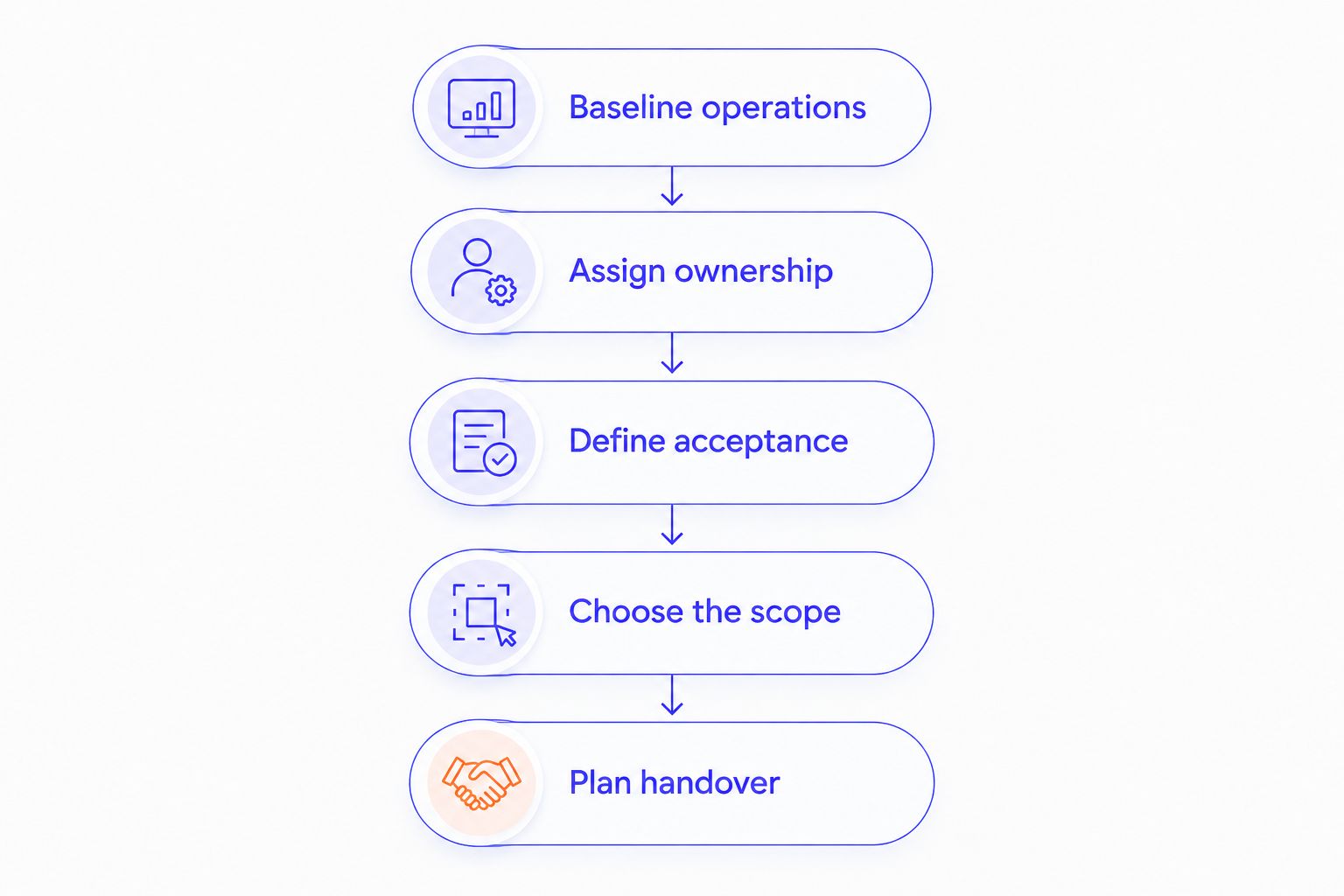
The counts above are recommended procurement requirements, not performance benchmarks. Their purpose is to make approval and handover concrete rather than leave them inside a broad promise to support the business.
For your 2026 procurement brief, require each supplier to respond to the same operating requirements. That gives you a comparable scope rather than a contest between presentation styles.
What should you ask each supplier?
Ask questions that expose responsibility before discussing staffing profiles. Require answers in the proposal so the delivery team inherits the commitments made during sales.
Ask a fractional CTO candidate:
- Which decisions will you own, and which require executive approval?
- How will you compare a store investment with an operational automation project?
- Who verifies the baseline and reports the financial effect?
- What implementation capacity is excluded from your engagement?
Ask a Shopify agency:
- Who owns failures that cross the store and ERP boundary?
- What evidence demonstrates that migrated data and order workflows are correct?
- Who can stop a release, and who executes rollback?
- What remains your responsibility after handover?
Ask either supplier: What would make you recommend deferring this purchase?
A useful answer names a failed business case, missing operating ownership, unavailable source data, or an unresolved dependency. An answer that treats every obstacle as more billable scope is not a reason to proceed.
Can a Shopify agency replace a fractional CTO?
A Shopify agency can cover technology leadership only when the engagement explicitly includes that responsibility. Development capability alone does not establish authority over budgets, enterprise architecture, or other suppliers.
Ask for the named decision-maker and their mandate. If your team already owns those decisions, adding another leadership role creates overlap rather than filling a gap.
Can a fractional CTO manage a Shopify migration?
A fractional CTO can govern a Shopify migration when migration oversight is part of the agreed mandate. Governance includes scope decisions, risk escalation, supplier accountability, and acceptance oversight; it does not automatically include coding or data migration execution.
Keep the implementation owner visible. The person approving a technical approach and the team executing it need a shared definition of completion.
When should you defer hiring either one?
Defer either engagement when you cannot explain the operating problem or assign an accountable owner. Supplier selection cannot repair a business case built on unverified assumptions.
For 2026 approval, connect proposed spending to baseline cost, store earnings, risk, or operating capacity. Do not treat labor hours removed from a workflow as EBITDA improvement unless the financial effect is actually established.
Where a combined consultancy fits
DigiForm is best for brands seeking Shopify consulting and implementation with accountable operating ownership. Its stated scope also includes AI strategy, governance, and implementation for CPG, manufacturing, and private-equity-backed companies.
That scope is relevant when commerce and operational automation need coordinated decisions. The buying constraint remains the same: a combined consultancy is unnecessary for a narrow task your current team already owns and can specify.
Require explicit responsibilities across strategy, implementation, and ongoing operations. Do not assume that one supplier means every responsibility is included.
FAQ
What's the main difference between a fractional CTO and a Shopify agency?
A fractional CTO provides technology leadership; a Shopify agency provides contracted commerce delivery. The actual responsibilities depend on the mandate and scope, not the title.
Does a scaling Shopify brand always need a fractional CTO?
A scaling Shopify brand does not always need a fractional CTO. Hire for an unresolved leadership gap, not growth alone, and check whether your existing team already owns technology decisions.
Should I hire a Shopify agency if I already have developers?
Hire a Shopify agency only if your existing developers lack the required capacity or capabilities for the defined work. Confirm who retains architecture, release approval, and ongoing operating ownership.
Who should own ERP integration during a Shopify migration?
Name a technology owner to settle ERP integration decisions and a delivery owner to implement and test them. Document responsibility for data rules, failed transactions, reconciliation, and incident escalation.
Can one consultancy handle strategy and Shopify implementation?
One consultancy can handle both when its contracted scope and assigned team cover both responsibilities. Require separate deliverables and acceptance criteria for decisions, implementation, and handover.
How do I compare fractional CTO and Shopify agency proposals?
Compare proposals against the same operating problem, decision rights, deliverables, exclusions, and acceptance criteria. Leadership and implementation are different purchases, so staffing descriptions alone do not make proposals comparable.
One last thing
Ask who owns the first failed order after launch. The answer should identify someone with access, authority, and a documented response—not a chain of suppliers referring you elsewhere.
Apply that test when evaluating DigiForm or any other consultancy. If ongoing responsibility disappears at acceptance, you are buying a project, not an operating arrangement.