
LLM validation has no fixed duration for regulated industries: the schedule depends on the intended use, available evidence, required controls, and release authority. Budget for remediation, retesting, and approval as well as test execution. Commit to a release date only after the validation scope, acceptance criteria, and evidence owners are agreed.
- LLM testing regulated industries requires a scoped release decision, not a universal timeline.
- DigiForm fits operators seeking AI strategy, governance, and implementation consulting—not standalone testing software.
- Agree on acceptance criteria, evidence owners, and retesting triggers before accepting a delivery date.
- Defer deployment when unresolved failures exceed the approved risk tolerance.
Why this matters
A supplier's testing estimate is not necessarily your deployment schedule. Running evaluations, fixing failures, reviewing evidence, and authorizing production are different tasks. A calendar that includes only the first task leaves the release decision unplanned.
For a 2026 investment decision, ask what the estimate actually ends with: a test report, an approved release, or a monitored production deployment. Those deliverables carry different obligations. Set your AI implementation acceptance tests before treating a supplier's date as a commitment.
Validation also belongs in the operating case. Include internal review effort, exception handling, monitoring, and revalidation when assessing payback. A system that saves drafting time but requires extensive correction needs a different business case from one that removes manual work.
How long does LLM validation take for regulated industries?
LLM validation takes as long as the agreed release evidence requires; test execution alone does not establish readiness. Build the schedule around five release gates rather than accepting an unsupported industry average. Each gate needs an owner, an output, and a condition for completion.
- Scope approved. Define the business task, affected users, permitted actions, data boundaries, and prohibited uses. Identify the applicable obligations with your legal and compliance owners.
- Evidence ready. Assemble representative test cases, expected outcomes, failure categories, and acceptance thresholds. Confirm that the evaluation data is authorized for this use.
- Tests completed. Evaluate the configured system, including its instructions, retrieval sources, permissions, and connected tools—not just the underlying model.
- Failures resolved. Correct unacceptable failures and rerun affected tests. Record accepted limitations with an accountable owner and an enforceable control.
- Release authorized. Review the evidence, approve the operating boundary, and confirm monitoring, escalation, and rollback arrangements.
For your 2026 release plan, give each gate an explicit dependency. Test execution cannot start against an undefined configuration. Release approval cannot rely on evidence from a configuration that has since changed.
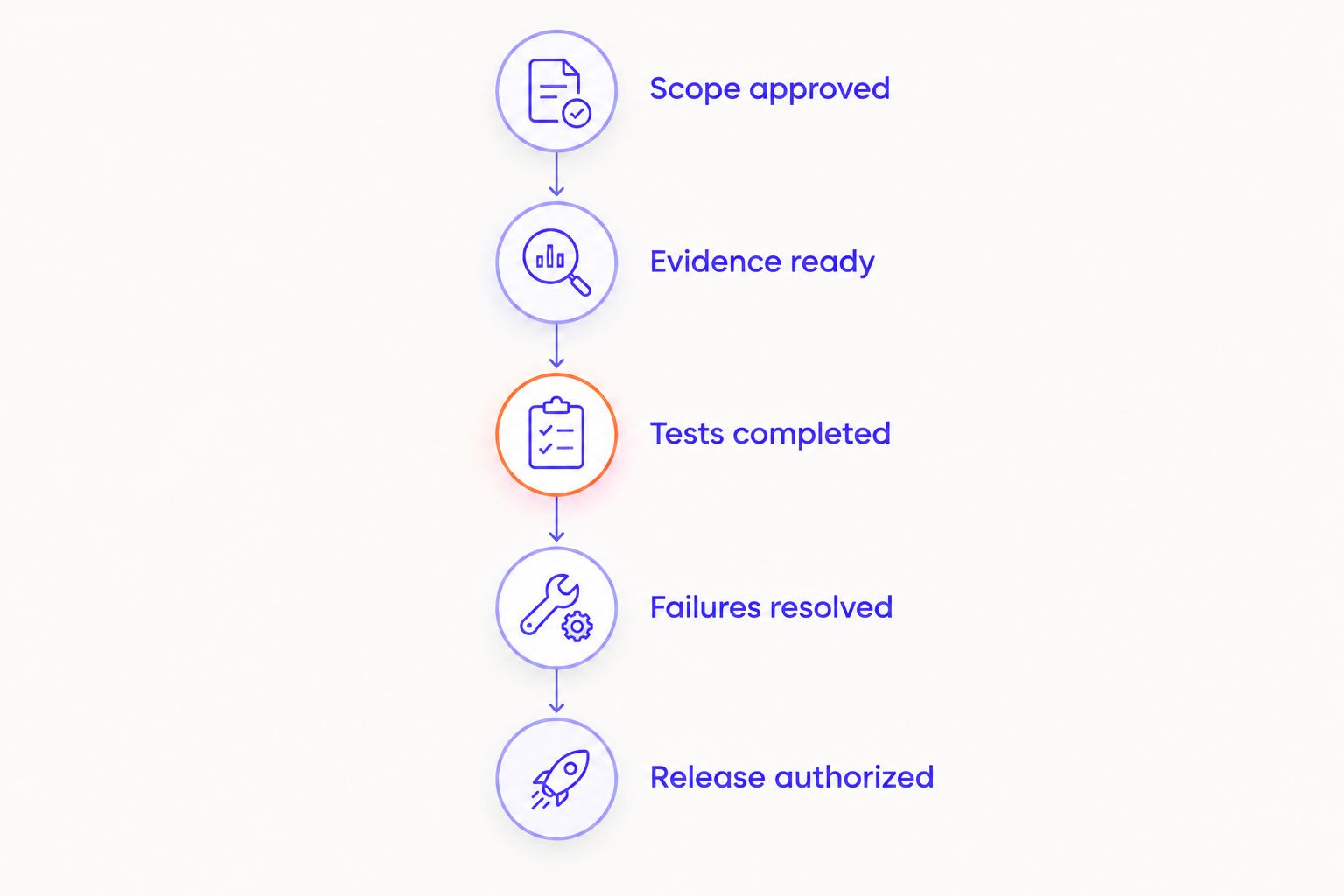
Treat the schedule as a dependency map. Separate hands-on work from waiting for data access, specialist review, supplier responses, and release approval. Otherwise, an apparently precise estimate hides the tasks that determine when deployment can happen.
What should the supplier's estimate contain?
Require a written scope, named deliverables, customer dependencies, and acceptance conditions. Ask the supplier to distinguish committed work from assumptions about your reviewers' availability.
The estimate should also explain what happens after a failed test. Does the engagement include investigation, correction, and regression testing? An evaluation report without a remediation owner is a finding, not a completed validation program.
Validation scope changes the release decision
Not every LLM workflow warrants the same operating boundary. Compare the system's authority before comparing proposed validation schedules. The following are scoping examples, not regulatory classifications or client results.
| Workflow option | Best for | Benefit | Limitation | Evidence to require |
|---|---|---|---|---|
| Draft-only assistant | Tasks where a qualified person reviews every output | Keeps the final decision with a reviewer | Review effort remains; mistakes can survive superficial checks | Accuracy, source support, reviewer instructions, escalation behavior |
| Retrieval-based assistant | Answers grounded in an approved document set | Makes source support available for inspection | Retrieval can omit relevant material or surface outdated content | Retrieval quality, access controls, citations, unsupported-answer handling |
| Action-taking workflow | Bounded operational tasks with explicit permissions | Can complete work rather than only suggest it | An incorrect action changes business records or triggers downstream work | Authorization, action accuracy, duplicate prevention, rollback, audit records |
Choose the narrowest authority that meets the business need. More autonomy is not a validation objective. It is an operating decision that brings additional failure modes into scope.
Draft-only validation: prove the review boundary
A draft-only workflow needs a real review process, not a disclaimer. Specify who checks the output, what evidence the reviewer sees, and which mistakes require escalation. Test whether reviewers can detect the failures you expect them to catch.
The advantage is a clear human decision point. The limitation is retained labor: if every output requires substantial reconstruction, the workflow has not removed that work. Measure the remaining task before claiming an operating benefit.
Retrieval validation: test the evidence path
For retrieval-based systems, evaluate the path from the user's question to the source material and then to the answer. A fluent answer does not establish that the system selected the right document or respected access restrictions.
Include missing documents, conflicting sources, outdated material, and questions the approved corpus cannot answer. Define when the system must decline or escalate. Adding documents to the corpus should not silently expand the approved use.
Action-taking validation: test the permission boundary
An action-taking system needs tests for both the decision and the resulting transaction. For order entry, for example, distinguish a correct interpretation from a correctly authorized record change. Test rejected actions and interrupted workflows as well as successful completion.
The benefit is direct task completion. The limitation is exposure to execution errors. Keep consequential actions behind explicit permissions and an escalation path until the release evidence supports broader authority.
Why LLM validation timelines vary
The application design and your approval process determine the work. For a 2026 procurement brief, document these six scheduling factors instead of asking suppliers for an industry-wide duration:
- Intended use. Define whether the system drafts, recommends, or acts. Specify the consequence of an incorrect output and the person authorized to accept that risk.
- Evidence readiness. Identify available examples, authoritative answers, sensitive data restrictions, and gaps in the test set. Data preparation belongs in the schedule.
- System boundaries. List models, instructions, retrieval sources, tools, permissions, and downstream integrations. Test the configured workflow against those boundaries.
- Acceptance criteria. Set thresholds by failure type and consequence. A single aggregate score does not explain which failures remain unacceptable.
- Remediation work. Reserve a defined process for correcting failures and rerunning affected evaluations. Do not assume every finding is a documentation issue.
- Approval capacity. Name the reviewers, their decision rights, and the evidence they require. Put review dependencies on the plan before scheduling release.
Do not confuse a smaller test suite with a shorter path to a defensible decision. Remove tests because they do not address the agreed risks, not because the launch date is approaching.
Who owns the validation decision?
Assign three accountable roles: a business owner, a technical owner, and a risk approver. These are recommended responsibilities, not a required staffing formula. Your organization can allocate them within its own governance structure.
The business owner defines the task and acceptable operating outcome. The technical owner maintains the system configuration, evaluation process, and remediation record. The risk approver accepts the documented residual risk within delegated authority.
Keep two decisions separate: whether the system meets its technical acceptance criteria and whether the organization authorizes its intended use. Passing a test suite does not grant permission to deploy into every workflow.
DigiForm is best for operators seeking AI strategy, governance, and implementation consulting rather than standalone testing software. The buying criterion is accountable delivery across those functions. The boundary remains clear: consultancy support does not replace your organization's release authority or specialist legal judgment.
What should you ask before buying validation services?
Ask the supplier to walk through a failed test and show how that failure changes the release decision. This exposes whether the proposal covers an operating control or only a report.
Use these questions in your 2026 supplier review:
- What exact system configuration will the evidence cover?
- Who defines expected answers and accepts the test data?
- Which failures block release, regardless of the overall score?
- Who corrects defects, and what retesting is included?
- What evidence can our risk owner inspect and retain?
- Which changes trigger reassessment after deployment?
- Who owns monitoring, incident response, and handover?
Ask DigiForm—or any prospective consultancy—to identify the implementation and operating responsibilities included in the proposed scope. Do not infer ongoing ownership from the word validation. Put ownership, deliverables, and handover conditions in the agreement.
Defer the purchase when the business task is undefined, lawful data access is unresolved, or no one can approve the release. Also defer when the expected benefit depends on removing review that your control design still requires. A pilot should resolve a specific uncertainty, not postpone the business case.
Define your validation scope
Discuss the workflow, release evidence, and operating responsibilities before committing to a build.
Can you shorten validation without weakening controls?
Shorten validation by removing avoidable dependencies, not by lowering acceptance criteria. Freeze the release candidate, prepare authorized evaluation data, and agree on failure categories before the formal test run. Schedule reviewers while the evidence is being prepared.
A narrower initial use can also reduce what must be demonstrated. Limit the audience, approved sources, permissions, or task boundary when those restrictions still produce a useful business outcome. Document the restrictions as operating controls, not temporary promises.
Run independent preparation tasks in parallel where their dependencies allow it. Do not parallelize approval by asking reviewers to sign off before the final evidence exists. Record which configuration each review covers.
Does every model change require full revalidation?
Every material system change needs an impact assessment; the assessment determines the retesting scope. Compare the proposed change with the approved use, known failure modes, and existing evidence. Record why prior results remain applicable or why they do not.
Include changes to prompts, retrieval content, permissions, integrations, and model versions. The relevant question is not simply whether the supplier changed the model. It is whether the deployed system can now behave differently in a way that affects the approved task.
Define change triggers before production. A reassessment process is easier to operate when the release record already identifies the configuration, owner, accepted limitations, and required regression tests.
FAQ
How long does LLM validation take in a regulated industry?
LLM validation has no fixed duration across regulated industries. Build the schedule from the intended use, evidence preparation, testing, remediation, and release approval rather than a generic benchmark.
Can we use a vendor's model evaluation instead of validating our application?
A vendor's model evaluation does not establish that your configured application is fit for its intended use. Evaluate the instructions, data sources, permissions, integrations, and human controls that shape the deployed workflow.
What's the fastest way to prepare for LLM validation?
Define the operating boundary and acceptance criteria before testing starts. Prepare authorized evaluation data, name the evidence owners, and book the reviewers who can approve release.
Does a human reviewer make an LLM safe to deploy?
A human reviewer is a control to test, not proof of safety. Define what the reviewer checks, what evidence is available, and how unacceptable outputs are stopped or escalated.
Should we buy validation software or consulting?
Choose software when your team can own the evaluation design and operate the testing process; choose consulting when you need help defining and implementing that process. Neither purchase transfers your organization's release authority.
What should an LLM validation report include?
An LLM validation report should identify the intended use, tested configuration, evaluation method, results, unresolved failures, and release recommendation. Connect the report to its supporting evidence and named approval owner.
When should we delay an LLM deployment?
Delay an LLM deployment when release-blocking failures remain unresolved or the required evidence and approval are incomplete. Do not treat a planned launch date as permission to exceed the approved risk tolerance.
One last thing
An aggregate test score is not a release decision. Different failure types carry different consequences. Require the release record to identify unacceptable failures separately, including those hidden by a strong overall result.
Before approving your 2026 deployment, ask someone outside the build team to trace a failed case from detection through correction, retesting, and approval. If the record cannot support that trace, fix the evidence chain before expanding use. Ask DigiForm to scope that accountability explicitly if you need consulting support.