
Best overall for LLM application testing: Giskard; best for drift monitoring: Evidently; best for fairness assessment: Fairlearn. This 2026 guide compares AI model validation tools for regulated industries by the evidence they produce, the risks they test, and the work your team must still own.
- Giskard leads this shortlist of AI model validation tools for regulated industries when LLM application testing is the priority.
- Choose Evidently for drift monitoring, Fairlearn for group fairness assessment, and SHAP for feature attribution.
- MLflow supports evaluation records; Great Expectations tests data quality. Neither replaces application validation.
- DigiForm is best for executives buying AI validation consulting and implementation, not standalone testing software.
- Require acceptance criteria, accountable owners, and reproducible evidence before approving a release.
Why this matters
A passing test is evidence for a defined claim, not permission to deploy. A model can pass a data-quality check and still produce an unacceptable decision. It can also perform well in aggregate while failing on a consequential subgroup.
Your 2026 buying decision starts with the system's intended use, prohibited actions, and approval requirements. Buying a dashboard before defining those requirements reverses the work.
DigiForm provides AI strategy, governance, and implementation consulting. The consulting decision is separate from the software decision: you need someone accountable for connecting test results to operating controls, release approval, and ongoing ownership.
What makes the best AI model validation tools
Use these criteria for your 2026 shortlist. Reject a supplier that cannot demonstrate the relevant requirements against your workflow.
- Risk coverage: Tests must address the actual failure: unsupported answers, disparate outcomes, data defects, drift, or unauthorized actions.
- Reproducible evidence: Preserve inputs, model configuration, evaluation logic, outputs, and approval decisions together.
- Deployment fit: Check where sensitive records travel, who can access them, and what leaves your environment.
- Release integration: Failed acceptance tests must reach someone with authority to stop deployment.
- Operating ownership: Name the person maintaining datasets, investigating alerts, and approving exceptions.
- Business case: Include integration, expert review, remediation, and maintenance in the decision—not just the testing interface.
AI validation tools at a glance
These tools address different layers. The ranking is a buying sequence by use case, not a claim that one package replaces the others.
| Tool | Best for | Standout capability | Key limitation |
|---|---|---|---|
| Giskard | LLM application risk testing | Scanning and evaluation for LLM applications | Does not establish organization-specific acceptance criteria |
| Evidently | Data and prediction drift monitoring | Data-quality and drift reports and tests | Drift does not establish its cause or business impact |
| Fairlearn | Group fairness assessment | Disaggregated metrics and mitigation algorithms | Requires justified groups, metrics, and trade-offs |
| SHAP | Feature attribution | Explaining model outputs through feature contributions | Attribution is not causal proof or fairness certification |
| MLflow | Evaluation recordkeeping | Experiment tracking, artifacts, and evaluation workflows | Recorded results are not independent validation |
| Great Expectations | Input-data validation | Executable expectations about data | Valid inputs do not guarantee valid model behavior |
1. Giskard: best AI validation tool for LLM application testing
Giskard provides testing capabilities for LLM applications, including scanning and evaluation relevant to retrieval-augmented generation. Put Giskard first when your release question concerns application behavior rather than only a predictive model's statistical performance.
A useful evaluation must represent the application you will deploy. Include its retrieval sources, instructions, tool permissions, and escalation behavior; testing the underlying model alone leaves those components outside the result.
Giskard pros:
- Provides a focused starting point for LLM application testing.
- Supports investigation of application vulnerabilities and failure cases.
- Helps turn behavioral requirements into repeatable evaluation work.
Giskard cons:
- Generated tests do not establish adequate coverage of your business process.
- Domain experts still need to define unacceptable outcomes and review disputed results.
Best for: Teams validating an LLM application before release or after a material change.
Ask the supplier to demonstrate how a discovered failure becomes a regression test. Require the original input, observed output, expected behavior, and remediation decision—not a summary score alone.
Documentation basis: Giskard documentation on LLM scanning and RAG evaluation.
Verdict: Buy for LLM application testing; hold if nobody owns the acceptance criteria.
2. Evidently: best AI validation tool for drift monitoring
Evidently provides reports and tests for data quality, data drift, and model evaluation. Choose Evidently when your operating question is whether production data or prediction behavior has changed relative to a defined reference.
Choose that reference deliberately. A comparison against an unrepresentative period creates a weak monitoring baseline, even when the calculation itself is correct.
Evidently pros:
- Makes reference-versus-current comparisons explicit.
- Supports repeatable data-quality and drift checks.
- Helps organize monitoring around defined datasets and metrics.
Evidently cons:
- A drift signal does not prove model performance has deteriorated.
- Performance assessment still requires suitable outcomes or labels where the task depends on them.
Best for: Teams that need ongoing surveillance of deployed predictive systems and their inputs.
Before adopting Evidently, identify who investigates each alert and what action follows. An alert without a response path adds review work without creating a control. Separate investigation thresholds from automatic release-blocking thresholds.
Documentation basis: Evidently documentation on data drift, data quality, reports, and tests.
Verdict: Buy for monitoring with an investigation owner; hold if alerts have no operating response.
3. Fairlearn: best AI validation tool for group fairness assessment
Fairlearn is a Python toolkit for assessing and improving fairness in machine-learning systems. Its assessment capabilities support comparison of model performance across groups; its mitigation algorithms address particular fairness objectives.
Fairlearn belongs in the shortlist when a decision affects people and group-level outcomes require examination. The toolkit supplies methods, not the legal or ethical justification for choosing a particular fairness definition.
Fairlearn pros:
- Supports disaggregated evaluation rather than aggregate metrics alone.
- Makes differences between defined groups visible.
- Includes mitigation methods for specified fairness objectives.
Fairlearn cons:
- Results depend on the groups, labels, and metrics you select.
- Improving one objective does not establish that every relevant fairness concern is resolved.
Best for: Technical teams investigating group-level performance and decision disparities.
Ask your validation lead to explain why each metric matches the decision being made. Also ask what happens when performance and fairness objectives conflict. That trade-off requires an accountable decision, not an undocumented default.
Documentation basis: Fairlearn documentation on assessment, MetricFrame, and mitigation.
Verdict: Buy for a defined fairness assessment; skip any proposal presenting it as automatic compliance.
4. SHAP: best AI validation tool for feature attribution
SHAP explains model outputs through feature contributions. Use SHAP when reviewers need to investigate which inputs contributed to a prediction, both for individual cases and across a dataset.
An explanation is not a validation conclusion. A plausible attribution can accompany an inaccurate prediction, a flawed dataset, or an unsuitable decision rule. Review the explanation alongside performance evidence and the intended use.
SHAP pros:
- Supports investigation of individual predictions.
- Helps examine patterns in feature contributions across cases.
- Provides a practical basis for discussing model behavior with technical reviewers.
SHAP cons:
- Feature attribution does not establish causation.
- Results require careful interpretation when inputs are dependent or the explanation setup changes.
Best for: Validation teams examining predictive-model behavior and unusual decisions.
Require the implementation team to document the explainer, reference data where applicable, and interpretation limits. Do not accept a feature-importance chart as a substitute for error analysis. Ask whether the explanation changes the release decision and why.
Documentation basis: SHAP documentation on explainers and feature-attribution methods.
Verdict: Buy for explanation work; skip it as a standalone validation program.
5. MLflow: best AI validation tool for evaluation recordkeeping
MLflow supports experiment tracking, artifacts, and evaluation workflows. Its role in this shortlist is preserving the relationship between a model or application configuration, its evaluation, and the resulting evidence.
That record becomes useful when a reviewer can reconstruct what was tested. A collection of runs without naming conventions, dataset references, and approval decisions remains a collection—not a release record.
MLflow pros:
- Organizes experiment parameters, metrics, and artifacts.
- Supports comparison of evaluation runs.
- Helps connect technical changes to recorded results.
MLflow cons:
- Tracking a test does not establish that the test is adequate.
- Approval authority and independent challenge require a separate operating process.
Best for: Engineering teams standardizing evaluation records across repeated releases.
Ask for a demonstration starting with a released system and working backward to its evidence. The team should identify the evaluated configuration, test data reference, results, exceptions, and approval. Do not settle for a dashboard tour.
Documentation basis: MLflow documentation on tracking, artifacts, and model evaluation.
Verdict: Buy for evidence organization; hold if recording experiments is being confused with approving risk.
6. Great Expectations: best AI validation tool for input-data checks
Great Expectations supports executable expectations about data. Use it to check properties such as required fields, permitted values, and other dataset conditions before data reaches a model or evaluation workflow.
This is an upstream control. A dataset can satisfy every specified expectation and still be unsuitable for the intended decision because the expectations did not test that question.
Great Expectations pros:
- Turns data assumptions into repeatable checks.
- Helps identify broken input contracts before downstream processing.
- Provides documented validation results for specified expectations.
Great Expectations cons:
- Does not establish model accuracy, fairness, or application safety.
- Checks require maintenance when legitimate data definitions change.
Best for: Teams with unstable source data or explicit input-data requirements.
Ask what happens to a failed batch: rejection, quarantine, manual review, or continued processing. The answer must be part of the workflow. A logged failure that leaves the same data flowing downstream is not a blocking control.
Documentation basis: Great Expectations documentation on Expectations and validation.
Verdict: Buy for input controls; skip it as evidence that the model itself is validated.
How this ranking works
This 2026 ranking uses documented tool functions and the buying criteria above. It does not claim comparative benchmark results, certification, or hands-on testing of your environment.
Giskard ranks first for the stated LLM application use case. Evidently, Fairlearn, and SHAP address different monitoring and assessment questions. MLflow organizes evidence; Great Expectations checks inputs. Select the missing control, not the longest feature list.
Require release gates before procurement
Write the acceptance tests for AI implementation services before choosing the reporting interface. Use 3 release gates, with evidence attached to each.
Intended use
Specify the task, permitted users, data boundaries, prohibited actions, and fallback process. An order-entry assistant that drafts a recommendation has a different approval boundary from a system that submits an order.
Test evidence
Connect each material failure to an acceptance test. Preserve failures as regression cases, document unresolved exceptions, and distinguish model-scored evaluations from expert-reviewed evidence.
Release approval
Require 2 accountable owners: a business owner for the operating decision and a technical owner for the implementation. Add independent review where your governance requirements demand it. Preserve 1 release record joining scope, evidence, exceptions, and approval.
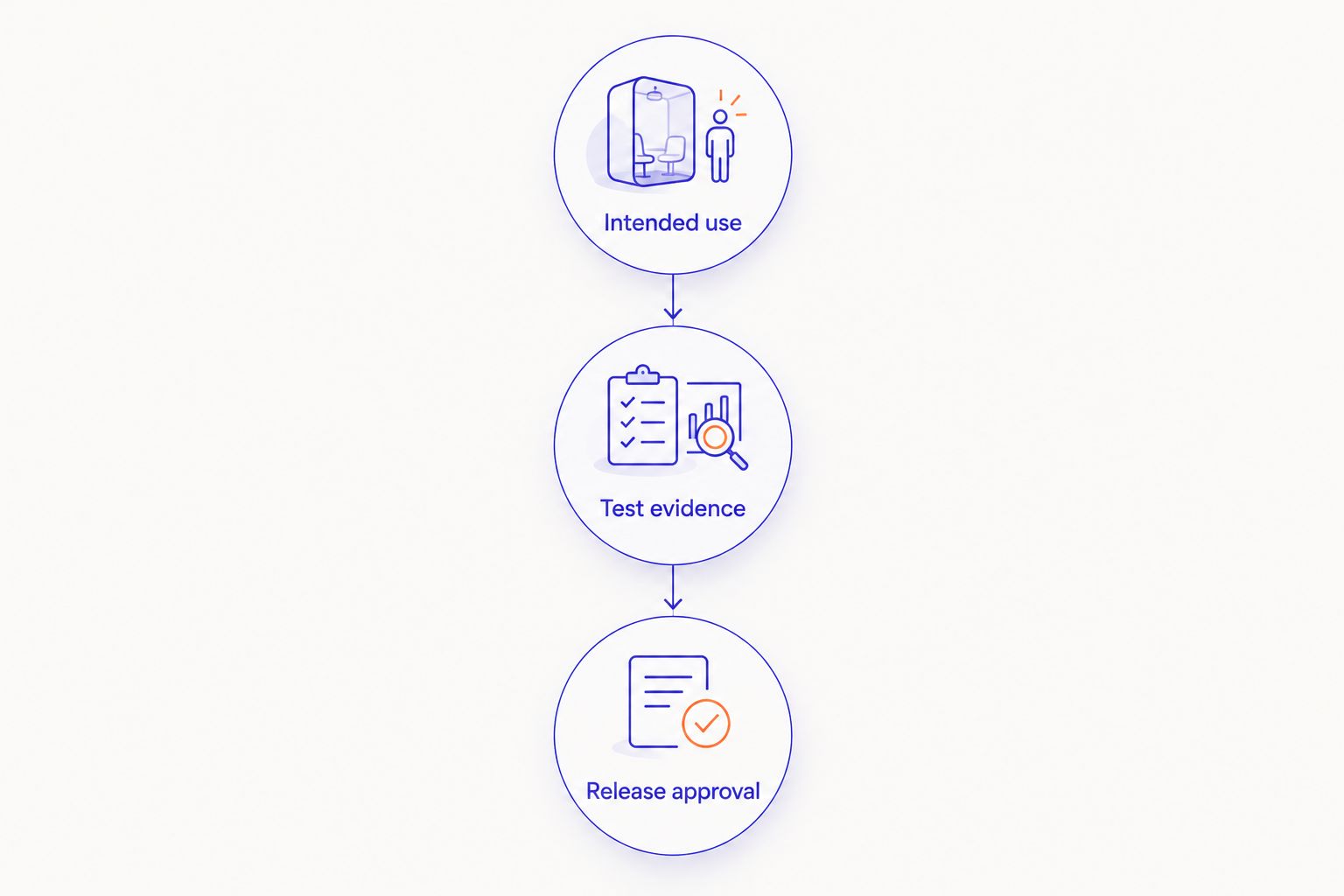
The release record must identify the configuration actually approved. A later model, retrieval, or permission change needs an explicit decision about reassessment; an old passing result does not answer a new test question.
Which AI validation tool should you choose?
Choose Giskard as the default starting point for LLM application validation in 2026. Choose Evidently instead when your immediate gap is production drift monitoring. Use Fairlearn, SHAP, MLflow, and Great Expectations for their distinct assessment and control roles.
DigiForm AI validation consulting is best for executives who need strategy, governance, and implementation connected to operating ownership. DigiForm is a consultancy, not a validation software vendor.
Defer procurement when you cannot name the release decision, evidence owner, or economic case. Include evaluation maintenance, expert review, exception handling, and remediation in baseline operating cost. Claimed time savings are not EBITDA improvement unless the operating plan explains how the benefit is realized.
FAQ
What's the best AI model validation tool for regulated industries?
Giskard is the default recommendation here for LLM application testing. Evidently fits drift monitoring, while Fairlearn and SHAP address fairness assessment and feature attribution. Choose by the validation question, not a universal ranking.
Does an AI validation tool make a system compliant?
No. A tool produces evidence for specified tests; compliance depends on the applicable obligations, intended use, controls, documentation, and accountable decisions.
Is Evidently better than Giskard?
Evidently is the better fit when your immediate requirement is data or prediction drift monitoring. Giskard is the starting point here for LLM application risk testing. The tools address different questions.
Can SHAP prove that an AI model is fair?
No. SHAP provides feature attribution, not proof of fairness. Assess relevant group outcomes, performance, data limitations, and decision rules separately.
Can MLflow replace an independent model validation process?
No. MLflow helps organize tracking and evaluation evidence. Independent challenge, acceptance criteria, and release authority remain responsibilities of your validation process.
What should I ask an AI validation supplier before buying?
Ask the supplier to reproduce a failed case, show the tested configuration, and explain who can block release. Then require the operating cost and ownership of test maintenance, exception review, and remediation.
When should we defer buying AI validation software?
Defer when the intended use, acceptance criteria, or accountable owner is undefined. Resolve those decisions first so the purchase addresses a specific control gap.
One last thing
Ask the supplier to show a failed test, not just a passing report. Follow that failure through investigation, remediation, rerun, and approval. If the demonstration ends at an alert, the operating process is unfinished.