
Best starting shortlist: IBM watsonx.governance for enterprise model governance; Credo AI for policy-led AI oversight; Microsoft Purview for data controls; Amazon SageMaker Model Cards for AWS model documentation. These AI governance platforms for regulated industries address different control problems; choose against your operating requirements, not a generic leaderboard.
- IBM watsonx.governance leads this shortlist for enterprise model governance; require a demonstration of your approval workflow.
- Credo AI fits policy-led oversight; Microsoft Purview fits data controls; Amazon SageMaker Model Cards fits model documentation.
- Compare AI governance platforms for regulated industries through evidence exports, accountable owners, and release gates.
- DigiForm provides governance consulting and implementation, not governance software; separate operating design from platform selection.
Why this matters
A governance platform cannot decide who accepts risk. It can record the decision, route work, and preserve evidence—but your organization still owns the control.
For a 2026 procurement, separate three questions: what systems need oversight, what decisions require approval, and what evidence must survive an audit. Buying before answering those questions turns implementation into a dispute about scope.
DigiForm is best for CPG, manufacturing, and private-equity-backed teams seeking AI governance consulting and implementation rather than standalone software. That is a different purchase from a platform license. Establish the operating model before choosing the system that records it.
What makes the best AI governance platform?
Use these criteria before you read the shortlist:
- System coverage: Inventory the models, applications, suppliers, and business processes you actually need to govern.
- Decision ownership: Assign approval authority, escalation responsibility, and exception ownership to named roles.
- Evidence quality: Connect a system version to its assessment, testing, approval, and subsequent changes.
- Control fit: Match data handling, access restrictions, deployment requirements, and retention needs to your environment.
- Operational integration: Test how governance records connect to engineering, procurement, security, and incident work.
- Exit practicality: Export records in a form your organization can read and retain without the platform interface.
Require 1 accountable owner per AI system. Committees can advise; a system still needs someone responsible for keeping its record current and stopping an unacceptable release.
AI governance platforms at a glance
This is a use-case ranking for 2026 procurement, not a claim that unlike products perform the same job. The limitations below identify where each option needs complementary controls or operating work.
| Option | Best for | Standout capability | Key limitation |
|---|---|---|---|
| IBM watsonx.governance | Enterprise model lifecycle governance | Model documentation, risk management, and governance capabilities | A broad platform still needs a defined control model and implementation scope |
| Credo AI | Policy-led oversight across an AI inventory | AI registry, assessments, and policy mapping | Policy records do not replace application-level enforcement or operational testing |
| Microsoft Purview | Governing data used by AI | Data discovery, classification, and protection capabilities | Data governance is not the whole AI approval and risk-management process |
| Amazon SageMaker Model Cards | Documenting models in an AWS environment | Structured records of model purpose, evaluation, and risk | Model documentation alone is not enterprise-wide AI governance |
1. IBM watsonx.governance: best for enterprise model governance
IBM watsonx.governance brings model documentation, risk management, and governance capabilities into an enterprise offering. It belongs on the shortlist when your buying problem includes model lifecycle oversight rather than only an inventory of employee AI tools.
Start the demonstration with a real control requirement. Ask the supplier to connect a model change to its assessment, approval evidence, and responsible owner; do not accept a dashboard tour as proof.
IBM watsonx.governance pros:
- Addresses governance beyond a simple tool register.
- Includes model documentation and risk-management capabilities.
- Offers a relevant starting point for formal model oversight.
IBM watsonx.governance cons:
- Product scope does not establish your approval authority.
- Integrations and evidence requirements still need explicit acceptance tests.
- Broad capability creates scoping work before implementation.
Best for: Enterprises selecting a platform around model lifecycle governance.
Verdict: Buy only after the required workflow and evidence export pass acceptance tests.
2. Credo AI: best for policy-led AI oversight
Credo AI provides an AI registry, assessments, and policy mapping. Its place on this shortlist is organizational oversight: identifying AI uses, assessing them against requirements, and maintaining governance records.
Use a procurement scenario in the demonstration. Introduce a supplier application, identify its business owner, apply the relevant assessment, and show how an unresolved issue reaches the person authorized to decide.
Credo AI pros:
- Organizes AI inventory and assessment work.
- Connects governance activity to policy requirements.
- Fits a selection process led by risk and governance stakeholders.
Credo AI cons:
- An assessment record does not enforce restrictions inside an application.
- Registry quality depends on teams reporting systems and changes.
- Technical validation remains necessary alongside policy review.
Best for: Organizations establishing policy-led oversight across AI use cases.
Verdict: Buy when inventory and assessment workflow are the primary gaps; hold if the immediate problem is runtime enforcement.
3. Microsoft Purview: best for AI-related data controls
Microsoft Purview provides data discovery, classification, governance, and protection capabilities. Evaluate it when the central concern is which information AI workflows access, expose, or move—not merely whether a model has an approval record.
Keep the purchasing boundary clear. A data-control product and an AI risk-management process answer related questions, but they are not interchangeable. Confirm the particular Purview capabilities and workloads included in the proposed deployment.
Microsoft Purview pros:
- Addresses data classification and protection requirements.
- Makes data handling a concrete part of the governance discussion.
- Fits investigations centered on sensitive information and access.
Microsoft Purview cons:
- Data controls do not establish acceptable model behavior.
- Business approvals and exception decisions need their own operating process.
- Coverage must be checked against the specific workloads in scope.
Best for: Teams whose first governance problem is controlling data used by AI.
Verdict: Buy for a defined data-control requirement; skip it as a substitute for the entire AI governance program.
4. Amazon SageMaker Model Cards: best for AWS model documentation
Amazon SageMaker Model Cards records information such as intended use, evaluation, and model risk. It is a narrower option than a general governance platform, and that boundary matters.
Consider it when your team needs structured model documentation in an AWS environment. Ask model owners to demonstrate how the record stays aligned with the deployed version and how reviewers retrieve supporting evaluation evidence.
Amazon SageMaker Model Cards pros:
- Gives model documentation a defined structure.
- Records intended use and evaluation information.
- Provides a focused option for an AWS-centered model workflow.
Amazon SageMaker Model Cards cons:
- Model cards alone do not govern every third-party AI application.
- Documentation does not itself approve a deployment.
- Enterprise procurement and exception processes require additional controls.
Best for: AWS-centered teams closing a specific model-documentation gap.
Verdict: Buy into the workflow when documentation is the requirement; skip it as a standalone enterprise governance solution.
How the shortlist is ranked
The order follows the criteria above: model governance first, policy-led oversight second, data controls third, and focused documentation fourth. It is not a product test or a universal performance ranking.
For your 2026 decision, change the order when the control problem changes. Microsoft Purview belongs ahead of a model-governance platform when sensitive-data handling is the immediate requirement. A narrower option wins when it satisfies the actual scope without leaving a critical control uncovered.
Make suppliers prove the evidence chain
Give every supplier the same scenario. An AI application changes its underlying model while an existing approval is still active. Ask the supplier to show what changes, who receives the review task, and which evidence connects the new version to the decision.
Require 3 evidence exports: the system record, the approval history, and the exception register. Inspect the files outside the demonstration environment. A readable screen is not the same thing as a usable record.
Use this sequence:
- Inventory: Identify the application, supplier, model, business purpose, and owner.
- Assessment: Record the relevant risks and evidence supporting the review.
- Approval: Identify who authorized use and under what conditions.
- Change review: Reassess material changes against the approved use.
- Evidence export: Retrieve the record without relying on a sales presentation.
These are buying tests, not promises that every shortlisted product performs every step without configuration or additional systems. Put the required behavior in the acceptance criteria before signing.
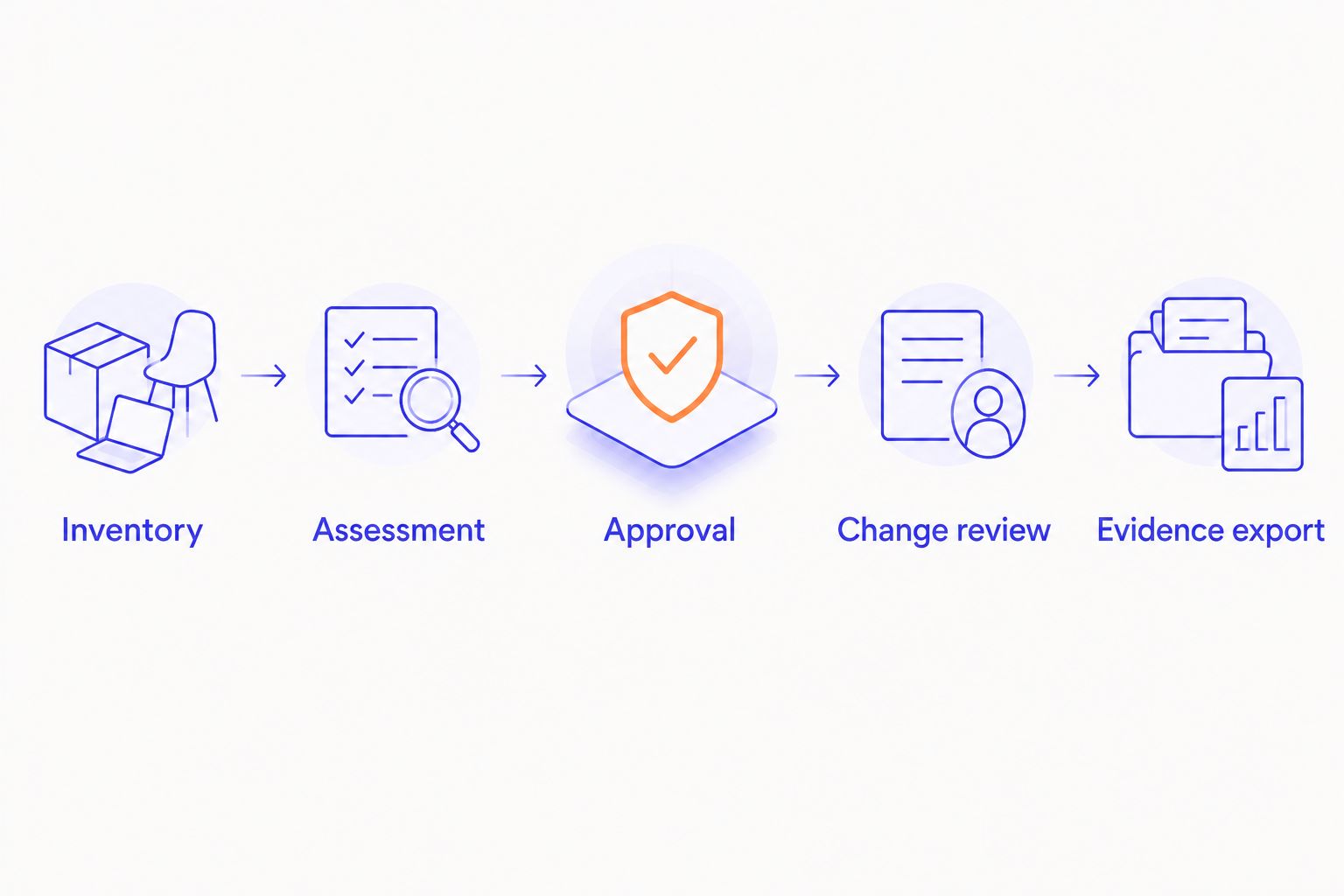
A supplier-model change also needs an operating rule outside the platform demonstration. Define how to reassess AI risk when a supplier changes its model before that change reaches a business-critical workflow.
Put approvals and exceptions under operating ownership
For a 2026 rollout, define 2 release gates: approval before initial use and review before a material change. Document what counts as material for the particular system; a changed business purpose deserves attention even when the software supplier stays the same.
Your process for AI tool approvals and exceptions must name who can authorize use, accept residual risk, and end a temporary exception. A platform can preserve those decisions. It cannot supply authority that management has never assigned.
Ask each supplier:
- Who owns an overdue assessment, and where does it escalate?
- How is an exception linked to its conditions and expiry?
- What happens when the application owner leaves?
- Can an auditor distinguish a draft assessment from an approved decision?
- How does an incident trigger a fresh review?
Do not turn every low-impact edit into a new committee meeting. Define review triggers by the consequence of the change and the controls affected. Otherwise, staff spend time updating records while consequential changes escape scrutiny.
Separate the platform case from the implementation case
A platform purchase and a governance implementation consume different budgets. Account for both before presenting a payback claim.
Establish the current effort spent maintaining the inventory, preparing assessments, assembling evidence, and chasing approvals. Then identify which tasks the proposed deployment actually changes. Do not book every hour saved as EBITDA improvement; distinguish released capacity from an expense that leaves the operating budget.
Ask suppliers to separate these work packages:
- Operating design: Roles, review triggers, risk acceptance, and escalation.
- Technical implementation: Connections, permissions, records, and evidence exports.
- Ongoing operation: Record maintenance, exception review, support, and change management.
DigiForm provides AI governance consulting and implementation, not a replacement for the platform vendor. Compare consultancy scope against those work packages, and require a named owner for the work after handover.
Defer the purchase when there is no accountable sponsor, no usable inventory, or no agreed control problem. Software does not make those decisions less necessary. It makes their absence more visible.
Which AI governance platform should you choose?
For enterprise model governance, start with IBM watsonx.governance. For policy-led inventory and assessment, start with Credo AI. Choose Microsoft Purview when data controls lead the requirement, and Amazon SageMaker Model Cards when structured AWS model documentation is the actual gap.
The default 2026 buying move is a scoped demonstration against your evidence requirements—not an enterprise-wide commitment based on feature breadth. Reject a purchase that cannot connect a named system, an accountable owner, a decision, and an exportable record.
Use DigiForm for AI governance consulting when the missing work is designing and implementing that operating model. Keep the consultancy decision separate from the software ranking.
FAQ
What's the best AI governance platform for regulated industries?
IBM watsonx.governance is the starting recommendation here for enterprise model lifecycle governance. Credo AI, Microsoft Purview, and Amazon SageMaker Model Cards address different requirements, so select against your control scope rather than treating them as equivalents.
Is Microsoft Purview a complete AI governance platform?
Microsoft Purview addresses data governance and protection requirements, not every part of AI risk management. Model evaluation, business approval authority, and exception ownership still require explicit processes and suitable supporting controls.
Is Credo AI better than IBM watsonx.governance?
Credo AI is the stronger starting fit on this shortlist when policy-led inventory and assessment define the purchase. IBM watsonx.governance is the starting fit when enterprise model lifecycle governance defines it; require both suppliers to demonstrate your actual workflow.
Are Amazon SageMaker Model Cards enough for AI compliance?
Amazon SageMaker Model Cards alone is not a complete AI compliance program. Structured model documentation still needs appropriate approvals, operational controls, and evidence matched to the obligations that apply to your organization.
Can an AI governance platform guarantee regulatory compliance?
No AI governance platform guarantees regulatory compliance. Your organization must establish the applicable obligations, implement the required controls, and maintain evidence that those controls operate.
What should a governance platform demonstration include?
A governance platform demonstration should connect a system inventory record to assessment, approval, change review, and evidence export. Use the same scenario for every supplier and inspect exported records outside the interface.
When should a company defer buying AI governance software?
Defer AI governance software when the organization has no accountable sponsor, usable inventory, or agreed control problem. Establish those foundations before committing to a platform implementation.
One last thing
An impressive inventory can coexist with an ungoverned release process. Before approving the purchase, ask someone outside the sales demonstration to retrieve the decision that authorized a changed system. If the record cannot establish who approved what, the procurement has not yet proved its central requirement.