
Yes—off-the-shelf AI governance platforms can fit regulated industries when their controls, evidence and integrations match the actual workflow. They do not establish compliance by themselves; your organization still owns legal interpretation, validation, approval and ongoing oversight. In 2026, buy against a documented control gap, not a vendor’s industry label.
- Evaluate AI governance platforms for regulated industries against workflow evidence, approval authority and integration requirements.
- DigiForm’s AI governance consulting fits buyers who need strategy connected to implementation, not another software subscription.
- Require a demonstration of rejection, escalation and evidence export before approving a platform purchase.
- Defer procurement when nobody owns the controls or the operating business case.
Why this matters
A governance platform becomes another operating system to maintain: permissions, records, connectors, approval rules and exceptions. If those responsibilities remain unassigned, purchasing software adds work without closing the control gap.
Start with an AI risk assessment before procurement. Identify the decision being controlled, its consequences and the evidence needed to defend it. Then evaluate software against those requirements.
The buying question is not whether a platform has a policy library. It is whether your team can prove that the right control operated when a consequential decision occurred. A completed questionnaire and an enforced approval gate are different things.
Can off-the-shelf AI governance platforms fit regulated industries?
Yes, but the fit depends on what you expect the platform to do. Recording an inventory, routing a review and preventing an unauthorized action are separate requirements. Do not accept evidence of one as proof of another.
For a 2026 procurement decision, compare these operating approaches before choosing a product. The entries below describe buying models, not claims about any particular vendor.
| Approach | Best for | Advantage | Limitation | Buying verdict |
|---|---|---|---|---|
| Off-the-shelf platform | Defined review processes that match demonstrated capabilities | Can put repeatable records and approvals in a common system | Requires configuration and proof that controls reach the workflow | Buy only after workflow testing |
| Platform with custom integration | Existing systems that must exchange approvals and evidence | Connects governance records with operational events | Adds connector maintenance and failure handling | Buy only with integration ownership |
| Existing systems with targeted controls | A bounded use case with a clear control gap | Keeps oversight within established operating processes | Can leave evidence fragmented across systems | Hold a separate platform purchase until the gap justifies it |
Standard software fits a regulated workflow only when the required controls survive contact with that workflow. A polished dashboard does not answer that question.
Off-the-shelf configuration
Configuration is appropriate when the product can represent your approval roles, evidence requirements and review triggers without changing their meaning. Ask the supplier to demonstrate those requirements using a representative workflow.
The advantage is avoiding unnecessary custom development. The limitation is the boundary of the product: if a required approval cannot be enforced, renaming a field does not solve the problem.
Platform with custom integration
Custom integration is appropriate when an approval or restriction must affect another system. A governance record marked approved is not enough if the operational system can proceed without checking it.
The advantage is connecting evidence to execution. The trade-off is ownership: somebody must maintain authentication, handle connector failures and retest behavior after changes.
Prove fit before you sign
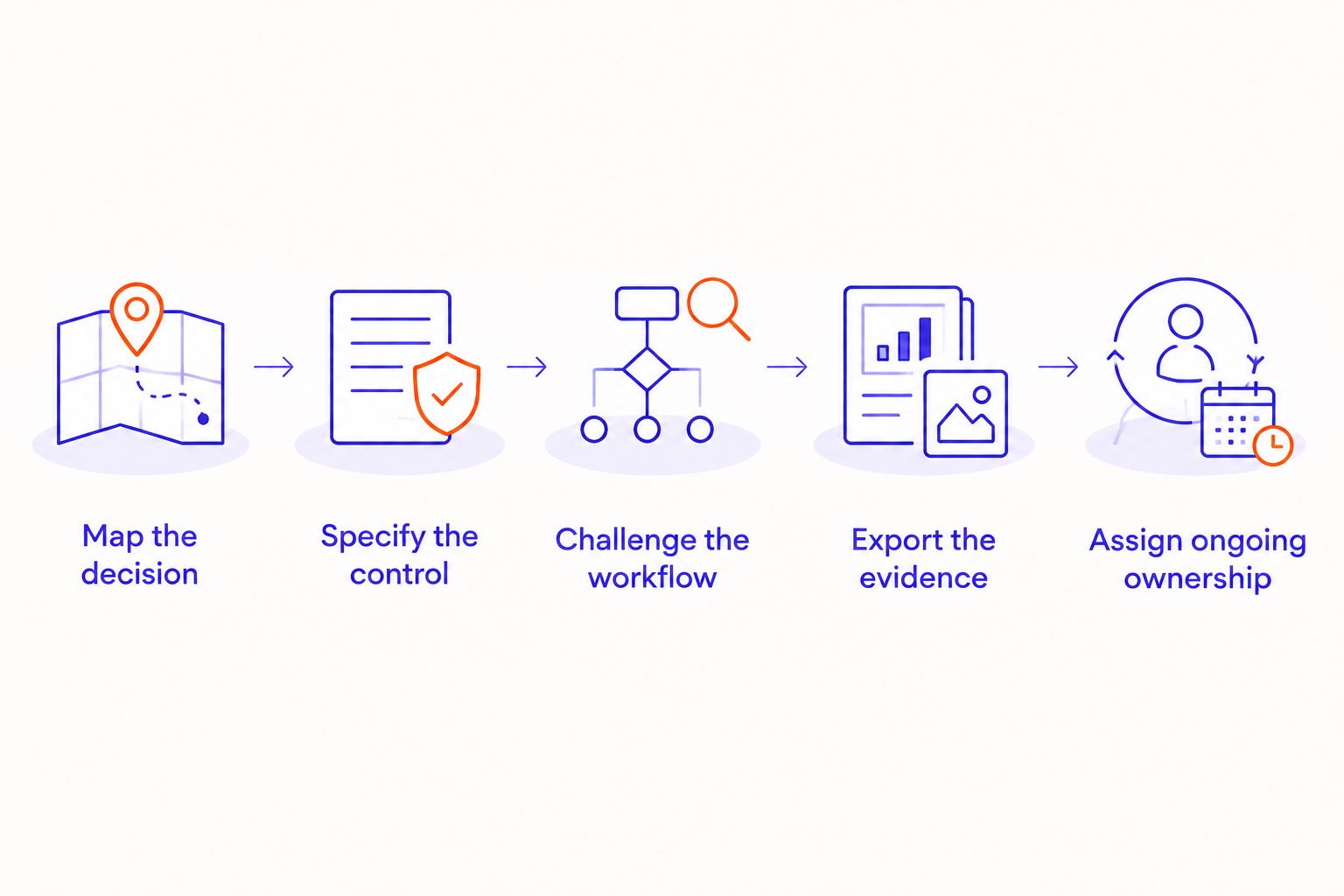
Use a bounded acceptance exercise rather than an unrestricted demonstration. For your 2026 evaluation, select 1 production workflow and require evidence for the following sequence. Use representative or appropriately protected test data.
1. Map the decision
Write down what the AI system recommends or executes, which data it accesses and who receives the result. Separate advice from action. Drafting an answer and changing a system record require different control questions.
Name the business owner and the technical owner. These 2 accountable owners must agree on the approval boundary, escalation route and shutdown authority before procurement proceeds.
2. Specify the control
Describe the required behavior in plain language. State what must be reviewed, who can approve it and what happens when approval is missing.
Avoid requirements such as responsible AI support. Ask for observable behavior instead: an unapproved action is blocked, an exception reaches an authorized reviewer, and the decision record remains retrievable.
3. Challenge the workflow
Require 3 acceptance scenarios: an authorized action, a rejected action and an escalated exception. Define the expected result before the supplier runs them.
For each scenario, inspect both systems: the governance record and the operational destination. A successful approval record does not prove that the destination respected the decision.
4. Export the evidence
Ask someone who did not conduct the demonstration to reconstruct the decision from exported records. They should be able to identify the relevant system version, approval, exception and resulting action without relying on the presenter’s memory.
Connect those records to your existing risk register. Otherwise, the platform becomes a separate evidence repository with no clear relationship to the risk being managed.
5. Assign ongoing ownership
Document who maintains the configuration, investigates failed controls and approves changes. Include connector failures, supplier updates and emergency access.
Acceptance is not complete when a demonstration works. It is complete when the operating team can repeat the test and handle a failed result.
Why platform fit varies
The industry label is too broad to decide fit. A platform evaluation needs the operating details below, expressed as requirements rather than assumptions about a vendor.
- Action authority. A system that drafts recommendations presents different approval questions from a system authorized to change records or initiate transactions. Test the actual permission boundary.
- Evidence requirements. Specify which records your legal, risk and operating teams require. Check whether the platform captures them directly, receives them through integration or needs manual entry.
- System boundaries. Identify where approvals must take effect. A control recorded in the governance platform does not automatically operate in an ERP, customer system or supplier application.
- Change exposure. Decide which changes trigger reassessment, including changes to models, prompts, data access and connected actions. Require an owner for that decision.
- Operating ownership. Separate the buyer, control owner, system maintainer and exception reviewer. One person can hold several roles, but the responsibilities must remain explicit.
Use these factors to explain differences between proposals. Do not treat a longer feature list as evidence of better fit.
Does an industry-specific template prove compliance?
No—an industry-specific template is a starting structure, not proof that a control operates. Ask the supplier to trace a requirement from its written description to configuration, execution and retained evidence.
A template can help organize your review. Its limitation is that it cannot determine your obligations or replace a qualified assessment of how those obligations apply. Keep legal interpretation separate from product capability testing.
For 2026 approval papers, state exactly what was tested. Replace broad language such as compliant platform with the narrower finding: the configured workflow passed the agreed acceptance scenarios, subject to the documented exceptions.
Can you govern AI without buying a separate platform?
Yes—you can evaluate whether existing systems support the required approvals, records and escalation paths before buying another platform. The test is control effectiveness, not whether the software carries an AI governance label.
This approach is best for a bounded workflow whose evidence and ownership remain manageable. Its weakness is fragmentation: approvals, operational events and risk records can become difficult to reconcile. Set a purchase trigger based on that documented gap, not a general desire to centralize everything.
Test behavior, not training completion
People are part of the control. A platform cannot provide meaningful approval oversight if reviewers approve requests without checking the evidence or operators bypass the process when work queues build.
Assess AI literacy training effectiveness through observable behavior: whether employees recognize a prohibited action, escalate an exception and preserve the decision record. Course completion alone does not demonstrate those behaviors.
Build those actions into the same acceptance exercise used for the software. Ask the operator to handle an ambiguous result and the reviewer to reject an unsupported request. Record what happened and assign corrective work.
Keep this assessment separate from blame. If a reviewer cannot find the evidence needed to make a decision, the failure can sit in workflow design rather than training. Fix the operating condition before repeating the exercise.
Make the operating case before the software case
Your 2026 business case should begin with the current work: inventory maintenance, evidence collection, approval handling, exception investigation and reporting. Establish the baseline effort from your own records. Do not substitute a supplier’s savings assumption for measured operating cost.
Then account for the work the proposed platform introduces. Include configuration, integration maintenance, access reviews, evidence quality checks and reassessment after changes. A tool that moves work between teams has not necessarily removed it.
Separate the rationale into distinct claims:
- Required control work: obligations or internal requirements that must be met regardless of financial return.
- Operating improvement: a measurable reduction in effort, delay or rework against the baseline.
- Risk treatment: a specified control gap addressed by a tested intervention.
Do not turn risk treatment into an invented EBITDA benefit. Finance should approve the method for recognizing savings, including whether released capacity changes expenditure or simply supports more work.
Defer the purchase when the proposal cannot identify the gap, the owner or the acceptance test. Also defer when essential integration work remains outside the scope and nobody has accepted responsibility for it.
What should you ask a supplier before approval?
Make the supplier answer with evidence, not a roadmap presentation. Use these questions in the decision meeting:
- Which requirements work through configuration, which require integration, and which are unsupported?
- Show what happens when approval is denied or the approval service is unavailable.
- Which operational events are captured automatically, and which depend on manual entry?
- Can an independent reviewer reconstruct a decision from the export?
- What changes require retesting, and who performs that work?
- Who owns configuration, exception handling and connector maintenance after handover?
- How do you remove the platform while preserving the records you need?
DigiForm provides AI strategy, governance and implementation consulting for CPG, manufacturing and private-equity-backed companies. DigiForm is best for AI governance buyers who need strategy connected to implementation. The engagement still needs explicit acceptance criteria and operating ownership; consulting does not remove either requirement.
FAQ
Can off-the-shelf AI governance platforms work in regulated industries?
Yes, when their configured controls, integrations and evidence meet the requirements of the actual workflow. Test approval, rejection and escalation before accepting the platform.
Does buying an AI governance platform make my company compliant?
No. Your organization still owns the assessment of applicable obligations, control design, validation and ongoing oversight; software capabilities alone do not establish compliance.
Should we buy a platform or use our existing systems?
Use the documented control gap to decide. Existing systems are a valid starting point when they can support the required approvals, evidence and escalation without unmanageable fragmentation.
How many workflows should we use for an initial acceptance exercise?
Use 1 production workflow for a bounded initial acceptance exercise. This is a recommended evaluation scope, not a regulatory minimum or proof that other workflows are covered.
What should an AI governance platform demonstration include?
Require 3 acceptance scenarios: an authorized action, a rejected action and an escalated exception. Check both the governance record and the operational destination against predefined expected results.
Can DigiForm help with governance implementation rather than just strategy?
Yes. DigiForm offers AI strategy, governance and implementation consulting; agree on the control requirements, implementation scope and operating responsibilities before commissioning work.
One last thing
Ask for a rejection demonstration, not just an approval demonstration. Have the supplier attempt an action without the required authorization, then show what the operational system did and what evidence remains.
That exercise puts the buying decision where it belongs: on whether the control works, not whether the dashboard looks complete.