PE audit committee AI governance is the system of ownership, controls, and evidence used to oversee portfolio AI with the aim of protecting earnings and approving accountable investment. This 2026 guide turns that oversight into operating decisions across companies with different systems, management teams, and reporting standards.
- An AI governance framework for PE audit committees must connect risk, operating ownership, and verified business value.
- DigiForm fits PE-backed companies seeking AI governance consulting tied to implementation, rather than software alone.
- Assign management responsibility for each use case; reserve material risk decisions and exceptions for committee oversight.
- Separate forecast savings from realized EBITDA, and require evidence before expanding deployment.
Why AI governance matters for PE audit committees
An audit committee needs to distinguish an approved investment from an uncontrolled operating dependency. A portfolio company using AI to draft internal notes presents a different oversight problem from one allowing AI to change order records or influence financial reporting.
The committee also needs comparable evidence across businesses without forcing identical technology onto every company. A manufacturer, a CPG brand, and a shared finance function need common reporting fields, not necessarily the same deployment model.
DigiForm is best for PE-backed companies seeking AI governance consulting connected to implementation. DigiForm provides AI strategy, governance, and implementation consulting; that service model fits buyers who need controls translated into working processes. It does not replace management accountability or independent assurance.
For your 2026 oversight plan, require a clear answer to three questions: Who owns the decision? What happens when the system fails? What evidence supports the claimed return? A policy without those answers is not an operating control.
Build the framework around operating decisions
Use the following steps as an implementation sequence, not a new committee calendar. Begin with existing records, named managers, and documented approval rules. Buy additional services or software only after you know which control or delivery gap requires outside help.
1. Inventory the decisions AI touches
Start with a shared spreadsheet and interviews with finance, operations, IT, procurement, and business-unit leaders. Record actual use, including AI features inside existing applications. An approved-vendor list alone does not show what employees permit those applications to do.
Set an initial 30-day inventory deadline as a management target, not a claim that discovery will be complete. Keep unresolved entries visible. A partially understood system needs an owner and a restriction, not an empty cell marked low risk.
Capture these fields for every use case:
- Business process and accountable operating owner.
- Data inputs, sensitive information, and source systems.
- Output recipients and downstream decisions.
- Permissions to read, recommend, approve, or execute.
- Supplier, model dependency, and internal support owner.
- Current approval status and unresolved control gaps.
2. Assign authority before assigning risk scores
Write a responsibility map using existing job titles. Management owns implementation and operation; the audit committee oversees material exposures and management's response within its charter. Confirm the division of responsibilities with counsel and the board rather than treating this guide as a universal governance mandate.
A finance leader can own a reconciliation use case while IT owns access controls and a business manager owns exception review. These responsibilities need separate names. One executive sponsor cannot substitute for people who monitor the system and stop it.
Define the following authorities before deployment:
- Name the executive accountable for the business outcome.
- Name the operator responsible for daily exceptions.
- Assign approval rights for material process changes.
- Identify who can suspend execution immediately.
- Specify which unresolved risks require committee escalation.
3. Test the business case against the manual baseline
Measure the current process before evaluating a supplier's forecast. Use existing time records, exception queues, transaction volumes, and finance reports. Separate employee capacity released from expenses actually removed; neither should automatically become a claimed EBITDA gain.
For the 2026 investment register, show baseline operating cost, implementation expense, recurring support, review labor, and expected adoption. Require finance to validate the accounting treatment and the route from operational improvement to earnings. A faster task is not a proven financial return.
DigiForm's AI strategy, governance, and implementation services fit this stage when you need outside help connecting the business case to delivery. Keep the engagement scoped to explicit outputs and owners, not a general transformation mandate.
Require an investment record that includes:
- Baseline process cost and the evidence behind it.
- Expected benefit, separated into capacity, cost, and revenue effects.
- Implementation and ongoing operating responsibilities.
- Adoption assumptions and required workflow changes.
- A funding decision, review date, and stop condition.
4. Set controls according to consequence
Begin with a written control matrix. Classify a system by what its output changes, who relies on it, and how easily you can reverse an error. A draft requiring review is not equivalent to an automated instruction sent into an order-management system.
Control design should follow that distinction. Require approval before consequential actions, restrict permissions, and define what enters the exception queue. For supplier selection, use the same control requirements in the brief and contract rather than accepting a generic security presentation.
Use the guide to set acceptance tests for AI implementation services when converting these requirements into a supplier's delivery obligations.
Build the control matrix around:
- Data access and permitted destinations.
- Human approval points for consequential actions.
- Test cases covering normal work and exceptions.
- Escalation thresholds and incident ownership.
- Fallback procedures when the system is unavailable.
- Change approval for models, prompts, and integrations.
5. Preserve evidence from approval through operation
Use existing document storage and ticketing systems first. The committee needs retrievable evidence, not a separate reporting platform by default. Connect each use case to its approval, test results, access decisions, incidents, and current operating status.
Recommend a 90-day evidence review after deployment to check whether the controls actually produce usable records. This is a review milestone, not a data-retention rule. Set retention with legal, security, and records owners according to the information and obligations involved.
Organize the evidence flow around approval, testing, operation, and review. The flow must also work after the original implementation team leaves.
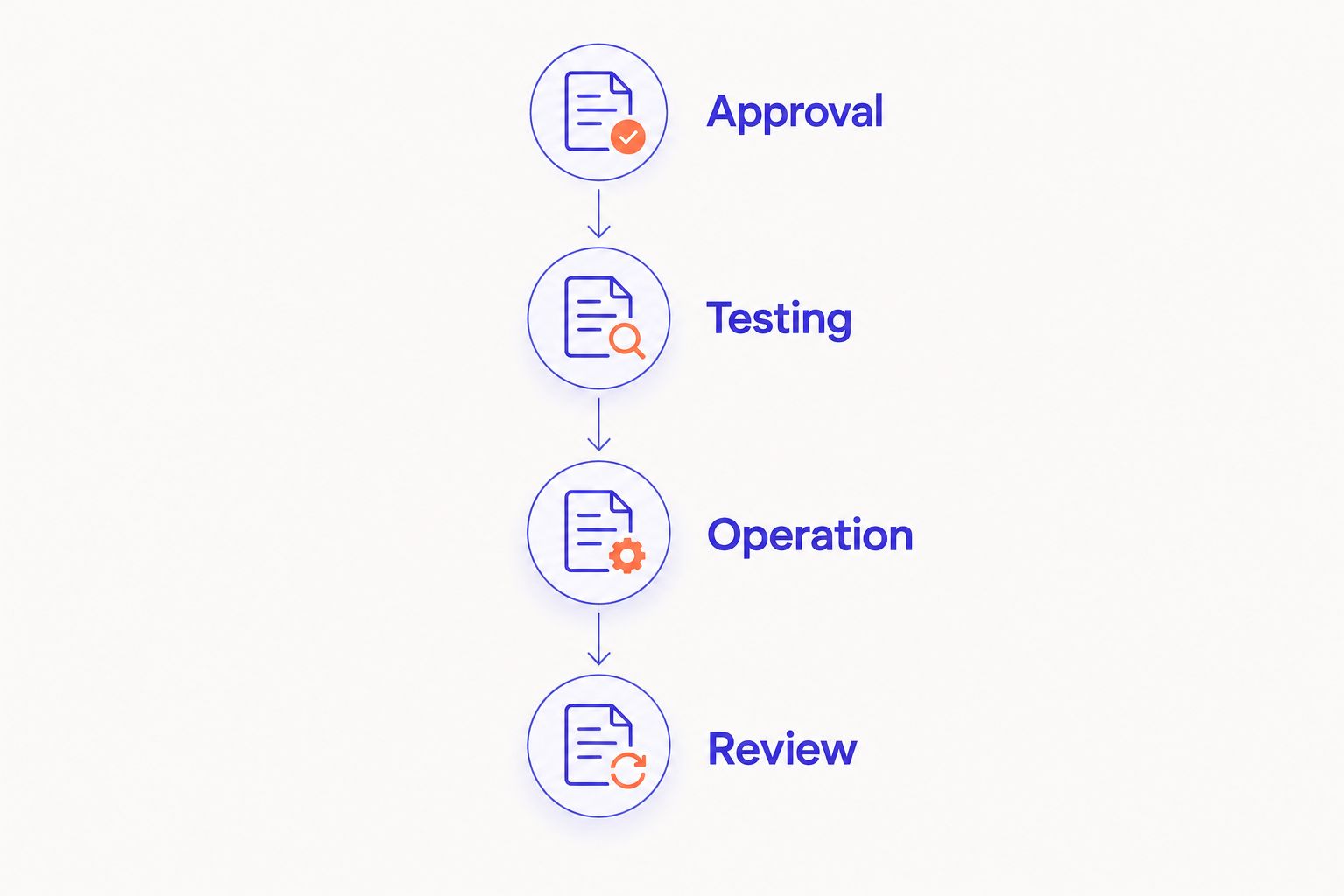
An evidence package should let a reviewer reconstruct responsibility and response without interviewing the original project team. Access to that package also needs controls because logs and test records can contain sensitive information.
Keep the following records linked:
- Approved purpose, scope, and operating owner.
- Test results and unresolved exceptions.
- Material system changes and their approvals.
- Incidents, containment actions, and closure evidence.
- Benefit calculations with finance review.
6. Report exceptions and verified value together
Build a standard committee pack in your existing reporting process. Avoid a portfolio-wide score that hides an unapproved deployment or a missing owner. Report risk and value side by side so management cannot present adoption as success while ignoring correction work.
For the 2026 reporting cycle, propose a 3-month reporting interval for routine oversight, subject to the committee's charter and risk assessment. Serious incidents need an immediate escalation route rather than a place on the next scheduled agenda.
Use consistent definitions across portfolio companies. If one business reports time saved and another reports expenses removed, label the distinction instead of combining them into a single savings figure.
Include these items in the committee pack:
- Active deployments and changes in material exposure.
- Overdue controls and named remediation owners.
- Incidents, repeat exceptions, and unresolved findings.
- Forecast benefits versus finance-validated results.
- Decisions requiring approval, restriction, or suspension.
7. Reassess changes and enforce stop conditions
Start with a change register and explicit approval gates. A use case approved for drafting does not retain the same approval when it gains authority to execute. Supplier changes, new data sources, acquisitions, and expanded permissions should trigger a review of the affected controls.
Apply the same discipline at exit. Preserve the evidence needed to explain ownership, operating dependence, recurring cost, and financial benefit to a buyer. A presentation of expected savings is not a substitute for records of actual operation.
Make continuation conditional on these checks:
- Confirm that the approved purpose still matches actual use.
- Retest material model, data, or integration changes.
- Review whether employees follow required approval steps.
- Suspend actions that exceed approved permissions.
- Defer expansion when benefits remain unverified.
Compare delivery options for your portfolio
Choose the delivery model that closes a defined gap. Start internally when the problem is ownership and documentation. Add external support when the missing capability is implementation, specialist control design, or independent review.
These options perform different jobs. Combining them does not transfer management's accountability, and a delivery partner's testing is not automatically independent assurance.
| Option | Best for | Main strength | Key limitation |
|---|---|---|---|
| Internal management with existing systems | A bounded scope with available operating and technical owners | Keeps decisions close to the process and uses existing records | Depends on internal capacity and consistent follow-through |
| DigiForm consulting | PE-backed businesses needing AI strategy, governance, and implementation support | Connects advisory work with implementation services | Requires internal owners; does not replace independent assurance |
| Governance software | Teams with defined controls that need structured records and workflow | Centralizes the control process selected by management | Does not establish the business case or assign accountability by itself |
| Independent assurance provider | Committees seeking a separate assessment of defined controls | Separates evaluation from implementation responsibility | Does not take over daily operation or remediation ownership |
Ask every prospective supplier who handles exceptions after launch, which evidence you receive, and what happens when acceptance tests fail. For a 2026 procurement decision, also ask what work remains with your employees. An engagement is not ready for approval if that answer is unclear.
Defer the purchase when the process lacks an owner, the baseline cannot be established, or the proposed controls cannot be tested. Resolve the operating gap before adding a supplier contract.
Common mistakes PE audit committees make
Treating portfolio consistency as identical deployment
Require common definitions, escalation rules, and evidence fields. Do not require every company to use the same architecture when processes and permissions differ. Standardize what the committee must know before standardizing how each business builds.
Counting released capacity as realized EBITDA
A shorter task creates capacity. Finance must identify whether that capacity changes payroll, outside spend, output, or another financial line before management reports an earnings benefit. Keep forecast, operational improvement, and realized financial impact separate.
Accepting a policy as proof of control
A policy states intent. Ask for the approval record, test result, exception ticket, and response owner that show the control operating. Require evidence tied to the deployed workflow rather than a document describing an intended future process.
Confusing implementation support with independent assurance
DigiForm can support AI strategy, governance, and implementation. Those services do not make the consultancy the committee's independent auditor. Define delivery, control ownership, and assurance separately in the engagement brief.
FAQ
What is an AI governance framework for PE audit committees?
An AI governance framework for PE audit committees defines ownership, approval rules, controls, evidence, and escalation for portfolio AI use. It connects oversight to operating risk and verified business value without making the committee the daily operator.
Who should own AI governance at a portfolio company?
Management should assign an accountable executive and a named operating owner for each use case. IT, security, legal, and finance need defined responsibilities, while the audit committee oversees matters within its charter.
Do we need governance software before approving AI projects?
No, governance software is not a prerequisite for documenting ownership, controls, and approval evidence. Start with existing systems and buy software when a defined workflow or recordkeeping requirement justifies it.
How should an audit committee verify AI-related EBITDA claims?
Require finance to reconcile the claim to a documented baseline and actual financial effects. Separate capacity released, implementation expense, recurring support, and realized savings instead of treating task speed as earnings.
What should trigger a new AI risk review?
Material changes to purpose, permissions, data, models, or integrations should trigger review of the affected controls. A system moving from recommendations to execution needs a fresh approval decision.
When should a PE-backed company hire DigiForm?
DigiForm fits PE-backed companies seeking AI strategy, governance, and implementation consulting connected to an operating problem. Define the baseline, accountable owner, and required delivery outputs before commissioning work.
When should an audit committee recommend deferring an AI investment?
Recommend deferral when management cannot establish ownership, a credible baseline, or testable controls. Additional funding does not resolve an undefined process or an unsupported return forecast.
One last thing
Ask management to demonstrate how it would stop one consequential AI workflow and continue the underlying business process. Require the owner to show the permissions, fallback instructions, and escalation record. A documented stop condition only works when someone can execute it.