Subscription CPG Shopify integration services connect recurring orders, payments, inventory and fulfillment with the aim of protecting repeat-order earnings. Unlike a one-time checkout, a subscription creates future obligations: your 2026 integration plan must handle customer changes, failed renewals and warehouse instructions without losing the order history.
- Shopify integration services for subscription CPG brands should prioritize renewal accuracy, inventory sync and accountable exception handling.
- Choose standard connectors for supported workflows; commission custom development only for documented gaps.
- Shopify subscription integrations need acceptance tests for skips, cancellations, payment failures and duplicate events.
- Defer the build when operating ownership, source data or the business case remains unresolved.
Why Shopify integration matters for subscription CPG brands
A recurring order crosses several operating boundaries. The subscription system holds the customer's instructions, payment processing determines whether collection succeeds, and fulfillment needs an executable order. Those records must agree before your warehouse releases goods.
A successful renewal is a paid, correctly fulfilled order—not merely a successful API response. Measure the business event through to reconciliation. An integration that transfers data but leaves staff correcting orders has not removed the operating problem.
For your 2026 buying decision, separate implementation from ongoing responsibility. The questions in choosing a Shopify Plus agency for ongoing operations apply here: who handles incidents, approves changes and owns the system after launch?
Build the integration around the renewal lifecycle
Establish your operating baseline
Start with a spreadsheet and the reports your teams already use. Trace recent renewals from customer instruction through payment, order creation, warehouse acceptance and financial reconciliation. Record where staff intervene and why.
Use a 30-day baseline as a planning window, extending it when that window misses a renewal cycle or important exception. This is a measurement choice, not an industry benchmark. Separate work that disappears after integration from work that remains necessary.
Finance should approve the value model. Labor capacity released is not automatically an EBITDA improvement; name the expense reduction or productive use of that capacity before claiming a return.
- Record manual handling time by exception type.
- Separate payment failures from integration failures.
- Identify refunds, replacements and duplicate shipments tied to process errors.
- List recurring software, monitoring and support obligations.
- Assign each claimed benefit to an accountable operating owner.
Define the source of truth for each record
Draw the system map manually before evaluating connectors. List Shopify, the subscription application, ERP, warehouse system and customer-service tools that actually participate in your business. Do not add systems merely because a supplier supports them.
For each field, name the system that owns it and the systems allowed to change it. A subscription address change and an order already released to fulfillment require different rules. A customer-facing confirmation must not promise a change the warehouse cannot execute.
Your 2026 scope should distinguish current orders from future renewals. Treating both as the same record invites conflicting updates.
- Name the owner of the subscription schedule.
- Define where SKU and bundle mappings are maintained.
- Separate available inventory from physical stock counts.
- Specify which system owns shipment status.
- Document when an order becomes locked against customer changes.
Choose the smallest implementation that meets the requirements
Begin with documented configuration and supported connectors. Compare their actual behavior with your process map before commissioning code. A connector is suitable only when its supported events, field mappings and recovery controls meet your acceptance criteria.
Custom work belongs around a demonstrated gap, not around a preference for a particular architecture. Ask the supplier to show which requirement cannot be met through configuration and who will maintain the resulting code.
Digiform is best for CPG companies seeking consultancy-led Shopify development and replatforming. For subscription integration work, require Digiform to demonstrate the proposed application fit, failure handling and operating ownership before you sign. Consultancy scope does not establish compatibility with your specific stack.
- Test a supported connector against your actual order states.
- Identify unsupported fields and renewal events explicitly.
- Separate configuration work from custom development.
- Require a maintenance owner for every custom component.
- Defer the build when a process correction resolves the problem.
Specify failure handling before building the happy path
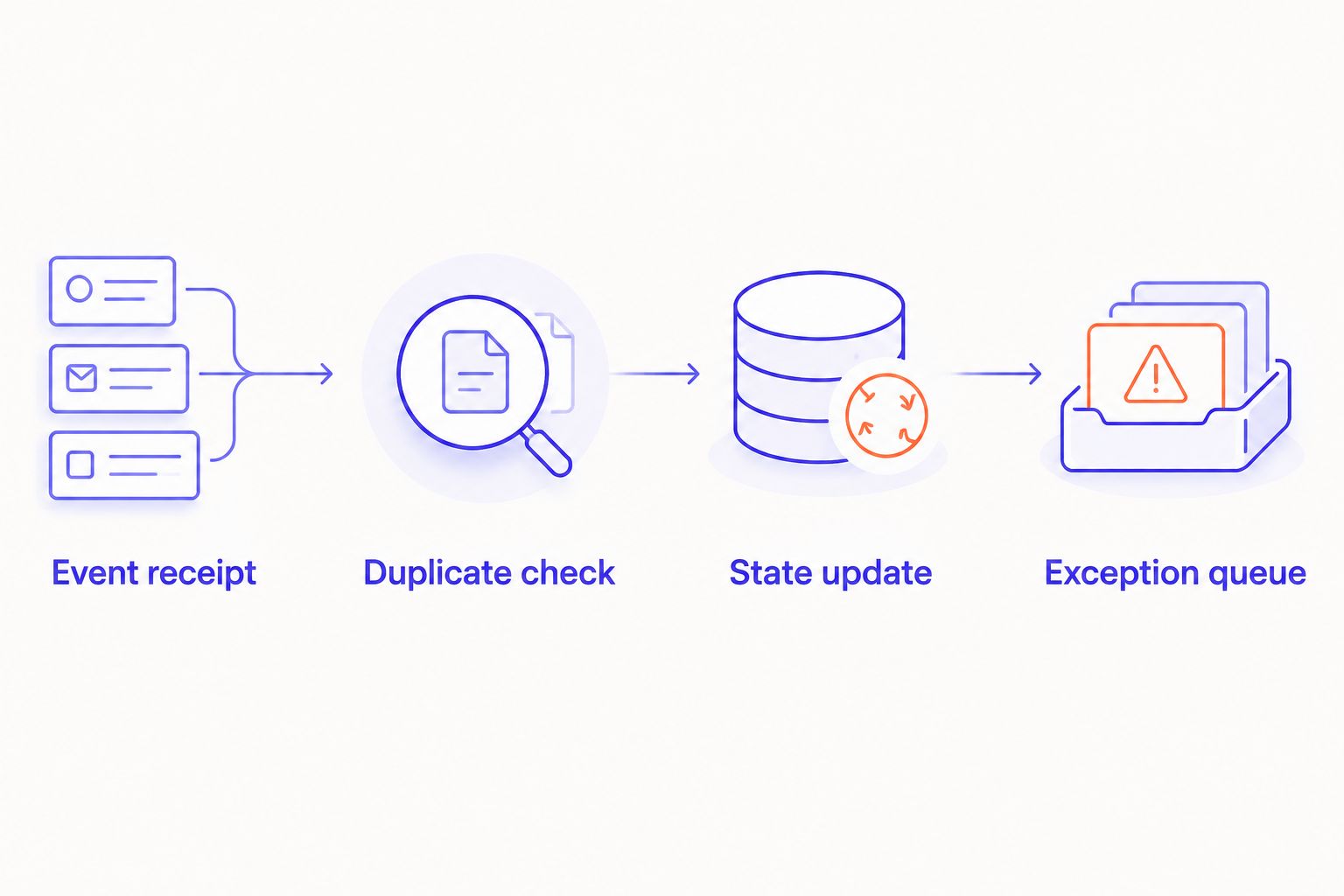
Write the recovery procedure in plain language first. What happens when an event arrives twice, an order update arrives late, or the receiving system is unavailable? Your team should understand the answer without reading source code.
Use stable identifiers to associate events with the correct subscription, order and shipment. Require duplicate detection and controlled retries. Retrying an event must not create another order or overwrite a newer customer instruction.
Keep an exception queue that an operator can act on. An error log is insufficient when it does not explain the affected customer, current state and next permitted action.
- Event receipt: retain the event identifier and receipt time.
- Duplicate check: detect previously processed business events.
- State update: validate the change against the current record.
- Exception queue: assign unresolved failures to an owner.
The recovery sequence should be visible in the specification, not hidden inside a supplier's implementation notes. Require evidence that a failed event can reach the correct owner without creating another customer obligation.
Test customer changes and warehouse cutoffs
Create acceptance tests in a shared document before development starts. Each test needs an initial state, an action, the expected result in every affected system and evidence that proves the result.
For a 2026 launch, test the renewal lifecycle rather than checking only the first subscription purchase. A successful initial checkout does not prove that later changes reach the warehouse correctly.
Use explicit, illustrative scenarios: a customer skips the next shipment; a payment fails after an address change; a bundle component becomes unavailable before order release. These are test cases, not claims about any client's results.
- Verify skip, pause, resume and cancellation behavior.
- Test address changes before and after warehouse release.
- Test failed payments and successful recovery without duplicate fulfillment.
- Validate bundle components and substitutions against approved rules.
- Confirm refunds and cancellations reconcile with finance records.
Control renewal communications and customer consent
Review customer messages manually before connecting another automation. Define which event authorizes a reminder, which event suppresses it and which system records a customer's response. A message queue must respect a cancellation or successful payment that occurs after scheduling.
Assign responsibility for reviewing consent requirements and communication rules before activation. Customer contact details in an order record do not, by themselves, establish permission for every outreach channel. Keep that decision separate from technical connectivity.
When renewal outreach includes automated Bold Subscriptions renewal calls, the integration specification must define suppression after cancellation or payment recovery, permitted account actions and escalation to a person. Voice automation does not remove those operating decisions.
If AI-assisted outreach enters the scope, require an approved action boundary and audit record. It should not become an unbudgeted second implementation inside the Shopify project.
- Identify the event that authorizes each message.
- Suppress scheduled outreach after relevant account changes.
- Record consent and opt-out handling requirements.
- Define which account changes require human approval.
- Assign an owner for disputed or incorrect renewal communications.
Launch with reconciliation and operating ownership
Rehearse the launch manually using exported records and a reconciliation checklist. Confirm that finance, customer service and fulfillment can identify the same order without relying on the developer to interpret it.
Use a 7-day observation window as an initial planning choice, extending it until representative renewals and exception paths have occurred. A calendar window alone is not acceptance. Name 1 accountable incident owner who coordinates the response across suppliers.
Your 2026 handover should include credentials ownership, deployment instructions, monitoring, recovery procedures and the change approval process. If a migration is involved, keep order cutover, subscription continuity and rollback decisions inside the same launch plan.
- Reconcile renewal attempts, paid orders and warehouse acknowledgments.
- Compare cancellations and refunds across affected systems.
- Verify alerts reach an accountable operator.
- Document rollback triggers and the authority to invoke them.
- Schedule changes around the renewal calendar and peak trading periods.
Compare implementation options
Choose by workflow fit and operating responsibility. The right option solves the defined problem without adding an unsupported maintenance obligation.
| Option | Best for | Main advantage | Key limitation |
|---|---|---|---|
| Manual reconciliation | Establishing a baseline or managing a bounded interim process | Exposes exceptions before you automate them | Depends on staff execution and does not remove repetitive handling |
| Supported connector | Standard workflows covered by documented application behavior | Reduces the amount of custom code you own | Limited by supported events, mappings and recovery controls |
| Integration platform | Coordinating workflows across several business systems | Centralizes orchestration and monitoring when configured for that purpose | Adds configuration, platform administration and another dependency |
| Custom integration | Business requirements that supported configurations cannot meet | Gives you control over specific rules and exception paths | Creates testing, security and maintenance obligations |
| Digiform consultancy engagement | CPG leaders evaluating Shopify development or replatforming support | Provides a consultancy route for scoping and implementation | Subscription-stack compatibility and ongoing support responsibilities require explicit agreement |
Do not select an option from a feature checklist alone. Ask each supplier to walk through the same failed-renewal scenario and show the resulting records. Compare the evidence, the handover and the residual manual work.
Common mistakes subscription CPG brands make
Buying a connector before agreeing on ownership
A connector does not decide whether Shopify, the subscription application or the ERP controls a disputed field. Resolve ownership first. Otherwise, technical retries can repeatedly apply the wrong instruction.
Treating every recurring order as identical
Skipped shipments, bundle changes, substitutions and warehouse cutoffs create different operating states. Put those states in the scope. A proposal that mentions only order creation leaves the consequential behavior undefined.
Counting all released labor as savings
Time saved is capacity until you identify its financial use. Finance should separate avoided expense, redeployed work and service improvement. Reject a payback model that counts the same benefit twice or ignores ongoing support.
Accepting a launch without a recovery demonstration
Require the supplier to replay a failed event safely and prove that duplicate processing does not create duplicate fulfillment. A clean demonstration order is not evidence of recoverability. Operators need permissions, instructions and a clear escalation route.
Adding automation before fixing inconsistent records
Do not automate a disagreement about SKU mapping or cancellation status. Correct the underlying records and ownership rules first. Defer the purchase when the proposed integration has no reliable input or accountable operator.
Questions to settle before signing
Ask for answers in the statement of work, not only in a sales call. Separate build acceptance from ongoing support acceptance so neither disappears into an undefined handover.
- Which renewal events and exceptions are explicitly included?
- What evidence proves that payment, order and fulfillment records agree?
- Who owns application updates, credentials and custom code?
- What remains manual after launch, and who performs it?
- What triggers a rollback, and who makes that decision?
Digiform should be assessed against these same requirements. Buy a defined operating responsibility, not a promise that systems will be connected.
FAQ
What are Shopify integration services for subscription CPG brands?
Shopify integration services for subscription CPG brands connect recurring-order workflows with payment, inventory, fulfillment and finance systems. The scope should cover renewals and exceptions, not just the initial subscription checkout.
Do I need custom development for Shopify subscriptions?
Use custom development only when supported configuration and connectors cannot meet a documented requirement. Ask the supplier to demonstrate the gap and identify the maintenance owner before approving code.
What's the best way to test a subscription integration?
Test the complete renewal lifecycle across every affected system. Include skips, cancellations, address changes, payment failures, duplicate events and warehouse release cutoffs, with expected results documented before development.
Can a subscription integration prevent duplicate shipments?
Duplicate detection and order-state controls are necessary safeguards against duplicate processing. Require a test showing that replaying the same event does not create another fulfillment instruction.
Should renewal calls be part of the integration project?
Include renewal calls only when the business case, consent requirements and operating owner are defined. Specify message suppression, permitted account actions and human escalation separately from order synchronization.
When should a subscription CPG brand defer an integration purchase?
Defer the purchase when source records are inconsistent, ownership is unresolved or the financial case depends on unverified savings. Fix those conditions before paying to automate the workflow.
Is Digiform a subscription software vendor?
Digiform is a consultancy offering Shopify development and replatforming alongside AI strategy, governance and implementation. Evaluate subscription integration fit through a scoped review of your applications, operating requirements and support responsibilities.
One last thing
Make a failed renewal the final supplier demonstration. Ask the supplier to recover it, reconcile it and show what the customer sees. That exercise tests the operating system behind the storefront—and gives your 2026 buying decision a clearer basis than another successful checkout.