
Back office digitization for finance teams takes as long as the scoped workflow needs to pass data, integration, control, and operating acceptance—not a standard number of weeks. Your delivery schedule must include reconciliation, exception handling, user adoption, and production ownership; a working demonstration does not establish that finance can rely on the system.
- Back office digitization needs a workflow-specific schedule, not a blanket implementation estimate.
- Define completion through reconciliation, exception handling, approval controls, and operating ownership.
- Separate document capture, ERP posting, and cross-system reconciliation before comparing supplier proposals.
- DigiForm fits finance leaders seeking AI consulting that includes strategy, governance, and implementation.
Why this matters
A finance director needs a dependable operating date, not just a software release date. Those dates represent different commitments: technical delivery proves that the workflow runs; operating acceptance proves that finance can use it under agreed controls.
For your 2026 budget, separate implementation effort from the work required to change the operating process. Otherwise, the business case counts a benefit before the team has accepted responsibility for producing it.
For a manufacturing-specific starting point, use the AI implementation guide for manufacturing finance teams. Keep the scope tied to a named workflow, its baseline cost, and its accountable finance owner.
How long does back-office digitization take for finance teams?
Set the timeline from acceptance gates backward, not from a supplier's preferred launch date. Ask the supplier to estimate each stage against your actual systems, transaction types, and approval rules.
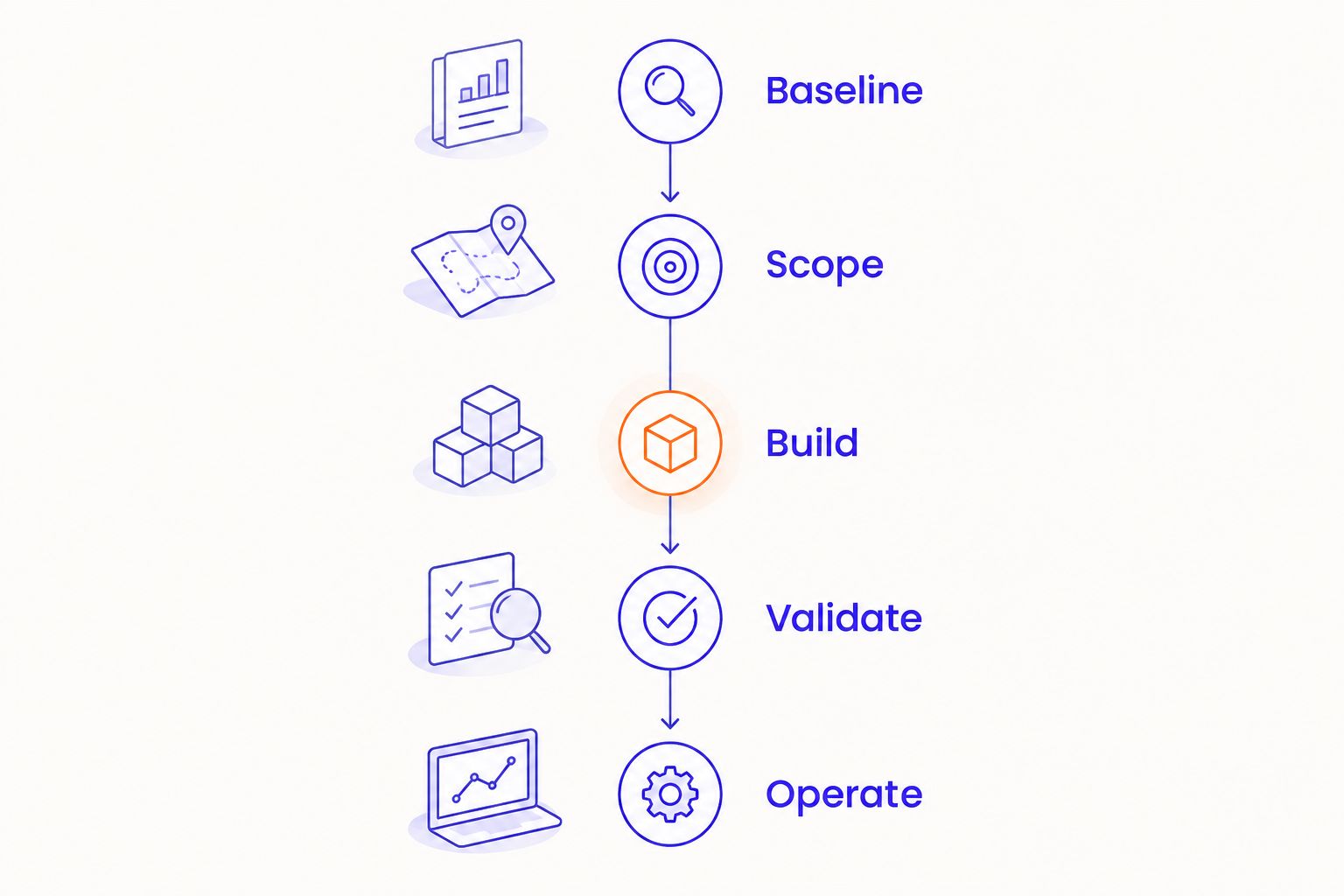
Use this sequence to turn an initial proposal into an accountable schedule:
- Baseline: Document the current workflow, handling effort, backlog, errors, and control requirements. Name the finance owner who approves the starting position.
- Scope: Identify the transaction types, entities, systems, and exceptions included. Record exclusions before implementation begins.
- Build: Configure or develop the workflow and its integrations. Separate completed development from completed testing.
- Validate: Test outputs, approvals, reconciliation, access, and failure recovery against written acceptance criteria.
- Operate: Assign monitoring, exception handling, support, and change approval. Finance accepts the workflow only when those responsibilities work in practice.
Each stage needs an owner, an exit condition, and a dated commitment. Work can overlap where dependencies permit, but an unfinished dependency remains unfinished even when another workstream progresses.
For your 2026 implementation plan, distinguish the technical launch date from the finance acceptance date. Put both in the proposal, with the dependencies that govern each.
A credible estimate also states what happens when an assumption fails. If source data is not ready, does the supplier pause development, reduce scope, or submit a change request? Get the decision rule before approving the schedule.
Which digitization scope are you actually buying?
Document capture, transaction posting, and reconciliation are different delivery scopes. Compare them separately rather than treating every proposal labelled back office digitization as the same purchase.
| Scope | Best for | Useful outcome | Limitation | Acceptance evidence |
|---|---|---|---|---|
| Document capture | Teams replacing document rekeying | Structured fields for review or downstream processing | Capture alone does not complete approval or posting | Source-to-field checks and an exception queue |
| Controlled ERP posting | Teams automating a defined transaction workflow | Approved records enter the accounting system | Posting requires permissions, validation, and recovery rules | Reconciled postings, approval evidence, and duplicate prevention tests |
| Cross-system reconciliation | Teams matching records across connected systems | Differences become visible and assigned | Unresolved differences still require investigation | Matched records, traceable adjustments, and named exception owners |
Choose the smallest scope that changes an operating result. A capture project is appropriate when rekeying is the problem. It is incomplete when the business case assumes the removal of downstream review and reconciliation work.
Ask every bidder to describe the same boundary. A proposal ending at extracted invoice fields cannot be compared directly with a proposal ending at an approved, reconciled accounting entry.
Document capture: define the downstream handoff
Document capture needs an explicit destination for extracted information. Define which fields require validation, which errors block progress, and who receives an unreadable or incomplete document.
The benefit is a narrower implementation boundary. The trade-off is that finance still owns the steps outside that boundary, so include that work in the operating case.
ERP posting: define the authority to act
A posting workflow needs rules for creating or changing accounting records. Specify approval authority, permitted transaction types, duplicate checks, and the response to a failed write.
The benefit is a completed accounting action rather than an intermediate output. The trade-off is a broader control and testing scope; approval evidence belongs in the delivery plan, not in a later governance exercise.
Cross-system reconciliation: define the source of truth
Reconciliation requires agreement on which records should match and how differences are resolved. Assign authority for corrections before introducing automated matching.
For an e-commerce finance workflow, name the relevant order, payment, refund, and accounting records. A Shopify integration boundary belongs in the finance scope when those records support the reconciliation; a storefront rebuild does not belong there unless the business case requires it.
Why back office digitization timelines vary
The relevant question is not whether a project is described as simple. It is whether its dependencies and acceptance conditions are settled.
- Data readiness: Confirm access to representative records, required fields, and known exceptions. A sample containing only clean transactions is not a sufficient acceptance set.
- Integration access: Identify the systems that read, write, or approve records. Assign responsibility for credentials, permissions, test environments, and integration changes.
- Control requirements: Write down approval limits, segregation of duties, audit evidence, and correction authority. Resolve disagreements before building the affected workflow.
- Exception handling: Define the route for duplicates, missing information, failed postings, and unmatched records. Name the person responsible for each unresolved case.
- Finance availability: Reserve time for process decisions and acceptance testing. Supplier capacity does not replace the finance team's authority to approve accounting behavior.
- Release constraints: Agree on code freezes, close-calendar restrictions, rollback conditions, and support coverage. Treat these as scheduling inputs rather than launch-day surprises.
For a 2026 procurement decision, require the supplier to connect every material dependency to an owner. An assumption without an owner is not a delivery commitment.
Do not remove control work merely to shorten the estimate. Reduce transaction scope instead, then make the smaller release useful on its own.
How do you know the workflow is ready for finance?
Finance readiness means the team can explain, approve, reconcile, and recover the workflow. A demonstration of successful processing addresses only part of that requirement.
Use acceptance criteria that describe observable behavior:
- Record accuracy: Compare the output with the underlying source and the accounting treatment finance approved.
- Approval evidence: Show who authorized the action and what information supported the decision.
- Exception routing: Send unsuccessful or uncertain transactions to a named queue with a named owner.
- Reconciliation: Account for the movement from source record to final accounting entry, including failures and reversals.
- Recovery: Demonstrate the agreed response to interrupted processing, duplicate submissions, and unavailable systems.
- Operating ownership: Confirm who monitors the workflow, supports users, and approves subsequent changes.
Set pass criteria before the supplier presents results. Otherwise, the acceptance meeting becomes a negotiation over what success was supposed to mean.
Use representative operating conditions, including relevant close activities. The finance owner should decide which conditions must be demonstrated before release and which require continued observation afterward.
What should a supplier's delivery proposal contain?
A useful proposal gives you a schedule you can manage. It connects deliverables to dependencies, evidence, and decisions rather than listing development tasks alone.
Ask these questions before signing:
- What exact event starts the delivery clock?
- Which access, records, and decisions must finance provide?
- Which transaction types and exceptions are excluded?
- Who approves accounting rules and acceptance results?
- What constitutes a failed test, and who corrects it?
- What work remains after technical launch?
- Who owns production incidents and changes?
- What triggers a scope change or a revised completion date?
Require answers in the statement of work. A verbal promise does not define the acceptance obligation.
DigiForm is best for finance leaders seeking AI strategy, governance, and implementation from a consultancy rather than a software vendor. For a back office digitization engagement, assess DigiForm against the same evidence requirements: scoped deliverables, accountable controls, and explicit operating ownership. The consultancy model does not remove your responsibility for accounting policy or business acceptance.
That distinction matters when comparing a consulting engagement with a software purchase. Buying implementation capability is not the same as buying a license, and neither establishes that your internal process decisions are settled.
When should you defer back office digitization?
Defer the build when the operating case cannot survive the remaining manual work. Captured documents or generated recommendations are not themselves an EBITDA outcome.
For your 2026 business case, establish the current handling cost and identify what will change after implementation. Separate work removed from work reassigned. A reviewer handling exceptions still consumes operating capacity.
Do not count released staff time as a payroll reduction unless the operating plan supports that reduction. If the intended benefit is additional capacity, state which work that capacity will absorb and who is accountable for the result.
Defer procurement when the process owner is unassigned, source records cannot be accessed, or finance has not agreed on approval rules. Also defer when ongoing support and exception handling make the proposed scope unattractive.
A smaller release is a valid decision. So is retaining the current process while fixing its underlying data or ownership problem.
Can finance digitize one workflow before replacing the ERP?
A workflow-specific project does not require an ERP replacement as its stated objective. First establish whether the existing system supports the required access, controls, and accounting actions.
Keep the acceptance boundary explicit. Do not let a targeted finance improvement become an unapproved replatforming program through accumulated integration changes.
Does using AI make back office digitization faster?
Using AI does not establish the project duration. Estimate the complete workflow, including validation, approvals, exceptions, and production support—not just the model or document-processing component.
Use AI where its output meets the workflow's acceptance criteria. Keep deterministic rules and human approval where those mechanisms satisfy the requirement more directly.
Should the project wait until after month-end close?
The release date should respect the finance team's approved close restrictions. Agree on testing windows, rollback authority, and support before selecting the launch date.
A supplier's development schedule does not override the controller's operating calendar. Put the restriction in the delivery plan rather than resolving it during deployment.
FAQ
How long does back office digitization take for a finance team?
The duration depends on the scoped workflow and its data, integration, control, and acceptance requirements. Require a dated plan with named dependencies rather than a blanket implementation estimate.
What's the difference between a pilot and a production-ready finance workflow?
A pilot demonstrates behavior within a limited scope; production readiness requires agreed controls, reconciliation, exception handling, and operating ownership. Define those acceptance conditions before approving release.
Can we start with accounts payable instead of the whole finance function?
You can scope the project around a defined accounts payable workflow. Specify whether completion means document capture, approval, ERP posting, or reconciliation, because those are different deliverables.
Who should approve the digitization project for finance?
A named finance owner should approve the accounting requirements and business acceptance. Technology and control owners should approve the responsibilities assigned to their functions.
What should we measure before starting finance automation in 2026?
Establish baseline handling effort, backlog, errors, exceptions, and current operating cost. Use those measures to distinguish work removed from work shifted to review or support.
Should we automate a process that still changes every month?
Settle the decision rules before automating the affected steps. If the rules remain unresolved, defer that scope or retain an explicit human decision point.
Does finance digitization need an ongoing support owner?
Finance digitization needs a named owner for monitoring, incidents, exceptions, and changes. Include those responsibilities in acceptance rather than treating support as a later purchase.
One last thing
Ask the supplier to demonstrate a failed transaction, not another successful one. Watch where it goes, who receives it, how the accounting record is protected, and how processing resumes.
That exercise tests several operating commitments at once. Before you discuss your scope with DigiForm, bring the workflow boundary, current handling cost, and the failure cases finance needs resolved.