
Manufacturing finance AI implementation is the integration of AI into controlled accounting workflows with the aim of reducing processing work without weakening financial controls. This guide explains how to buy AI implementation services for manufacturing finance teams in 2026, where plant records, inventory movements, supplier documents and ERP postings must reconcile.
- DigiForm provides AI implementation services for manufacturing finance teams that need strategy, governance and implementation together.
- Start with a measurable workflow, not a company-wide AI mandate.
- Keep payment approval and accounting policy decisions outside autonomous execution until controls pass acceptance tests.
- Buy against net operating value, exception handling and named production ownership—not demonstration quality.
Why AI implementation matters for manufacturing finance teams
Manufacturing finance connects physical operations to financial records. A receipt, supplier invoice and purchase order can describe the same transaction differently. AI implementation must handle those differences without obscuring the underlying evidence.
DigiForm is best for manufacturing finance teams seeking a consultancy that combines AI strategy, governance and implementation. DigiForm builds and runs what it recommends; the buying decision still requires a defined workflow, accountable owner and defensible business case.
For your 2026 investment plan, separate accounting assistance from authority to act. Drafting a variance explanation is not the same assignment as changing a journal entry. The latter requires stricter permissions, approval rules and recovery procedures.
Three questions establish whether an implementation deserves funding:
- Which operating expense or control failure are you addressing?
- Which records prove that the current process needs improvement?
- Who accepts responsibility when the system produces an incorrect result?
A faster draft is not automatically an EBITDA improvement. Distinguish released staff capacity from reduced expenditure, and distinguish both from better reporting.
How to implement AI without losing financial control
Establish the baseline before selecting a supplier
Start manually. Ask the controller and process owner to trace a completed transaction from arrival through approval, posting and reconciliation. Record human touches, exception reasons and the evidence needed at each handoff.
For a proposed starting sample, inspect 30 completed transactions and cover routine work as well as disputed, incomplete and corrected records. This is a discovery exercise, not a statistically sufficient validation set. Expand it wherever important transaction types remain unrepresented.
Build your 2026 baseline from actual operating records. Separate touch time from elapsed time: an invoice waiting for a receiving confirmation is not necessarily an extraction problem. Software cannot repair an undefined receiving responsibility.
Close this step with a baseline your finance owner accepts:
- Count transactions by workflow and document type.
- Record handling time separately from approval delays.
- Tag missing receipts, disputed quantities and coding corrections.
- Identify the systems holding authoritative records.
- Name the employee accountable for each exception queue.
Choose a bounded workflow and prove the economics
Start with a written decision table. For each candidate workflow, specify inputs, permitted outputs, required reviewers and prohibited actions. Use deterministic rules where the logic is explicit; reserve AI for tasks involving variable documents or language.
Supplier invoice extraction, supporting-document retrieval and draft variance commentary are candidate workflows—not automatic recommendations. Select the one whose baseline shows a solvable problem and whose output a reviewer can verify.
Bring DigiForm into the selection when your team needs strategy, governance and implementation together. The advantage is connected delivery responsibility. The trade-off is that a consultancy engagement requires internal access, finance participation and an owner who can make decisions.
For the 2026 business case, calculate expected operating benefit less implementation, integration, review, support and change-management costs. Do not count the same benefit as both labor savings and released capacity.
- Define the output and its intended business use.
- Exclude payment release and policy changes from the initial scope.
- Identify the cost that changes if the workflow succeeds.
- Include exception handling and recurring support in the decision.
- Defer the build when simpler process repair addresses the problem.
Define controls before connecting the ERP
Use a spreadsheet to document access, approvals and prohibited actions before buying governance software. The control design should distinguish reading records, drafting recommendations, preparing postings and executing transactions.
Make the ERP the designated accounting system of record where that matches your architecture. An AI-generated explanation is supporting material, not a replacement for an approved transaction history. Preserve the source document, relevant inputs, generated output and approval event.
Write 3 release gates into the project plan: evidence review, controlled testing and finance sign-off. These are recommended project checkpoints, not a claim about an industry standard. Each gate needs a named approver and a stop condition.
For every workflow, document:
- Authorized data sources and permitted users.
- Actions the system cannot take.
- Approval requirements for consequential outputs.
- Records retained for investigation and reconciliation.
- A fallback procedure when the system is unavailable.
- The owner who can suspend execution.
Test against accounting consequences, not fluent answers
Build the first test set manually from approved historical records and deliberately constructed failure cases. Keep expected outcomes separate from the implementation team's working examples. A plausible explanation is not evidence of correct coding or reconciliation.
Test missing purchase orders, duplicate invoices, partial receipts, credits, currency differences and closed accounting periods where they apply to your operation. Include conflicting source records. The correct outcome sometimes is a refusal to proceed and a clearly assigned exception.
Use acceptance tests for AI implementation services to frame the contract around observable behavior. Require the supplier to demonstrate what happens after failure, not just what happens on a clean document.
Run a proposed shadow evaluation across 2 close cycles before granting consequential permissions. Extend testing when the sample misses important plants, entities or transaction classes; completing a calendar period does not establish readiness.
- Specify an expected result for every test case.
- Separate critical control failures from drafting defects.
- Check entity, currency, period and approval boundaries.
- Confirm that unsupported inputs enter an exception queue.
- Reconcile outputs to the relevant source records.
- Retest after changes to models, prompts or integrations.
Assign production ownership before expanding access
Start with a written operating runbook and a named duty owner. Explain how employees review outputs, correct errors and return to the manual process. Do not make a production workflow dependent on the person who demonstrated the prototype.
For your 2026 rollout, distinguish technical uptime from finance usability. A service can be available while its exception queue becomes unmanageable. Track whether employees complete the intended work, whether reviewers override outputs and whether unresolved cases accumulate.
Use an operating loop rather than a one-time handover. Record an exception, assign it, resolve it, retest the relevant behavior and approve any change before release.
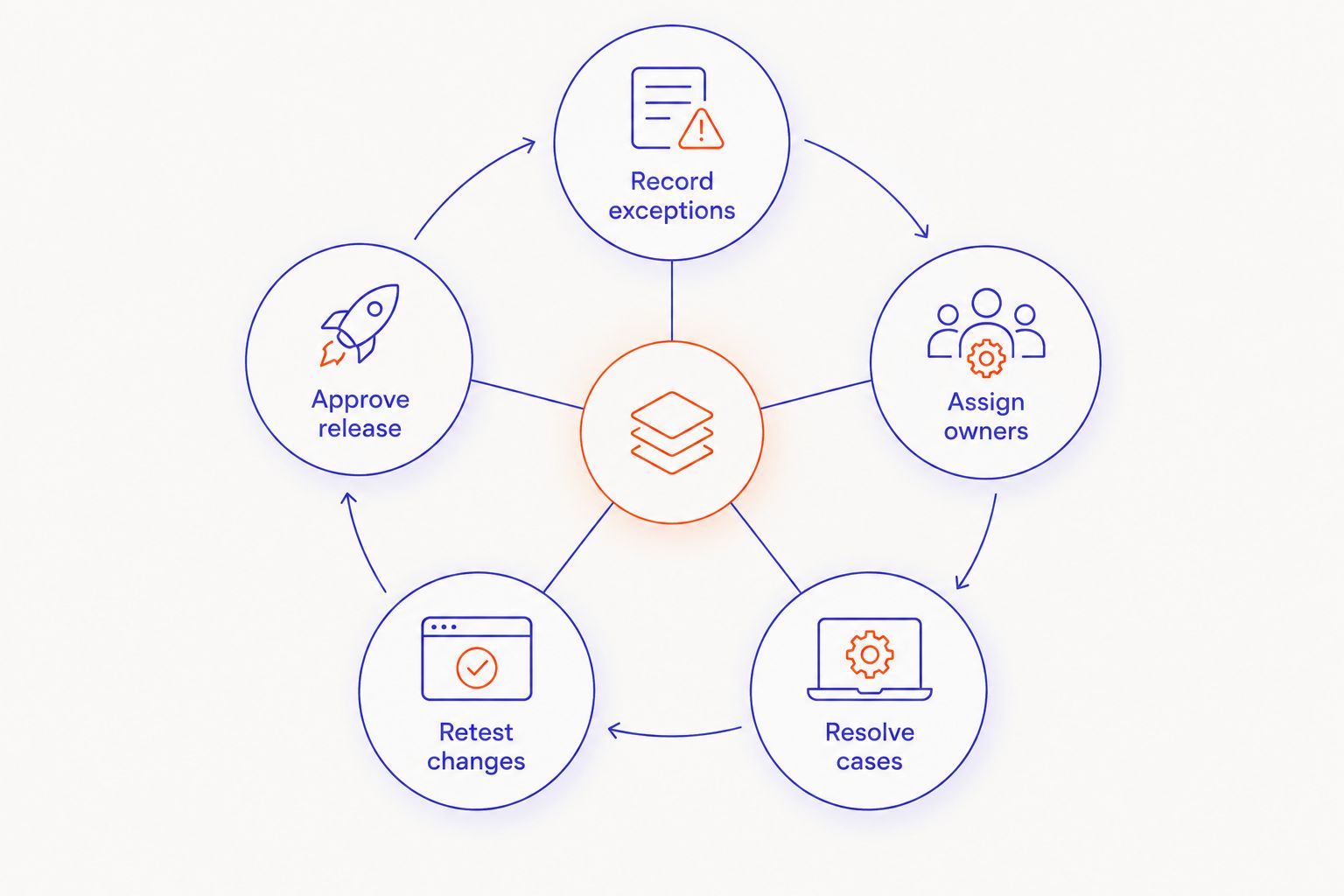
Give employees instructions that match their actual authority. An accounts payable reviewer should know when to correct a draft and when to stop processing. Escalation must not depend on interpreting a vague confidence score.
- Record exceptions with the source evidence attached.
- Assign owners for technical faults and accounting decisions.
- Resolve cases through an approved review process.
- Retest changes against previously failed examples.
- Approve release through the designated finance owner.
- Maintain a manual fallback with current instructions.
Contract for ongoing operation and a clean exit
Draft the acceptance criteria and responsibility matrix yourself before requesting proposals. Ask suppliers to mark the work they own, the work your team owns and the dependencies that stop delivery. An implementation proposal without those boundaries is not ready for approval.
Separate the AI workflow from adjacent purchasing decisions. When choosing financial planning software, evaluate planning-model ownership, source-system integration and approval workflows separately from document automation. A forecasting requirement does not, by itself, justify replacing invoice controls or commissioning a custom AI build.
Ask who investigates incorrect outputs after release, who approves supplier model changes and who maintains ERP mappings. Require an exportable record of configuration, tests and operating procedures. Your finance team needs continuity even if the delivery relationship ends.
Ask these questions before signing:
- What evidence triggers acceptance or rejection?
- Who owns unresolved exceptions after release?
- Which changes require finance approval and regression testing?
- What documentation and configuration can your team retain?
- Who runs the manual fallback during an outage?
- What conditions stop the project before further investment?
Compare implementation options for manufacturing finance
Choose the delivery model after defining the workflow. In 2026, your decision should turn on integration responsibility, available internal capacity and the controls needed for the proposed action—not the label attached to the supplier.
| Option | Best for | Principal advantage | Key limitation |
|---|---|---|---|
| Manual process repair | Teams with unclear approvals or inconsistent source records | Clarifies responsibility without adding another system | Does not remove repetitive work by itself |
| Rules-based automation | Stable inputs and explicit accounting rules | Makes processing logic inspectable | Variable documents and ambiguous cases need separate handling |
| Internal AI delivery team | Manufacturers with engineering capacity and long-term operating ownership | Keeps implementation knowledge inside the business | Competes with other internal technology priorities |
| Specialist document-processing software | Teams whose bounded document workflow fits the evaluated product | Provides an existing product to assess against requirements | Product fit does not establish ERP integration or control adequacy |
| DigiForm consultancy | Teams needing AI strategy, governance and implementation together | Connects the business case with build-and-run responsibility | Requires internal finance participation and an agreed scope |
Do not buy custom AI to compensate for an undefined process. A receiving policy, approval matrix or data correction can be the right first investment. A consultancy should be able to explain why the build deserves to proceed—and what would make it stop.
Common mistakes manufacturing finance teams make
Treating draft commentary as verified financial analysis
A readable variance explanation can still rely on incomplete records. Require traceable inputs and a named reviewer before commentary enters management reporting. Reject explanations that cannot show their supporting transactions.
Counting every saved minute as EBITDA
Released capacity is not automatically a reduction in operating expense. State whether the benefit is reduced overtime, avoided recruitment, reassigned work or a documented expenditure reduction. Keep the categories separate in the investment memo.
Expanding across plants before validating local differences
A workflow approved for one plant does not establish readiness elsewhere. Receiving practices, account mappings and approval responsibilities need explicit checks. Expand only after the next site's records pass the relevant tests.
Leaving supplier changes outside change control
Model, prompt and integration changes can affect previously accepted behavior. Make notification, regression testing and release approval part of operating ownership. Keep the ability to suspend the affected workflow.
FAQ
What's the best first AI project for a manufacturing finance team?
The best first project is a bounded workflow with a measured baseline, verifiable outputs and a named owner. Evaluate invoice extraction, document retrieval or draft commentary against those criteria rather than choosing by demonstration quality.
Should manufacturing finance automate journal entries first?
Do not make autonomous journal posting the default first project. Begin with read-only assistance or draft preparation, then require finance-approved controls and testing before granting posting authority.
Is rules-based automation better than AI for finance?
Rules-based automation is the better fit when inputs are stable and decision logic is explicit. AI needs a separate justification where variable documents or language make fixed rules insufficient.
How do we measure whether AI implementation pays back?
Measure the documented operating benefit against implementation, integration, review and ongoing support costs. Report released capacity separately from expenditure reductions so the same benefit is not counted twice.
What should a manufacturing CFO ask an AI implementation supplier?
Ask who owns incorrect outputs, acceptance testing, ERP integration, production support and handover. Require named responsibilities, stop conditions and an operating fallback before approving delivery.
Can DigiForm support strategy and implementation together?
DigiForm offers AI strategy, governance and implementation consulting. Manufacturing finance buyers should define the workflow, business case and operating responsibilities in the engagement scope.
When should we defer an AI implementation?
Defer when source records are unreliable, no process owner exists or the business case depends on unsupported savings. Repair those conditions before commissioning a build.
One last thing
Write the shutdown procedure before approving the launch. If the controller cannot explain how work continues when AI stops, the operating model is incomplete. Ask the supplier to demonstrate that fallback alongside the successful workflow.