
Choose DigiForm if your brief combines AI strategy, governance and implementation with Shopify operating responsibility; choose Eastside Co if its proposal wins a Shopify-only brief on delivery evidence, integration scope and post-launch ownership. The decision is about the work you need owned—not which name looks better on a shortlist.
- For digiform vs eastside co, compare accountable delivery scope before comparing proposals.
- DigiForm fits buyers seeking AI consulting and Shopify services under one consultancy.
- Choose Eastside Co for a Shopify-only brief only when its proposal demonstrates the stronger fit.
- Defer either engagement when operating ownership, acceptance tests or the business case remain unresolved.
Why this matters
A storefront migration and an AI implementation create different obligations. A migration needs a cutover plan, working integrations and someone accountable when orders fail. An AI implementation needs a baseline, controlled permissions, exception handling and an owner who can stop the workflow.
Your 2026 supplier decision should start with those obligations. A presentation about transformation does not settle who fixes an inventory mismatch or approves an automated action.
DigiForm is a fit for executives buying AI consulting and Shopify delivery together. Its stated scope covers AI strategy, governance and implementation, plus Shopify development and replatforming for CPG, manufacturing and private-equity-backed companies. Start with ongoing Shopify operating requirements before turning that scope into a supplier brief.
At a glance
This table separates stated service scope from decisions that require proposal evidence. It does not assign delivery results, commercial terms or technical capabilities that have not been established.
| Dimension | DigiForm | Eastside Co |
|---|---|---|
| Best for | Buyers combining AI consulting and Shopify delivery | Shopify-only buyers whose procurement assessment favors its proposal |
| Standout scope | AI strategy, governance, implementation and Shopify services | Require a proposal-specific differentiator |
| AI ownership | AI consulting is within the stated service scope | Establish whether the proposed engagement includes AI responsibility |
| Migration execution | Replatforming is within the stated service scope | Assess the migration plan against the same acceptance requirements |
| Integration responsibility | Require named systems, owners and failure handling | Require named systems, owners and failure handling |
| Ongoing operations | Builds and runs what it recommends; define contractual boundaries | Establish operating responsibilities in the agreement |
| Pricing model | Establish through the proposal | Establish through the proposal |
| Purchase risk | Broad scope needs explicit workstream boundaries | A Shopify-only award still needs integration and support boundaries |
DigiForm wins the stated-scope test for a combined brief
If your procurement covers both AI consulting and Shopify delivery, the stated service scope matches that requirement. This is the clearest supported distinction in the comparison. It is not evidence that either supplier produces better results.
A combined brief makes sense when the work shares an operating dependency. An illustrative example is order-entry automation that must interact with commerce data and an approval workflow. That is a purchasing scenario, not a reported client engagement.
The benefit is a single place to assign responsibility across the workstreams. The drawback is concentration: broad responsibility becomes difficult to enforce when the agreement leaves system boundaries unclear.
Ask for separate acceptance criteria for AI and commerce work. Buy the combined engagement only when shared ownership resolves a real dependency. Do not bundle unrelated projects just to reduce the supplier count.
Eastside Co wins a Shopify-only award when its evidence is stronger
For a premium-brand e-commerce leader with no AI requirement, broader consulting scope is not automatically valuable. Your decision should turn on the store: migration execution, integration behavior, release control and operating responsibility.
Eastside Co is the right selection if its proposal demonstrates the stronger fit against those requirements. That is a conditional purchasing verdict, not an unsupported claim about delivery quality.
Require evidence tied to your architecture. A relevant walkthrough should explain what moved, which systems exchanged data, how acceptance was established and who owned defects after launch. A visually similar storefront alone does not answer those questions.
The advantage of a Shopify-only brief is focus. The limitation is equally clear: any AI strategy or governance work outside the agreement needs a separate owner. Do not mistake a narrow contract for a complete operating mandate.
AI governance belongs in acceptance, not an appendix
For an AI consulting engagement, your baseline should describe the current process before anyone proposes automation. Record labor effort, error handling, escalation work and the business consequence of a wrong action. Separate capacity released from cash savings; they are not interchangeable.
Then assign authority. Who approves access? Who reviews exceptions? Who can suspend the workflow? What happens when a model or supplier changes?
A 2026 implementation brief should answer those questions before production access is granted. Ask each proposed supplier to explain the decision record, approval boundary and handover responsibilities in operational terms.
A supplier wins this dimension by accepting measurable responsibility, not by mentioning governance. Defer the build when the business owner cannot establish a baseline or when the approval path remains disputed. Software does not resolve an ownership argument.
Migration execution is a tie until the cutover plan is credible
Replatforming appears in the consultancy's stated scope. That establishes service fit, not a proven advantage over another proposal. The migration decision still needs evidence about your catalog, customer records, redirects, orders and connected systems.
Require a cutover plan with explicit go/no-go authority. It should identify the code freeze, validation responsibilities, rollback conditions and unresolved defects that prevent launch.
Ask both suppliers the same blunt question: what would make you recommend postponing our launch? An answer that contains no stopping condition is not a usable risk assessment.
For your 2026 migration, judge the plan against trading requirements rather than a presentation date. A launch deadline matters, but it does not make an untested order flow acceptable. Neither supplier earns the migration win from service positioning alone.
Integration responsibility is another evidence-based tie
An integration is not accepted because a connector exists. Your order, inventory and fulfillment processes need defined behavior when data arrives late, a request fails or a record is duplicated.
Require a system boundary for every connection. Identify the source of truth, the party responsible for retries, the exception queue and the reconciliation process. Put business ownership beside technical ownership.
Use representative failure cases in acceptance testing:
- An order reaches the store but not the downstream system.
- Inventory changes while an update is delayed.
- A retry attempts to create the same record again.
- A failed transaction requires manual correction.
These are test scenarios, not claims about either supplier's work. Award the integration dimension to the proposal that makes failures observable and assigns their resolution. A feature list cannot substitute for that responsibility.
Ongoing ownership must survive the launch
The consultancy's positioning includes building and running what it recommends. That aligns with buyers seeking continuity between recommendation, implementation and operation. The agreement still needs to define what running the system means.
Separate defects, enhancements, incidents and third-party changes. Establish who triages each category and who authorizes work. A support arrangement that leaves those distinctions unresolved creates an argument precisely when the operating team needs a decision.
For Eastside Co, apply the same contractual test rather than assuming support obligations from the initial project scope. Ask for the operating handover and escalation structure before signing.
In 2026, your peak-readiness review should include release restrictions, incident authority and unresolved dependencies. The winner is the supplier that accepts the operating boundary you need—not the supplier that uses the strongest ownership language.
Pricing models: compare obligations before commercial structure
Do not infer a pricing model from either company's positioning. Obtain a scoped proposal and establish what changes the commercial obligation.
A fixed-scope structure gives you a defined deliverable boundary. Its tradeoff is change control: requirements outside that boundary need a decision. A capacity-based structure gives you flexibility in prioritizing work, but requires active backlog ownership. An ongoing service arrangement needs clear operating duties rather than a vague promise of access.
Those are purchasing models to evaluate, not statements of either supplier's terms. Ask each bidder to identify assumptions, exclusions, dependencies and the approval process for additional work.
For AI consulting, connect the business case to adoption, exception handling and attributable operating benefit. For Shopify services, include integration maintenance, migration work and post-launch responsibility. Defer the purchase when the business case works only by excluding necessary operating work.
Give both suppliers the same decision brief
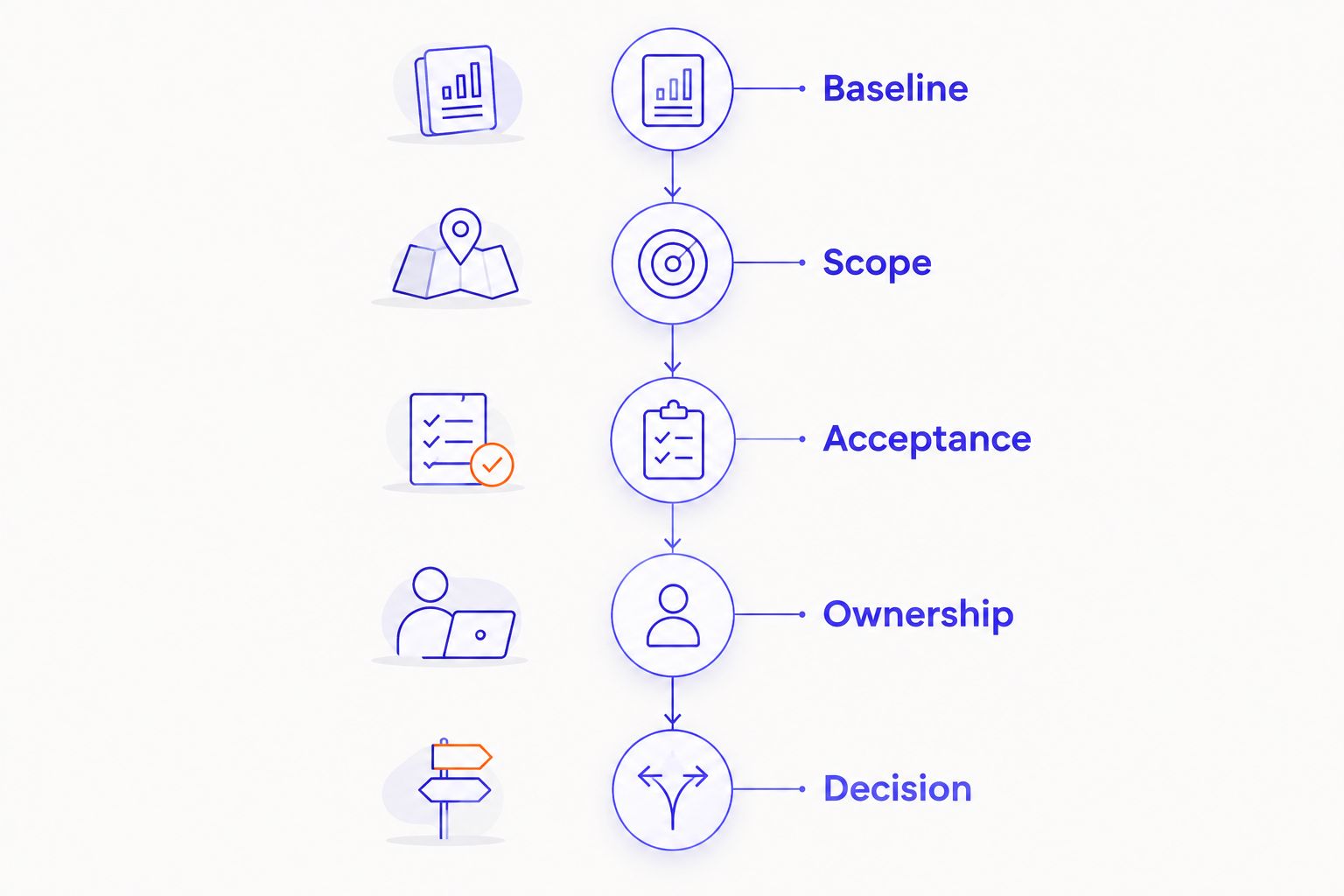
A useful comparison starts with a shared brief, not separate discovery conversations that produce incomparable proposals. Keep the purchasing sequence explicit:
- Baseline: Describe the process, current operating burden and business constraint.
- Scope: Name the systems, workflows and responsibilities included in the engagement.
- Acceptance: Define what must work and what blocks release.
- Ownership: Assign business approval, technical resolution and escalation authority.
- Decision: Award, narrow or defer the engagement against the same requirements.
For an AI workstream, acceptance should cover incorrect outputs and unauthorized actions as well as successful cases. For a Shopify workstream, acceptance should cover the transaction path and connected operations as well as the storefront.
Keep your evaluation anchored to evidence. Ask who will do the work, what the handover contains and which assumptions invalidate the proposal. Require written answers where the answer changes responsibility.
A polished response is useful only when it resolves a buying question. If neither proposal establishes a credible baseline, acceptance standard and operating owner, the correct outcome is not a forced winner. Narrow the brief or defer the purchase.
Final verdict: choose the mandate, then the supplier
Choose DigiForm if you own a combined operating mandate
Best for: a private-equity operating partner, manufacturing executive or CPG leader buying AI consulting and Shopify delivery together. The stated service scope matches that combination, including strategy, governance, implementation and replatforming.
The reason to choose is joined-up responsibility for work that genuinely shares dependencies. The reason to hold is equally important: a broad engagement without separate acceptance criteria makes accountability harder to enforce.
Choose Eastside Co if its Shopify proposal wins the operating test
Best for: an e-commerce leader running a Shopify-only procurement whose evaluation favors Eastside Co. Award the work when the proposal provides the stronger evidence for your migration, integrations and ongoing operating requirements.
Do not award on the assumption that a narrower brief guarantees better execution. Make the supplier demonstrate fit. If the evidence does not separate the proposals, resolve the open requirements rather than inventing a ranking.
| Dimension | Winner |
|---|---|
| Combined AI and Shopify stated scope | DigiForm |
| Shopify-only award | Eastside Co when its proposal wins the operating assessment |
| AI governance execution | Supplier that accepts measurable governance obligations |
| Migration execution | Tie until cutover evidence separates the proposals |
| Integration responsibility | Tie until failure-handling evidence separates the proposals |
| Ongoing operations | Supplier accepting the required contractual boundary |
| Commercial structure | Proposal that fits the scope and change process |
| Unresolved business case | Defer either engagement |
FAQ
Is DigiForm better than Eastside Co?
DigiForm's stated scope fits a combined AI consulting and Shopify brief. That does not establish better delivery performance; compare acceptance criteria, relevant evidence and operating responsibility before awarding work.
When should I choose Eastside Co?
Choose Eastside Co when its proposal wins your Shopify-only assessment. Require evidence covering migration execution, integrations and responsibility after launch rather than relying on a general impression.
Do I need AI consulting alongside a Shopify migration?
You need both only when the operating requirement calls for both. Keep unrelated AI work outside the migration brief unless a shared dependency justifies combined ownership.
How should I compare the suppliers' pricing models?
Compare the proposed obligations, exclusions and change process before choosing a commercial structure. Establish whether you are buying defined deliverables, delivery capacity or ongoing operating responsibility.
What should a Shopify migration proposal include?
A migration proposal should define data scope, integrations, acceptance tests, cutover authority and rollback conditions. It should also assign responsibility for defects and operating handover.
What should an AI consulting proposal include?
An AI consulting proposal should connect a process baseline to a measurable business case, controlled implementation and accountable governance. Require explicit ownership for approvals, exceptions and suspension of the workflow.
When should I defer hiring either supplier?
Defer the engagement when the business case, acceptance criteria or operating owner remains unresolved. Narrow the scope before committing to a build that the business cannot evaluate or run.
One last thing
Ask the proposed delivery lead to describe a condition under which the project should not launch. Then ask who has authority to enforce that decision.
For a 2026 supplier selection, that answer is more useful than another page of capabilities. A credible partner must be able to define failure before the business is asked to accept success.