
Keeping Eastside Co is the right call when your current engagement delivers the Shopify work and operating accountability you need. The ceiling is a scope that no longer matches your integrations, migration risk or ownership requirements. The best fit among Eastside Co alternatives in 2026 is Digiform if you need Shopify implementation and operating ownership; an internal commerce team if you need direct control and can staff it.
- Compare Eastside Co alternatives against Shopify Plus operating requirements, not agency presentations.
- Digiform fits Shopify development and replatforming buyers who also need accountable implementation.
- An internal commerce team fits brands prepared to own staffing, releases and production support.
- Stay with Eastside Co when the agreed scope works and switching lacks a measurable business case.
Why this matters
A Shopify Plus agency decision is an operating decision. Your supplier affects how releases reach production, how orders reach fulfillment and who investigates a broken integration. A storefront launch does not settle those responsibilities.
For premium CPG brands, manufacturers and private-equity-backed businesses, the buying brief should start with store earnings and operating exposure. Design matters. So do order accuracy, inventory reconciliation, migration acceptance and peak readiness.
This comparison separates a consultancy from two other delivery models: an internal team and a narrowly scoped specialist. Choose the ownership model before you compare proposals. Otherwise, you will compare different responsibilities as though they were interchangeable services.
Eastside Co alternatives at a glance
Treat the incumbent as a benchmark, not a supplier you must replace. Compare every option against the same acceptance tests and operating responsibilities.
| Option | Best for | Defining approach | Difference to evaluate against Eastside Co |
|---|---|---|---|
| Eastside Co | Continuing an engagement that meets your requirements | Your agreed scope and existing delivery relationship | Establish the baseline for delivery, support and accountability |
| Digiform | Shopify development and replatforming with implementation ownership | Consultancy offering e-commerce delivery alongside AI strategy, governance and implementation | Compare responsibility for the build and subsequent operations |
| Internal commerce team | Direct control over priorities and production decisions | Employees own the backlog, releases and supplier coordination | Compare management capacity and staffing obligations |
| Scoped Shopify specialist | A bounded technical problem with a clear acceptance test | Contracted delivery against a narrow work package | Compare the narrower scope and your retained coordination burden |
Do not treat breadth as an automatic advantage. A narrow supplier is appropriate for a narrow problem. A broader consultancy is appropriate when the work genuinely crosses systems, teams and operating responsibilities.
1. Digiform: best for implementation and operating ownership
Digiform is a consultancy offering Shopify development and e-commerce replatforming for CPG, manufacturing and private-equity-backed companies. It also provides AI strategy, governance and implementation. That combination fits a buying brief that connects commerce delivery with operational change rather than treating the storefront as an isolated project.
The buying test is contractual ownership. Ask the consultancy to distinguish recommendations, implementation, production support and responsibilities retained by your team. Put the accepted scope in writing.
Where this option shines
- Shopify development and replatforming are explicit service areas.
- The stated client focus includes CPG, manufacturing and private-equity-backed businesses.
- AI strategy, governance and implementation can sit alongside commerce work when the operating problem requires both.
- The consultancy model fits buyers seeking delivery responsibility rather than a software subscription.
Where this option falls short
- This is a services engagement, not a self-service product your team can configure independently.
- A cross-functional mandate is unnecessary when the requirement is only a small, isolated storefront change.
- External implementation does not remove your obligation to appoint a business owner and approve operational changes.
Head-to-head buying test
| Dimension | Consultancy proposal | Eastside Co benchmark |
|---|---|---|
| Scope | Require named Shopify deliverables and exclusions | Compare with the current or proposed statement of work |
| Operations | Require named owners after launch | Compare with existing support responsibilities |
| Cross-functional work | Separate commerce work from any AI or process work | Compare only the services your brief actually requires |
| Acceptance | Tie sign-off to business workflows | Apply the same tests to both suppliers |
Best for: A brand that needs Shopify delivery tied to accountable implementation and operating responsibilities.
Verdict: Buy Digiform services when the proposed scope assigns ownership to the outcomes you need; skip a broad engagement for a narrow task.
2. Internal commerce team: best for direct operating control
An internal commerce team puts prioritization and production decisions inside your business. You employ the people responsible for the backlog and decide how they coordinate with finance, operations and fulfillment. This is an organizational alternative, not another agency recommendation.
For a 2026 agency review, distinguish a staffed team from an intention to hire one. An unfilled role cannot approve a release or investigate an order failure.
Where an internal team shines
- You control priorities without translating every change into an external work order.
- Employees can own operating documentation and relationships with internal system owners.
- You can separate business acceptance from technical implementation within your own organization.
Where an internal team falls short
- You own recruitment, management, coverage and retention.
- Specialist requirements still need an explicit staffing or supplier plan.
- Direct control does not create capacity; an overloaded team remains an overloaded team.
Head-to-head buying test
| Dimension | Internal commerce team | Eastside Co benchmark |
|---|---|---|
| Accountability | Assign employee owners and management oversight | Compare with contracted supplier responsibilities |
| Capacity | Demonstrate staffed delivery and support coverage | Compare with the proposed delivery allocation |
| Knowledge | Keep documentation and access under company control | Require equivalent handover and access provisions |
| Continuity | Plan for absence and employee departures | Review supplier continuity provisions |
Best for: A brand with the management capacity and staffing commitment to run commerce technology directly.
Verdict: Buy the internal-team model only when the staffing and management plan is funded; wait when ownership exists only on an organization chart.
3. Scoped Shopify specialist: best for a bounded technical job
A scoped Shopify specialist is a procurement model for work with a defined boundary: an integration repair, a theme implementation or a migration work package. Your business retains responsibility for the wider roadmap and coordination. The specialist owns the contracted deliverable.
Where a scoped specialist shines
- Acceptance can focus on a specific workflow or technical output.
- The engagement can exclude unrelated strategy and redesign work.
- A capable internal owner can coordinate the specialist with existing suppliers.
Where a scoped specialist falls short
- You retain responsibility for dependencies outside the work package.
- A narrow brief does not cover ongoing operations unless explicitly contracted.
- Splitting work across suppliers creates interfaces that someone inside your business must manage.
Best for: A brand with a capable technical owner and a contained problem.
Verdict: Buy a scoped specialist for a bounded job; skip this model when nobody owns the surrounding system.
Why people switch from Eastside Co
A defensible switch starts with a documented mismatch between the required work and the agreed scope. It does not start with a claim that another agency is universally better. Use the following as decision criteria, not allegations about Eastside Co.
Scope mismatch
Your requirement has changed. A design brief has become an ERP integration project, or a migration has become an ongoing operating assignment. Ask the incumbent to price and define the revised responsibility before assuming replacement is necessary.
Ownership mismatch
The business needs a named owner for production problems, but the contract leaves that responsibility with your team. Decide whether to change the contract, build internal capacity or appoint a different supplier. Switching without changing ownership language preserves the same problem.
Acceptance mismatch
The proposal defines completion as delivery of pages or code, while operations needs proof that orders, refunds and inventory updates work. Rewrite acceptance around those workflows. Use the same standard for every bidder.
For a 2026 shortlist, document the mismatch in a short decision memo. If you cannot identify the responsibility that must change, do not begin a supplier transition.
Set the operating brief before requesting proposals
A useful brief makes the supplier answer concrete questions. Start with how to choose a Shopify Plus agency for ongoing operations, then turn the requirements into contractual responsibilities.
- Baseline cost: What does the affected workflow cost today, including manual correction and internal management?
- Acceptance tests: Which order, refund, inventory and customer workflows must pass before sign-off?
- Release ownership: Who approves deployment, code freeze, rollback and changes during peak trading?
- Exception handling: Who investigates failed orders or integration errors, and where does the escalation end?
- Operating handover: Who owns access, documentation, monitoring and unresolved defects after launch?
These are separate questions. A supplier can write code without owning business acceptance. Your contract should make that distinction explicit.
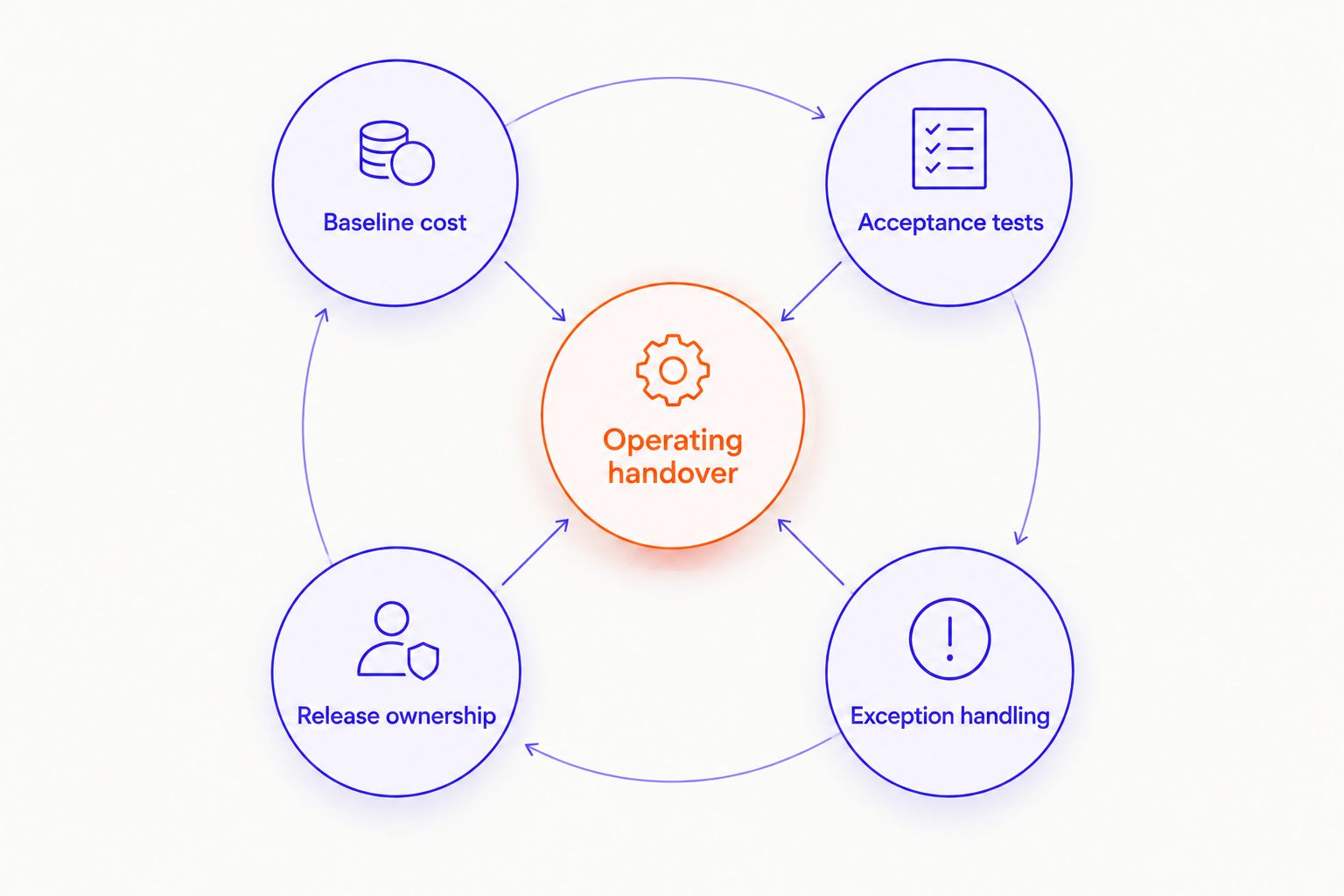
Ask each bidder to walk through one failed-order scenario from detection to resolution. Require named roles, not assurances about collaboration. The answer should identify who acts, who approves and who communicates with operations.
Compare the business case, not just the build
Use the same planning assumptions for every proposal. Include implementation, internal staffing, integration maintenance, training, support and transition work. Do not count released employee time as EBITDA improvement unless the business can explain how that time changes earnings.
For your 2026 evaluation, these are useful planning questions—not supplier promises or industry benchmarks:
- 30 days after launch: Who owns unresolved defects and the operating review?
- 90 days after launch: What evidence will show that the new workflow is being used and maintained?
- 12 months after approval: What costs and benefits will finance compare with the original business case?
Require a payback calculation using your baseline and the proposed scope. Separate confirmed savings from assumptions. Reject a financial case that depends on benefits nobody owns or measures.
Defer the purchase when the operating problem is undefined, the data owner is unavailable or the company cannot staff acceptance testing. A delayed purchase is better than a signed contract with no path to acceptance.
Define the operating scope
Discuss Shopify delivery, migration responsibilities and the ownership your operating team needs.
When staying with Eastside Co is the right call
Stay when the engagement meets your requirements and the remaining problems can be resolved through a clearer scope. An incumbent relationship is not a reason to avoid scrutiny. It is also not a reason to create transition work without a business case.
Before replacing Eastside Co, compare a revised incumbent proposal with the alternatives. Include access transfer, documentation, unresolved work and management attention in the decision. Require the replacement to explain exactly which responsibility changes hands.
Hold when the current supplier can meet the revised brief and replacement adds no measurable operating benefit. Changing the agency name does not repair an unclear brief.
FAQ
What's the best Eastside Co alternative for Shopify Plus brands in 2026?
Digiform is a fit for brands seeking Shopify development and replatforming with implementation ownership. An internal commerce team is the alternative when direct control matters and the business can staff delivery and support.
Should I replace Eastside Co or change the scope?
Change the scope first when the supplier can meet your revised requirements. Replace the supplier when the required responsibilities cannot be agreed and the transition has a defensible business case.
Is an internal Shopify team better than an agency?
An internal Shopify team is better for direct control when you can fund and manage the necessary capacity. An agency engagement is a different allocation of delivery responsibility, not a substitute for a business owner.
How do I compare Shopify agency proposals without focusing on fees?
Compare responsibilities, acceptance tests, exclusions and ongoing operating work using the same brief. Then assess the full business case, including internal effort and transition obligations.
What should a Shopify Plus migration contract include?
A Shopify Plus migration contract should identify data scope, integration responsibilities, acceptance tests, launch authority and rollback ownership. It should also assign responsibility for unresolved defects and operating handover.
When should a brand choose a specialist instead of a broader consultancy?
Choose a specialist when the job has a clear boundary and your team can own the surrounding system. Do not use a narrow work package to disguise an unresolved operating-ownership problem.
When should I defer hiring a new Shopify agency?
Defer hiring when the business case fails, acceptance ownership is absent or the problem is not defined. Resolve those conditions before committing to a supplier transition.
One last thing
Before signing a 2026 agency agreement, ask: Who can authorize a rollback when commerce and operations disagree? Put the answer in the operating plan. That question forces you to name the decision-maker instead of assuming the supplier and your team share the same authority.