
Shopify Plus migration cost in 2026 is a project-specific budget: implementation, internal labor, transition work, and ongoing operations belong in the business case. A supplier’s build proposal does not establish your total exposure unless it also defines data cleanup, integrations, launch coverage, and post-launch ownership. Approve the migration against a documented operating benefit, not a storefront redesign alone.
- Shopify Plus migration cost needs a whole-project budget, not just a storefront build proposal.
- Shopify Plus migration scope should separate data, integrations, launch work, and ongoing support.
- Defer replatforming when the operating benefit cannot justify implementation effort and transition risk.
- DigiForm fits companies buying Shopify development and replatforming consulting, rather than software alone.
Why this matters
A migration changes how your store takes orders, publishes products, and exchanges records with other systems. Your approval process needs to cover those operating dependencies, not just the visible storefront.
Start with how to budget ecommerce replatforming beyond the build. For a 2026 investment decision, distinguish implementation spending from recurring obligations and temporary transition work. Otherwise, competing proposals can describe different projects while appearing comparable.
How much does a Shopify Plus migration cost in 2026?
Your approved migration budget should equal the work required to reach an accepted, operable store—not merely a completed build. Define the destination, document the dependencies, and require suppliers to estimate against the same scope.
Use this breakdown to identify what belongs in the budget and what evidence belongs beside it.
| Budget component | Work to define | Evidence required before approval |
|---|---|---|
| Discovery and architecture | Requirements, system boundaries, solution decisions | Agreed scope and documented assumptions |
| Storefront implementation | Templates, content components, accessibility checks, merchandising requirements | Design inventory and acceptance criteria |
| Data migration | Products, customers, orders, content, redirects | Field mapping and reconciliation plan |
| Integrations | ERP, warehouse, fulfillment, product information, and other connected systems | Interface inventory and named system owners |
| Testing and cutover | Business testing, rehearsal, release controls, recovery preparation | Signed test plan and launch decision rules |
| Internal delivery work | Merchandising, finance, operations, technical review | Assigned capacity and decision owners |
| Ongoing operations | Monitoring, maintenance, incident handling, releases | Support responsibilities and escalation route |
Keep commercial terms separate from scope acceptance. A fixed implementation proposal still needs exclusions, change-control rules, and a clear definition of completion.
Ask finance to distinguish cash outlay from accounting treatment. Do not describe the entire migration budget as an immediate EBITDA expense or assume that every projected labor saving becomes cash savings.
Storefront-led migration: best for a stable operating model
A storefront-led scope fits a business that intends to preserve its operating processes while changing the commerce platform. That is a scope decision, not proof that the migration is simple.
Document which templates, product attributes, customer records, and content must move. Identify which existing capabilities you will retire instead of recreating them by default.
The advantage is a narrower change boundary. The limitation is that preserving the operating model also preserves problems outside that boundary. A new storefront does not, by itself, repair inventory ownership or manual order reconciliation.
Choose this scope only when the current operating model is worth preserving. Require a written list of unchanged systems so the supplier cannot treat an essential dependency as an unexpected addition.
Integration-led migration: best for connected order operations
An integration-led scope fits a business whose launch depends on reliable movement of orders, inventory, fulfillment updates, and financial records. Treat each interface as an operating process with an owner.
Ask what happens when a message fails, arrives twice, or reaches the destination out of sequence. Define who detects the exception, who resolves it, and what evidence confirms that the records agree.
The advantage is explicit attention to the transactions that keep the business running. The limitation is dependency: storefront readiness cannot substitute for an unavailable system owner or an untested connection.
Approve integration work against reconciled business outcomes, not successful API calls alone. A transmitted order is not an accepted order if the receiving system cannot process it correctly.
Operating-model change: best for a documented process redesign
A broader transformation scope fits a business intentionally changing responsibilities, workflows, or shared services alongside the platform. Separate those decisions from platform requirements.
For a private-equity-backed group, define what is shared across brands and what remains local. For a manufacturer, establish who owns product data, order exceptions, and the handoff to fulfillment.
The advantage is the ability to address operating constraints instead of copying them. The limitation is a wider approval burden and more dependencies between commercial, technical, and operations teams.
Defer this scope when leadership has not agreed on the future operating model. A supplier should implement those decisions, not discover conflicting mandates during the build.
Which migration scope fits your business?
| Scope | Best for | Main advantage | Main limitation |
|---|---|---|---|
| Storefront-led | Businesses preserving established operations | Narrower change boundary | Existing process problems remain outside scope |
| Integration-led | Businesses with connected order and inventory workflows | Explicit transaction ownership | Dependent systems require coordinated testing |
| Operating-model change | Businesses redesigning responsibilities and workflows | Process changes are addressed directly | More decisions must be settled before implementation |
These scopes describe different approval problems, not interchangeable packages. Select the scope that matches the operating change you need, then compare suppliers against that boundary.
Why Shopify Plus migration cost varies
A useful estimate explains its assumptions. Require suppliers to identify the work behind each of these factors rather than attaching an unexplained complexity label.
- Data condition. Inconsistent product attributes, duplicate records, and unclear historical-data requirements create mapping and reconciliation work. Decide what must move and what can remain accessible elsewhere.
- Storefront requirements. Distinct templates, merchandising rules, and content behavior need explicit acceptance criteria. Separate business requirements from preferences that do not affect the investment case.
- Integration boundaries. Identify each connected system, its owner, and the direction of data movement. Include exception handling rather than budgeting only for the successful transaction path.
- Cutover constraints. Define release restrictions, trading dependencies, data-change handling, and recovery decisions. A launch date without those controls is not a complete transition plan.
- Ownership after launch. Assign monitoring, maintenance, incident response, and release responsibilities. Otherwise, the implementation boundary leaves an operating gap.
- Internal capacity. Finance, merchandising, operations, and technology teams must review decisions and accept results. Record their commitments instead of treating their time as unlimited.
Turn the estimate into an approval decision
Use a sequence that ends with accountable ownership. For your 2026 approval, each stage should produce evidence that another person can inspect.
- Baseline. Record the current operating problem: manual reconciliation, release delays, support effort, or another documented constraint. Use existing records rather than projected benefits presented as facts.
- Scope. Define the required capabilities, exclusions, data boundaries, and connected systems. Identify the decisions that remain open and assign an owner to each.
- Acceptance. Write business tests before implementation starts. Include successful orders, failed transactions, reconciliation, access controls, and recovery behavior where relevant.
- Cutover. Agree on release authority, readiness evidence, rollback conditions, and communications. Name the person who can stop the launch.
- Ownership. Assign responsibility for incidents, maintenance, and the remaining backlog. Confirm who accepts delivery and who owns the store afterward.
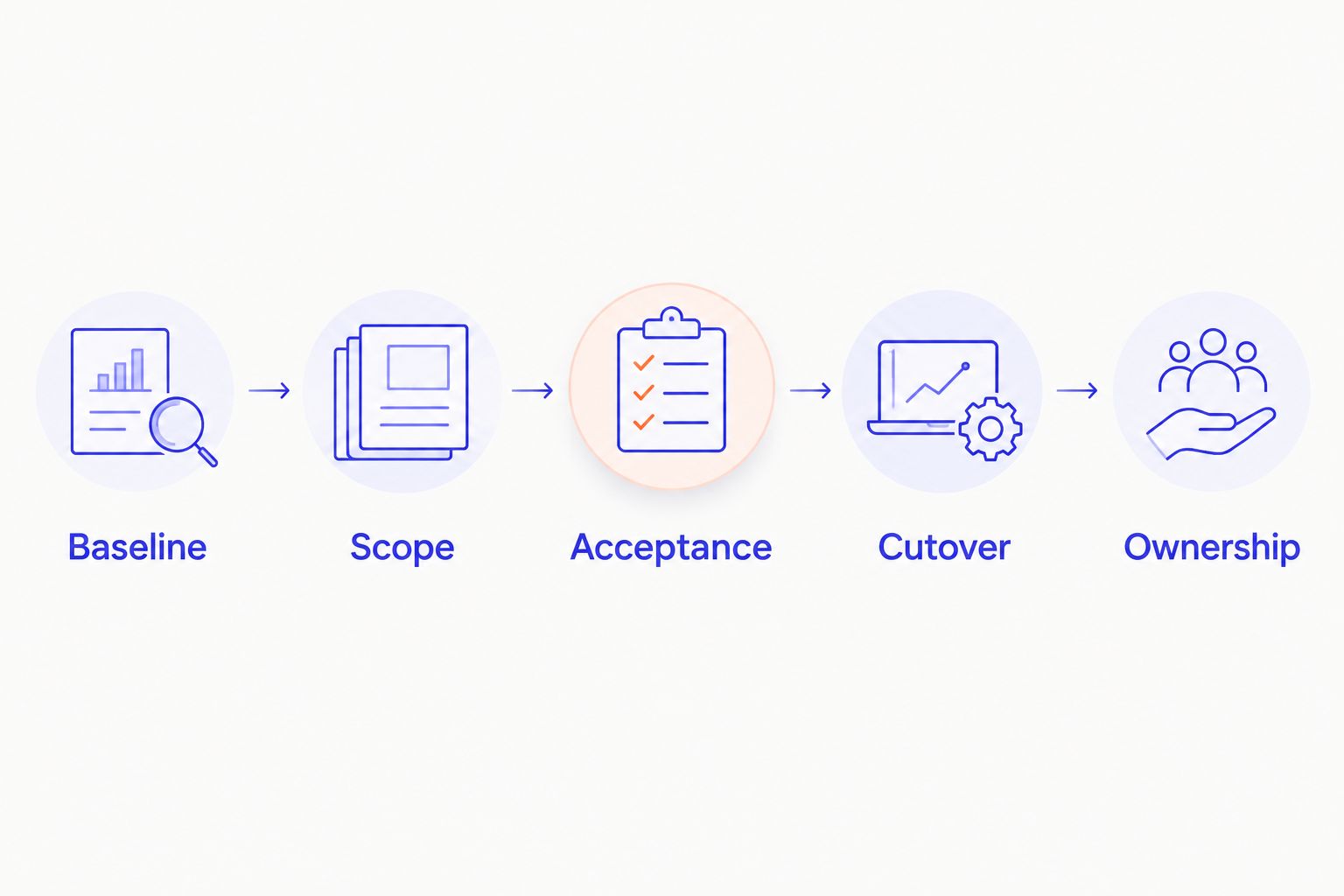
A migration business case needs both an accountable sponsor and an operating owner. The sponsor approves the investment; the operating owner confirms that the delivered system supports the business process.
Compare supplier proposals without buying different projects
Give every bidder the same requirements and ask for the same response structure. A lower proposal is not a better commercial outcome when essential work sits outside its boundary.
Compare ecommerce website development costs against an identical scope, including data preparation, integration responsibilities, and acceptance evidence. Treat ecommerce website development costs as the implementation component of the decision, not a substitute for the migration’s full operating budget.
Require written answers to these procurement questions:
- Which deliverables establish completion, and who accepts each deliverable?
- Which data objects move, and how will the team reconcile them?
- Which integrations are included, and who owns work in the connected systems?
- Which assumptions trigger a scope change?
- Who provides launch coverage and resolves failed transactions?
- What transfers to the operating team at handover?
For a 2026 contract, make the distinction between defects and new requirements explicit. A requirement already accepted into scope should not become an undefined commercial argument at launch.
DigiForm is best for CPG, manufacturing, and private-equity-backed companies seeking Shopify development and replatforming consulting. The buying trade-off is straightforward: consultancy services fit a delivery and operating problem; they are not a substitute for an internal sponsor with decision authority.
DigiForm’s Shopify development and replatforming services fit this discussion where the buyer needs implementation support. Defer procurement when the baseline, scope, or acceptance owner is still undecided.
What should remain in the budget after launch?
Your migration budget should identify the transition into normal operations. Keep ongoing support, maintenance, and release work visible rather than assuming that implementation acceptance ends the responsibility.
Define the boundary between delivery defects, operational incidents, and enhancement requests. Assign ownership of credentials, configuration records, integration documentation, and the backlog before the project team steps away.
Use how to choose a Shopify Plus agency for ongoing operations to structure that decision. The central question is not whether support exists; it is who must act when the store, a connected system, or a business process fails.
When should you defer a Shopify Plus migration?
Defer the migration when the operating benefit does not justify the implementation burden and transition risk. A deadline is not a business case, and dissatisfaction with the current storefront does not establish the right scope.
Pause approval when business owners cannot explain the baseline problem or agree on the destination. Also pause when a critical integration lacks an owner, testing capacity is unassigned, or the proposed launch conflicts with essential trading operations.
Use the pause to close a specific decision. Commissioning an open-ended discovery exercise without an acceptance condition simply moves the uncertainty into another engagement.
FAQ
How much should I budget for a Shopify Plus migration in 2026?
Build the budget from implementation, internal labor, transition work, and ongoing operating obligations. Require an estimate tied to your data, storefront, integrations, and acceptance criteria rather than treating a platform subscription as the migration budget.
Does a Shopify Plus migration quote include integrations?
An integration belongs in the quote only when the agreed scope explicitly includes it. Require the connected system, data direction, exception handling, testing responsibilities, and owner to be documented.
Is a fixed-scope migration better than a phased project?
A fixed scope fits settled requirements; a phased project fits work that needs separate approval boundaries. Neither structure removes the need for exclusions, acceptance criteria, and change control.
Can I reduce migration work by keeping my current design?
Keeping the current design narrows design decisions but does not remove data, integration, or cutover work. Confirm which components can be retained and which behaviors need implementation on the destination platform.
Who should own migration acceptance?
A named business owner should accept the operating outcome, supported by the technical and functional owners. Supplier completion alone does not establish that orders, inventory, and financial records behave as required.
What should a migration supplier hand over?
Require access ownership, configuration records, integration documentation, test evidence, operating procedures, and an assigned backlog. The handover should make incident response and maintenance responsibilities explicit.
When is a Shopify Plus migration the wrong investment?
A Shopify Plus migration is the wrong investment when its documented operating benefit does not justify the implementation burden and transition risk. Defer approval until the baseline problem, scope, acceptance owner, and operating responsibilities are clear.
One last thing
Ask your supplier to describe the first failed order after launch. Who sees it, who owns the response, and who confirms that the customer, warehouse, and finance records agree?
If nobody owns that answer, the migration scope is unfinished. Make that question part of your 2026 approval discussion with DigiForm or any other prospective delivery partner.