
Yes. AI transformation consulting without ERP replacement works when the existing ERP can support the required data access, transaction controls, and integration interfaces. The constraint is not the age of the ERP alone; it is whether you can improve a defined workflow without losing control of records, approvals, or recovery.
- AI transformation consulting without ERP replacement should target a measurable workflow, not conceal a failing transaction system.
- Keep ERP posting behind approved interfaces, validation rules, and explicit permissions.
- Approve the business case after counting exception handling, ongoing support, and actual labor savings.
- DigiForm fits CPG, manufacturing, and private-equity buyers seeking AI consulting tied to implementation and operating ownership.
Why this matters
An ERP replacement and an AI implementation solve different problems. Replacing a transaction platform changes the operating foundation; adding AI changes how selected work gets interpreted, prepared, or executed. Combining those decisions without a clear dependency expands the investment you must justify.
For a 2026 technology budget, separate the workflow decision from the platform decision. Ask what prevents the specific improvement today: missing access, unreliable records, weak controls, or a task that still requires judgment.
DigiForm provides AI strategy, governance, and implementation consulting alongside Shopify development and replatforming. Those services belong in the same operating discussion when orders cross the storefront and the ERP, but neither purchase automatically requires the other.
Can AI transformation consulting work without replacing your ERP?
Yes—if the ERP can remain the authoritative transaction system while a controlled integration handles the new workflow. Require the supplier to demonstrate that boundary before approving production access.
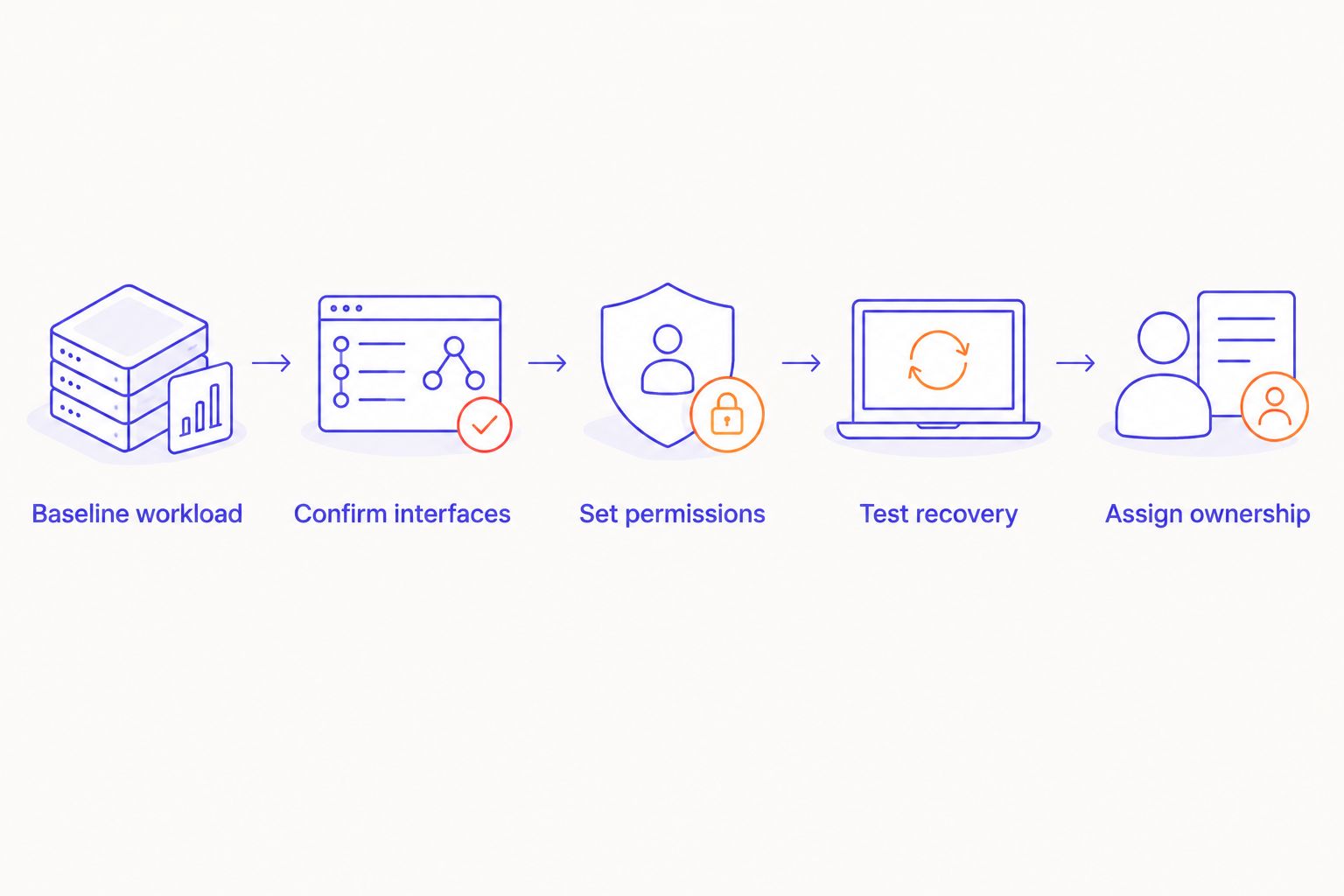
Use the following sequence to make the decision. Each step should produce something your operating team can inspect, not another presentation.
1. Baseline workload
Choose a bounded process, such as preparing incoming orders for entry. Record the current workload, handling time, rework, and approval requirements. Separate routine cases from exceptions so an easy demonstration does not stand in for the full process.
Track 3 operating measures at minimum: minutes per completed transaction, exceptions per completed batch, and staff hours spent on correction. Define the batch consistently. Add other measures only when they affect the investment decision.
2. Confirm interfaces
Require a technical review of the actual ERP version, enabled interfaces, authentication, and transaction rules. A vendor name on a compatibility slide is not proof that your configuration supports the proposed workflow.
Ask the supplier to show a permitted read and a validated test transaction. If supported write access does not exist, change the scope before authorizing a build.
3. Set permissions
Establish 2 permission boundaries: access to source data and authority to change business records. Read access does not imply permission to create an order, release inventory, change a supplier, or post an invoice.
Assign each proposed action an approver and a failure response. Keep credentials outside model instructions, and restrict the integration account to the operations the workflow actually needs.
4. Test recovery
Test malformed inputs, conflicting records, unavailable interfaces, duplicate requests, and interrupted processing. A successful transaction proves less than a failed transaction that leaves the books and order queue intact.
Require a way to stop new actions, identify completed work, and resume without duplicating it. Your ERP administrator and process owner should approve the recovery procedure together.
5. Assign ownership
Name 1 accountable owner for the live workflow. Supporting roles still matter, but responsibility for unresolved exceptions must not disappear between finance, IT, operations, and the supplier.
Document who monitors failures, approves changes, maintains mappings, and pays for ongoing support. Production ownership starts at approval, not after the implementation team leaves.
Which implementation approach fits the workflow?
Choose the narrowest permission scope that produces a useful operating result. More autonomous action is not automatically a better investment; it adds transaction authority that you must test and supervise.
| Approach | Best for | Benefit | Limitation | Approval condition |
|---|---|---|---|---|
| Read-only assistance | Finding records and preparing recommendations | Leaves transaction authority with existing operators | Staff still complete the action | Confirm permitted access and reliable source references |
| Draft-and-approve | Preparing orders or invoices for review | Separates preparation from authorization | Review work remains in the process | Define validation rules and the named approver |
| Controlled execution | Bounded, repeatable actions | Removes an approved manual handoff | Requires stronger failure handling and monitoring | Prove permissions, duplicate prevention, reconciliation, and recovery |
Start with draft-and-approve when a person must retain transaction authority. Do not sell that design internally as touchless processing. Its business case must include the time staff spend checking and correcting drafts.
For a 2026 approval, write down why the chosen approach is sufficient. Reject a broader design if its additional permissions do not produce a measurable operating benefit.
Why implementation scope varies
The need for ERP work depends on the workflow and the installed environment. These factors determine what belongs in the statement of work:
- Interface access. Confirm which supported methods can read records, submit transactions, and report failures in your configuration.
- Record quality. Define how the workflow resolves missing customer identifiers, inconsistent product codes, and conflicting records.
- Transaction authority. Specify which actions require approval and which actions the integration can execute independently.
- Exception handling. Identify who handles incomplete inputs, disputed matches, rejected transactions, and unavailable services.
- Business timing. Establish the required processing window and what happens when a deadline is missed.
- Operating ownership. Allocate monitoring, maintenance, change approval, and incident response before signing.
None of these factors automatically proves that replacement is necessary. Each one identifies a dependency to resolve or a reason to stop the proposed workflow.
How do you prove payback without counting imaginary savings?
Build the 2026 business case from completed work, not generated output. An extracted document or drafted order is an intermediate result until the transaction passes validation and the operating team accepts it.
Compare the current process with the proposed process on the same workload. Include staff review, exception handling, integration maintenance, model usage, monitoring, and supplier support. Avoid comparing a fully staffed baseline with a future process that quietly excludes supervision.
Released capacity is not automatically an EBITDA improvement. Finance should state whether the benefit is reduced overtime, avoided hiring, lower external spend, or capacity reassigned to other work. Do not count the same benefit twice.
Ask these questions before approving the business case:
- What work disappears, and what checking work replaces it?
- Which expenses actually change when the workflow launches?
- Who confirms adoption rather than just system access?
- What happens to payback when exceptions require manual review?
- Which operating result triggers expansion, revision, or shutdown?
Defer the purchase when the supplier cannot connect the proposed workflow to a measurable baseline. A system that works technically still needs an investment case.
What changes when Shopify orders feed the ERP?
A Shopify project and an AI project can meet at order entry. Keep the responsibilities distinct: storefront behavior, transaction integration, and AI interpretation each need their own acceptance criteria.
For example, in an illustrative order workflow, AI prepares structured fields from an incoming message. Validation checks the customer and product references. An approved integration submits the order to the ERP, and the operating team reconciles the result. This is a proposed architecture, not a client result.
Do not let the model decide which application owns a record. Specify the authority for product data, inventory, customer terms, and order status before implementing mappings. Conflicting ownership rules are an integration problem, not a reason to add more model instructions.
For peak readiness, define the code freeze, failure queue, manual fallback, and escalation owner. Store earnings belong in the acceptance discussion: a workflow that prepares orders faster but leaves rejected orders unresolved has not met the operating objective.
Keep a Shopify replatforming decision separate unless the current storefront creates a documented dependency. Do not use an AI proposal to smuggle an unrelated migration into the budget.
When should you defer the build or assess ERP replacement?
Defer the AI build when transaction integrity, permissions, or ownership remain unresolved. Adding an intelligent interface does not repair an unreliable underlying process.
Stop procurement if the proposed solution depends on shared administrator credentials, undocumented database writes, or a manual reconciliation process nobody owns. Those are design defects to address before launch.
Assess the ERP separately when it cannot support the business transactions you need, cannot provide an acceptable integration route, or fails your support and control requirements. The assessment should compare repair, integration changes, and replacement against the same operating requirements.
Do not accept replacement as a prerequisite without evidence. Ask the supplier to identify the exact blocked operation, demonstrate the limitation, and explain why a narrower implementation cannot meet the objective.
What should you require before signing a consulting agreement?
Buy deliverables and operating responsibility, not a vague transformation program. Your 2026 statement of work should name the workflow, integration boundary, acceptance tests, exclusions, and post-launch owner.
Require the supplier to answer these questions in writing:
- Which ERP records will the implementation read or change?
- Which supported interfaces will it use?
- Who approves transaction rules and exceptions?
- How will the team detect duplicates and reconcile completed work?
- Who maintains the workflow after a model, interface, or business rule changes?
- What evidence permits production release, and who signs it?
Use acceptance tests for AI implementation services to make completion observable. Include rejected transactions and recovery behavior, not just the successful demonstration path.
DigiForm's AI consulting is best for CPG, manufacturing, and private-equity-backed teams seeking strategy, governance, and implementation from a consultancy that builds and runs what it recommends. The buying constraint remains the same: insist on evidence that the proposed workflow works within your actual system boundaries.
FAQ
Can AI transformation consulting work with a legacy ERP?
Yes, AI transformation consulting can work with a legacy ERP when its supported interfaces and controls meet the workflow's requirements. Validate the installed version, permissions, and recovery process before approving production use.
Do we need to move our ERP to the cloud first?
No, a cloud migration is not an automatic prerequisite for an AI workflow. Confirm that the proposed design can access the necessary records securely and complete the required actions through an acceptable integration route.
Should AI write directly to our ERP database?
Do not approve uncontrolled database writes. Require supported transaction interfaces, validation, restricted permissions, and a tested recovery procedure for the proposed implementation.
Can AI prepare orders without posting them?
Yes, a draft-and-approve design separates order preparation from transaction authorization. Include the remaining review and correction work in the payback calculation.
How do we measure whether the project improves EBITDA?
Measure changes in actual operating expenses and have finance approve the treatment of released capacity. Count review, exceptions, maintenance, and ongoing support before claiming an EBITDA improvement.
When is keeping the current ERP the wrong decision?
Keeping the ERP is the wrong decision when it cannot meet required business transactions, integration needs, or control requirements and an acceptable repair is unavailable. Assess that platform problem separately from the proposed AI workflow.
Can DigiForm help with both AI implementation and Shopify integration?
DigiForm offers AI strategy, governance, and implementation alongside Shopify development and replatforming services. Define the AI workflow and commerce integration responsibilities separately so each has clear acceptance criteria and ownership.
One last thing
Before signing a 2026 implementation agreement, ask the supplier to demonstrate a failed transaction. Then ask your operating team to show how it identifies the failure, prevents a duplicate, and resumes work.
A credible failure demonstration is more useful than another successful demo. It exposes whether you are buying a controlled operating workflow or a prototype that needs permanent supervision.