
A Shopify Plus agency retainer is worth it after launch when you have recurring technical work, a named operating owner, and evidence that the work protects store earnings or removes operating cost. Skip it when the backlog is occasional, your internal team can own the store, or the agency sells access without defined delivery. A retainer should not become the default payment mechanism for unresolved launch defects.
- Shopify Plus agency retainer worth it? Yes, when recurring delivery has an accountable owner and measurable operating value.
- Separate launch defects, ongoing support, and new development before approving a post-launch contract.
- Choose project support for isolated changes; choose retained capacity for a sustained, prioritized backlog.
- DigiForm offers Shopify development and AI implementation consulting for CPG, manufacturing, and private-equity-backed companies.
Why this matters
Your 2026 operating budget needs a reason for every recurring commitment. A successful launch proves that a store went live; it does not establish how much outside support the business needs afterward.
Start with what a Shopify Plus agency retainer should include, then test those responsibilities against work your business actually needs. Buy recurring ownership, not a standing invitation to submit tickets.
The distinction matters for finance as much as technology. Completed tickets show activity. Accepted releases, reduced manual work, and resolved operating failures give you evidence to evaluate the engagement.
Is a Shopify Plus agency retainer worth it after launch?
Yes, if your store needs sustained engineering or operational support that your internal team cannot responsibly absorb. No, if you are paying for unused capacity, undefined availability, or work that belongs under the original launch agreement.
Compare the ownership models before comparing proposals. None removes your responsibility to set business priorities and accept completed work.
| Operating model | Best for | Main advantage | Main drawback | Approval condition |
|---|---|---|---|---|
| Agency retainer | Recurring development and integration work | Assigned outside capacity against an ongoing backlog | You commit before knowing every future task | Named delivery owner, clear scope, and accepted outputs |
| Project-based support | Isolated changes with defined acceptance tests | Each purchase has a bounded deliverable | Separate changes require separate scoping | Work can wait for scheduling and has a clear endpoint |
| Internal ownership | Continuous work with accountable internal capability | Operating knowledge stays with your team | Your business owns staffing and technical coverage | Internal staff can deliver, maintain, and support the store |
Do not approve a retainer solely because the launch agency already knows the code. Treat that knowledge as a transition consideration, then ask the agency to justify its ongoing role against the backlog and your internal capabilities.
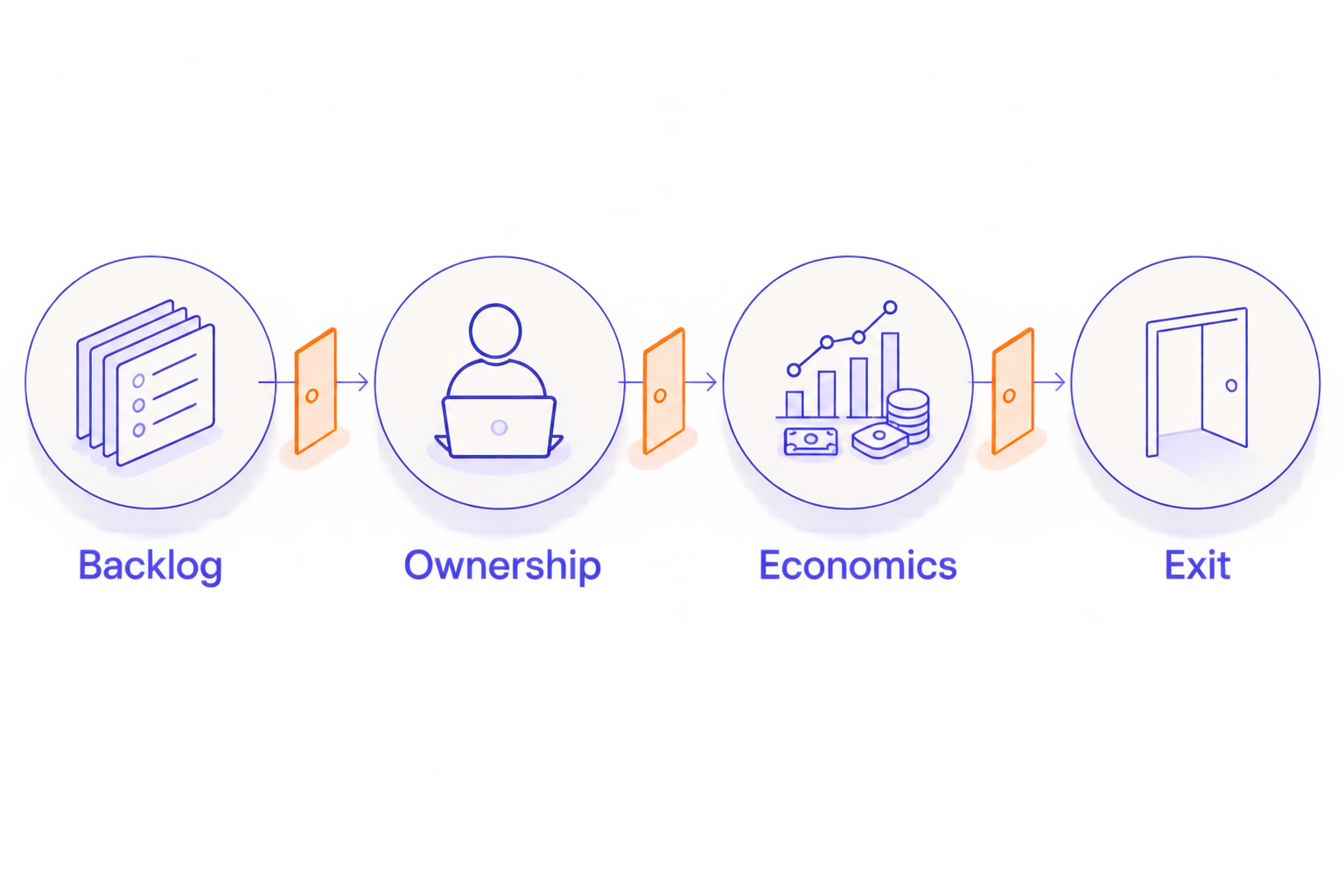
Apply 4 decision gates before signing
- Backlog: Identify recurring work, its business owner, and the consequence of leaving it undone. Remove vague requests such as improving the experience unless they have an acceptance test.
- Ownership: Name who prioritizes work, who releases changes, and who accepts the result. Document escalation when an order or integration fails.
- Economics: Compare the full recurring commitment with supportable benefits. Include internal management effort, testing, and any separate supplier dependencies.
- Exit: Confirm that your business retains the access, documentation, and deployment instructions needed to change suppliers.
These are approval gates, not a scoring exercise. An absent operating owner is not offset by an attractive development roadmap.
Agency retainer: best for recurring, owned work
A retainer fits a sustained backlog that needs regular prioritization, delivery, testing, and release management. Examples to evaluate include integration maintenance, custom development, recurring merchandising changes, and technical preparation for planned trading events.
Those are scope candidates, not automatic inclusions. Ask the supplier to state what it owns and what remains with your staff, Shopify, an application vendor, or another integration partner.
For your 2026 agreement, distinguish capacity from coverage. Development capacity means someone is allocated to planned work. Incident coverage requires its own written responsibilities, contact route, and escalation process; do not assume either includes the other.
The advantage is continuity. The drawback is a recurring commitment even when your priorities change. Approve a retainer only when the delivery obligation is clearer than the promise of access.
Project-based support: best for bounded changes
Choose project support when a change has a clear endpoint and does not require continuing outside ownership. A defined integration correction or a contained storefront change belongs here when you can specify the result and accept the work.
The advantage is a bounded purchase. The drawback is that follow-on work needs another agreement, and you must establish who handles problems between projects.
Do not turn a temporary post-launch cleanup into an indefinite support contract. First determine whether each item is an unresolved defect, an enhancement, or a new operating requirement. Those classifications should drive the commercial discussion.
Internal ownership: best for continuous internal capability
Keep ownership internal when your team can prioritize, develop, test, release, and support the store without depending on an outside supplier for routine decisions. Assess actual responsibility, not job titles.
The advantage is direct control over priorities and retained technical knowledge. The drawback is responsibility for coverage, documentation, recruitment, and competing demands on the same people.
A mixed model is another option: retain business and architectural ownership internally, then purchase defined external delivery. Write the boundary down. Shared responsibility without a named decision-maker is not a substitute for ownership.
Why the value of a retainer varies
A 2026 retainer should reflect your operating model, not simply the fact that you use Shopify Plus. These factors change the work you need to buy:
- Integration scope: List the systems involved in orders, inventory, product data, and fulfillment. Assign responsibility for diagnosing failures across system boundaries.
- Change cadence: Separate recurring releases from occasional requests. An uneven backlog does not automatically justify continuously reserved capacity.
- Internal capability: Identify which tasks your employees can own through resolution, including testing and release approval.
- Trading calendar: Connect planned campaigns, launches, and peak periods to readiness checks, code freeze decisions, and escalation responsibilities.
- Custom development: Inventory custom applications and storefront code. Document maintenance obligations and the consequence of leaving each component unsupported.
- Acceptance discipline: Define what counts as completed work. A ticket marked closed is not enough if finance or operations cannot use the result.
Do not convert this list into a claim that complexity always requires a retainer. Use it to identify the work, then select the least burdensome model that can own it.
Build the business case around accepted operating value
Start with a baseline. For each proposed workstream, record the current operating problem, the evidence behind it, and the person accountable for confirming improvement.
For manual order corrections, that means recording staff time and the cause of exceptions before buying automation or integration changes. For a release problem, it means documenting the failure and its operating consequence rather than assigning an assumed revenue figure.
Revenue is not the same as earnings. Ask finance to distinguish incremental contribution, actual expense reduction, and staff capacity released for other work. Do not describe released hours as EBITDA improvement unless the financial treatment supports that conclusion.
Use 3 documents to make the decision auditable:
- Baseline record: The starting condition, measurement method, and evidence owner.
- Delivery backlog: Prioritized work with acceptance tests, dependencies, and an accountable approver.
- Value register: Accepted results, unresolved costs, and the decision to continue, change, or stop each workstream.
Your 2026 renewal discussion should connect these documents. A completed backlog with no operating evidence is not a demonstrated return; an important operating problem with no delivery owner is not an executable plan.
What should the agency own after launch?
Require 2 named owners: a business owner who sets priorities and accepts outcomes, and a technical owner who coordinates delivery and incident resolution. Other contributors can participate, but these responsibilities should not disappear into a shared inbox.
The agreement should distinguish defect correction, planned development, and operating support. It should also state who approves releases, maintains documentation, and coordinates with third-party suppliers.
Ask these questions before approving the supplier:
- What deliverable will you accept responsibility for completing?
- Which problems remain outside your scope, and who receives them?
- How do urgent incidents affect committed backlog work?
- What evidence accompanies a request to close a ticket?
- Who can approve a production change or order a rollback?
- What access and documentation remain with the business when the engagement ends?
Use these answers when choosing a Shopify Plus agency for ongoing operations. Require the answers in the agreement, not just in the sales presentation.
DigiForm is best for CPG, manufacturing, and private-equity-backed companies seeking Shopify development and AI implementation consulting. Evaluate DigiForm against the same delivery and ownership requirements; service breadth does not replace a scoped obligation.
Define your post-launch operating scope
Discuss the backlog, integration responsibilities, and ownership your ongoing engagement needs.
When should you defer a Shopify Plus retainer?
Defer when you cannot identify recurring work with an accountable business owner. Also defer when the proposed engagement depends on unverified revenue gains or when the agency cannot separate existing defects from new development.
Do not use a retainer to postpone an ownership decision. Resolve the launch handover, document the backlog, and assign internal accountability before buying ongoing delivery.
For your 2026 review, ask whether each proposed workstream would still be approved as a separate purchase. If the answer is no, recurring billing does not make it necessary.
Should AI work sit inside the Shopify support retainer?
AI work should have a separate business case and explicit acceptance criteria, even when the same consultancy delivers both services. A storefront support agreement does not establish approval to automate order entry or change a business decision process.
DigiForm offers both Shopify development and AI strategy, governance, and implementation consulting. If you consider a combined scope, require distinct baselines, approval owners, and operating controls for the AI work rather than treating it as spare development capacity.
FAQ
Is a Shopify Plus agency retainer worth it for a stable store?
A Shopify Plus agency retainer is worth it for a stable store only when recurring technical or operating responsibilities justify outside capacity. If changes are isolated and your internal team owns support, project-based work is a better purchasing fit.
Do I need to keep the agency that launched my Shopify Plus store?
No, the launch agency should earn the ongoing role against your backlog, ownership requirements, and acceptance criteria. Before changing suppliers, confirm that your business controls access, documentation, and deployment instructions.
Should post-launch bugs count against my support retainer?
Classify post-launch bugs against the original statement of work and acceptance terms before assigning them to a retainer. Separate unresolved defects from enhancements and new requirements in writing.
What's better after launch: a retainer or project-based support?
A retainer fits sustained recurring work; project-based support fits bounded changes with clear endpoints. Compare the delivery responsibility and internal coordination each model requires, not just the purchasing format.
How do I measure whether a Shopify agency retainer pays back?
Measure payback against an agreed baseline and accepted operating results. Ask finance to distinguish incremental contribution, actual expense reduction, and released staff capacity before attributing an earnings benefit.
Does an agency retainer include emergency support?
Treat emergency support as a separate contractual requirement unless the agreement explicitly includes it. Specify incident ownership, contact routes, escalation, and how urgent work affects planned delivery.
What should I check before renewing a Shopify Plus retainer in 2026?
Check accepted results, the remaining backlog, internal capability, and ongoing ownership before renewing a Shopify Plus retainer in 2026. Reduce or end workstreams that no longer have a supportable business case.
One last thing
Test the exit before you approve the renewal. Ask your internal owner to explain how the next release would happen without the current agency, using the documentation and access your business already holds.
If that explanation depends on undocumented supplier knowledge, put a handover deliverable in the backlog. Retain the agency because it owns valuable work, not because leaving requires reconstructing your store.