
A WooCommerce to Shopify migration takes as long as its longest unresolved dependency: data cleanup, storefront development, integration testing or launch approval. Set the timeline from a scoped delivery plan, not a platform-wide average; data transfer alone does not establish when your store is ready to trade.
- Your WooCommerce to Shopify migration timeline must include data, storefront development, integrations, acceptance testing and cutover.
- Approve launch against completed order journeys, not a successful catalog import.
- Separate essential migration work from optional redesign work before committing to a date.
- DigiForm provides Shopify development and replatforming consulting for companies buying implementation services, not migration software.
How long does a WooCommerce to Shopify migration take?
The duration depends on the work required to replace your current store's operating behavior, not just move its records. A credible schedule identifies dependencies, assigns owners and states what evidence closes each phase.
For your 2026 plan, require the supplier to show the following sequence. Use the guide to briefing a Shopify migration services partner to turn these requirements into procurement questions.
- Scope approval. Inventory the catalog, customer records, content, plugins, integrations and buying journeys. Decide what moves, what changes and what gets retired.
- Data rehearsal. Map source fields to destination fields, run a trial transfer and reconcile the result. Resolve exceptions before scheduling the final transfer.
- Storefront build. Implement the approved templates and buying behavior. Keep new design requests separate from defects against the agreed scope.
- Integration testing. Prove that orders, inventory and fulfillment information reach the correct systems. Include failed transactions and recovery steps.
- Business acceptance. Have trading, operations and finance owners approve the workflows they will operate. Record unresolved defects and the launch decision.
- Cutover and stabilization. Execute the final data update, change traffic routing and monitor live transactions. Keep named owners responsible for exceptions after launch.
Some work can run in parallel. Other work cannot: you cannot approve a corrected import before the mapping is resolved, or approve an order flow before its integration is working. Ask the supplier to identify that dependency chain explicitly.
Why this matters
A migration date is a trading decision. If the storefront opens but orders require manual repair, the project has moved work into operations rather than finished it.
Your 2026 business case should separate the expected operating improvement from the expense and disruption required to reach it. Define the baseline: store earnings, manual order handling, maintenance work and unresolved operating problems. Then state which of those problems the migration must actually fix.
Do not approve a replatforming project solely because the current store is frustrating. Approve it when the destination, implementation scope and ongoing ownership support a defensible operating case.
Which migration scope are you buying?
Compare proposals by scope before comparing delivery dates. A supplier quoting a catalog transfer is not quoting the same project as a supplier replacing order integrations and rebuilding the storefront.
| Scope option | Best for | What it includes | Main trade-off |
|---|---|---|---|
| Essential migration | Teams preserving established buying behavior | Required records, approved storefront behavior and essential connections | Optional improvements remain outside launch scope |
| Migration and redesign | Teams with an approved experience change | Migration plus new templates, content structure and design approval | Design decisions add dependencies to the delivery plan |
| Migration and integration rebuild | Teams changing connected operating workflows | Migration plus revised order, inventory or fulfillment connections | External systems and exception handling require additional acceptance work |
These are buying scopes, not fixed-duration packages. A store with a familiar-looking design can still have difficult integration work beneath it.
Essential migration
Keep this scope focused on the behavior required to keep trading. Document intentional differences between WooCommerce and Shopify rather than assuming every existing behavior must be reproduced.
The benefit is a narrower acceptance target. The limitation is equally clear: migration does not automatically resolve weak merchandising, poor content or an inefficient internal process. Put deferred improvements into a separate backlog with an owner.
Migration and redesign
Approve the design direction before treating the build schedule as committed. Product detail pages, navigation, collection structure and content requirements all need decision-makers.
The benefit is coordinated change rather than separate migration and redesign projects. The drawback is a wider approval surface. If stakeholders are still debating the experience, keep that uncertainty visible instead of burying it inside development estimates.
Migration and integration rebuild
Treat connected systems as part of the store, not a later technical task. Identify where product information, sellable inventory, order status and fulfillment updates originate.
The benefit is an opportunity to correct the operating flow alongside the storefront. The drawback is dependence on other systems and their owners. If those owners cannot support testing, defer the affected launch commitment.
Why the WooCommerce to Shopify migration timeline varies
Use these factors to challenge the schedule. Each factor should produce a work item, an owner or an explicit exclusion—not a vague contingency line.
- Data condition. Missing identifiers, inconsistent attributes and duplicate records require decisions before reconciliation can pass.
- Existing functionality. Review the business purpose of each WooCommerce plugin and custom behavior. Specify whether to replace, rebuild or retire it.
- Storefront change. New templates, navigation and content introduce approval work beyond transferring existing material.
- Connected systems. ERP, warehouse, payment and other connections require access, test cases and responsible system owners where they are in scope.
- Customer journeys. Include subscriptions, wholesale purchasing or other special flows only when your store uses them. Each needs explicit acceptance criteria.
- Launch constraints. Promotions, peak trading, staff coverage and change restrictions determine when an otherwise completed build can be released.
For a 2026 launch commitment, put these assumptions beside the date. A schedule without assumptions cannot show whether a later request is a defect, a scope change or a missed dependency.
What should be finished before you commit to launch?
Use readiness gates rather than a percentage-complete report. A nearly finished storefront does not compensate for an unproven order handoff.
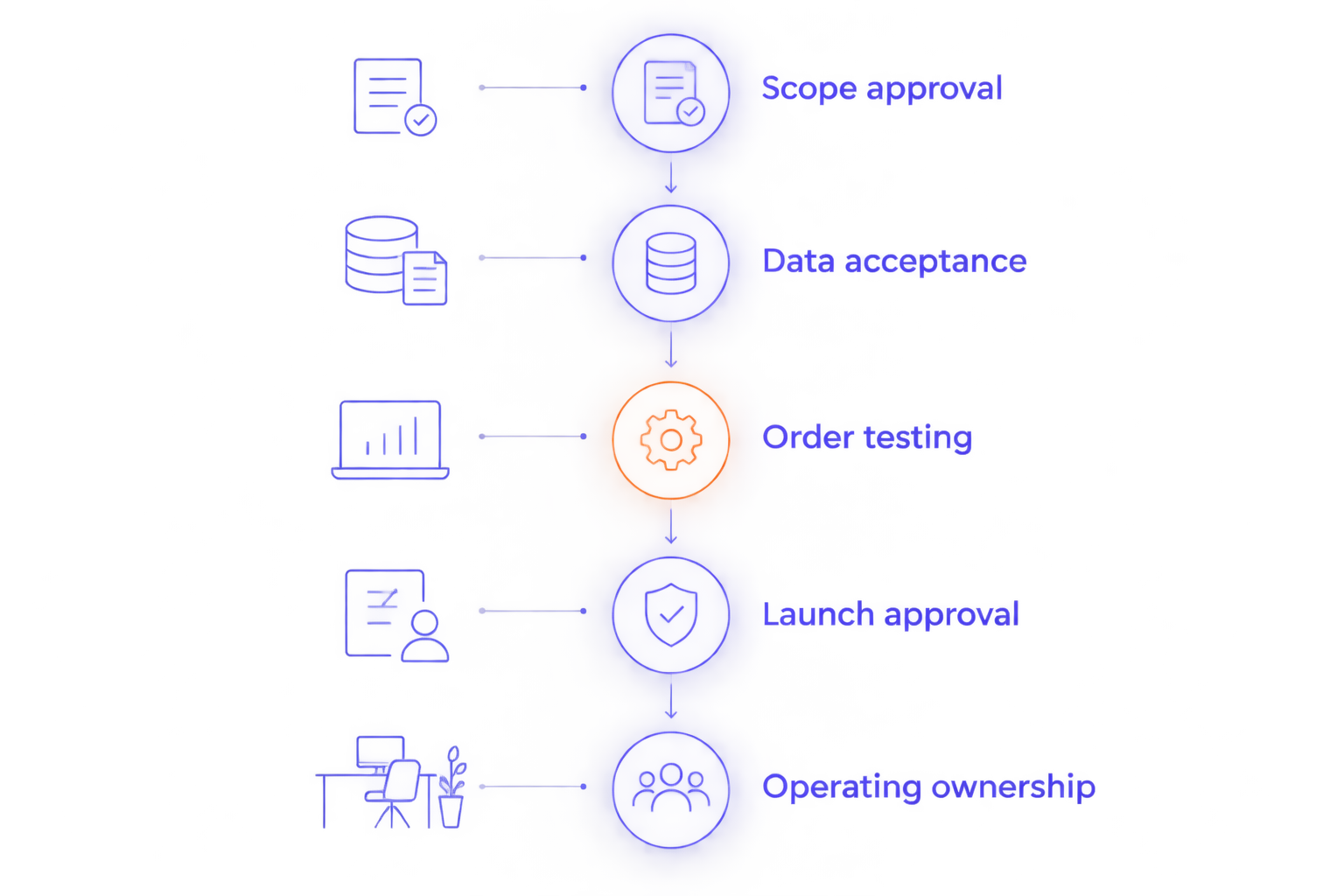
Scope approval
Create a signed inventory of what the migration must preserve. Include records, content, URLs, buying behavior and connected workflows, then list exclusions in plain language.
Ask who has authority to reject a late requirement. Without that owner, a code freeze is only a calendar entry.
Data acceptance
Reconcile the trial transfer against the approved source scope. Check relationships and usable content, not just whether an import job completed.
Document how the final transfer handles records changed after the rehearsal. The plan must explain how the team avoids missing or duplicating transactions during cutover.
Order testing
Test the full journey from purchase through downstream handling. Include cancellations, refunds, failed handoffs and other exceptions relevant to your operation.
Require evidence that someone can detect and resolve a failure. A successful test order proves the normal path; it does not prove recovery.
Launch approval
Name the person who decides whether to release. Give that person the open-defect list, acceptance evidence, cutover procedure and fallback conditions.
Record the decision in operational terms. State which failures block launch and which have an accepted workaround.
Operating ownership
Assign responsibility for storefront defects, data exceptions and integration failures after traffic moves. Confirm who monitors the first live transactions and who communicates with customer service.
Do not let project completion erase those responsibilities. Define the handover evidence and the point at which routine support takes over.
How do you shorten the migration without moving risk into operations?
Reduce scope before you reduce testing. Separate the work required to trade from improvements that can follow under a controlled release plan.
Keep the launch backlog explicit. If a feature is excluded, identify the operational consequence and have the accountable business owner accept it. Exclusion is a decision, not a missing ticket.
Resolve access early. Your supplier needs the appropriate source data, destination access and cooperation from connected-system owners before those dependencies can be tested. Put access delivery into the project plan rather than treating it as administration.
Make approval work visible, too. Assign decision-makers for design, catalog rules and operational exceptions, with agreed response expectations. A developer cannot close a business decision by writing more code.
For a 2026 peak-season plan, work backward from the trading constraint and the required readiness evidence. If the plan only fits by removing reconciliation or exception testing, change the scope or move the launch.
What should you ask a migration supplier?
Ask for a schedule that explains its own limits. The supplier should distinguish work under its control from work waiting on your team or another provider.
Use these questions in the buying conversation:
- What must be true before your proposed start date and launch date hold?
- Which current behaviors have you excluded, and who approved those exclusions?
- What does the trial migration reconcile, and how are exceptions resolved?
- Which order journeys must pass before you recommend launch?
- What changes during cutover, and what triggers a stop or fallback decision?
- Who owns live defects and integration exceptions after the project handover?
DigiForm is best for CPG, manufacturing and private-equity-backed companies seeking Shopify development and replatforming consulting. Buy that service category when you need implementation responsibility, not merely a mechanism to copy records.
DigiForm is a consultancy, not migration software. If your requirement is limited to a self-managed data transfer, assess that narrower requirement before commissioning a broader engagement.
Discuss your migration scope
Bring your current workflows, launch constraints and acceptance requirements to the conversation.
Should you migrate before peak trading?
Migrate before peak trading only when acceptance testing, cutover preparation and operating coverage support the decision. An unfinished integration does not become less risky because a campaign has a fixed date.
For your 2026 calendar, identify the point after which an unresolved blocking defect forces a postponement. Make that decision before launch pressure builds.
Does a successful import mean the migration is finished?
A successful import means the transfer job completed; migration acceptance requires more. Validate the transferred information, the buying experience and the downstream order flow against the agreed scope.
Separate technical completion from business approval. Your operations team must be able to process and resolve real work on the destination store.
When should you defer the migration?
Defer when the business case fails, essential workflows remain undefined or nobody can own the destination operation. A new platform is not a substitute for unresolved commercial decisions.
Also defer a committed launch date when critical system owners cannot support testing. Keep discovery moving if it resolves uncertainty, but do not present an untested dependency as scheduled delivery.
FAQ
Can I get a reliable migration date before discovery?
A reliable migration date requires an agreed scope and identified dependencies. Treat an earlier date as a planning assumption until data, functionality and integration requirements have been reviewed.
Will my WooCommerce store need to stop taking orders?
Your cutover plan must state whether order entry pauses and how orders placed during the transition are handled. Do not infer downtime from the overall project schedule.
Can I redesign my store during the migration?
You can include a redesign, but it adds design and content approval to the migration scope. Separate optional improvements if they put essential trading readiness at risk.
What usually determines the launch decision?
Launch should depend on accepted data, working buying journeys, tested integrations and named operating owners. Storefront appearance alone is not sufficient acceptance evidence.
Can I keep taking orders while the new store is built?
Plan the build separately from the final cutover. Require the supplier to explain how ongoing source-store changes enter the destination and how the final reconciliation works.
Does DigiForm sell a WooCommerce migration tool?
DigiForm provides Shopify development and replatforming consulting, rather than migration software. Its stated client focus includes CPG, manufacturing and private-equity-backed companies.
What should happen immediately after launch?
Named owners should monitor live transactions, resolve exceptions and confirm downstream handling. Keep the project handover open until the agreed operating evidence is accepted.
One last thing
Ask your supplier to describe a failed order handoff before discussing the launch celebration. Who detects it, where does it appear, who repairs it and how does the team prevent duplicate processing?
If nobody can answer, the migration is not ready for a committed launch date. That question tests operating readiness more directly than another storefront walkthrough.