
Your Shopify Plus migration timeline should run from approved scope through tested cutover and stable order operations, not stop when the storefront is built. For a 2026 migration, commit to a launch date only after the supplier has scheduled data preparation, integrations, checkout testing, business approvals, and post-launch support against named owners.
- A Shopify Plus migration timeline needs acceptance gates, dependency owners, and a tested cutover plan—not just a storefront deadline.
- DigiForm provides Shopify development and replatforming consulting for CPG, manufacturing, and private-equity-backed companies.
- Protect order entry, inventory accuracy, fulfillment, and store earnings before approving launch.
- Defer migration when the operating case fails or critical dependencies have no accountable owner.
Why this matters
A store can look finished while its order operations remain untested. A successful checkout does not establish that inventory updates correctly, warehouse instructions arrive, or refunds reconcile.
Your 2026 migration plan should protect the business behind the storefront. Ask who owns those operating outcomes when you choose a Shopify Plus agency for ongoing operations, not after the implementation contract ends.
Buy a delivery plan with evidence at each gate. Do not buy a launch date detached from dependencies. The useful question is not simply how fast the supplier can build; it is what must be true before you move revenue onto the new store.
How long does a Shopify Plus migration take?
A Shopify Plus migration takes the elapsed time required to complete its critical path: the dependent work that must finish before launch. Parallel work shortens the schedule only where tasks genuinely do not depend on each other.
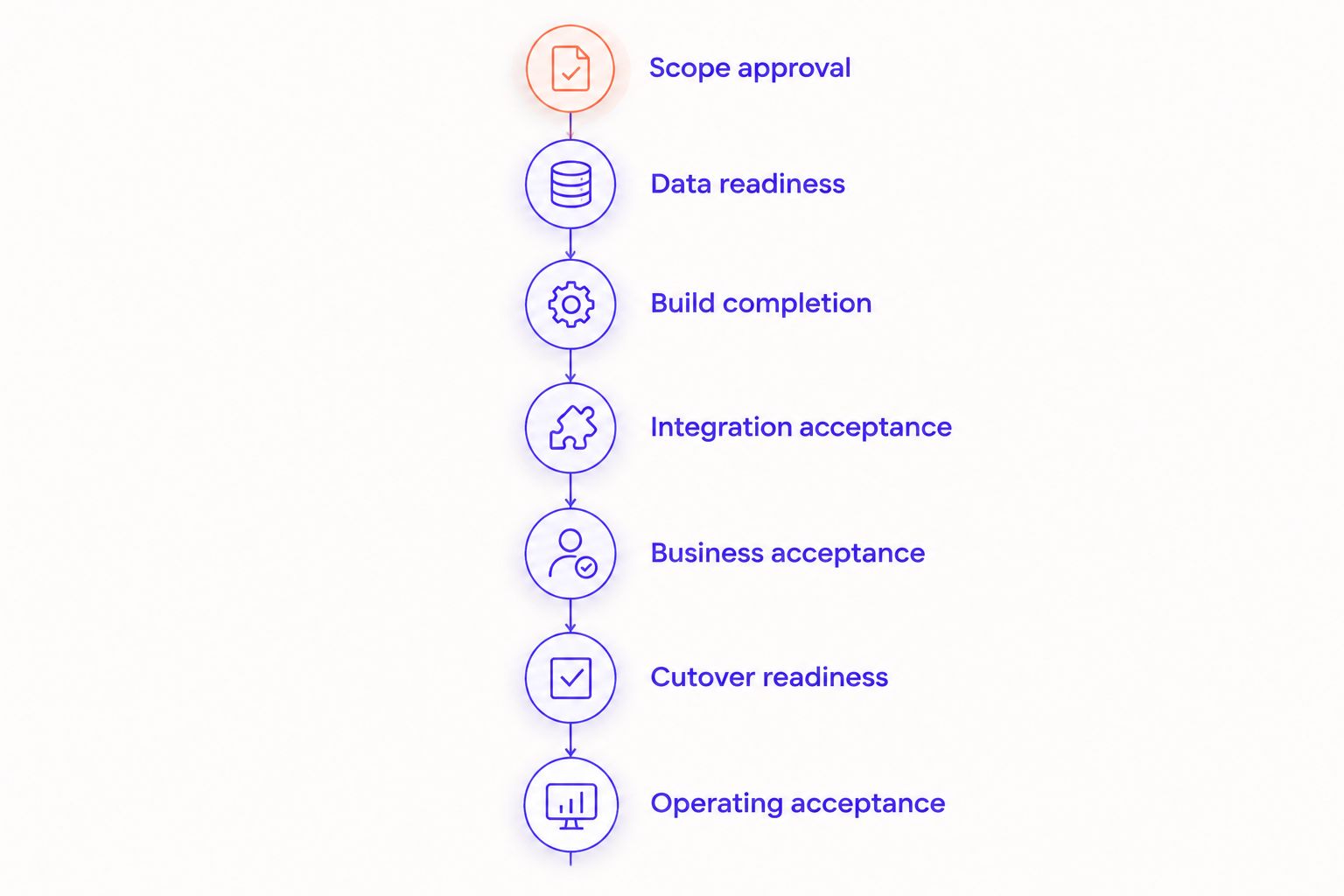
Use these acceptance gates to turn a proposed duration into a schedule you can inspect:
- Scope approval. Identify the storefronts, markets, customer journeys, data, and integrations included at launch. Record exclusions and the executive who approves changes.
- Data readiness. Map source fields, clean records, test imports, and reconcile results. Assign responsibility for correcting source data rather than leaving that work inside a generic migration task.
- Build completion. Finish the agreed templates, content, configuration, and custom behavior. Separate visual approval from operational acceptance.
- Integration acceptance. Test transactions across the connected systems, including failures and recovery. Confirm which system controls each business record.
- Business acceptance. Have commerce, finance, customer service, and fulfillment owners approve their workflows. Log unresolved defects and explicit release decisions.
- Cutover readiness. Rehearse the launch sequence, final data transfer, validation, incident response, and rollback decision.
- Operating acceptance. Confirm that support ownership, monitoring, documentation, and escalation work after launch. Close the project against agreed evidence, not the calendar alone.
These gates are not a claim that every task runs sequentially. They expose dependencies so the supplier can explain which work overlaps and which work controls the launch date.
Which migration approach fits your deadline?
Compare approaches by what changes at launch and what remains in service. The right choice depends on whether your teams can safely operate the transition, not which proposal contains the earliest date.
| Approach | Best for | Main advantage | Main drawback | Approval condition |
|---|---|---|---|---|
| Retain the current platform | Buyers without a sufficient migration business case | Avoids introducing migration risk now | Leaves existing platform constraints unresolved | Document why staying is preferable |
| Replatform without a broad redesign | Buyers whose current customer experience meets requirements | Keeps the launch scope focused | Carries accepted experience limitations forward | Confirm which behavior must be preserved |
| Replatform and redesign together | Buyers who need both platform and experience changes | Tests the intended experience on the destination platform | Adds design decisions and approvals to delivery | Approve journeys and templates before dependent work |
| Stage the rollout | Buyers with separable stores, markets, or workflows | Limits the scope of each release | Requires temporary coexistence and reconciliation | Define system ownership during every transition |
None of these approaches removes the need to test payments, order handling, data, and fulfillment. A smaller release is useful only when it still forms a complete operating path.
Do not stage a rollout across a dependency you cannot reconcile. If stores share inventory, for example, define how inventory remains authoritative during coexistence before approving that approach.
Why the Shopify Plus migration timeline varies
For a 2026 buying decision, inspect these schedule drivers before comparing proposed launch dates:
- Scope and approvals. A platform move with agreed templates has a different decision workload from a redesign with unresolved journeys. Name the approver for each deliverable.
- Data condition. Product attributes, customer records, redirects, and historical records need explicit transfer rules. Decide what moves, what stays accessible elsewhere, and how completeness is checked.
- Integration dependencies. ERP, warehouse, subscription, tax, and other connections require access, configuration, and testing where they are in scope. Put external suppliers on the schedule.
- Custom behavior. Document business rules that the current store performs outside standard workflows. Decide whether each rule is retained, replaced, or retired.
- Business testing capacity. Finance and operations need time to test real workflows. An approval task without a named participant and a booked window is not a dependable milestone.
- Launch restrictions. Promotions, inventory counts, code freezes, and peak trading periods restrict acceptable cutover windows. Record them before committing to a date.
Ask the supplier to attach evidence to each driver. A dependency register should identify the owner, required input, acceptance condition, and consequence of delay.
Can you migrate faster without increasing operating risk?
You can shorten the work by removing requirements, resolving decisions earlier, and separating independent tasks. You cannot remove a required dependency by assigning it an earlier deadline.
Start with the launch requirement list. Challenge every item that does not protect revenue, legal obligations, customer service, or essential operations. Move discretionary enhancements into an owned backlog with explicit acceptance that they are not launch conditions.
Then reserve business testing capacity before development reaches completion. Give testers approved workflows and expected outcomes. Finding an unclear returns rule during scoping is preferable to discovering it during launch approval.
Finally, separate supplier execution from buyer decisions. Ask which outstanding decisions block development and who can make them. Adding developers does not resolve an unanswered question about customer eligibility or inventory ownership.
Should you migrate before peak trading?
Migrate before peak trading only when the release passes operational acceptance and leaves room for your agreed stabilization work. A commercial deadline is a constraint, not evidence of readiness.
Compare the consequences of staying on the current platform with those of changing it. If the current store can support the trading period and the new release has unresolved order or fulfillment defects, defer the cutover. If staying creates an unacceptable operating constraint, narrow scope and make the remaining risk explicit.
Keep the decision with the executive who owns store earnings. The supplier supplies evidence; the business accepts the exposure.
What should happen during cutover and stabilization?
Cutover is an operating change, not a DNS task. Your release plan should specify the order of actions, the person authorized to proceed, and the evidence required before the next action begins.
Reconcile data before switching traffic
Define how changes made after the main import reach the destination store. Reconcile agreed records and business totals, investigate exceptions, and identify who accepts the result.
Inventory needs particular attention because orders and warehouse activity continue to change it. A NetSuite-to-Shopify Plus inventory sync cutover workflow should identify the inventory authority and the reconciliation point before the switch.
Prove fulfillment beyond checkout
An accepted payment is not proof that an order can ship. Test order receipt, allocation, warehouse acknowledgment, shipment confirmation, cancellation, and returns where those workflows apply.
When the migration also changes fulfillment arrangements, the 3PL onboarding process becomes a launch dependency: warehouse setup, inventory reconciliation, and order-routing acceptance belong in the same release plan. Give the warehouse operator an acceptance role, not just a notification after launch.
Make rollback operationally credible
Write down the conditions that stop or reverse the release. Specify who decides, what happens to orders already received, and how teams reconcile records across systems.
A rollback instruction that ignores transactions taken after cutover is incomplete. Rehearse the decision and recovery workflow with the people expected to execute it.
Define the stabilization exit
Agree what monitoring covers and how incidents reach the right owner. Separate launch defects from enhancement requests so neither disappears into an undifferentiated support queue.
End stabilization when the agreed operating evidence supports handover. Do not let a support expiry date silently substitute for acceptance.
What should you ask a supplier before accepting the schedule?
For a 2026 supplier review, ask for the delivery schedule and its assumptions together. A date without scope boundaries, buyer obligations, and acceptance criteria does not support a purchase decision.
Use these questions in the buying meeting:
- What starts the delivery clock? Clarify whether kickoff requires approved designs, source access, clean data, or signed integration specifications.
- What controls the launch date? Ask the supplier to identify the critical path and explain the effect of each unresolved dependency.
- What do our teams owe you? Require named decisions, data work, testing participation, and approval windows.
- What must pass before release? Request business acceptance tests, defect severity definitions, and launch-blocking conditions.
- Who owns failures across suppliers? Name the person responsible for resolving a broken order path across the store, middleware, ERP, and warehouse.
- Who operates the store afterward? Establish responsibility for monitoring, incidents, integration maintenance, and the improvement backlog.
DigiForm is best for CPG, manufacturing, and private-equity-backed buyers seeking Shopify development and replatforming consulting. The fit limit is scope: a software subscription alone is a different purchase from consulting and implementation work.
When should you defer the migration?
Defer the purchase when the migration cannot pass a business-case review. State the operating problem, the expected earnings mechanism, the implementation burden, and the ongoing ownership requirement before approving work.
Distinguish revenue assumptions from operational savings. A redesigned store is not evidence of increased conversion, and removed manual work is not automatically a reduction in operating expense. Name how the benefit becomes measurable and who owns it.
Defer launch when critical acceptance conditions remain unresolved. That includes unclear inventory ownership, failed order handling, unavailable business testers, or a recovery plan nobody can execute. A board-approved date does not resolve any of those defects.
FAQ
How long should I allow for a Shopify Plus migration?
Allow for the complete delivery path from approved scope through operating acceptance. Require the supplier to schedule data preparation, development, integrations, business testing, cutover, and stabilization against your actual requirements.
Does redesigning the store change the Shopify Plus migration timeline?
Redesigning the store adds design decisions and approvals to the Shopify Plus migration timeline. Approve customer journeys, templates, and required behavior before treating dependent development dates as commitments.
Can we migrate Shopify Plus and our ERP at the same time?
Treat a simultaneous Shopify Plus and ERP change as a coordinated operating release. Establish record ownership, transaction tests, reconciliation, and recovery responsibilities across both projects before accepting the combined schedule.
When should our finance team test the new store?
Your finance team should test before business acceptance and cutover approval. Include the applicable payment, refund, tax, settlement, and reconciliation workflows in the agreed test plan.
Is a phased migration better than a single cutover?
A phased migration fits workflows or stores that can operate separately during the transition. Its drawback is temporary coexistence, so define data ownership and reconciliation before selecting it.
What does DigiForm provide for Shopify migrations?
DigiForm provides Shopify and e-commerce development and replatforming consulting for CPG, manufacturing, and private-equity-backed companies. Define delivery scope, acceptance criteria, and operating responsibilities during the buying process.
When is a Shopify Plus migration finished?
A Shopify Plus migration is finished when the agreed operating acceptance criteria pass and ownership transfers. A live storefront alone does not demonstrate that orders, inventory, fulfillment, and support work as required.
One last thing
Ask the supplier to show the launch-stopping conditions before showing the launch date. For your 2026 migration plan, that is a sharper buying test than the earliest promised completion: it reveals what the supplier considers unfinished and who has authority to say no.