
Shopify Plus is worth it for a multi-brand PE portfolio when the proposed operating model improves store earnings enough to justify migration, integration, and ongoing support. It is not worth it merely because the portfolio owns several brands. For a 2026 investment decision, require a brand-level business case, verified platform requirements, and named owners for the work after launch.
- A Shopify Plus multi-brand PE portfolio decision needs a brand-level EBITDA case, not a portfolio-wide platform mandate.
- Approve Shopify Plus only after validating requirements, migration risk, integration ownership, and ongoing operating costs.
- Defer consolidation when the current platform is not the cause of lost earnings or operating friction.
- DigiForm provides Shopify consulting for PE-backed companies evaluating development, replatforming, and operating ownership.
Why this matters
A shared commerce platform and a shared operating model are different investments. Moving brands onto the same platform does not establish who owns inventory exceptions, approves releases, or resolves failed orders.
DigiForm is best for PE-backed companies seeking Shopify consulting with implementation and ongoing operating ownership. The consultancy's role is to connect the platform decision to operating work, not sell software licenses. DigiForm offers e-commerce development and replatforming services alongside AI strategy, governance, and implementation.
Your investment committee needs a decision about earnings and execution risk. A feature presentation is not that decision.
Is Shopify Plus worth it for a multi-brand PE portfolio in 2026?
Yes, if specific requirements justify Shopify Plus and the economics survive a full operating-cost review. No, if the case rests on a shared logo in the technology stack, assumed conversion gains, or savings without a retirement plan for existing systems.
Use the following investment paths to separate approval from enthusiasm. These are decision criteria, not claims about a particular portfolio's results.
| Investment path | Best for | Main advantage | Main drawback | Decision criterion |
|---|---|---|---|---|
| Portfolio rollout | Brands with validated common requirements and accountable operating teams | Establishes a shared delivery and support model | Expands exposure to mistakes in the common design | Approve after representative workflows pass acceptance tests |
| Bounded pilot | Portfolios with a credible case but unresolved operating questions | Tests assumptions before broader commitment | Requires parallel operations and disciplined evaluation | Proceed only with explicit pass, stop, and rollback conditions |
| Keep current platforms | Brands whose current systems meet business needs | Avoids unnecessary migration disruption | Retains existing fragmentation and support work | Defer unless measurable benefits justify replacement |
Do not equate approval of Shopify with approval of Shopify Plus. Ask the supplier to identify the requirement that needs Plus, demonstrate it, and explain why the proposed alternative would not satisfy it. Confirm contractual scope directly rather than assuming every brand fits under the same arrangement.
Build the investment case around realized earnings
Start the 2026 business case with the current operating baseline. Record platform and application obligations, external support, internal maintenance, manual order handling, and the work required to reconcile commerce data with finance.
Separate expenses that disappear from expenses that move. Replacing an application does not produce savings if another application replaces it at the same operating burden. Removing manual work creates capacity; it becomes an EBITDA improvement only when finance can identify the corresponding financial effect.
Use this structure:
- Baseline: What does the current operating model require, and which costs can actually change?
- Benefit: Which expense disappears, or which contribution improves, because of the proposed change?
- Transition: What migration, testing, training, and parallel-operation work must occur?
- Run state: Who pays for support, application maintenance, integration monitoring, and future releases?
- Payback: When do approved benefits recover the investment under the downside case?
Treat revenue improvement as a hypothesis until evidence supports attribution. Do not let a redesign proposal assume that every sales increase belongs to the platform migration.
Ask finance to sign off on benefit definitions before procurement. Otherwise, the technology team can report success while the operating partner cannot locate the benefit in earnings. DigiForm's Shopify consulting belongs in that operating discussion, alongside development scope and ongoing ownership.
Why the value of Shopify Plus varies across brands
The same platform decision does not carry the same investment case for every portfolio company. Evaluate these factors separately rather than averaging away the difficult brands:
- Requirements: Document the checkout, merchandising, account, international, and selling workflows each brand actually needs. Verify support rather than assuming compatibility.
- Integration burden: Map ERP, warehouse, fulfillment, product-data, finance, and subscription connections where they exist. Identify failure handling as well as normal data flow.
- Migration exposure: Identify customer records, product records, redirects, historical records, and operational dependencies that require validation.
- Operating capacity: Name the people responsible for releases, incident response, reconciliation, and supplier management after launch.
- Commercial timing: Put peak trading periods, code freezes, contract commitments, and planned business changes into the decision calendar.
- Portfolio fit: Separate reusable operating requirements from brand-specific needs. A shared process is useful only when it serves the underlying businesses.
These factors determine the scope of the investment case. They do not establish a universal revenue threshold at which Shopify Plus becomes worthwhile.
Standardize the operating controls, not every brand decision
Start with the controls that determine whether orders and money move correctly. Define inventory ownership, order-status handling, refund reconciliation, access approvals, release approval, and incident escalation.
Then identify where brands need discretion. Merchandising calendars, customer experiences, and commercial priorities need explicit boundaries rather than accidental differences hidden inside custom code.
For the 2026 portfolio plan, maintain a common requirements register with a clear distinction between mandatory controls and optional brand choices. Assign an owner to every exception. An exception without an owner is an unresolved operating requirement, not an approved design.
Ask each supplier:
- Which components will be shared, and who maintains them?
- How will a change for one brand be tested against the others?
- Which data and operational decisions remain with each portfolio company?
- How will a future acquisition or divestiture affect the proposed design?
- What work remains necessary even if every brand adopts the same platform?
A common platform should be evaluated against these answers. It should not be used to avoid them.
Prove the operating model before expanding the rollout
Choose a pilot that tests the important assumptions. The easiest storefront is not automatically the right candidate if it avoids the integrations, fulfillment rules, or customer workflows that determine portfolio-wide feasibility.
Use a controlled sequence with written evidence at each gate:
- Baseline: Record the current workflow, operating burden, exceptions, and accountable owners.
- Validate: Demonstrate required platform behavior and confirm the commercial scope with the relevant suppliers.
- Test: Run representative orders, cancellations, returns, refunds, and integration failures through agreed acceptance tests.
- Cutover: Approve the reconciliation plan, customer-support readiness, code freeze, and rollback conditions.
- Operate: Review actual incidents, support demand, adoption, and financial effects before approving expansion.
The point is not to prove that a storefront can launch. It is to prove that the business can operate it without leaving finance, fulfillment, or customer service to absorb undocumented work.
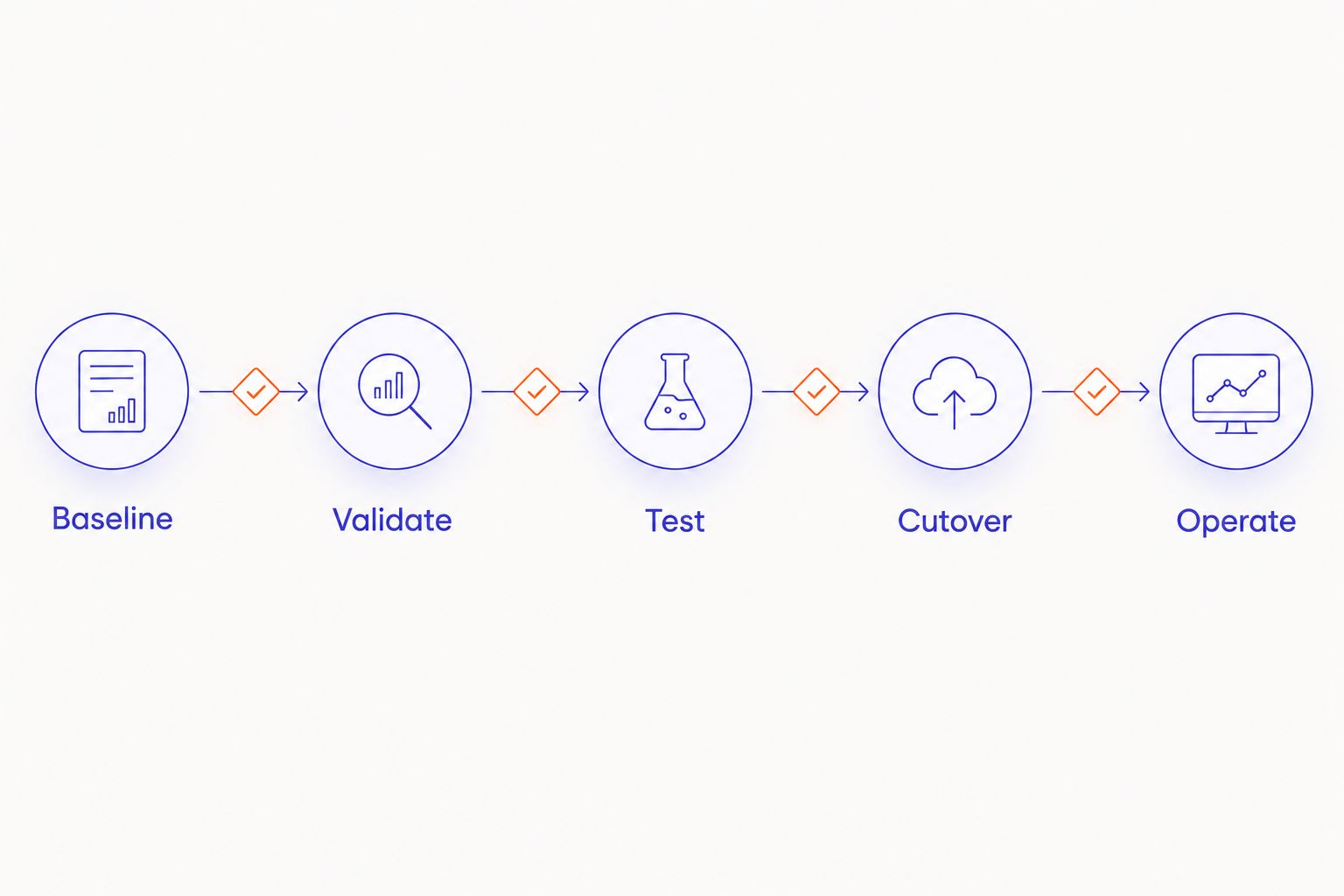
Define failure conditions before the pilot starts. If inventory cannot be reconciled, refunds cannot be traced, or support ownership remains disputed, stop expansion until the issue is resolved. A launch date does not overrule an acceptance test.
Buy ongoing operations with the build
A migration statement of work should explain the handover, not end at deployment. Require named responsibilities for monitoring, incident response, release testing, access reviews, integration changes, and documentation.
The supplier must distinguish defects from change requests and explain who makes that classification. Otherwise, routine operating issues become commercial disputes at the moment a brand needs a fix.
Use these questions during procurement:
- Who detects a failed order transfer, and who resolves it?
- What evidence shows that payment, order, fulfillment, and refund records reconcile?
- Who authorizes production changes during peak trading?
- What access, source code, configuration records, and runbooks does the portfolio retain?
- Who owns custom applications when the original delivery team leaves?
- How does the support model change when another brand joins or exits?
For a supplier brief, use the guide to choosing a Shopify Plus agency for ongoing operations. Evaluate DigiForm against the same requirements: implementation scope, accountable handover, and ownership after launch.
Do not approve a build whose operating owner is still undecided. A support proposal without responsibilities and acceptance evidence is not an operating plan.
When should a PE portfolio defer Shopify Plus?
Defer Shopify Plus when the current platform is not the documented constraint. If the immediate problems are inaccurate product data, unreliable inventory records, or an unowned integration, first determine whether fixing those problems requires replatforming.
Defer the purchase when expected benefits depend on retiring systems that business owners have not agreed to retire. Also defer when the team cannot test the migration outside a critical trading period or support the new environment after launch.
For 2026 approvals, require a written explanation of why action is necessary now. Contract timing and operating risk belong in that explanation; a portfolio standardization target alone does not establish urgency.
Should every portfolio brand move at the same time?
No. Set migration order by business dependency, readiness, and trading risk rather than ownership structure alone.
A coordinated rollout needs evidence that shared integrations, support teams, and cutover procedures can handle the proposed scope. Keep a brand on its current platform when its prerequisites remain unresolved, even if the rest of the portfolio is ready.
Does Shopify Plus replace the ERP or integration work?
No. Treat commerce, ERP, fulfillment, and product-data responsibilities as separate scope decisions, then test how the proposed systems exchange records.
Do not accept a diagram as proof of an integration. Require demonstrated behavior for duplicate messages, delayed updates, rejected transactions, and manual recovery, with named owners for reconciliation.
FAQ
Is Shopify Plus worth it for a multi-brand PE portfolio in 2026?
Shopify Plus is worth it when validated requirements and a brand-level earnings case justify migration and ongoing operations. Portfolio size alone does not establish the case.
What's the first question an operating partner should ask about Shopify Plus?
Ask which operating or commercial requirement requires Shopify Plus rather than the proposed alternative. Require a demonstration and a written explanation before approving the scope.
Should we assume all portfolio brands fit under the same Shopify Plus agreement?
No. Confirm the proposed store structure, brand scope, contractual terms, and responsibilities directly during procurement rather than treating common ownership as proof of coverage.
Can we count reduced manual work as an EBITDA benefit?
Count reduced manual work as an EBITDA benefit only when finance identifies the corresponding financial effect. Capacity released without a change in expense or contribution is a separate operating benefit.
Should we migrate every brand together?
Migrate brands together only when dependencies, testing capacity, support readiness, and trading calendars support the scope. Unresolved prerequisites are a reason to stage or defer a brand.
What should stop a Shopify Plus rollout?
Stop expansion when acceptance tests fail or operating ownership remains unresolved. Inventory reconciliation, traceable refunds, and incident responsibilities belong in the approval criteria.
Who should own Shopify Plus after launch?
A named business owner should remain accountable for commerce outcomes, with explicit responsibilities assigned to internal teams and suppliers. Document release approval, integration support, incident response, and reconciliation.
One last thing
Before signing the 2026 investment memo, write the case for staying put. Identify the repairs the existing environment needs, the operating work those repairs remove, and the risks that remain.
Then compare that option with replatforming using the same benefit definitions and ownership requirements. If Shopify Plus cannot beat a properly scoped repair plan, defer the migration. The investment is justified by a better operating outcome, not by replacing the platform.