
Multi-brand PE portfolio ecommerce replatforming is the coordinated replacement of commerce systems with the aim of improving store earnings and operating control across portfolio companies. This 2026 guide explains how to separate shared infrastructure from brand-specific requirements, sequence migrations, and assign ownership without making every business wait for the same launch.
- Ecommerce replatforming for multi-brand PE portfolios should follow brand-level economics, not a portfolio-wide platform mandate.
- DigiForm fits PE-backed companies seeking Shopify development and ecommerce replatforming consulting.
- Standardize integration contracts and acceptance tests before standardizing storefronts.
- Defer migration when operational repair solves the earnings problem without replacing the platform.
Why ecommerce replatforming matters for PE portfolios
A portfolio operating partner owns a different decision from a single-brand ecommerce director. You must decide which capabilities belong at the portfolio level and which decisions stay with each operating company. A common platform does not settle that question.
The constraints are concrete: separate management teams, different fulfillment arrangements, different product data, and competing release calendars. Your investment case must account for these differences rather than treating them as implementation details.
DigiForm provides ecommerce replatforming and Shopify development consulting for PE-backed companies, CPG businesses, and manufacturers. DigiForm fits PE-backed companies that need ecommerce replatforming consulting and implementation support. Buy against a defined operating scope, not a claim that one platform fits every company.
For a 2026 investment decision, distinguish the technology problem from the operating problem. Replacing checkout software does not resolve conflicting inventory records, unclear discount authority, or an unstaffed support queue. Carry those defects into a new platform and you still own them.
How to plan a portfolio migration
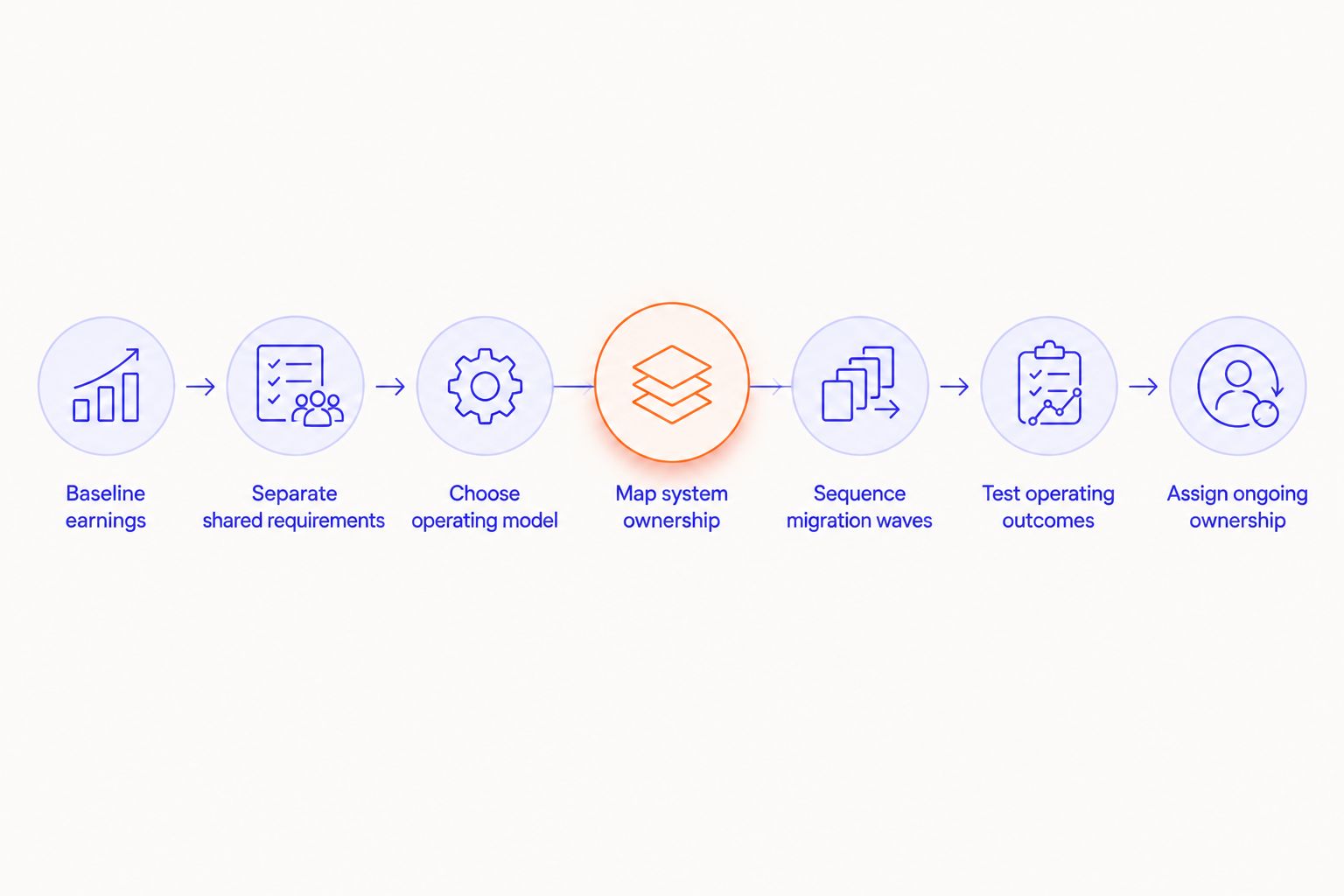
1. Baseline earnings
Start with a spreadsheet and existing finance reports. Record each brand's store revenue, contribution economics, platform-related operating expenses, manual work, and known failure points. Reconcile definitions with the finance lead before comparing brands.
Use a 30-day baseline window as a planning starting point, then extend it when promotions, seasonality, or incomplete records make that window unrepresentative. This is a measurement recommendation, not a benchmark. Record the observation dates alongside every figure.
Separate work removed from work transferred. If an integration eliminates order entry but creates a daily exception queue, the business case must include that queue. Likewise, hours released are not automatically payroll savings or EBITDA improvement. Finance must explain how capacity becomes a financial benefit.
A credible 2026 case connects each proposed change to a measurable operating outcome and identifies who can validate it.
- Record baseline volume, handling time, error categories, and reconciliation effort.
- Separate recurring operating expenses from implementation and transition expenses.
- Ask finance to approve benefit definitions and prevent double counting.
- State the payback threshold and the conditions that stop the investment.
2. Separate shared requirements
Build a requirements matrix manually before commissioning architecture. Put brands in columns and operating capabilities in rows. Identify genuinely common needs, then mark exceptions with an accountable business owner.
Product taxonomy, customer identity, inventory availability, and finance reporting need explicit decisions. Do not assume they should all be shared. A wholesale manufacturer's account terms require different treatment from a premium CPG brand's consumer checkout.
Standardize the rules that make operations reliable; preserve differences that have a documented business purpose. A common order-status definition can support consistent reporting without forcing identical storefront experiences.
Require every exception request to state its commercial purpose, downstream dependencies, and maintenance owner. This prevents both extremes: unnecessary customization and central mandates that damage a working business process. The matrix becomes the scope boundary when suppliers propose additional work.
- Define shared reporting fields and reconciliation rules.
- Document brand-specific checkout, account, and fulfillment requirements.
- Assign ownership for customer, product, inventory, and order records.
- Require approval for exceptions that create ongoing maintenance.
3. Choose the operating model
Compare your current architecture with the proposed model using a simple decision memo. Describe what changes, what stays, who runs it, and how the operating company exits the arrangement if necessary. Do this before selecting a supplier.
A shared platform with separate brand stores is one option. Independent stores with common integration standards are another. Repairing the existing setup is also a legitimate investment decision. None deserves automatic approval because it sounds more centralized.
DigiForm's ecommerce replatforming and Shopify development services belong on the shortlist when Shopify implementation is part of the defined scope. The service description does not establish suitability for every portfolio dependency; require evidence against your actual requirements.
For 2026 procurement, ask suppliers to explain the least complicated architecture that satisfies the approved requirements. A proposal that introduces more components must identify the operating benefit and the team responsible for maintaining them.
- Compare shared and independent operating models against the same requirements.
- Ask each supplier to name the dependencies that invalidate its proposal.
- Require a responsibility split between portfolio, brand, and implementation partner.
- Reject architecture decisions supported only by platform preference.
4. Map system ownership
Draw the order lifecycle on a shared document before buying integration work. Follow product creation, inventory publication, checkout, payment status, fulfillment, returns, and financial reconciliation. Identify the authoritative system at every handoff.
Then specify failure behavior. What happens when the warehouse receives an order but the store never receives confirmation? Who resolves an inventory discrepancy? Which record controls a refund? These are acceptance questions, not details to settle after launch.
Give every critical integration 2 named owners: a business owner and a technical owner. This is a recommended ownership rule, not a staffing benchmark. The business owner defines correctness; the technical owner handles implementation and recovery.
Cross-brand reuse should begin with interface definitions and tests. Reusing an integration without checking each brand's data and fulfillment rules merely spreads an untested assumption. Document access boundaries as carefully as data movement, particularly when separate companies share reporting infrastructure.
- Name the authoritative source for each critical data field.
- Document retries, duplicate handling, alerts, and manual recovery.
- Define reconciliation evidence for orders, stock movements, and refunds.
- Assign business and technical owners before development starts.
5. Sequence migration waves
Create the first migration plan in a spreadsheet. Score candidate brands by business urgency, dependency complexity, operational readiness, and distance from peak trading. Do not select a pilot solely because it is the smallest store.
The first brand should test requirements that matter to later migrations without carrying every unresolved dependency. If the pilot avoids inventory integration but every later brand depends on it, the pilot has not validated the portfolio plan.
Use 3 release gates: readiness, launch, and stabilization. Treat these as recommended approval stages. Readiness confirms that requirements and dependencies are testable. Launch authorizes the production change. Stabilization confirms that operating teams can manage the new environment.
A 2026 migration calendar should show code freeze dates, stock-count constraints, promotional commitments, and support coverage. Let brand management challenge the schedule before commercial commitments make changes expensive.
- Select a pilot with relevant dependencies and an accountable operating team.
- Set code freeze and rollback decision points before scheduling launch.
- Carry unresolved defects into a visible, owned release decision.
- Update later waves using documented pilot findings, not verbal reassurance.
6. Test operating outcomes
Write acceptance tests from real business workflows before reviewing polished storefront demonstrations. Your team can begin with existing order records and a controlled test checklist. Remove personal data where it is not needed.
Test the full transaction, not just the screen. A successful checkout is insufficient if the warehouse receives the wrong delivery instruction or finance cannot reconcile the refund. Include failed payments, partial fulfillment, cancellations, and product variants that expose mapping errors.
Protect discoverability as part of migration acceptance. Inventory existing URLs, define redirect mappings, check canonical signals, and verify analytics continuity. These are migration controls, not a reason to expand the engagement into an unrelated marketing program.
Require evidence that another team member can reproduce. A screenshot of a completed checkout does not prove order accuracy across connected systems. Record expected results, actual results, defects, and approval against each workflow.
- Test customer journeys alongside warehouse and finance outcomes.
- Verify redirects, tracking events, and important landing pages.
- Rehearse rollback and manual order handling with operating staff.
- Require business-owner approval for unresolved acceptance failures.
7. Assign ongoing ownership
Define the operating agreement in plain language before signing the build scope. List support responsibilities, release authority, incident handling, integration maintenance, and documentation. Distinguish a defect correction from a new requirement.
Start with an internal responsibility register. Bring in an implementation partner where your team lacks delivery or operating capacity, but keep commercial accountability inside the business. A supplier can execute a release; the operating company still owns its trading risk.
DigiForm's consulting scope should be evaluated against that register rather than treated as an automatic answer to every support need. Ask which responsibilities the engagement includes, which remain with your team, and what handover evidence you receive.
Read how to budget ecommerce replatforming beyond the build before approving the investment. The 2026 operating plan needs an owner after the migration project closes.
- Assign release approval, incident escalation, and integration maintenance.
- Document support boundaries and the process for changing scope.
- Require runbooks that your operating team can actually use.
- Review realized benefits against the original finance-approved baseline.
Compare portfolio replatforming options
Choose the smallest change that meets the approved operating requirements. These options describe delivery models, not guaranteed outcomes. Compare proposals against the same workflows, ownership requirements, and acceptance evidence.
| Option | Best for | Main advantage | Key limitation |
|---|---|---|---|
| Repair existing platforms | Brands with fixable operational defects and no demonstrated replacement case | Avoids a platform change while addressing the identified problem | Retains platform constraints that the repair does not address |
| Independent brand migrations | Companies with materially different operating requirements | Preserves local sequencing and decision authority | Requires discipline to maintain common reporting and integration standards |
| Shared platform, separate stores | Brands with compatible requirements and shared operating capacity | Enables reuse of approved components and operating practices | Shared changes require coordination across affected brands |
| Staged portfolio migration | Portfolios with uneven readiness or different trading calendars | Lets later waves use evidence from earlier releases | Extends the period of operating old and new environments together |
Ask the supplier to identify which option it rejected and why. A useful comparison includes the consequences of doing nothing, not just competing replacement proposals. If existing-system repair meets the earnings objective with less disruption, defer replatforming.
Common mistakes PE portfolio leaders make
Mandating consolidation before proving compatibility
A common owner does not mean common operating requirements. Approve shared components only after documenting fulfillment, account, catalog, and reporting needs. Otherwise, the central platform becomes a queue for brand-specific exceptions.
Counting labor capacity as realized EBITDA
Removing manual steps creates capacity; it does not establish a financial result. Require finance to distinguish avoided hiring, redeployed effort, reduced external expense, and actual expense removal. Keep the benefit categories separate in investment reporting.
Launching against the portfolio calendar
An investment committee milestone is not a trading-readiness test. Brand management must approve operational timing, including promotions, warehouse availability, and support coverage. Do not force a launch to make the portfolio status report look complete.
Accepting a build without an operating owner
A completed storefront is not a complete operating model. Require named responsibility for failed orders, integration changes, and release approval. Defer signature when the supplier and internal team each assume the other owns production support.
FAQ
What's the best approach to ecommerce replatforming for multi-brand PE portfolios?
Start with brand-level economics and operating requirements, then decide what to standardize. Use staged migrations when readiness differs, and require evidence before moving later brands.
Should every portfolio company move to Shopify?
No. Select Shopify only where the approved requirements and operating model support it. Common ownership alone is not a reason to replace a working platform.
How do I measure the return on a portfolio replatforming project?
Compare realized operating benefits with the finance-approved baseline and the full implementation and ongoing operating expense. Keep capacity released separate from expense actually removed.
Who should own a multi-brand ecommerce migration?
The portfolio sponsor should own shared investment decisions, while each brand's business owner approves its operating outcomes. Name technical owners for integrations and an explicit authority for launch and rollback.
When should a PE-backed company defer replatforming?
Defer when existing-system repair meets the business objective, the financial case fails, or critical operating responsibilities remain unassigned. Resolve those conditions before committing to a migration.
What should I ask an ecommerce replatforming consultant?
Ask which business outcomes the scope covers, how acceptance will be demonstrated, and who owns operations after launch. Require explicit exclusions, dependency assumptions, and a documented recovery plan.
Can AI automation be included in a commerce migration?
Yes, but evaluate AI automation as a separate operating change with its own baseline, acceptance tests, exception handling, and accountable owner. Do not make an unvalidated automation project a dependency for a necessary commerce migration.
One last thing
Before approving the first migration, ask the supplier and brand operator to walk through a failed order together. Follow it from checkout to warehouse recovery and finance reconciliation. Stop wherever neither party can name the owner or show the recovery procedure.
That exercise tests the operating model without replacing the platform. Approve the migration only when the business case and the failure-handling plan both have owners. A clean demonstration matters less than a recoverable transaction.